AT&T Routes 40% of Its AI to Open Models — AI Digest
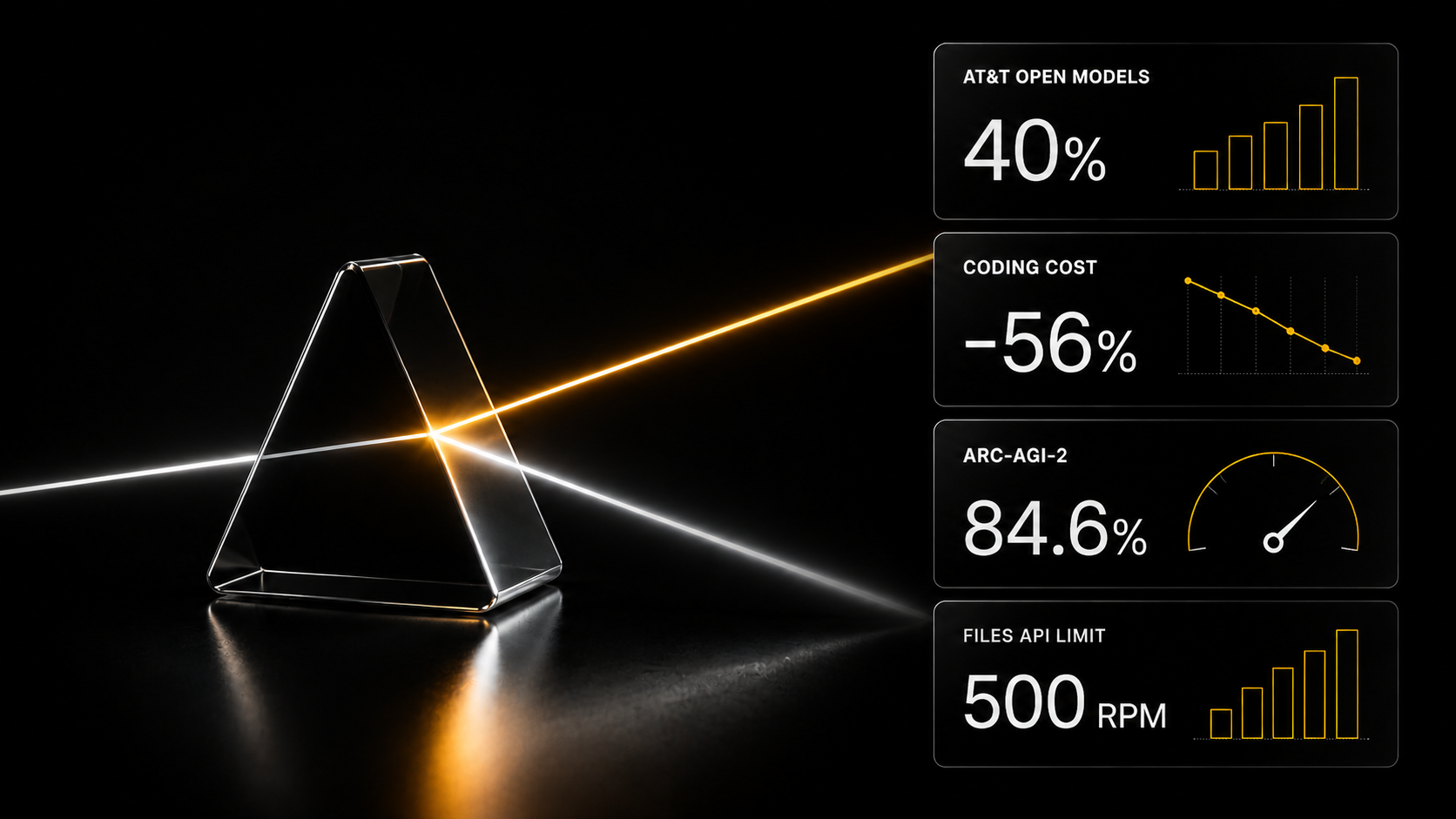
AT&T routes 40% of employee AI usage to open models and cuts coding costs by 56%. Anthropic ships computer use, the Skills API and the Files API to GA, and Gemini 3.7 Flash hits 84.6% on ARC-AGI-2 at $0.25 per task.
Today's top stories
AT&T routes 40% of employee AI usage to open models
AT&T now sends 40% of all employee AI usage to open-weight models and is targeting 60–70%. Open weights are models whose parameters are published, so a company can run them on its own infrastructure instead of paying per API call. A breakdown published on 20 August 2026 puts the carrier at 45B tokens per day and reports coding costs down 56% for a 2% quality drop after part of the load moved to open weights (AT&T deployment summary). One widely shared reply called the numbers a warning sign for the enterprise moat of OpenAI and Anthropic (reply), while the Ollama team publicly welcomed AT&T to open models (post). Deployable open projects are collected in the AI SKILLS open-source catalog, and which open LLMs are worth running locally is covered in our open-model guide.
Anthropic ships computer use, browser tool, Skills API and Files API to GA
Anthropic moved four Claude Platform components to general availability on 20 August 2026: computer use, the browser tool, the Skills API and the Files API (Anthropic announcement). The Skills API adds versioned, reusable procedures an agent loads on demand (Skills API details). The Files API gained expiration control, 5x higher rate limits — up to 500 requests per minute — and 1 TB of storage per organization (Files API details). Anthropic also published an AG-UI adapter for Claude Managed Agents that maps chat threads onto managed sessions and streams text, tool calls and thinking into a custom interface (AG-UI adapter). Ready-made procedures in this format live in the Skills for Claude Code catalog; how SKILL.md itself is structured is covered in our Claude Code skills guide.
Gemini 3.7 Flash scores 84.6% on ARC-AGI-2 at $0.25 per task
Gemini 3.7 Flash scored 84.6% on ARC-AGI-2 at $0.25 per task and 95.5% on ARC-AGI-1 at $0.12 per task. The measurement was published by the ARC Prize foundation on 20 August 2026 (ARC Prize results). What matters is not the absolute score but the price attached to it: ARC-AGI-2 is built from abstract-reasoning puzzles that until now only expensive frontier models cleared at these rates. Gemini 3.7 Flash is separately being praised for agentic vision work — driving interfaces and reading screenshots (practitioner assessment). For anyone building routing logic, the practical consequence is direct: sending work to the cheap tier no longer implies an obvious quality tax.
Moderna and Merck report the first positive Phase 3 for a personalized cancer vaccine
Moderna and Merck reported the first ever positive Phase 3 results for a personalized cancer vaccine — in melanoma, with fewer recurrences — and Moderna stock rose more than 110% (results discussion). The approach is individualized: the vaccine is built against the neoantigens of a specific tumor and paired with immunotherapy. The main objection is economics — individualized manufacturing is estimated at roughly $150k per patient, which caps global cost-effectiveness without a large efficiency gain. The second objection is attribution: several commenters note the underlying work dates back to around 2017, so crediting the current generative-AI wave is a stretch. The result also led the headlines of The AI Daily Brief (20 August 2026 episode).
Harness continual learning claims 10%+ gains with frozen model weights
A paper on harness continual learning reports gains above 10% across textual, multimodal and open-world tasks with the model weights left untouched. A harness is the layer around a model — prompts, memory, skills and routing rules — that can be changed without any retraining. The failure mode the authors highlight is harness-level forgetting: improving one component silently breaks behavior that used to be reliable. Their proposed fix, guarded harness evolution, splits proposing an update from committing it (paper breakdown). Two negative results sit alongside it: memory-based self-improving agents look considerably weaker once task order effects and evaluation variance are controlled for (breakdown), and post-trained agents tend to lock into their first strategy and spend the remaining budget on local refinement instead of revisiting the plan (breakdown).
Numbers and facts
- Cerebras CS-4: 250 PFLOPs per WSE-3 Turbo, 43.2 PB/s of memory bandwidth, and 750 PFLOPs for a three-wafer rack; a claimed 4,400+ tokens per second per user on GPT-OSS-120B, all on the same 5nm process, 4T transistors and 900k cores (launch summary).
- GLM-5.3 Max: projected #2 among open models and #8 overall on the Code Arena: WebDev frontier at 1597 points and $3.65 per million tokens (Arena measurement).
- Muse Spark 1.2: +2.1% net improvement in Agent Arena versus 0.9% for v1.1, with Bash Recovery up 11.4% (Arena measurement); ranked #1 for Video-to-Website, #2 for Image-to-HTML and #3 for Image-to-Frontend (DesignArena measurement).
- Gemma passed 1B downloads (Google announcement).
- Kimi K3 has rolled out to more than half of Ollama's subscription base, with US/EU hosting and zero data retention (Ollama announcement).
- GPT-5.6 Sol went 50% off through Router (announcement), amplified by GitHub Copilot (GitHub post) and VS Code (VS Code post).
- Our own catalog on 22 August 2026: 10,101 active Claude Code skills, 590 open-source tools, 3,268 automation templates and 338 generation models — AI SKILLS platform figures, not third-party ones.
Different perspectives: are open models eating the enterprise market?
The argument turns on one number: AT&T cut coding costs 56% for a 2% quality drop and already routes 40% of its AI load to open models (deployment summary). The question is whether that is one large carrier's special case or a general shift in enterprise demand.
For. Open weights take the broad middle of the workload, where "good enough" is far cheaper than "best available": cost falls by multiples, quality by percentage points. Distribution backs this up — Kimi K3 reached more than half of Ollama's subscribers with US/EU hosting (announcement) and Gemma crossed 1B downloads (announcement).
Neutral. AT&T itself describes hybrid routing, not replacement: frontier models stay on the hardest tasks while open models absorb the volume. That is an architecture decision rather than a side to pick, and the savings depend entirely on how well a company can sort tasks by difficulty.
Against. Closed providers are answering with price and limits, not surrender: GPT-5.6 Sol went 50% off through Router (announcement). Meanwhile user complaints are shifting from quality to consumption ceilings — a $200/month OpenAI Pro plan can be exhausted in a single heavy agent day (user complaint). Put plainly, scarcity in closed capacity shows up as quotas, which is not the same thing as losing to open models.
Tools and techniques
- A semantic cache in front of the LLM. A semantic cache is a layer that returns a stored answer when an incoming request is close in meaning to one already seen, instead of calling the model again. A practical write-up from the Qdrant team reports a 57.1% hit rate, 55.7% fewer tokens and roughly 15 ms latency on a hit (write-up).
- Gisting — compressing context into short summaries. Reported results: about 40% lower end-to-end latency and about 15% higher throughput, with better answers (claim, Shopify engineering write-up).
- Transparent backgrounds in GPT-Image-2 are in preview, aimed at reusable design assets without manual cutouts (OpenAI announcement). Prompts for a specific image are easy to assemble in the AI SKILLS prompt generator.
- Awesome Gemma — a fresh index of model variants, deployment guides and fine-tuning recipes (repository announcement).
In brief
- OpenAI installed its first NVIDIA Vera Rubin racks and is running the training stack for next-generation pre-training on them (engineer post, Greg Brockman comment).
- OpenAI paused training of new models for two weeks while it reviewed its security measures (Hard Fork, NYT).
- ChatGPT gained an Apple Messages plugin on Mac: message search, catch-up, drafting and sending straight from the desktop app (announcement).
- Computer History and Record & Replay became available to Pro, Business and Enterprise Mac users in the EEA, UK and Switzerland (announcement, Record & Replay).
- Anthropic opened Claude Academy with 355 learning resources (Superhuman AI).
- Anthropic is working on a watermark for Claude-generated text meant to survive copying and editing; the mechanism has not been disclosed (Matt Wolfe).
- Chroma introduced Foundation, a research preview of agent memory assembled from an agent's own past sessions (announcement).
- Generalist AI showed GEN-1.5, a robot that reproduces a task after a single demonstration (demo and discussion).
- Autonomous Intern 2 is a pyramid-shaped mini computer built to run agents, keeping memory, project files and API keys on the device (Matt Wolfe).
- Opposition to AI data centers has become one of the fastest-moving bipartisan issues in the US, driven by electricity, water, noise and property values (The AI Daily Brief).
- Developers report that Linux materially outperforms macOS on agent workloads that hammer the filesystem (observation).