AI for analysts: the pre-mortem that finds a third more risks

Asking about risks directly gives three obvious answers, and six months later the project falls over for a reason that was not on the list. The technique of "the failure has already happened, explain why" uncovers roughly a third more threats. Below is a full run: a failure frame with figures, four categories of cause, a matrix including detectability, and mitigations with owners.
Asking about risks directly gives three obvious answers, and six months later the project falls over for a reason that was not on the list. The technique of "the failure has already happened, explain why" uncovers roughly a third more threats. Below is a full run: a failure frame with figures, four categories of cause, a matrix including detectability, and mitigations with owners.
---
The question "what are our risks?" does not work
Before launching a project, the team gets together and is asked what could go wrong.
Back come three or four obvious things: we won't make the deadline, the budget might run short, a competitor might ship something. They get written into a table and the table goes into a folder.
Six months later the project fails for a reason that was not in the table.
It is not that the team thought badly. A direct question about risks works poorly for three reasons, all of them known.
People do not want to look disloyal: naming a serious risk is close to saying "I don't believe in this project". Optimism at the start systematically depresses estimates. And groupthink quickly reduces the discussion to a consensus that offends nobody.
There is a technique that removes all three at once.
The method: failure as an accomplished fact
!The Pre-mortem assistant: what it does and what the method rests on
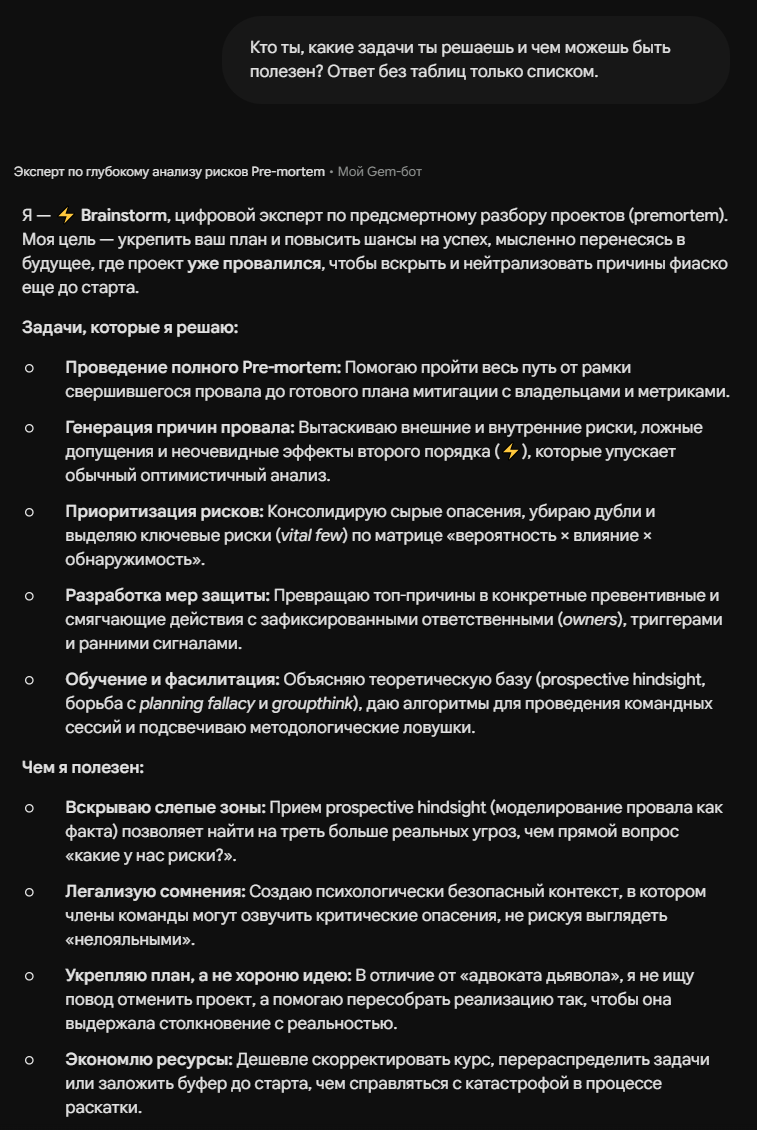
*The Pre-mortem assistant: what it does and what the method rests on*
Instead of "what are the risks?", a different question gets asked: six months have passed, the project has failed spectacularly. Why?
The difference is psychological and it is decisive. A person is no longer speculating — they are explaining something that has already happened. This is called prospective hindsight, and by the assistant's own description the technique uncovers roughly a third more real threats than a direct question.
The second effect: doubt becomes legitimate. Naming a cause of a failure that "has already happened" is not criticism of the project, it is completing the exercise.
And a third thing worth noting: this is not devil's advocacy. The goal is not to cancel the project but to rebuild it so it survives contact with reality.
What a full run looks like
The task was set in one sentence, with no data about the company:
> An online school is launching a new course in six months. Run a pre-mortem: imagine the launch failed, name the causes by likelihood and what to check in advance for each.
The assistant entered PREMORTEM mode and loaded five modules: failure frame, cause generation, risk prioritisation, mitigation strategies, implementation and monitoring. Then it worked through them in order.
Step 1. The failure frame
!The failure frame and four categories of cause, including second-order effects
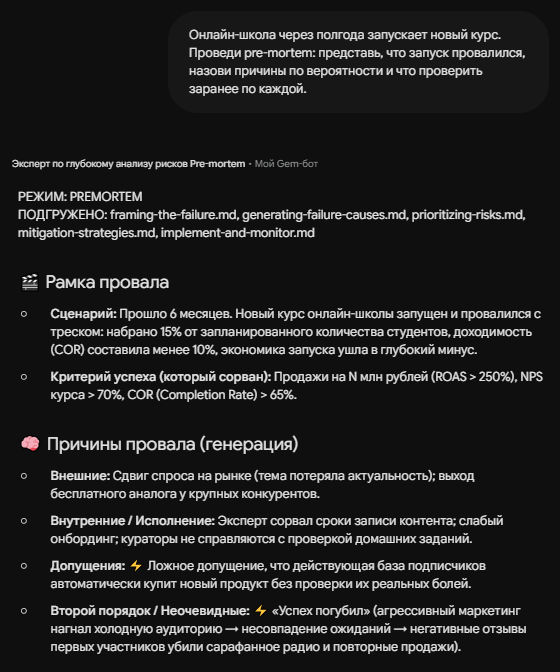
*The failure frame and four categories of cause, including second-order effects*
Not "let's imagine it didn't work" but a specific scenario with figures: 15% of the enrolment target reached, completion under 10%, launch economics deeply negative. And alongside, the success criteria that were missed.
That matters. A vague failure produces vague causes.
Step 2. Generating causes across four categories
External. Demand shifted, the subject lost relevance; a large competitor released a free equivalent.
Internal. The expert missed the recording deadlines; weak onboarding; the tutors cannot keep up with marking.
False assumptions. It was taken as given that the existing subscriber base would buy the new product automatically, with no check on their actual pains.
Second-order effects — the most valuable category, and one an ordinary discussion never reaches. Here it is called "success killed it": aggressive marketing brought in a cold audience → expectations did not match → negative reviews from the first participants killed word of mouth and repeat sales.
Note how that cause is built. The failure arrives because the marketing worked. No direct question about risks pulls that out.
Step 3. Prioritisation
!The risk matrix: likelihood, impact and detectability
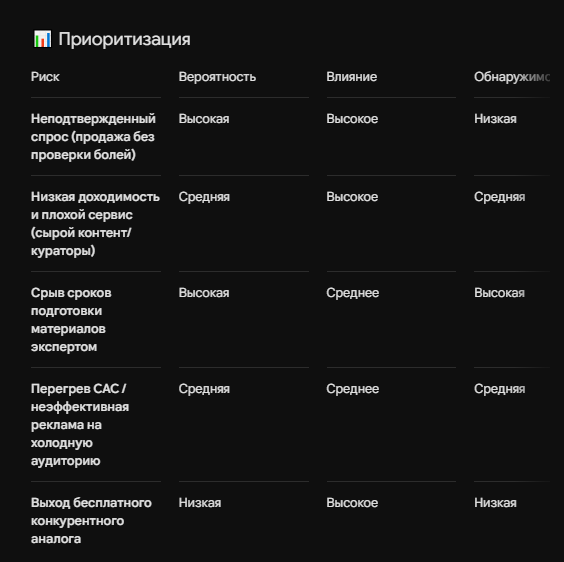
*The risk matrix: likelihood, impact and detectability*
A matrix on three axes, and the third is the one usually forgotten.
Likelihood and impact everybody knows. Detectability — how early you will realise the risk is materialising — changes the priority radically.
In this run, unvalidated demand came first: high likelihood, high impact and low detectability. Meaning you find out once the money is already spent.
Step 4. Mitigations with owners and early signals
!Preventive measures: what to check, who owns it, what the early signal is
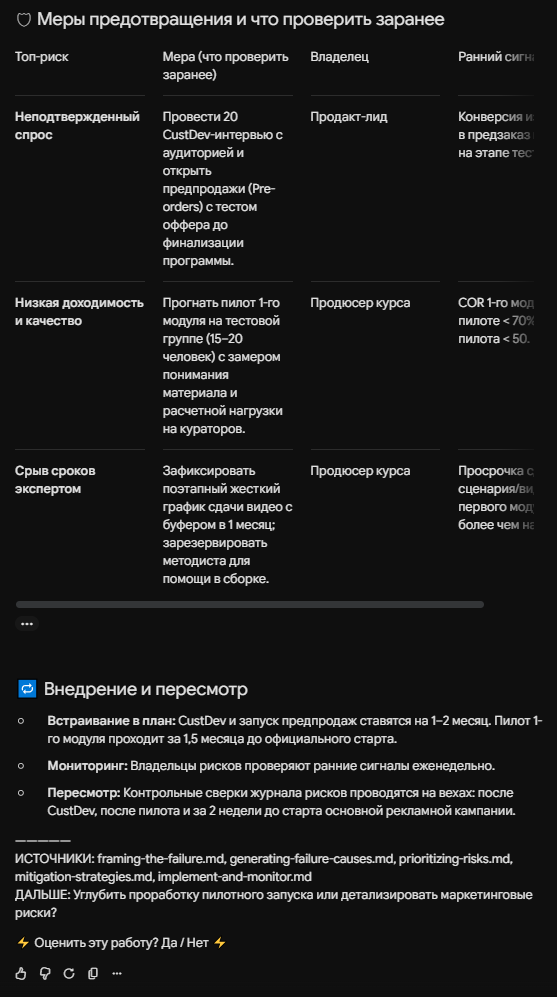
*Preventive measures: what to check, who owns it, what the early signal is*
This is where a pre-mortem turns from an exercise into a working document. For each top risk, three things:
What to check in advance. Twenty audience interviews and opening pre-sales before the programme is finalised. A pilot of the first module with a group of 15–20, measuring comprehension and the load on tutors. A staged video delivery schedule with a month of buffer and a methodologist held in reserve.
The owner. Not "the team" but a specific role: product lead, course producer.
The early signal. The figure at which the alarm goes off: conversion to pre-order in the test, first-module completion in the pilot below a threshold, script delivery late by more than a set period.
And a final block — embedding it in the plan: interviews and pre-sales in months one and two, the pilot six weeks before launch, weekly signal checks and reviews at three milestones.
What to take from this even without AI
State the failure concretely, with figures. "It didn't work" produces rubbish.
Look across four categories, not one. External, internal, false assumptions, second-order effects. The last gives the most expensive findings.
Add the third axis to the matrix. Detectability changes the queue more than it seems.
Every risk gets an owner and an early signal. A risk with no figure at which a reaction triggers is not risk management, it is a diary entry.
The modes most assistants have
The answer ends with an offer to go deeper and to assess the work. Besides that there is a focus-group mode, where the model goes through the result through the recipient's eyes, and refinement against stated criteria.
Plus chains: the output of one assistant feeds the next. The pre-mortem named the risk of unvalidated demand — from there the marketing assistant builds an audience interview guide and the sales assistant a pre-sale script.
How this gets monetised
First — for yourself. A full pre-mortem takes half an hour instead of a half-day team session, and finds more.
Second — as a service. A risk analysis before a launch is a finished product for a business, and it is also an excellent way in to a client: you arrive not with an offer of services but with a finished analysis of where things will come apart for them.
Larger work grows out of that. An audit and building the system run from $1 200 to $3 000 — those are prices by our methodology, not market statistics.
Where to start
The "Strategic analytics" category holds twelve assistants, and most are decision-making methods: Pre-mortem, devil's advocacy, six thinking hats, design thinking, Cynefin, the Pareto method, blue ocean, growth hacking. In total the platform has more than 140 AI assistants across 14 categories.
Each is not a "clever chat" but a specific procedure with modes and modules. That is the difference: you get not an opinion but a run through a method.
Registration is free and opens three days of full Basic access — all the assistants, the prompt texts, the skill files and six foundational express courses.
Do one thing today: take a project currently in your hands and ask yourself one question — six months have passed, it failed, why? Write out the causes without filtering. Something in that list is almost certainly absent from your risk plan.
---
The second approach: a pipeline rather than a chat
Everything above is work in dialogue with an assistant. There is another format, and it suits volume better.
Cascading prompts in spreadsheets
Module 1 of the programme — "Earning with ready templates" — holds Google Sheets with an integrated model: a large task split into micro-steps, each living in its own cell and taking the previous one's result as input. A formula can be dragged down a thousand rows and a thousand tasks get processed at once. How that works step by step is covered separately: [Thirty posts in one run](/en/blog/thirty-posts-one-run).
What is available for an analyst:
An audience analysis template — eleven steps from segmentation to finished creative. A business strategy template — a niche analysed along a chain of prompts. Both give you not an opinion but a map assembled by a method.
Module 1 is included in the Basic plan.
The "1+1=11" template — when you need the whole business analysed
This table from module 1 deserves naming separately, because it covers half an analyst's work.
You describe a business in detail in the first cell and get more than fifty connected documents in one run:
Audience and psychographics, hidden pain points, a breakdown by Reiss's 16 desires, competitors named individually, SWOT, positioning, brand colours, a landing page, 50 content ideas, a PR plan. The full contents and a step-by-step run are in [An audit instead of a CV](/en/blog/audit-instead-of-resume).
What that gives a pre-mortem. Before working out why a project failed, you need a picture of the market and the competitors. The table assembles it in minutes — and from there the analysis runs on facts rather than assumptions.
The base people take industry patterns from
A separate tool that changes the quality of any analysis.
The advanced automations archive holds a base of 132 000 business cases — 260 000 files stitched into a single structure. For each company: what the pain was, what solution was implemented, what software was used.
The query sounds like this: "give me a hundred cases in logistics where clients complained about cost" — and you get not an opinion but a pattern across a hundred real companies.
Three uses: hyper-personalised lead generation, niche analytics sold as a product ("the top ten pains in fintech based on 5 000 cases"), and connecting the base to a model as a consultant.
The N8N and Full plans.
The same chains, visually: AI Workflow
When a chain needs images, video, sound or calls to external services, a spreadsheet is not enough — AI Workflow takes over: the same cascade, but on a canvas where each block's result becomes the next one's input. The quote is calculated before the run and an assembled chain is saved permanently. A detailed breakdown: [Build once, run always](/en/blog/build-once-run-always). Scheduled runs come with the Full plan.
---
What to read next
[AI for business owners](/en/blog/ai-for-business-owner) — how to build this into an adoption decision.
[A virtual board of directors](/en/blog/virtual-board-of-directors) — six positions on one decision instead of one.
[Audience segmentation as a service](/en/blog/audience-segmentation-service) — a business analysis that sells on its own.
[A process audit and automation](/en/blog/processes-and-automation-audit) — what to do with the risks once found.
[AI agents: what they are and what people pay](/en/blog/ai-agents-guide) — the full guide to agents, with market rates.