AI for lawyers: what genuinely gets covered and where the risk starts

A contract review that used to take a day gets done in ten minutes — and the next thought arrives immediately: what if there had been a mistake in it. Below is both what an assistant actually produces and the protocol without which the result cannot be taken into work.
A contract review that used to take a day gets done in ten minutes — and the next thought arrives immediately: what if there had been a mistake in it. Below is both what an assistant actually produces and the protocol without which the result cannot be taken into work.
---
Work that consists of re-reading
A lawyer at a small company or in private practice spends most of their time not on difficult decisions but on repetitive review.
A contract arrives from a counterparty. It has to be read in full, gaps found, wording that works against your side flagged, and comments assembled. A standard contract takes between an hour and half a day. There are several a week.
And the work itself repeats: the same places, the same risks, the same list of what templates usually omit.
From my audience survey, the wording of somebody who had already tried it: a contract review that used to take a day, done in ten minutes.
And right behind it comes the thought that turns you cold: what if there had been a mistake? Below is both what genuinely comes out and the protocol without which you cannot use it.
What the assistant produces
I took the corporate lawyer from the catalogue and set one task with no documents attached:
> Put together a checklist for reviewing a services agreement from the contractor's side. Which clauses are essential, which wordings work against the contractor, what is most often missing from standard templates.
!The corporate lawyer — its specialism and range of tasks
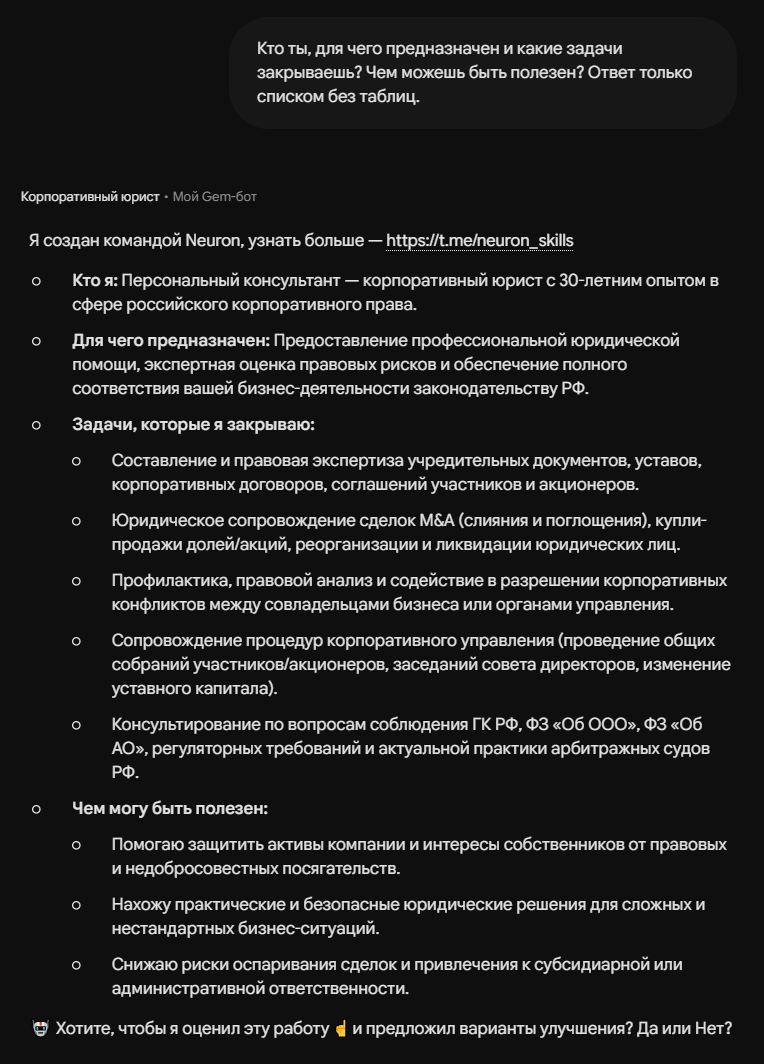
*The corporate lawyer — its specialism and range of tasks*
The assistant immediately set out a frame that not every practising lawyer states: a paid services agreement carries more risk for the contractor specifically, because in most civil-law systems the client keeps an unconditional right to walk away at any time, and because services are intangible by nature.
A note before the substance: statutory references differ by jurisdiction, and every one of them has to be checked against the source — which is exactly what the protocol below is for.
Then the analysis in three parts.
Part one: essential and protective clauses
!The first part of the checklist — protective clauses with statutory references
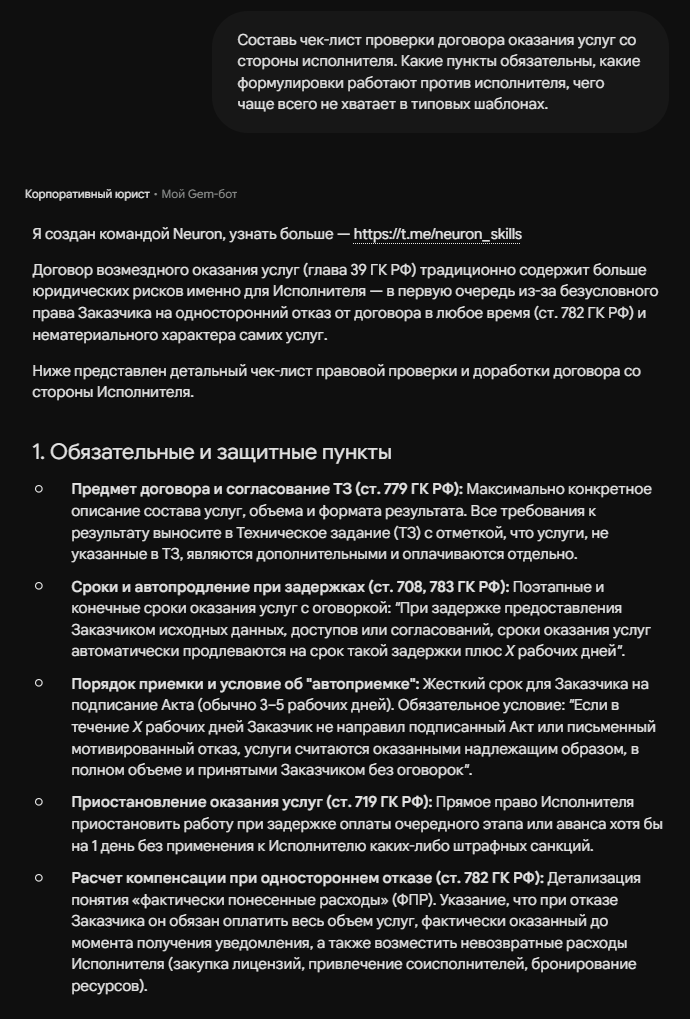
*The first part of the checklist — protective clauses with statutory references*
Five clauses, each with a reference to the governing rule and ready wording:
Subject matter and the statement of work. Anything not listed in the statement of work is an additional service and is billed separately.
Automatic extension of deadlines. An explicit clause: where the client delays source data, access or sign-offs, deadlines extend by the length of the delay plus several working days.
Automatic acceptance. A hard deadline for signing off the delivery, and if the client sends neither an acceptance nor a reasoned rejection, the services are deemed accepted without reservation.
The right to suspend work if payment is even a day late — with no penalties falling on the contractor.
Calculating compensation on unilateral termination. An itemisation of costs actually incurred: licences purchased, subcontractors engaged, resources reserved.
Part two: dangerous wordings
!Red flags and what is missing from standard templates
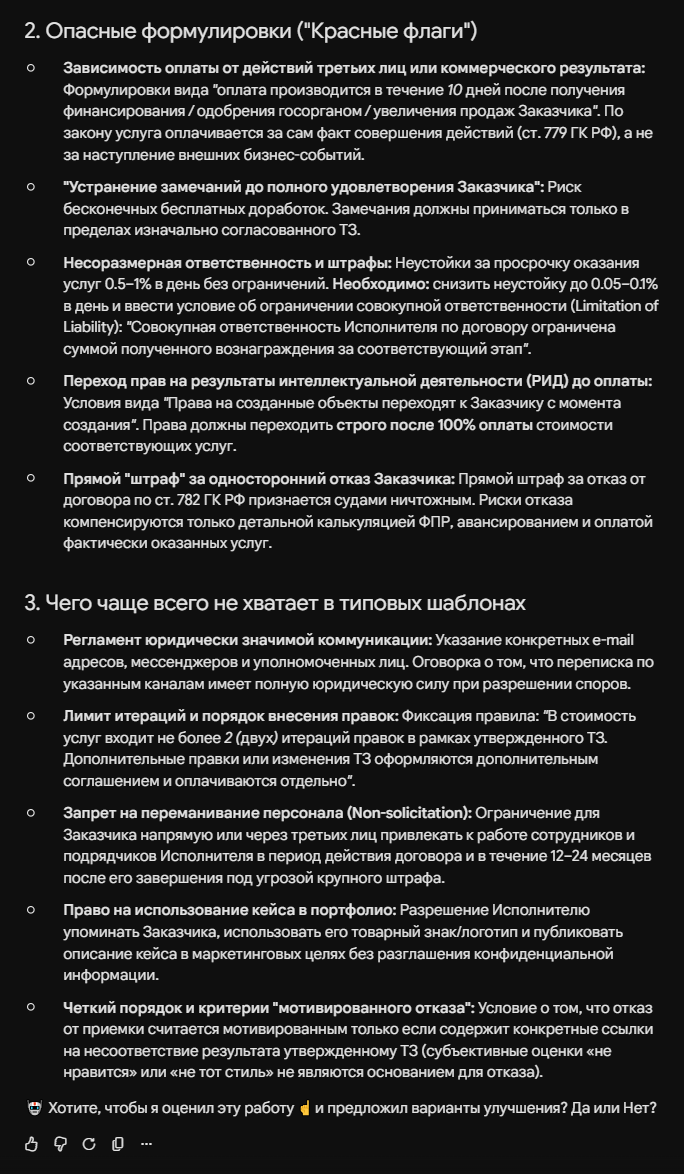
*Red flags and what is missing from standard templates*
Here is the most practically useful part. Five red flags, and all of them turn up constantly:
Payment tied to external events — "after funding is received", "after regulatory approval". A service is paid for the fact of the work being performed, not for somebody else's business events occurring.
"Addressing comments until the client is fully satisfied" — endless free revisions. Comments are accepted only within the agreed statement of work.
Disproportionate penalties — 0.5–1% a day with no cap. The assistant names the specific move too: reduce to 0.05–0.1% and cap total liability at the fee for the stage.
Rights in the deliverable transferring before payment. Rights should transfer strictly after payment in full.
A direct penalty for the client terminating — courts commonly treat this as void, and what is needed instead is a detailed calculation of costs.
Part three: what templates are missing
Clauses that almost never make it into a contract downloaded off the internet:
- A protocol for legally significant correspondence — named addresses and individuals, and a clause on the evidential weight of that correspondence in a dispute
- A cap on revision rounds, with explicit wording about two rounds within the statement of work
- A non-solicitation clause covering staff and subcontractors for a period after completion
- The right to use the project in your portfolio, naming the client
- Criteria for a reasoned rejection — subjective "I don't like it" and "wrong style" do not count
The protocol without which you cannot use this
Now the honest part, and it matters more than everything above.
The model states non-existent rules as confidently as real ones. A mistake looks exactly like a correct answer: an article number looks like an article number, a citation like a citation. There will be no signal saying "I am not sure here".
For a lawyer that does not mean "unusable" but "unusable without a process".
Split the answer into two kinds of content. Verifiable statements — rule numbers, dates, sums, citations, quotations. And reasoning — the logic, the structure, the wording. The second you judge with your own expertise. The first gets checked against the source every time, even when it looks obviously right.
Supply the material instead of relying on its memory. "Here is a contract, review it against these points" is more reliable than "tell me what contracts usually contain". When all the material comes from you there is nothing to invent — and that is the safest mode of working.
Nothing goes out without a review by a human lawyer. AI speeds up the analysis and the drafting. Responsibility for the wording sits with the person signing under it.
And clients' personal data does not go into a chat. If you are unsure, assume it must not.
What is safe here and what is not
Safe almost always: analysing a document you supplied, finding contradictions inside it, comparing two versions, preparing checklists and questions for a counterparty, restating something complex in plain language for a client.
Requires full verification: any rules, deadlines, references and anything that was not in the material you supplied.
Not to be handed over at all: final decisions with legal consequences, and data that must not leave the building.
Two things people usually do not know
The assistants have checking modes. Every answer ends with an offer to assess the work and suggest improvements. There is a focus-group mode where the model goes through its own answer through the recipient's eyes, and a refinement mode working against stated criteria. That turns a first draft into a checked document without your involvement.
Assistants can be put in a chain. The output of one feeds the next. The corporate lawyer analysed the contract — the paralegal assistant then built a letter to the counterparty from those comments. That is how a process gets assembled rather than an answer.
How this gets monetised
First — speed for yourself. A contract reviewed in ten minutes instead of a day. This is not about cutting headcount, it is about the freed-up time going to work nobody ever got round to.
Second — as a service to business. A legal risk audit for a small company: contracts with clients and contractors, staff confidentiality obligations, rights in work created by contractors, public-facing documents. Work like that costs from $2 400 — that is the price by our methodology, not market statistics. The bulk of it is analysing existing documents and mapping risks, and that speeds up several times over.
Where to start
The "Legal" category holds thirteen assistants: corporate, tax, employment, intellectual property, a paralegal assistant, insolvency, property, succession and others. In total the platform has more than 140 AI assistants across 14 categories.
Worth singling out the express course "Perplexity as an investigative tool" — it is not about law, it is about a method of verification: how to check a fact, a reference or a figure in minutes instead of taking a text at its word. For this profession it matters more than any other. It costs $9 and is included in Basic.
Registration is free and opens three days of full Basic access — all the assistants, the verification course and five more foundational ones.
Do one thing today: take a contract you are working under right now and run it through part three of the checklist — the one listing what templates are missing. The correspondence protocol, the cap on revisions, the criteria for a reasoned rejection. If even two of those are absent, you have found your open risks in five minutes.
---
The second approach: a pipeline rather than a chat
Everything above is work in dialogue with an assistant. There is another format, and it suits volume better.
Cascading prompts in spreadsheets
Module 1 of the programme — "Earning with ready templates" — holds Google Sheets with an integrated model: a large task split into micro-steps, each living in its own cell and taking the previous one's result as input. A formula can be dragged down a thousand rows and a thousand tasks get processed at once. How that works step by step is covered separately: [Thirty posts in one run](/en/blog/thirty-posts-one-run).
What is available for a lawyer:
The HR template — from a job title it generates duties, KPIs, reporting formats and a job description in a formal standardised layout. For a lawyer that is a ready draft of personnel documents that only needs checking.
Module 1 is included in the Basic plan.
The same chains, visually: AI Workflow
When a chain needs images, video, sound or calls to external services, a spreadsheet is not enough — AI Workflow takes over: the same cascade, but on a canvas where each block's result becomes the next one's input. The quote is calculated before the run and an assembled chain is saved permanently. A detailed breakdown: [Build once, run always](/en/blog/build-once-run-always). Scheduled runs come with the Full plan.
---
Ready tools for documents
Module 5, the lesson "Analysing reports" — going through any documentation: quotes, accounts, analytics. The model finds contradictions between sections and discrepancies between text and tables.
Qwen VLM for diagrams — a separate model that turns an image of a diagram into structured data. A scan of an org chart, a process flow or a deal structure becomes a readable set of objects and relationships.
For a lawyer that is a way to work with scans and photographs of documents rather than only with text files.
Module 5 is on Basic; Qwen VLM in the automations archive is on N8N and Full.
---
What to read next
[Checking a fact with AI search](/en/blog/fact-checking-with-ai) — the verification method that matters more than any other for this profession.
[Face rights in AI advertising](/en/blog/face-rights-in-ai-ads) — an adjacent topic where freelancers need a lawyer.
[A legal risk audit](/en/blog/legal-risk-audit) — the same skill sold as a service.
[A company knowledge base as a service](/en/blog/company-knowledge-base) — what to do with scattered internal rules.
[Best open LLMs 2026](/en/blog/open-source-llm-guide) — the full guide to open models.