Local AI models for sensitive data: when it is the only option
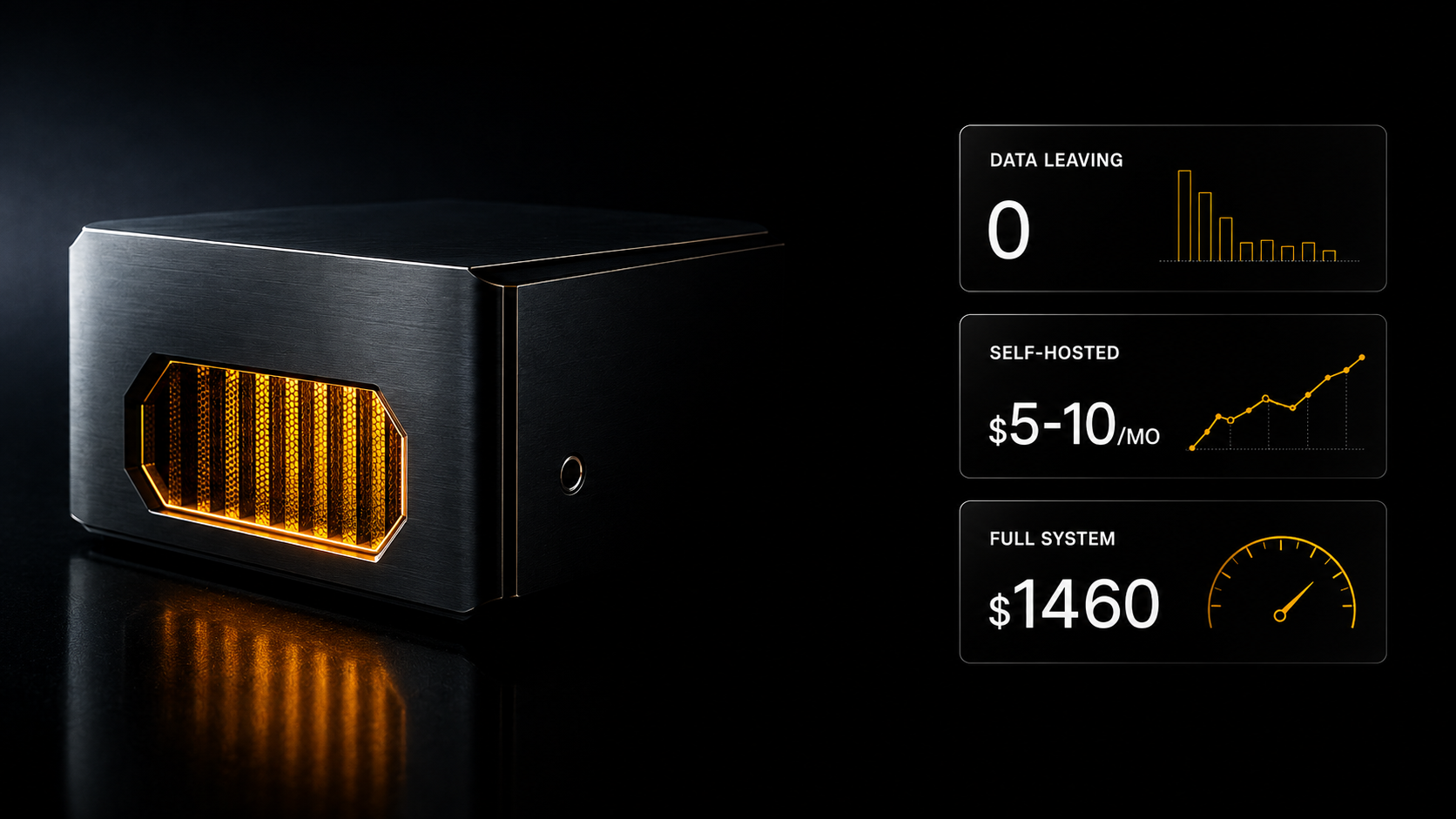
For some clients the whole conversation about AI ends with "we're not allowed". Their problem is not price — they cannot send a document outside at all. Below is how local deployment works, where its limits are, and why this is the narrowest but most solvent segment.
For some clients the whole conversation about AI ends with "we're not allowed". Their problem is not price — they cannot send a document outside at all. Below is how local deployment works, where its limits are, and why this is the narrowest but most solvent segment.
---
Companies that cannot use the ordinary tools
There is a category of client for whom every conversation about AI looks the same: interesting, but we're not allowed.
Clinics with patient records. Law firms with case material. Financial companies. Organisations with restricted documents. Any business with requirements on how it handles information.
Their problem is not the price and not the difficulty. They cannot send a document outside at all — that is not caution but a condition of operating.
So for them the question is not "is it worth trying" but "does an option exist where the data does not leave the perimeter".
It does. Let us go through how it works, where the limits are and why this is the narrowest but most solvent segment.
What "inside the perimeter" means
In plain words.
Ordinary working: your text goes to somebody else's server, gets processed there, the answer comes back. Every request is metered. The information has left your organisation.
Local deployment: the model runs on your hardware. Nothing goes anywhere. Nobody meters the requests.
Three consequences, and the first matters more than the rest:
The data stays with you. For the industries listed above that is not an advantage but the ticket in.
There is no per-request charge. You pay for infrastructure rather than for every query.
There is no dependence on external access. It works even when an outside service is unavailable.
Who genuinely needs this
Honestly, because it suits a minority.
Organisations with data requirements. The first and main group. The question is not convenience — some information simply cannot be sent out.
People with a large flow of repetitive tasks. Tagging enquiries, processing documents, categorising bulk material. At thousands of requests a month, per-query charging becomes noticeable.
People who keep running into access problems. When the work regularly stops and the client's deadlines do not move.
Who does not need it: one-off tasks, working from a phone, non-sensitive data, modest volume. Ordinary tools will cover the same thing more cheaply and simply.
Do not chase local deployment on principle. It is a solution for particular conditions rather than a badge of sophistication.
Where local models lose
The gap is real and worth knowing about before rather than after.
Complex reasoning. On tasks requiring long chains of logic, the top closed models are noticeably stronger.
Creative text. The difference in liveliness is audible.
Current information. A local model knows only what was in its training and does not search.
The barrier to entry. You need hardware with headroom and a willingness to configure things.
Support. Updates, compatibility, rollbacks — now your concern.
The hybrid scheme: how this works in practice
Almost nobody works purely locally, and rightly.
Kept local: everything sensitive, the accumulated context, regular repetitive tasks, work with internal documents.
Sent outside: complex creative tasks, generating images and video, searching for current information, anything where the quality of the top models is noticeably higher.
The rule for dividing them: if there is data that cannot leave, local, regardless of quality. If there is no such data and you need the best result, outside.
What that gives you: privacy where it is compulsory and quality where it decides. Plus resilience: when external access drops, part of the work continues.
What it costs: two sets of tools and the discipline of deciding each time where a task goes. Within a month that becomes automatic.
How this sells
Here is the most lucrative part of the subject, and there are two arguments.
Argument one: admissibility
For a clinic, a law firm or a financial company, local deployment is a condition of the deal rather than an advantage. Without it the conversation does not start.
If you work with clients like that, it is your ticket in — and simultaneously what excludes competitors offering ordinary solutions.
Argument two: the costs they fear
When you sell a company a system running round the clock, the client asks two questions: what does deployment cost, and what will this cost every month.
The second frightens them more. A one-off sum they are prepared to spend; an open-ended payment whose size depends on load, they are not.
"Part of the load runs on a model deployed at your end and is not metered" removes that objection entirely.
How to phrase it in a proposal
Not "we use open models" — that tells a client nothing.
But this: "sensitive data gets processed on your server and does not leave the perimeter; complex tasks go to external models, and that is a separate modest cost line you can see in the dashboard".
Transparent, verifiable, and it removes both fears at once.
What such work involves
Not "install a model". The full composition, which also justifies the price:
- Working out what exactly cannot leave — the client usually has no such list, and compiling it is already value
- Choosing a configuration for the tasks and the available hardware
- Deployment and configuration
- Splitting the flows: what goes local, what goes out
- A knowledge base on internal documents
- Behaviour rules: what to do when data is missing, when to hand over to a human
- A metrics dashboard
- Instructions and staff training
- An updating procedure
The last two get skipped most often — and they are exactly why systems die within a month.
The price range
By my scrape of 848 job listings over 24 days: a system or pipeline — $490–1 460, against a $30–75 median for one-off work.
A caveat: an explicit budget appears in 6% of listings, with between two and fifteen observations per category.
A real example from practice. A system for a dental clinic — $1 900 a year, paid in full, with a CRM at $3 000–3 600 as the second step. The comparison was not against zero but against an in-house team at roughly $720 a month plus taxes and holidays.
Where the main money is: in support. Updates, changes to processes, keeping the base current. That is a recurring payment and an honest one: a system with no owner survives until the first failure.
A narrow segment with a high fee
Worth saying plainly.
There are few clients here. This is not a mass niche and you will not build a flow of one-off jobs on it.
But the fee is higher, competition is lower, and the clients are long-term — because a system built into an organisation's perimeter does not get changed every year.
In my dataset 21.9% of clients are explicitly looking for somebody long-term. Here that share is higher: having deployed a system at a client's, you get the support work by default.
How to find clients like that: not in a general job feed. Through the industry — where data requirements exist by definition.
What is available on the platform
Open source solutions — ready projects to deploy yourself. The catalogue is open to everyone, the file links after free registration.
The "OpenClaw" express course — a background service on your own hardware with local memory, proactivity and messenger connections, with more than fifty skills included. $9, included in the Make and Team plans. Not in the three free days of Basic.
Before deploying your own, check whether the task has a simpler solution: 140+ AI assistants across 14 categories from the Basic plan and more than 3 000 automation templates from Plus.
The legal category — thirteen assistants. Compulsory for this subject: data handling requirements, consents, the client contract.
Registration is free and opens three days of full Basic access.
Where to start today
One action. Write out the tasks you do not give to AI because the data is sensitive. Not the ones you solve but the ones you do not solve at all.
An empty list means the subject of local models is not yet for you, and that is a fine answer.
A list of three or four regular items is your justification. And it is the same list you show a manager or a client: it convinces better than any account of the technology.
---
What actually gets deployed and what it costs a client
Local deployment sounds abstract until the figures get named.
The phrasing from the n8n course: deploying the platform on a client's server via Docker gives them unlimited automations for a fixed $5–10 a month instead of bills from cloud platforms where every action is metered.
What the skill involves: deployment on a VDS via Docker, configuring environment variables and basic security, working with whole data arrays, global error handling — a single rescue flow that catches failures from every other automation and sends alerts.
Your own generation, not only your own logic
It is not only automations that get deployed locally.
Wan 2.2 Turbo on Modal — a ready video generation server working from photographs: a five-second clip at 720p in forty seconds. You stop depending on the availability of somebody else's service and on their pricing.
Local AI models on the Full plan.
And the most expensive thing built on this approach
RAG agents — models on a company's private base. They answer from internal documents, send nothing outside and do not invent.
By the course's description, systems like that fetch tens of thousands of dollars on the market — precisely because for some clients this is a condition of working rather than an advantage.
The N8N and Full plans.
---
What to read next
[Best open LLMs](/en/blog/open-source-llm-guide) — which models suit this.
[A local AI operator with memory](/en/blog/local-ai-operator) — the next step after deployment.
[A company knowledge base as a service](/en/blog/company-knowledge-base) — what gets built on this.
[AI in medicine](/en/blog/ai-in-medicine) — the industry where this is a condition of working.