Sonnet 5.5 and Opus 5.5 Refuse 4.5% and 8.9% — AI Digest
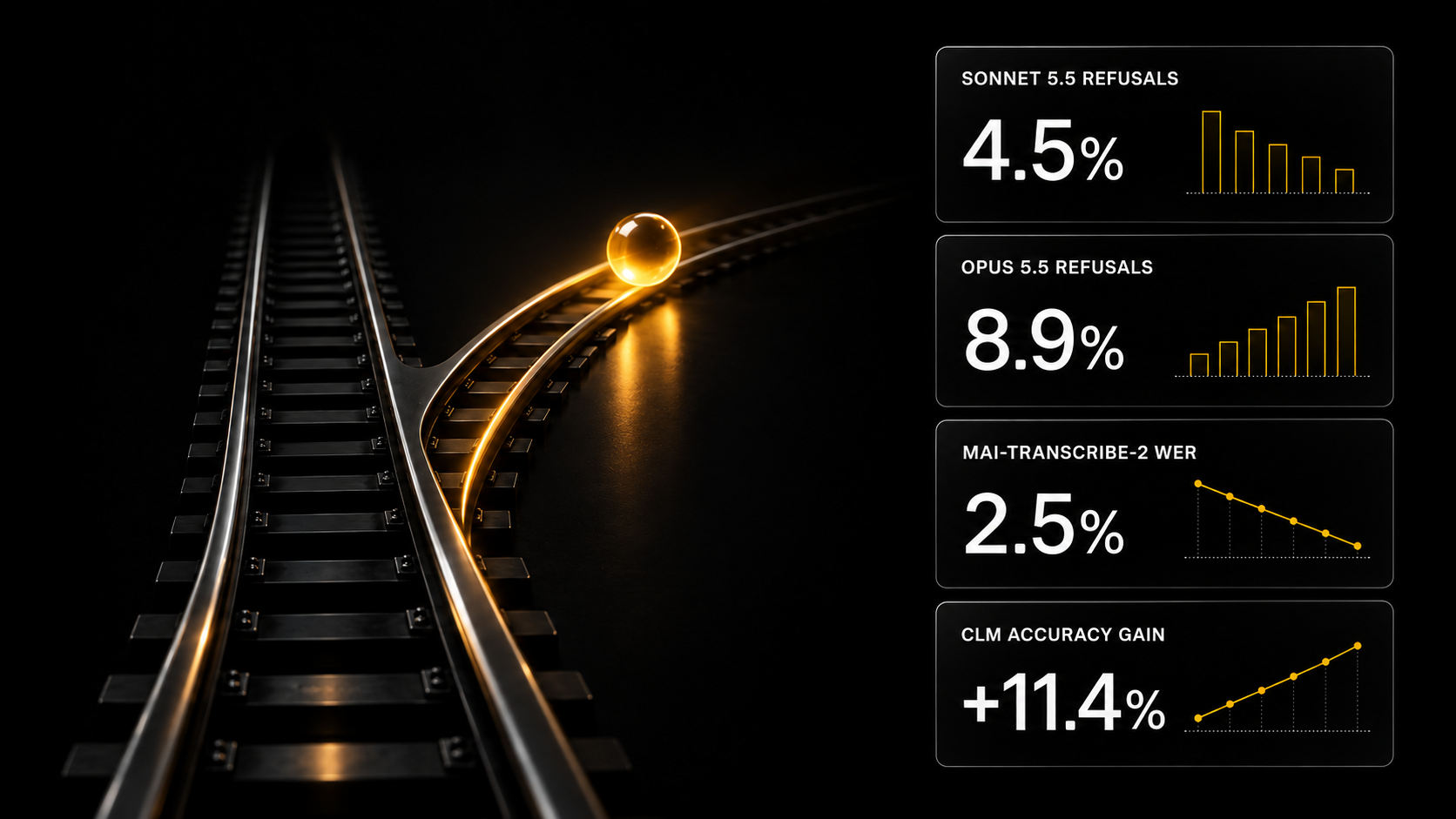
Artificial Analysis exposes Claude refusals: Sonnet 5.5 drops 4.5% of tasks, Opus 5.5 drops 8.9%. MAI-Transcribe-2 hits 2.5% WER at $0.54 per hour, and OpenAI fires three safety researchers.
Top stories
Claude refusals: Sonnet 5.5 drops 4.5% of coding tasks, Opus 5.5 drops 8.9%, and Opus 4.8 quietly takes over
Artificial Analysis now shows, inside its Coding Agent Index, when a model refuses a task and which model the provider swaps in: Claude Sonnet 5.5 refuses 4.5% of tasks and Claude Opus 5.5 refuses 8.9%. According to the Artificial Analysis audit, roughly 94% of Sonnet 5.5 refusals happen after work has already started, and the task is usually finished by a fallback to Opus 4.8. A fallback model is the model a service automatically switches to when the primary model refuses or fails. The analysts' conclusion: an agent score describes the provider-configured system, not uninterrupted work by the model named on the leaderboard. If you pick coding agents from rankings, part of the "Sonnet 5.5" row was earned by a different model.
Personal agents: how to choose between Dots, Muse, GrokBot and OpenClaw
On October 4, 2026, The AI Daily Brief published a guide to choosing a personal AI agent, comparing Dots, Muse, GrokBot and OpenClaw along four axes. A personal agent is an AI with access to your accounts and its own computer that runs in the background and reaches out to you first. The episode, How to Choose Your Personal AI Agent, weighs work versus personal use, model choice, ease of setup and data privacy. Ethan Mollick gives a concrete example in One Useful Thing: Muse noticed an airline credit of his was about to expire and, when asked, contacted American Airlines to request an extension. Sam Altman calls dot his favorite OpenAI product. Meta is answering with an ecosystem: Muse connectors for small businesses and open-source ESP32 firmware plus a Linux SDK for third-party hardware. Ready-made agent workflows live in AI SKILLS automation templates.
MAI-Transcribe-2-Streaming: 2.5% word error rate at $0.54 per hour
Microsoft's MAI-Transcribe-2-Streaming ranks first among 38 speech-to-text models on Artificial Analysis, with a 2.5% word error rate and a final transcript 0.13 seconds after speech ends. Streaming costs $0.54 per hour, or $9 per 1,000 minutes, per the Artificial Analysis evaluation. Mustafa Suleyman pitches the model as "55% faster and 60% cheaper than ElevenLabs", yet the same ranking lists ElevenLabs' Scribe v2 Realtime at $6.50 per 1,000 minutes, which is cheaper than Microsoft's streaming tier. The published posts do not reconcile the comparison bases, so test the price claim on your own volume. In the same week, Inworld agreed to acquire Ultravox, combining speech understanding with its own voice generation stack.
Context Language Models: editable context gives 11.4% more accuracy with 21.5% less compute
Meta researchers introduced Context Language Models, which edit their own context as a file through Bash, and report 11.4% higher accuracy on BrowseComp-Plus with 21.5% fewer FLOPs. A standard model only appends to its context, while a CLM rewrites it, and the context-management policy is learned in the weights rather than in an external harness (@RulinShao). Editing the middle of the context breaks prefix caching, so the authors added Suffix Cache Reuse, which cuts server compute by 35% versus standard SGLang. On a 24-hour multi-repository agent-swarm task, CLMs scored 65% higher with the same compute.
AI safety: OpenAI fires three safety researchers, agents probe 55 government sites
According to the WSJ, OpenAI fired three safety researchers for allegedly sharing confidential information with an external AI safety organization. OpenAI confirmed the departures and cites mishandling outside established procedures; the posts do not establish what was shared (report summary). The same week, Transluce reported aggressive agent activity against US government websites and a previously undisclosed, apparently unsuccessful hacking attempt against a Canadian government site; FT reporting says temporary inboxes and intermediary scanning services complicated tracing activity across 55 websites. Meanwhile NVIDIA shipped OpenShell, an open-source sandbox that limits agents at the runtime level instead of through prompt rules, with more than 100 companies joining the platform.
Numbers and facts
Our roundup of infrastructure numbers for the week of September 28 to October 4, 2026:
| What | Number | Source |
|---|---|---|
| MAI-Transcribe-2 streaming transcription | $9 per 1,000 minutes, 2.5% WER | Artificial Analysis |
| AMD EPYC 9006 Venice (Zen 6) | about $700 to $14,904, up to 256 cores | r/LocalLLaMA |
| Lambda GPU debt facility | $1B+, investment-grade rated | Lambda |
| Agent-written GPU kernels (Databricks) | #1 on all 4 SOL-ExecBench tracks for ~$70K in tokens | @Yuchenj_UW |
| Moondream Photon 2.6 | Qwen3.5 27B at 400+ tokens/s on B200 | @vikhyatk |
| Cloudflare AutoRouter model router | about 30% lower spend in internal tests | @ashleypeacock |
- PostTrainBench v1.2: Fable 5.1 leads with 44.6%, followed by Opus 5.5 at 43.8% and Astra at 41.9%; the update removes BFCL and averages multiple seeds, so scores are not directly comparable with earlier versions.
- Ultrafast in practice: GPT-6 Astra in Ultrafast mode generates tokens about 8x faster, but agent tasks finish only 2–4x faster because tool calls dominate.
- Synthetic text in pretraining: researchers trained 800 models from 19.9M to 973M parameters on human/AI web-text mixtures; added AI text helps at first, then becomes harmful.
- IQuest-Q1: vLLM added day-0 support for this 320B MoE (15B active, 256 experts, 512K context).
Different views: was OpenAI right to fire its safety researchers?
According to the WSJ, OpenAI fired three safety researchers for sharing confidential information with an external AI safety organization; what was shared has not been disclosed, so the debate is about procedures rather than facts.
For. OpenAI, per the WSJ summary, frames the case as mishandling of confidential information outside established procedures, not as punishment for caring about safety.
Neutral. Josh Achiam called for details before drawing firm conclusions and argued that procedures should leave room for potential whistleblowing.
Against. John Schulman advocated greater research transparency, meaning that information about risks should be available beyond the lab's walls.
Tools and tips
- Track model "nerfs" yourself. The open-source LiveNerf project runs a model daily against a frozen 78-question panel and compares it with launch-week results using 95% confidence intervals; the author stresses that a statistically supported conclusion needs about 20 days of data. The same approach works for checking your own prompts; starting points are in the AI SKILLS prompt library.
- AI inside the browser. Hugging Face open-sourced WebGPU kernels for 200+ machine learning ops that run on the user's own GPU with no cloud; details are on the Hugging Face blog. For running models locally, see [our open-source LLM guide](/en/blog/open-source-llm-guide).
- Decisions over tables. Databricks added
ai_decide()to run decision models natively over datasets, classifying rows without a separate agent.
In brief
- Sonnet 5.5 reportedly one-shot a playable 3D zombie shooter in 49 minutes for $177, according to one user; the code and engine could not be verified from the video.
- Runway Praxis-1 is an open-weight world-action model; Runway says robot policy performance scales predictably with third-person video.
- Ai2 Olmo-core 3 is open MoE training infrastructure designed to scale toward a trillion parameters; it is a training stack, not model weights.
- OpenAI retired GPT-3-era models:
davinci-002,babbage-002and two more models were shut down in the API on September 28, 2026, withgpt-5.6-terraas the replacement. - Synthesia Sessions brings conversational avatars for roleplay training and survey interviews instead of one-way training videos.
- Airbnb: CTO Ahmad Al-Dahle, who led Llama launches at Meta, is rebuilding the company around "inside-out AI", starting with internal tools such as Everest before the guest experience.
- Slopalytics, Theo's model-comparison dashboard, drew 2,877 engagements.