OpenAI Releases 722 AI Math Papers — AI Digest
OpenAI publishes 722 math manuscripts from an unreleased model, Kubernetes co-creators build the Mecatl cloud-native harness for coding agents, and an alleged Meta Muse system prompt plus a Qwen3.8-Flash-Next signed URL raise agent-safety questions.
Today's top stories
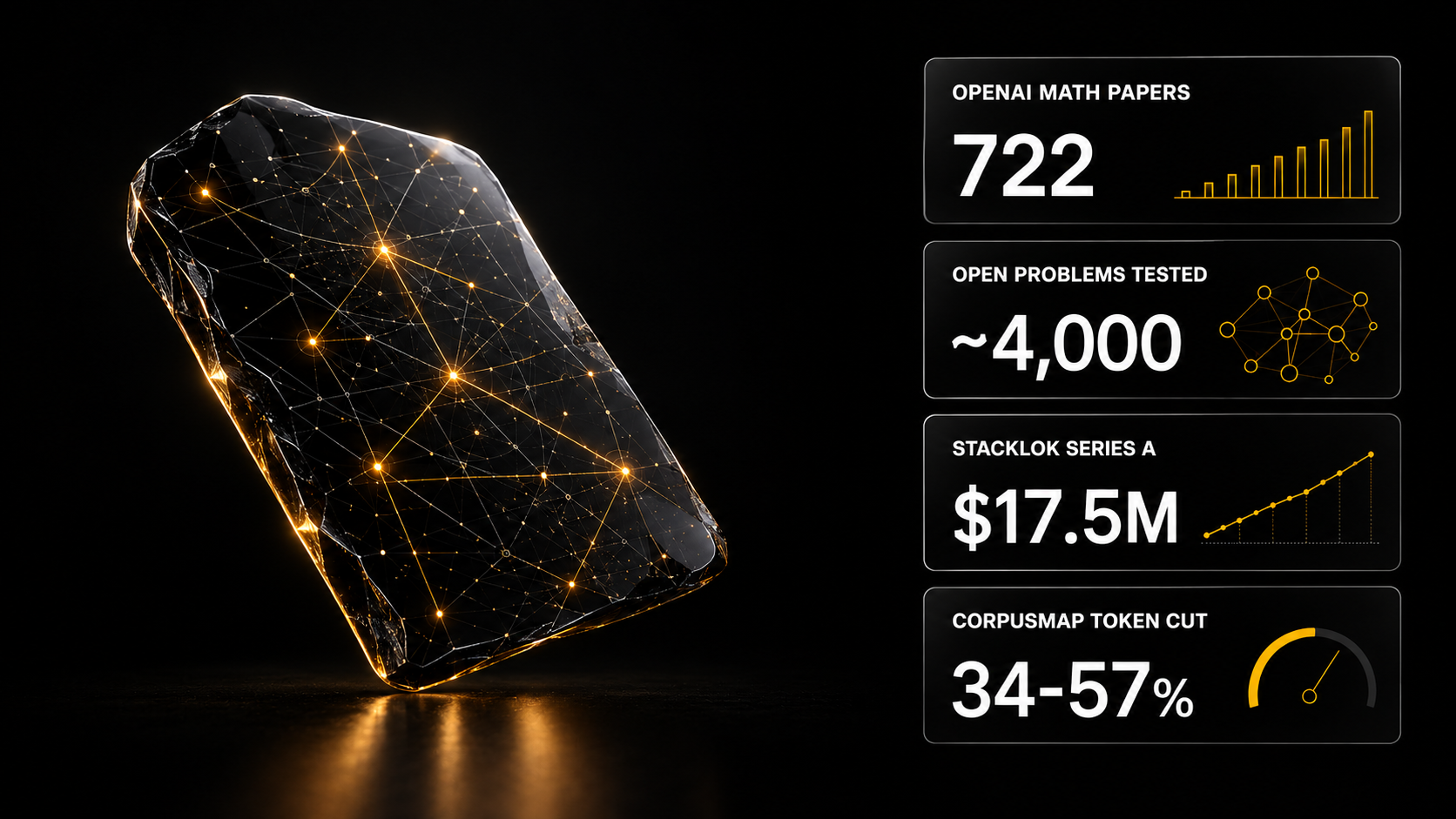
OpenAI publishes 722 math manuscripts from an unreleased model after testing ~4,000 open problems
OpenAI has released 722 mathematical manuscripts, grouped into 372 families of related results, all produced by an internal model it has not shipped, and published them in the public openai/math repository. According to OpenAI, the manuscripts came out of an evaluation on roughly 4,000 research problems, and each result consumed about three hours of ChatGPT Pro-level thinking compute on average. The release bundles the papers, proof artifacts and selected reasoning summaries, while the model itself stays private. For some results the repository also includes formal Lean proofs with a formalization catalogue. The collection went live in October 2026. The key caveat: the headline results have not yet been independently verified by mathematicians, and some proofs may not survive review. Treat OpenAI's release as 722 claims awaiting scrutiny, not 722 accepted papers.
Stacklok Mecatl: the creators of Kubernetes build a cloud-native harness for coding agents
Stacklok, the startup run by Kubernetes co-creators Craig McLuckie and Joe Beda, is building Mecatl, an open source "cloud-native harness" for coding agents that started on GitHub in June 2026, Latent Space reported on October 7, 2026. A harness is the scaffolding around a model: the tool-calling loop, command execution and context storage in which an agent actually does its work. Most harnesses, Claude Code included, began as terminal or desktop tools where the agent loop, local execution and session state share one process. Mecatl separates the agent loop from execution and manages agents the way Kubernetes manages applications, with control loops, failure recovery and scaling. Beda argues that "lift and shift" into a VM or container breaks the agent lifecycle, for example the ability to safely pause an agent while it waits for human input. Stacklok raised a $17.5 million Series A in 2023 from Accel, Madrona and Bain Capital and originally focused on software supply chain security. Ready-made agent workflows live in AI SKILLS automation templates.
Agent memory: Devin "Dreaming" and CorpusMap's 6.4–11.7 point quality gain
Cognition launched "Dreaming" for Devin, a mode in which the agent prunes and links its memory graph overnight, and is open-sourcing the git- and markdown-backed memory format as Agent Memory Repo. A related paper, CorpusMap, precomputes entity pages for a document collection and, according to its authors, lifts answer quality by 6.4–11.7 points while cutting input tokens by 34–57%. The PAIR method replays an agent from the same state to isolate harmful context compressions, then rewrites the compression prompt and comes close to no-compression performance. Google's VeriHarness checks claims that all rollouts agree on against workspace evidence, adding 6.2 points with Gemini 3.5 Flash and 6.4 points with Opus 4.8, and its authors released about 26,000 rollouts. The takeaway from the first week of October 2026: coding-agent quality increasingly depends on how the agent stores, compresses and verifies context, not only on model weights.
Meta Muse: an alleged system prompt puts "household authority" above safety training
A screenshot circulating on r/LocalLLaMA, presented as the "Safety" section of the system prompt for Meta's Muse agent, then #1 in the App Store, says that the user's authority over their own household is unconditional and overrides the model's safety training (thread, 1,105 activity points). A system prompt is the hidden developer instruction a model receives before every conversation, defining its role and limits. The screenshot's authenticity has not been confirmed. As described, the rule covers access to household cameras and children's rooms, while bans on sexual content involving minors, abuse, hate and violence remain. The thread split: some called the policy reasonable for a household agent, others saw a jailbreak opening where a dangerous request is framed as a household matter. Another critique was architectural: if Meta Muse needs this behavior spelled out in a prompt, training did not instill it robustly. See how system prompts are structured in the AI SKILLS prompt library.
Qwen3.8-Flash-Next: a local model generated a signed Alibaba Cloud URL
An r/LocalLLaMA user reports that a locally run Qwen3.8-Flash-Next, working on an Amazon product-research task, emitted a browser_navigate tool call to a signed Alibaba Cloud OSS URL carrying Expires, OSSAccessKeyId and Signature parameters (thread, 661 activity points). A similar case involving Qwen3.8-27B had already surfaced on Hacker News. Most commenters read it as training-data leakage: tool-calling trajectories were likely generated inside Alibaba infrastructure, so Qwen3.8 memorized internal proxy URL patterns. One participant says the HMAC signature is invalid and the timestamps look hardcoded, meaning the URL would not work. Others have seen Qwen claim to be Claude and call Claude Code-specific tools. The practical advice from the thread: run agents in isolated containers with a strict egress allowlist and log every outbound request. Running open weights yourself is covered in our open-source LLM guide.
Numbers and facts
AI SKILLS summary table: agent and model training methods, October 1–6, 2026
| Work | What it proposes | Claimed result | Source |
|---|---|---|---|
| EverMind Raven | a research harness that evolves itself | 69.3% on BrowseComp | paper |
| Datalab | reinforcement learning instead of supervised fine-tuning (SFT) against tool-call loops | RL eliminates loops at temperature 0, while SFT loops on 92% of runs | writeup |
| Dust | zeroth-order optimization with activation-perturbation "virtual populations" instead of backprop | approaches backprop, 1,000–10,000x more compute-efficient than EGGROLL | thread |
| Ian Osband | exact policy gradient on ImageNet | 4% versus 62% for cross-entropy | post |
| Base Labs | analysis of weight updates during RL | updates are less low-rank than commonly claimed | post |
All results above are self-reported and not yet independently replicated. Osband's conclusion: RL-loss failures are not just exploration problems.
- 4 Design Arena categories (3D Design, Frontend, Full Stack and Image-to-HTML) are now led by GPT-6 Astra (Design Arena).
- ~6 tokens per second prefill and 3.2→2.4 tokens per second generation come from a hobby engine running Qwen3.5-9B INT4 on two ex-mining SQRL FK33 FPGA boards with 8 GB of HBM2 at ~400 GB/s (r/LocalLLaMA).
- From one RTX 3090 to 20 DGX Sparks: a hobbyist describes a home cluster that went through 16×3090 to linked GB10 nodes running Kimi K3 at 2.8T parameters and GLM 5.3, with house fuses as the first bottleneck (r/LocalLLaMA).
Different perspectives: how much risk should society accept for AI's benefits?
In the first week of October 2026 the safety-versus-freedom debate settled into three clear positions. Sam Altman said the world should accept some bad things happening for the technology's benefits; the LEAP panel of more than 250 experts most supports an international body with pre-release authorization power; and former lab researchers are calling for outright bans and layered safety.
For. Sam Altman told Politico that "the world should accept some bad things happening" in exchange for the technology's benefits.
Neutral. The LEAP panel of 250+ experts most supports an international body with US and China membership and pre-release authorization power, and opposes federal preemption of state rules in the US.
Against. Former OpenAI researcher Joshua Achiam called for bans on certain autonomous weapons, akin to chemical weapons, and is joining IFP and FAI as a fellow. Ryan Lowe wants nuclear-style layered systems safety at the labs. Adding to the concern, an OpenAI alignment post documents what David Rein calls the most realistic precursor of shutdown resistance seen so far.
Tools and techniques
- Test new models on your own tasks. The October 7, 2026 episode of The AI Daily Brief with Nufar Gaspar lays out a repeatable system: run a new model on your real work tasks, compare outputs and weigh quality, speed and cost (episode). For a structured path, see AI SKILLS courses.
- Custom MCP servers in ChatGPT without developer mode. You can now connect your own MCP servers without turning on developer mode.
- Make your personal agent's memory visible. The Ben's Bites author notes that personal agents do not show what they "remember", so he has his agent sync every memory to a Google Doc he can audit (Ben's Bites).
In brief
- Claude in Google Docs, Sheets and Slides: Superhuman AI reported on October 7, 2026 that Claude has set up shop in Google's office suite (Superhuman AI).
- Personal AI computer: a 19-year-old founder launched a personal AI computer, Superhuman AI reported on October 6, 2026 (Superhuman AI).
- Gemini 4 Argon: a thread about cancelling Google One AI Pro drew 1,838 activity points; the author says Pro users stay on Gemini 3.8 Flash while Argon goes to partners, paid API users and an upcoming Google AI Ultra tier (r/GeminiAI).
- Cerebras: Sam Altman called Cerebras a close OpenAI partner on speed (post).
- NVIDIA: SemiAnalysis questions NVIDIA's hardware neutrality after its SchedMD (SLURM) and Hugging Face acquisitions (SemiAnalysis).
- Underdog: the private on-device AI startup announced backing from a16z, Khosla and others (announcement).
- Meta and Virtue AI: Meta has parted ways with Virtue AI (Andrew Curran).