How to write a commercial proposal people buy
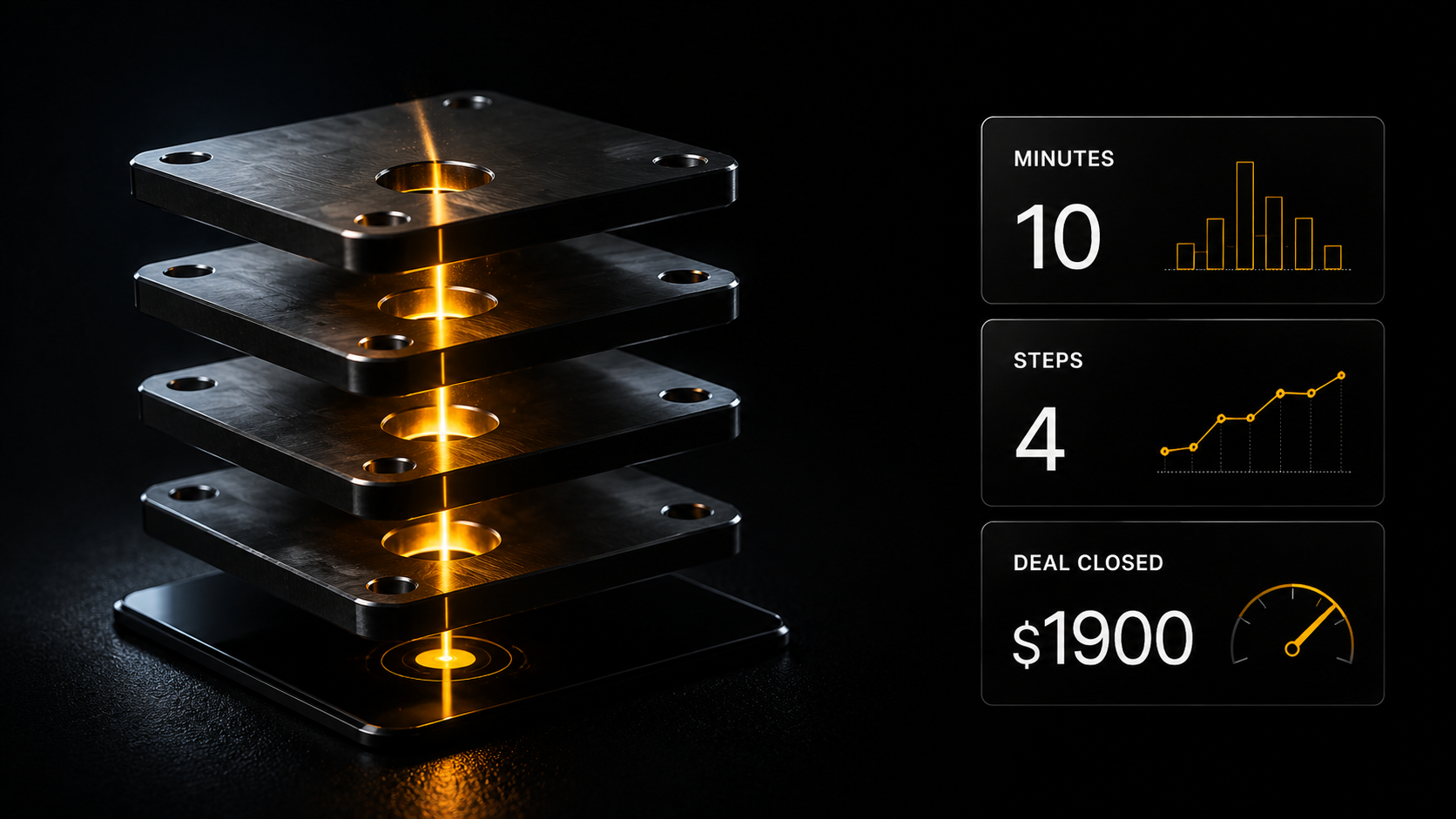
A proposal assembled in ten minutes out of something other than the client's own words is rubbish made quickly. What works here is the order, not the speed. Below is the whole cycle: reviewing the recording, a brief with a list of forbidden phrases, a check through the client's eyes, and building the file.
A proposal assembled in ten minutes out of something other than the client's own words is rubbish made quickly. What works here is the order, not the speed. Below is the whole cycle: reviewing the recording, a brief with a list of forbidden phrases, a check through the client's eyes, and building the file.
---
The call went well and then a week of silence
This is the moment where deals die most often. Not on the application, not on the call — after the call.
You talked, the client is interested, you agreed you would send a proposal. And then it turns out you cannot make a deck, the layout takes an evening, and the result looks like a school essay. Two days pass. Then three. Then you send something as plain text with "this for now, I'll format it later", and the client's interest cools along with the conversation.
The second version of the same trouble: you did make the deck. A beautiful one. And it does not sell, because it is built around what you can do rather than around what the client fears.
A proposal like that takes me less than ten minutes and it lands, because it is assembled from their own words. Here is the whole pipeline.
Where the content comes from
The key thought, without which everything else is just speed: the content of a proposal is not invented. It comes from the review of the call.
I record the call, give the audio to the sales assistant and get a review: what the client said about their losses, what they fear, which lever matters most to them, what will happen if I name a price with no justification.
From the conversation with Zakhar Fomin, owner of a dental clinic, came three pains: the fear a bot would lose an expensive patient; reactivating the base by hand through the calendar and a remote administrator; dead social media producing one patient every two months.
Each of the three became a block of the deck. Not one slide about "us" or "our advantages".
Why an ordinary proposal does not work
The root cause: it gets written from the freelancer's side. What I can do, which tools I have, how many stages my work has. The client reads that as a list of your activities and does not find themselves in it.
The misconception: "the main thing is to make it look good". Presentation matters, but second. A beautiful deck about something that does not hurt loses to an ugly deck about something that does.
And the systemic factor that decides everything: a proposal has to be written for the client type. Zakhar is a Controller. He needs figures, stages, control at every step and a dashboard where everything is visible. The same proposal for a Driver would need a different opening slide — about scale and result rather than losses.
One deck does not work for the same reason one cover letter does not.
The pipeline in ten minutes
Step 1. A brief for the deck — from the assistant
I write to the assistant: I need a proposal and a quote, I am setting this price, here is what I intend to do for this client.
It produces a detailed brief for the deck: requirements for the visual style, what to emphasise, which colours and icons to use, recommended fonts, how many slides there should be, how to structure it. And separately, which phrases to avoid. That matters more than it sounds: a list of forbidden formulations saves you from the clichés a proposal usually falls apart on.
Step 2. It checks itself
Then the assistant gives feedback on its own answer against its own criteria and offers options: refine against the notes, run a harsher assessment, clarify details.
And the most useful mode — the focus group. The model takes the role of the client with their type and walks through the deck slide by slide: what Zakhar would notice, where he would tense up, what he would skip. Then makes the corrections itself.
I did not even read that version. I copied the brief whole and moved on.
Step 3. A skill assembles the deck
Then Claude Code and a ready skill for building presentations.
What a skill is. Not one prompt but a chain of agents where the task is split into parts and each part gets passed on: a copywriter writes the text → a designer does the visuals → the next agent structures it by slide → a final proofreader checks the first three, makes corrections and delivers the result.
I installed the skill with one link, pasted in the brief and got an editable PowerPoint deck in 5–7 minutes. Saved it as PDF and sent it.
Ten minutes for everything, all told.
What came out inside
A slide-by-slide breakdown, because the structure matters more than the speed here.
Slide 1 — trust. A bold logo, calm premium colours. One job: the person should see this is a serious document rather than a letter knocked out on a knee.
Slide 2 — where you are losing money. The colours here are already red, and deliberately. Three technical breaks in the funnel draining revenue from the most expensive services — implants and veneers. The expensive service is named outright so the client thinks: right, I was losing those.
The work modules, three slides. The first — the funnel specification: audience segmentation, awareness stages, a loyalty map, positioning, lead magnets, unpacking the expert. The second — content production: ten units across five platforms. The third — a selling website, a knowledge base, an AI receptionist and a mini-app.
The owner's dashboard. A separate slide precisely because the client is a Controller: the cost of acquiring one patient, the agent's conversation-to-booking conversion, what time the assistant was answering. The person sees they will be able to control all of it — and that removes half their fears.
The economics. An in-house team — a marketer, a social media specialist, a remote administrator — costs around $720 a month, plus taxes, holidays and sick leave. The system costs $1 900 a year and works round the clock. The comparison sits next to the price rather than on a separate slide: the figure must not hang in the air.
Three sprints with staged payment. A Controller wants to control every stage, so a result is visible every week. Sprint one — design, analytics, documents, a customer journey map, lead magnets, the agent brief, the scripts. Sprint two, ten working days — the website, the mini-app, the receptionist logic. The third — a content factory with auto-posting to five platforms, an admin panel with analytics, integration with the clinic's system and activating the existing base.
The final slide — what is not being sold now. The CRM is moved to a second step with the wording "a considered second step rather than overpaying at the start". That costs $3 000–3 600 separately, and that is exactly why it is not in the main quote.
The logic is simple: pay for yourself first, reinvest second. The client sees nobody is trying to sell them everything at once — and trust grows.
What is not in this proposal
No "about us" slide. No company history, no list of tools, no years of experience. A client who got as far as a proposal has already decided you can do it — what matters now is what they get.
No technical terms without translation. No RAG, no vector database, no agent orchestration. Everything through what the person already understands: a receptionist, a base, a dashboard.
No promises about business results. No revenue growth, no patient numbers. The only things promised are what gets delivered: the system, the documents, the timescales. Promising somebody else's sales is the fastest way to fail the handover.
And nothing that can be sold as a second step. The CRM is deliberately left out. A proposal with everything crammed in looks more expensive and takes longer to decide on.
What matters here
Not the speed. Ten minutes is a pleasant consequence, but a proposal assembled in ten minutes out of something other than the client's words will simply be rubbish made quickly.
And not the tool. The skill could be replaced by any editor, Claude Code by hand. The one thing that cannot be replaced is the review of the call: if you do not know what the client fears, the fastest pipeline will assemble you a beautiful nothing.
What matters is the order. Review the call → a brief for the type → a check with the focus group → assembly. Each step eats the previous one's result, and out comes a document the client recognises themselves in.
What you need to repeat it
The sales assistant — reviewing the call, the brief for the deck, the focus-group mode. One of more than 140 AI assistants across 14 categories: sales, marketing, media, legal, HR, analytics, creative, engineering.
Skills for Claude Code — the catalogue and descriptions are open to everyone, the files come with the Basic plan, advanced skills with Creator+, or one-off for $9, or for 1 000 experience points.
The ten-lesson sales module — objections, rejections, the four client types, shaping an offer around demand.
Registration is free and opens three days of full Basic access — the sales module, all the assistants, the skill files, the prompt texts and six foundational express courses including "Freelance 2.0" with a full system of selling documents.
Do one thing on your next proposal. Do not sit down to lay it out. First write down three things the client said about their losses — and build the deck around them. Even assembled by hand in an ordinary editor, it will work better than a beautiful one.
If you know somebody who has spent three days making a deck for a client, forward this to them. Their problem is not the layout.
---
What the deck itself gets built with
The mechanics above are about content. That leaves presentation, and there is a ready route.
Gamma turns finished text into a stylish deck or a clickable mini-landing page to send a client. So the proposal arrives not as a Word file but as something that opens from a link.
The presentation skill in Claude Code — the alternative route: an editable file in 5–7 minutes. Inside it is not one prompt but a chain of roles — a copywriter, a designer, a structurer and a proofreader who checks the first three.
What the result looks like at full scale. A real proposal by this methodology was delivered as eleven sections across 157 pages: audience research, positioning, a nine-week content plan, lead magnets, three platforms by function, monetisation, websites, the funnel and the sales scripts.
The client sees not a quote but a whole system — and that is what separates a $1 900 proposal from a $200 one.
---
The series: one deal step by step
Eight pieces about one real deal — from a listing in a chat to the payment received. The client, Zakhar Fomin, owner of a dental clinic, gave permission to use his name and the figures.
- [1. Where to find work](/en/blog/where-to-find-ai-orders)
- [2. Reading the client type from the listing](/en/blog/client-type-from-posting)
- [3. The cover letter](/en/blog/cover-letter-without-portfolio)
- [4. The price question](/en/blog/what-to-answer-about-price)
- [5. The fifteen-minute call](/en/blog/fifteen-minute-sales-call)
- [6. Reviewing the recording](/en/blog/call-analysis-with-ai)
- 7. The proposal — you are here
- [8. The whole deal](/en/blog/full-deal-breakdown)
---
What to read next
[An itemised quote instead of buttons](/en/blog/quote-not-buttons) — which items make up the price.
[Reviewing a call with AI](/en/blog/call-analysis-with-ai) — where the content of a proposal comes from.
[One deal end to end: from a listing to $1 900](/en/blog/full-deal-breakdown) — the whole path this is part of.
[Skills for Claude Code](/en/blog/claude-code-skills-guide) — how the chain that builds the file works.