The third stream: work pays once, a link pays every month
A subscription feels like an expense right up to the moment a piece of work produces a third result. The first two are familiar: money from the client and a case history for the showcase. The third differs in that it repeats. Below: the figures for every plan, the honest threshold, and the point where the sum changes order.
A subscription feels like an expense right up to the moment a piece of work produces a third result. The first two are familiar: money from the client and a case history for the showcase. The third differs in that it repeats. Below: the figures for every plan, the honest threshold, and the point where the sum changes order.
Fifteen minutes of video where I take the model itself apart — that one is about how earning with AI works in general. This article is about what happens next: once you are already working with the tools and your work starts producing a third result.
---
One job, three results
You made a client a set of product listings. You got paid — that is the first result, and it is one-off.
The work stayed in your showcase. It brings the next clients — that is the second result, and it works without your involvement.
And five people saw the result and asked what it was made with. You answered. Two registered, one paid for a subscription — that is the third result, and it comes in every month for as long as that person pays.
The first two are covered in detail across this corpus. The third is not covered anywhere, and it is built differently.
Why "invite a friend" does not work
The standard referral mechanic rests on a request. You ask somebody to register, they sense you are being paid for it, and a relationship sours for no reason.
The reverse order works: you do not bring people in, you show results. The question "what did you make that with" gets asked without prompting. The link is handed over as an answer rather than as a request.
The difference is not etiquette but conversion. Somebody who came because you asked registers out of politeness and does not pay. Somebody who saw a specific piece of work and asked of their own accord arrives with a task.
How the programme is built
A link of the form aiskills.team/?ref=… appears after you buy any subscription — in the "Education" section and on the "My access" page. The same block holds two counters — Invited and Bought — and your current rate.
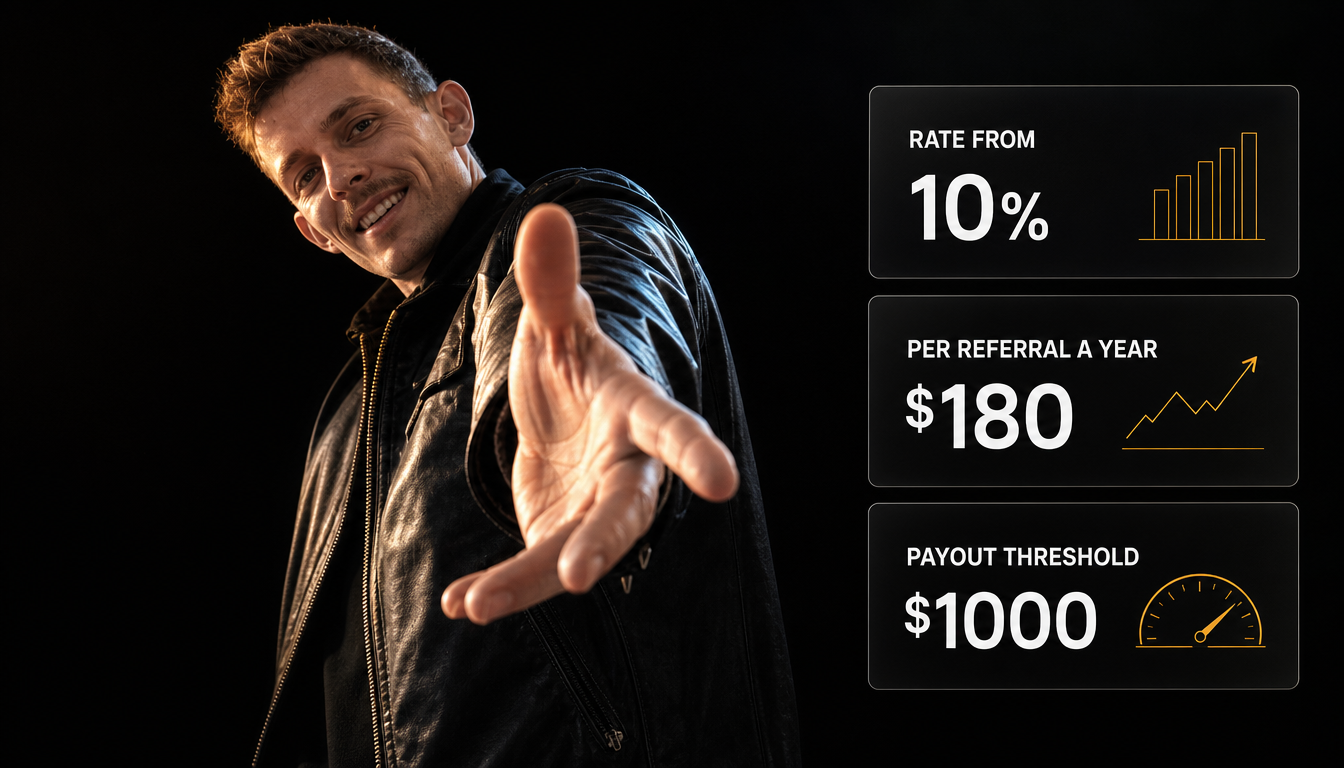
The rate rises with the number who bought: 10% from the start, 15% from 50, 20% from 200.
The percentage is calculated on every subscription payment rather than the first. Somebody who stays for a year is twelve payments from one invitation.
The base is the price minus the balance top-up. Every plan credits money to the user's internal balance on payment: they spend it on generations. That sum is deducted before the percentage is worked out, and rightly so — it is the user's money rather than platform revenue.
The payout threshold is $1 000. More on that below, separately, because it is the figure usually left unmentioned.
What a referral link brings in
| Plan | Price | To balance | Base | 10% | 15% | 20% |
|---|---|---|---|---|---|---|
| Basic | $79/mo | $10 | $69 | $6.90 | $10.35 | $13.80 |
| Plus | $99/mo | $19 | $80 | $8.00 | $12.00 | $16.00 |
| Creator | $139/mo | $29 | $110 | $11.00 | $16.50 | $22.00 |
| Make | $190/mo | $40 | $150 | $15.00 | $22.50 | $30.00 |
| N8N | $190/mo | $40 | $150 | $15.00 | $22.50 | $30.00 |
| Full | $599/yr | $99 | $500 | $50.00 | $75.00 | $100.00 |
Sums on the monthly plans are per month of payment. On Full, per year. Prices are as of September 2026; current prices are always on the pricing page.
#### The counter-intuitive part
Work out the annual income from one person at the 10% rate.
Basic — $82.80 a year. Plus — $96. Creator — $132. Make or N8N — $180. Full — $50.
A referral on Make brings 3.6 times more over a year than a referral on Full, although Full looks like the most expensive plan.
The reason is simple: Full costs $599 a year, while Basic comes to $948 paid monthly. The annual plan is cheaper per month, so the percentage from it is smaller.
What follows practically. If you show work made with automations, people come to you for Make and N8N. If you show pictures, they come for Basic and Plus. The first is roughly twice as valuable as the second, and that is worth bearing in mind when choosing what to publish.
#### What a term discount does
Somebody can pay for three months at once with a 10% discount, or six with 15%. The percentage is calculated on the amount actually paid, so your income from that person is lower than if they paid monthly.
| Plan | Six monthly payments | One payment for 6 months |
|---|---|---|
| Basic | $41.40 | $34.29 |
| Plus | $48.00 | $39.09 |
| Creator | $66.00 | $53.49 |
| Make or N8N | $90.00 | $72.90 |
The difference is seventeen to nineteen percent, and that is not nothing.
But that is the wrong way to count it. Monthly payment is six chances to change your mind. Somebody who has paid six months up front is already inside, and the question of whether they will renew does not arise until the term ends.
Those seventeen to nineteen percent are the price of income that does not depend on somebody else's mood next month. Under a recurring model, predictability is worth more than the difference in the sum.
Honestly about the $1 000 threshold
The threshold exists and has to be reached. Here is how many people, staying on a subscription for a year, it takes at the starting rate of 10%:
| Plan | People to $1 000 |
|---|---|
| Make or N8N | 6 |
| Creator | 8 |
| Plus | 11 |
| Basic | 13 |
| Full | 20 |
Realistically it is a mix of plans and the figure lands somewhere between. The order of magnitude is clear: not two or three people, and not two hundred. A dozen or so people brought in and still subscribed reach the threshold within a year.
And here is what changes the picture. With a one-off payout the threshold would be a wall: accumulate, withdraw, start again. Under a recurring model the base builds by itself. Even if you have stopped showing anything to anybody, the people you brought keep paying and your percentage keeps coming in.
The point after which this is a different story
Fifty buyers is not a round number chosen for looks. It is the threshold for 15%, and simultaneously the point where the monthly sum stops being small change.
With fifty people paying for a subscription:
| Plan | At 10% | At 15% |
|---|---|---|
| Basic | $345/mo | $517/mo |
| Plus | $400/mo | $600/mo |
| Creator | $550/mo | $825/mo |
| Make or N8N | $750/mo | $1 125/mo |
After that the payout threshold is cleared in a month or two rather than a year.
An important detail about the tiers. The 50 and the 200 count buyers, not people who followed the link. That is a higher bar than it first looks: between an invitation and a purchase sits conversion, and it differs for everybody.
That is exactly why the account area has two counters rather than one.
What raises the second figure
The gap between "Invited" and "Bought" is determined not by the wording of the invitation but by what the person saw before following the link.
A shown result converts. An account of the platform does not. "Look at this powerful thing" fails, because the person cannot see what they would do with it. "Here are the listings I put together yesterday in an evening, and here is what with" works, because it is clear.
The task has to be recognisable. People follow a link when they have recognised their own problem in your work. If they do not make product listings, your product listings will not convince them however strong the result.
Three days of access removes the risk. Worth saying outright: registration is free and opens three days of full Basic access. Somebody who knows they lose nothing follows a link more readily.
And do not promise income to the people you bring in. First, it is untrue: the result depends on them. Second, somebody who came for a promise leaves within a month — and your percentage leaves with them. A recurring model punishes inflated expectations harder than a one-off payout would.
The tie to the tools: what to show
The third stream appears for somebody who works and does not hide what with. Here is the breakdown by section — what you do for money and what part of it gets shown.
| Section | Work you get paid for | What to show |
|---|---|---|
| Gen AI | Listings, ad creatives, photo work | Before and after, in one frame |
| AI Blogger | A virtual ambassador, UGC for brands | A series of frames with one face |
| AI Workflow | Not one clip but a hundred a month | The pipeline diagram on the canvas |
| Assistants | An assistant for a department with a knowledge base | A dialogue where it clarifies rather than invents |
| Automations | Links, reports, bringing a client base back | A screenshot of the scenario and what it closed |
| Site templates | Landing pages and multi-page sites | The preview and how long the build took |
| Skills | Chains of agents for a task | What went in and what came out |
A pipeline diagram and a scenario screenshot convert better than pictures — for the reason in the previous section: they bring people to Make and N8N, and those are roughly twice as valuable.
What not to do with a referral link
A link in every message. It is handed over when asked for. Otherwise you become the person people avoid making eye contact with in chats.
Mailing your contacts. The conversion is near zero and the reputational cost is real.
Promises of income. Covered above: somebody brought in on a promise is the first to leave.
Accounts created for the counter. The tiers count buyers. Empty registrations move neither your rate nor your balance.
What the platform offers partners
Three days of full Basic access — free on registration. That is what you offer a person, rather than a subscription straight away.
More than 200 AI assistants across fourteen directions, over 10 000 skills, over 3 000 automation templates, over 190 Open Source solutions. The catalogues and previews are open to guests — anyone can see what exists before registering at all.
Term discounts: three months −10%, six months −15%. Somebody who pays six months up front is six months of payments in a row with no risk of dropping out on the second.
The partner programme area — the link, both counters, the current rate and the balance. It opens with a subscription: registration and the three-day trial are not enough for it.
Where to start today
One action, and it is not about the link.
Take the last piece of work you made with the platform's tools and publish it where people see you. With one line about what it was made with and how long it took.
Do not attach the link. Wait for the question.
It usually comes from one or two people in ten who looked — and those are exactly the ones with a task of their own. The rest do not need the link, and it is just as well you did not push it on them.
Then look at the two counters a month later. The gap between them shows what to fix: plenty invited and nobody buying means the work you showed is not landing on anybody's actual task.
---
What to read next
[What is on the platform](/en/blog/platform-14-sections) — what exactly to show from each section.
[What an AI blogger earns from](/en/blog/ai-blogger-monetization) — four income models, with a fifth now added.
[Build it once, it runs always](/en/blog/build-once-run-always) — the pipelines that bring the most valuable referrals.
[First for yourself, then for others](/en/blog/from-yourself-to-clients) — how a first piece of work becomes a showcase.
[AI agents: what they are and what they pay](/en/blog/ai-agents-guide) — the full guide to agents, with market rates.
---