What in Your Business to Hand to AI First, and How Many Hours It Saves
The owner of a salon, a shop or a practice doesn't need to know what an agent is or how one platform differs from another. They need to understand which of their daily tasks they can stop doing by hand and how many hours a week that gives back. Below is how to find that task in your own business in two hours, without installing anything.
The owner of a salon, a shop or a practice doesn't need to know what an agent is or how one platform differs from another. They need to understand which of their daily tasks they can stop doing by hand and how many hours a week that gives back. Below is how to find that task in your own business in two hours, without installing anything.
In short, if you are pressed for time
Start not with a tool but with hours. Where does time go that nobody counts?
Repetitive work is what gets handed to AI first: answers to the same client questions, booking and reminders, sorting incoming requests, routine texts.
The last to hand over is anything where the cost of a mistake is high: money, contracts, decisions about people.
How much you will save is something you calculate yourself, not a promise from an advertisement. The method is below; it takes a week of observation.
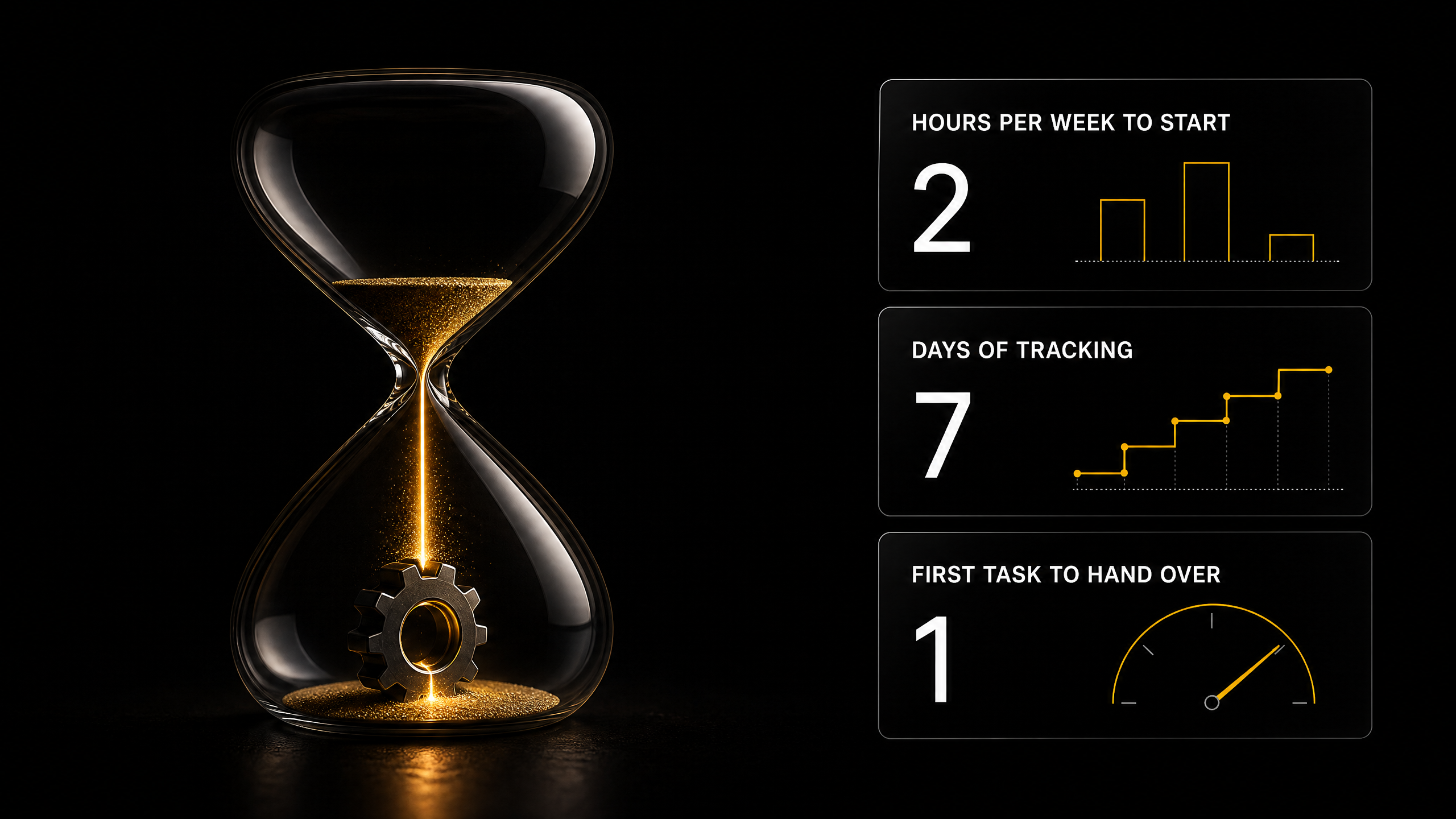
An assignment of two hours a week. More is not needed at the start, and owners usually don't have more anyway.
"I have no time to sit with this"
This is the most honest phrase of a small business owner, and it is the right one.
In our subscriber survey, among those who want to "build a system in their business," a third are people who have barely touched neural networks by hand. And they are the ones with the least free time: every third person in this group is ready to give the topic no more than two hours a week.
The professions there are: renovation of premises, selling fishing tackle, a beauty salon, a nutritionist, a doctor, an appraiser. Not IT. And the tasks they write to our bot are not about technology either: "a Telegram bot that marks employees' attendance, with pay calculated by the hour in a spreadsheet right away," "shift tracking," "cost price calculation."
A person comes not for a neural network. They come for their own hours.
How I know this
I have been building such things since 2019, and the latest of the showcase orders is the digitization of a dental clinic: a bot that answers patients and books appointments, a website, a funnel. The whole path from the first message to delivery is filmed step by step.
The main thing I took from there for an owner: the conversation starts not with "we have neural networks" but with the question "what gets lost while everyone is asleep."
Why adoption usually doesn't start
Root cause: nobody knows how much time goes on routine. It isn't counted because it is smeared across the day: five minutes here, ten there. Until there is a number, there is no decision: "we seem to manage as it is."
Misconception: "we have to automate everything right away." The owner looks at a big system, gets scared by the scale and postpones. The opposite works: one task, one week, one result.
Systemic factor: adoption is talked about in the language of those who implement it. They explain platforms and integrations to you, while you need to understand who will answer a client at eleven at night. While the conversation is in someone else's language, no decision is made.
What to hand over first
Answers to the same questions
"How much does it cost," "how do I get there," "are you open on Sunday," "is there an appointment for tomorrow." In any business with clients, half the correspondence is the same ten questions.
This is the first thing handed to AI: answers are taken from your own materials, the person gets a reply at night, and in the morning the administrator sees only what needs a decision.
Booking and reminders
A client booked and didn't come: for a salon and a clinic these are direct losses. A reminder the day before, rescheduling by message, confirmation: none of this needs a person.
Sorting incoming requests
Requests come from different places, some are junk, some are urgent. Sorting and a first reply are also in the first batch.
Routine texts
Product descriptions, replies to reviews, job postings, posts. Whatever is written by one template again and again.
What not to hand over right away
Everything where a mistake costs money or relationships: settlements with suppliers, contracts, decisions about employees. Here AI helps with preparation, but the last word stays with you, and this is not overcaution but a normal order of adoption.
A two-hour assignment
A week of observation, two hours in total.
Day 1, twenty minutes. Write down five tasks that repeat every day for you or your employees.
Days 2-6, ten minutes each. Next to each task, note how much time it took today. Roughly, not with a stopwatch.
Day 7, forty minutes. Add it up. Take one task, the one with the most hours and the lowest cost of a mistake. That is your first.
Now you have what most owners who are "thinking about adoption" don't have: a number. How many hours a week go on a specific thing. With this number you can go to a contractor, to an employee, or try it yourself, and compare a month later.
A prompt, if you have no time for a week of observation
The assignment above gives a measured number. The prompt below gives a preliminary one, in a single conversation. Copy it into an AI chat: it first asks three questions about your business and only then calculates, accounting for the time spent on checking and corrections and marking assumptions as assumptions.
```
<CONTEXT>
I am the owner of a small business and I want to understand which everyday tasks are worth handing to AI to free up time.
<ROLE>
You are a specialist in finding and reducing routine work.
<STEPS>
- Ask me three questions, one at a time: what my business does, which operations repeat most often and how much time they take.
- Find the three most suitable tasks for applying AI.
- Evaluate them by repeatability, time saved, simplicity and risk of error.
- Choose one task for the first experiment.
- Calculate the preliminary time savings, accounting for checking the AI's results.
<CRITERIA>
Do not offer complex systems and do not require installing programs. Use only known data; mark unknown values as assumptions. Avoid tasks with a high cost of error.
<INFO>
Get the information about the business from my answers.
<OUTPUT>
Show a short comparison table of three tasks and a summary:
- The one task to start with.
- Preliminary savings in hours per week.
- What to check before adoption.
- A first experiment lasting up to two hours.
Start with the first question.
```
The number from the prompt is a hypothesis, not a result. It is checked with the same one-week assignment: at the end the prompt itself suggests what to record for seven days.
If you need a more detailed breakdown, there are two more prompts: a full interview with a calculation of hours by formula and a separate savings calculator in the form of a table. Both are in the appendix to the article.
Prompts in this format are in the prompts section, and the platform's prompt generator will build a similar one for your task from a single phrase.
What to do today
Write down five repetitive tasks. It takes twenty minutes, and the whole week starts from it.
You can try one of them right away: in Cerebrum the task is described in plain words, without choosing a tool, and it suggests what to assemble it from and which step to start with.
Registration is free and opens three days of the Basic plan, no card needed.
Write your field to the consultant bot: it will tell you which task is usually first in it and what to cover it with.
What to read next
AI for a business owner: where to start if you won't be doing this yourself: three levels of adoption.
A clinic or a restaurant in the Stone Age: where offline businesses lose clients.
Process automation without a programmer: what can be connected together once the first task is working.