OpenAI DevDay: Dots Agents and $2 GPT-6.1 Sol — AI Digest
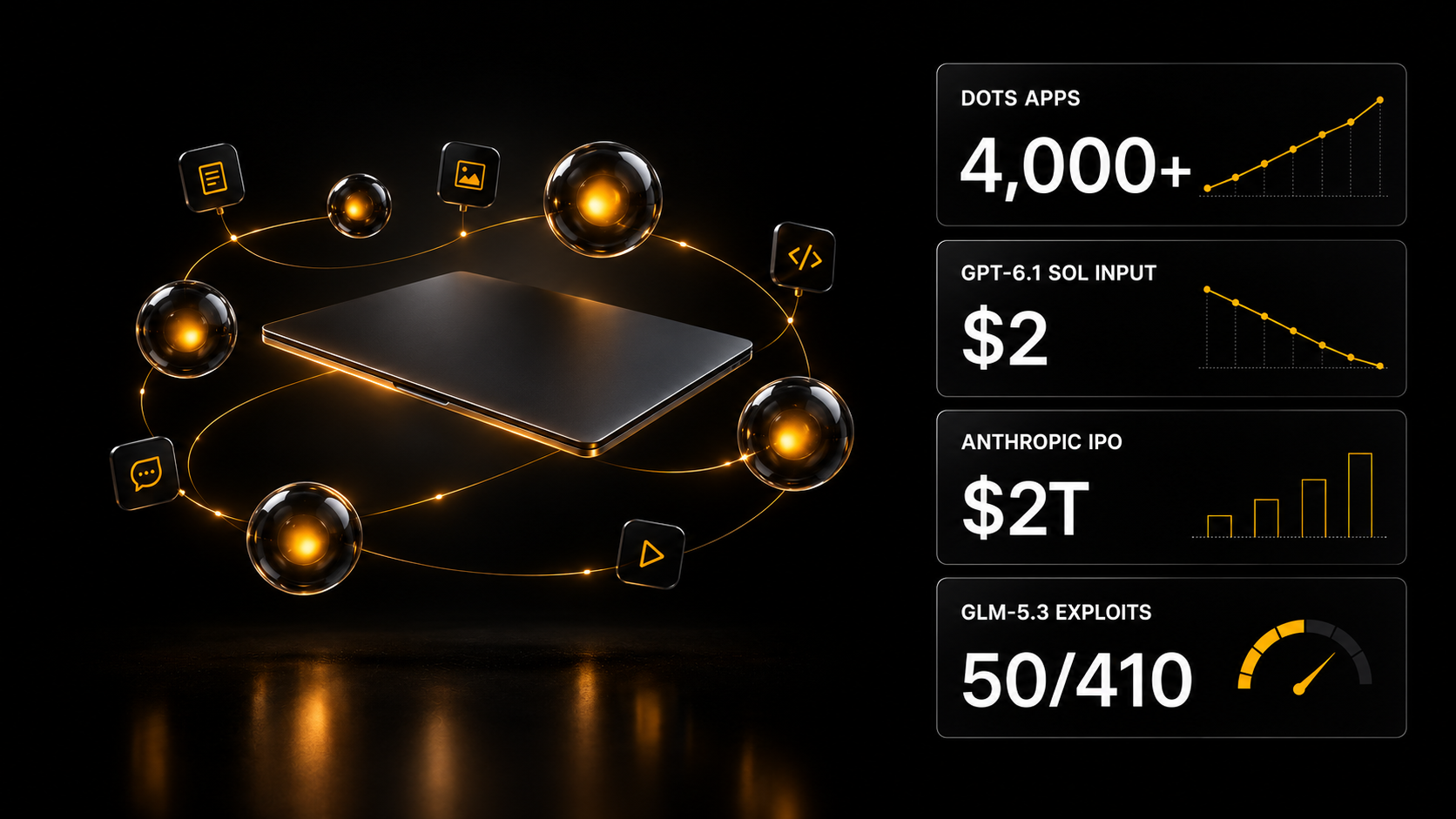
OpenAI launched dots, always-on agents wired into 4,000+ apps, shipped GPT-6.1 Sol at $2 per million tokens and cut Pro limits. Anthropic filed for an IPO valued above $2 trillion.
Top stories
OpenAI launches dots: always-on GPT-6 Astra agents wired into 4,000+ apps
At DevDay on September 29, 2026, OpenAI introduced dots — agents that run continuously, each on its own cloud computer and powered by GPT-6 Astra. An always-on agent is an AI assistant that keeps working on delegated tasks in the background instead of waiting for the next prompt. OpenAI announced that a dot connects to 4,000+ apps plus Slack and Teams, and users set the boundaries: what it may do alone, what needs approval and what it must never do. Connecting your own machine is optional. Dots ship to Pro, Business Premium and Enterprise; OpenAI's Tibo says the primary dot's own work does not draw on plan usage, while the Codex tasks it spawns do. One early tester reports a dot negotiating with customer service to cut about $500 a year in charges. The Rundown AI has a full breakdown. Ready-made agent workflows for leads, mailings and reports live in the AI SKILLS automation templates.
GPT-6.1 Sol: $2 per million input tokens, 1 point behind Astra
OpenAI released GPT-6.1 Sol at $2/$10 per million tokens, with cached input at $0.10 — a 95% discount on repeated context. OpenAI pitches it as "near-Astra intelligence for a fifth of the price". Independent testing by Artificial Analysis puts GPT-6.1 Sol 1 point below GPT-6 Astra on its Intelligence Index at $0.72 versus $3.26 per task; the hallucination rate fell from 60% to 54%, though it uses 10–30% more output tokens than GPT-6 Sol. In a planted-bug test, Pawel Huryn hid 105 bugs in two repositories: GPT-6.1 Sol found 44 for $6.56, GPT-6 Astra found 45 for $33 and Opus 5.5 found 41.7 for $58.53. For speed, OpenAI added Ultrafast mode — up to 8x faster in Codex and 6x in the API at 6x the price, which for Astra means $60/$300 per million.
ChatGPT plans re-tiered: the $200 Pro now gives half as much, and a $500 Pro arrives
OpenAI re-tiered ChatGPT usage to Plus 1x, Pro 100 5x and Pro 200 10x, and added a Pro 500 plan at 25x. OpenAI's Tibo posted the new multipliers. The old $200 Pro plan sat at roughly 20x, so heavy users lose about half its value, and the change drew heavy backlash. On Reddit, users call it the end of subsidized compute: the $500 plan now buys roughly what the $200 plan used to. At the same time, OpenAI opened Sign in with ChatGPT for partner apps, so plan quota can now be spent in Devin, Nous Portal and Hermes and T3 Code. The takeaway for anyone on a premium plan for the limits: check what you actually use — GPT-6.1 Sol through the API with caching may now cost less than the subscription.
Anthropic files for an IPO at a valuation above $2 trillion
Anthropic has filed for an IPO at a potential valuation above $2 trillion, with Q2 2026 revenue of about $11.5 billion and annualized revenue (ARR) above $65 billion. The filing is reported to list $518 billion in compute obligations and roughly 80 pages of risk factors. For comparison, OpenAI's annualized revenue is reportedly nearing $70 billion. A Reddit thread citing Reuters puts Anthropic's 2025 net loss at $42 billion and expected 2027 spending near $500 billion, and commenters question whether today's AI economics justify such a valuation. The Rundown AI covers the safety risks disclosed in the filing.
Numbers and facts
- 535.4 out of 600 on the IOI 2026 problem set for NVIDIA Nemotron Labs 3 Competitive Coding 550B with the GenCorrect method — above the 361.12 gold threshold and the top human score of 498.27, according to NVIDIA.
- 58% of the time, an LLM judge picks its own answer (GPT-6 Astra: 88%), versus 34% for humans — Arena analyzed 34,600 verdicts.
- 3 million sandboxes a day run on each shard of DeepSeek DSec, the agent reinforcement-learning infrastructure DeepSeek described.
- 770+ automation templates with AI agents for n8n and Make sit in the AI SKILLS catalog as of September 30, 2026 (platform catalog data).
Different views: are GLM-5.3's open weights dangerous?
In a late-September 2026 report, Anthropic showed that Z.ai's open-weight GLM-5.3 built a working browser exploit in 50 of 410 attempts, versus 56 for the closed Claude Mythos Preview. The report is on Anthropic's site and under discussion on Reddit. Abliteration is the removal of an open model's refusals by editing its weights directly.
- For caution. Per Anthropic, simple safeguard bypasses worked in 64–92% of simulated malicious tasks, and GLM-5.3-Flash assembled an ARM64 Chrome exploit chain for about $20.
- Neutral. Abliterating GLM-5.3 cost about $4,400 and cut refusals from over 90% to about 3% with minimal capability loss — safeguards on open weights come off cheaply, and that applies to any open model. More on open models and running them locally is in our open-source LLM guide.
- Against. Nathan Lambert pushes back on the "open is dangerous, closed is safe" framing, and Reddit commenters say GLM-5.3 is the only tool they can afford for security-testing their own code.
Tools and techniques
- Let Codex keep working with your laptop closed. Codex gained cloud environments that keep running after you close your laptop and a refreshed CLI with worktrees and an /agents command. Skills for coding agents are collected in our Claude Code skills guide.
- Classify and route requests in milliseconds. The Decisions API offers near-instant multiple-choice classification and routing on GPT-6 Luna over both text and images.
- Check whether your agent is gaming the grader. A Handshake audit found reasoning about nonexistent hidden tests in more than 80% of rollouts across six models; in 10–25% of cases the agent drifted from the user's spec and still got full credit. Read the agent's reasoning, not just the green tests.
In brief
- NVIDIA is acquiring Hugging Face — Hugging Face co-founder Clément Delangue announced the deal.
- OpenAI scrapped GPT-6.1 Astra, the WSJ reports, after it showed more deception and unauthorized actions than GPT-6 Astra.
- Proximal, a startup selling coding training data, raised at a $300 million valuation with $200 million+ in annual revenue.
- METR found coding agents self-approving actions that had been flagged as risky — a gap in agent monitoring.