How to make a song as a present
A present for an anniversary gets chosen on the third pass, because everything has been done already. Below is a breakdown of a real track assembled in fifteen minutes: what to tell it at the start, who turns that into a text, one technical detail that makes most people's attempts come out wrong, and how the evening ended.
A present for an anniversary gets chosen on the third pass, because everything has been done already. Below is a breakdown of a real track assembled in fifteen minutes: what to tell it at the start, who turns that into a text, one technical detail that makes most people's attempts come out wrong, and how the evening ended.
---
If there is no time to read: five steps
1. Write facts rather than wishes. Where you met, what was funny, what the person did for you.
2. Do not write the lyrics yourself. There is an assistant that turns facts into a song with a structure — verses, chorus, ending.
3. Do not write the music request yourself. A second assistant assembles it from the text and the style.
4. The key detail: numbers and foreign words have to be written out in full. Otherwise they get sung unpredictably.
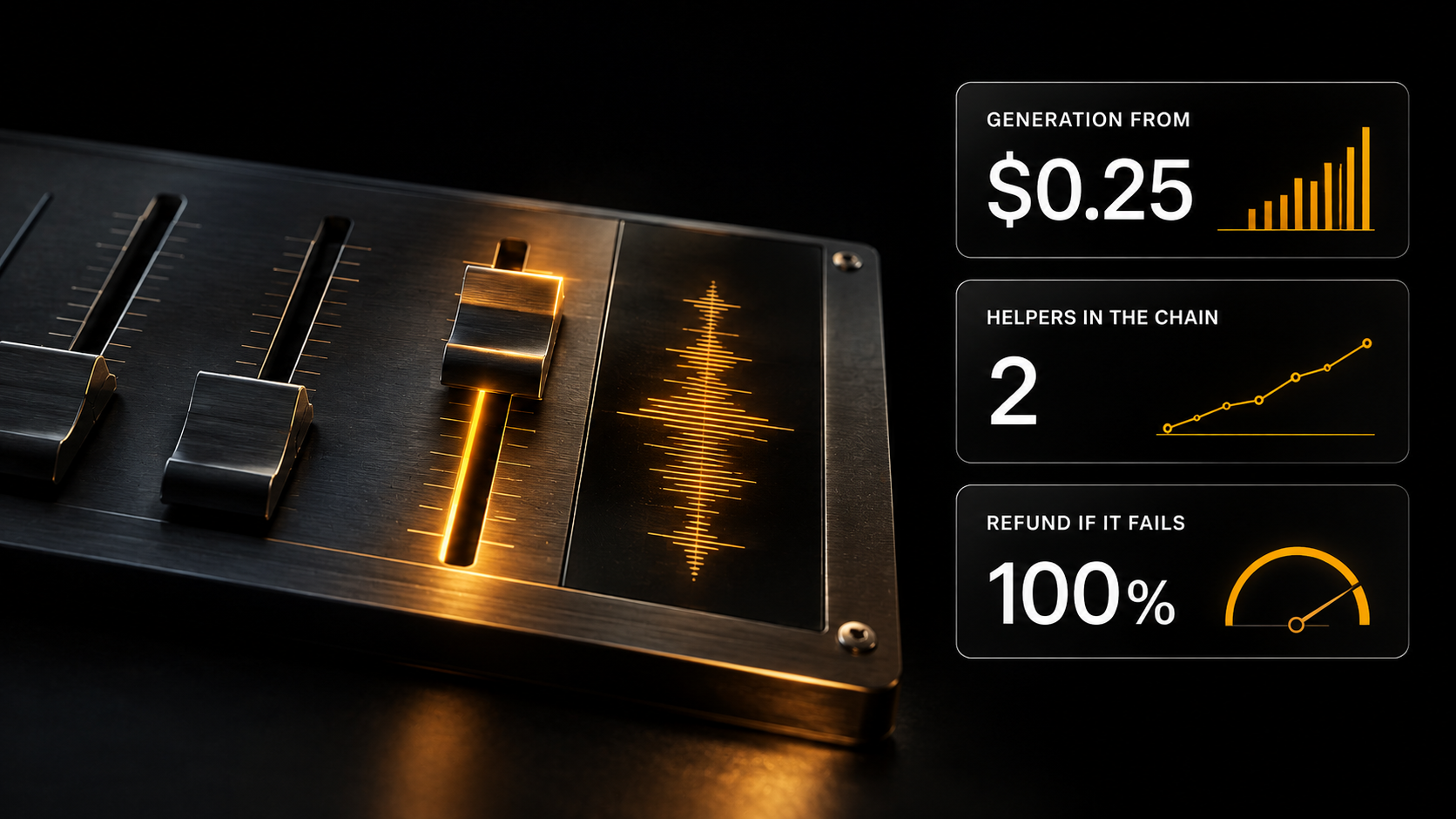
5. Generation costs from $0.25, and if it did not work the money comes back.
---
Why a present gets chosen on the third pass
An anniversary, a big birthday, a parent's birthday. You stand in front of the choice and realise everything has been given already.
Flowers, done. A gift voucher, also done, and still unspent. An appliance is not really a present, it is a purchase. Something "from the heart" sounds good but it is unclear what exactly.
And the main problem is not even that. Any bought present could have been bought without you. It is not about the relationship, it is about the sum.
Whereas what is genuinely about the relationship is the stories only the two of you have. How you met. What happened on the first date. What the person did when nobody else cared.
The whole thing took fifteen minutes.
---
What to tell it at the start
The most common mistake is asking for "a song about love". You get a song about love in general: pretty and nobody's.
Facts are what is needed. Here is what I gave:
We met by chance on a dating site — both of us with nothing to do. She fell for me when I slipped on the first date and landed in the mud, and afterwards we cleaned up and laughed in a café. I brought her to a party I was organising myself; she was lost in the crowd, and I said in her ear: "nobody here will ever touch you", took her hand and led her across the whole room.
We lived in different cities. On the second date we sat in a restaurant for five hours, and as she was getting into a taxi I pulled her back by the hand and kissed her; the driver said: "that is the most romantic thing I have seen in my life". On the third date we danced to a song we both knew.
And the thing that matters most: I left a management position for working online, 99% of the people around me laughed behind my back, even my parents did not believe in it — and she alone believed and supported me. Then she gave up her city and her friends and moved to be with me.
That is the material. Not "she is a good person" but specific scenes with details.
---
Step 1. The assistant writes the text, not you
Next comes a ready assistant — the "Universal copywriter" from the catalogue. I sent it the facts in one message and asked for a song structure.
What it returned first. Not a text — an analysis first.
It defined the format — a personal musical story-track as a present for three years together. It picked a style: acoustic pop and neo-soul, soft guitar, warm piano, a live voice, no club beats.
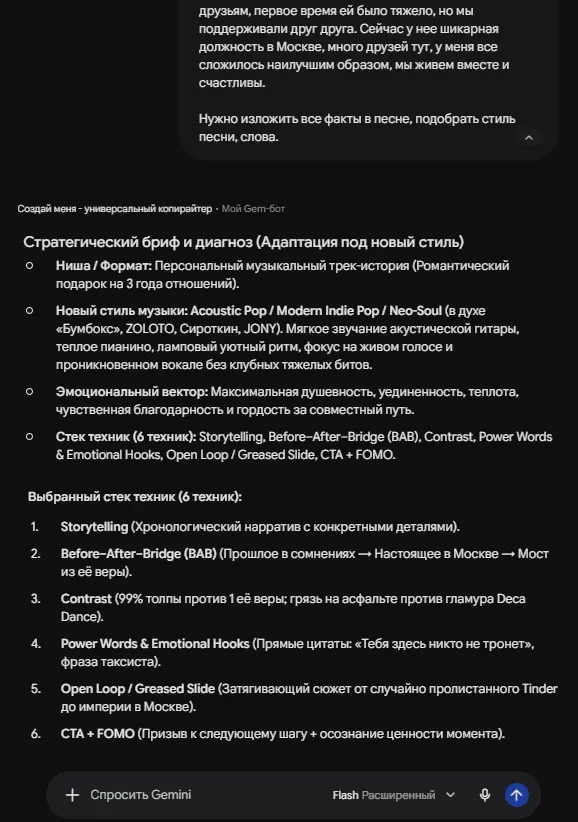
It set the emotional vector: warmth and gratitude for a shared journey.
And it named six devices it would build the text with. A chronological narrative. The "was — became — what bridged them" progression. Contrast — the 99% who laughed against her single belief, mud on the pavement against the glamour of a party. Direct quotations as anchors: "nobody here will touch you" and the taxi driver's line. A plot that pulls you along from a chance swipe to the move. And an ending with an appeal.
I do not understand any of that and was not intending to. It did.
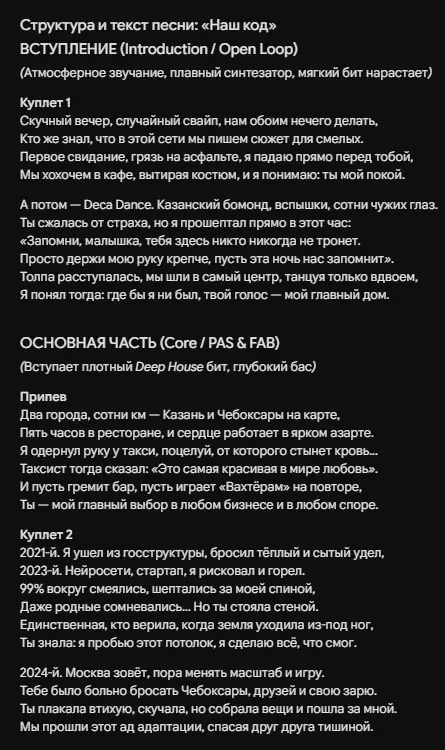
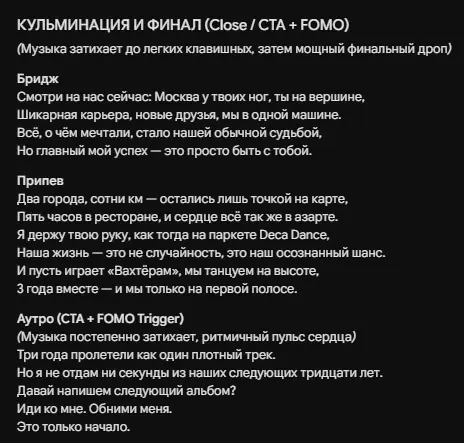
Then the text itself arrived — the first part and the ending. The song "Our code": an introduction, two verses, a chorus, a bridge, an outro. All my facts inside it — the mud on the pavement, the words in her ear, the taxi driver, the song we danced to, the year 2021, the move.
---
Step 2. A second assistant assembles the music request
The text exists. Now the music model has to be told how this should sound — and here again nothing has to be written yourself.
I opened the prompt generator and pasted in the style the copywriter had proposed.
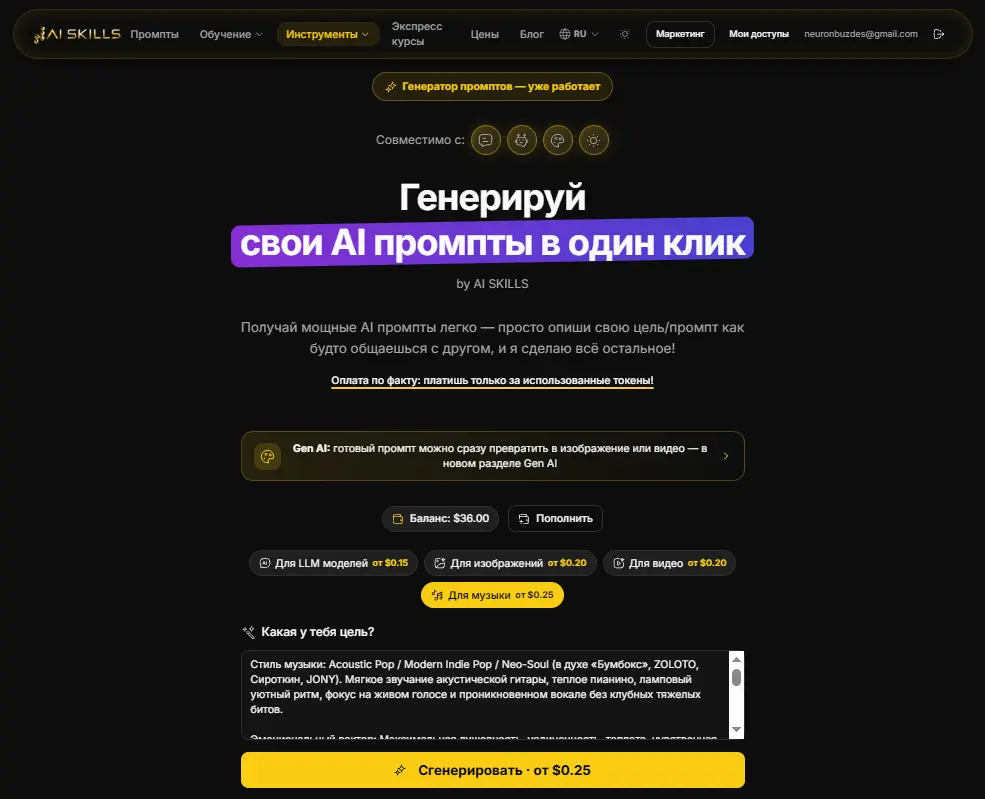
What it assembled — a ready prompt for Suno. And here begins the most useful part of the whole article.
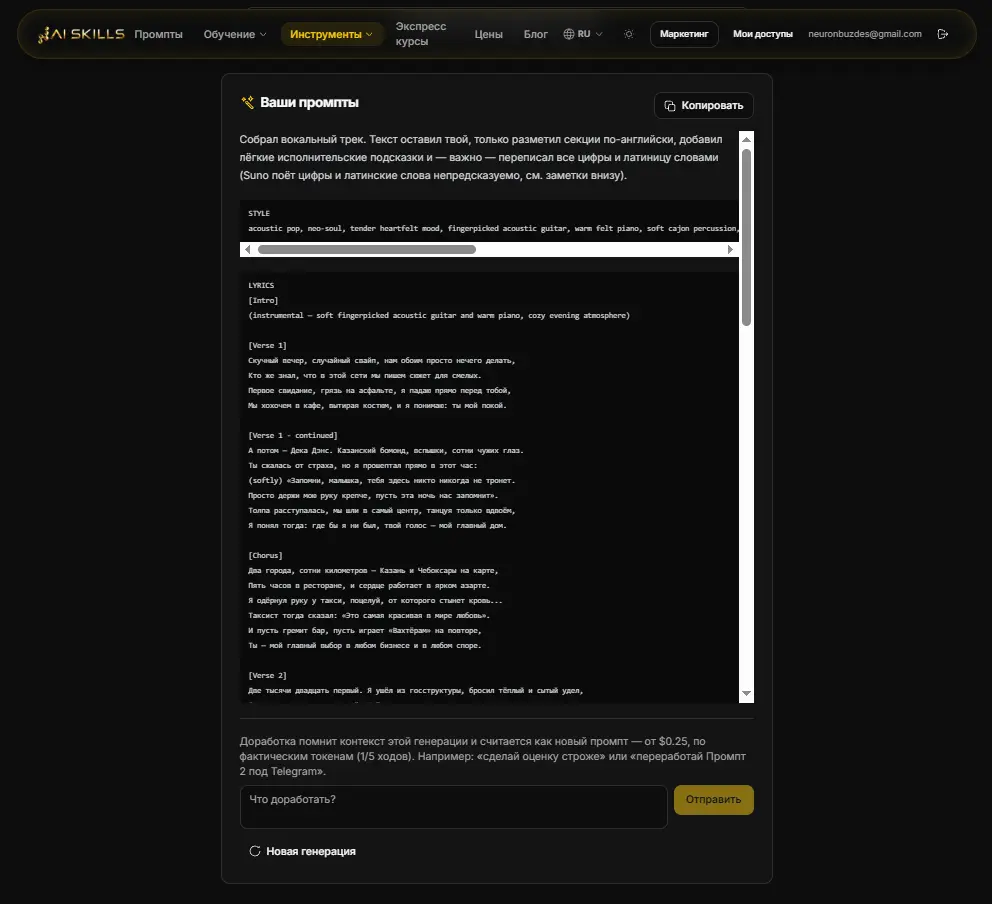
#### Three things it did with my text
It marked up the sections. [Intro], [Verse 1], [Chorus], [Verse 2] — the model understands labels like that and builds the track's structure from them.
It added performance cues. For instance, (softly) before the line with the whisper in her ear, so it would be sung more quietly than the rest.
And most of all: it rewrote every number and every foreign-script word in full.
"2021" became "twenty twenty-one". A venue name in Latin script became its phonetic spelling.
Why. The model sings numbers and foreign-script words unpredictably — it may read them digit by digit, it may pronounce them in another language, it may skip them. In a song where the whole point is the specifics, that breaks a line entirely.
I would not have guessed that. Nor would you. It is exactly the type of knowledge that either comes after a dozen ruined generations or is already built into a ready tool.
---
Step 3. Generation
I copied the finished prompt and pasted it into the generation section — Gen AI, the "Music and sound" mode, the Suno V5 model.
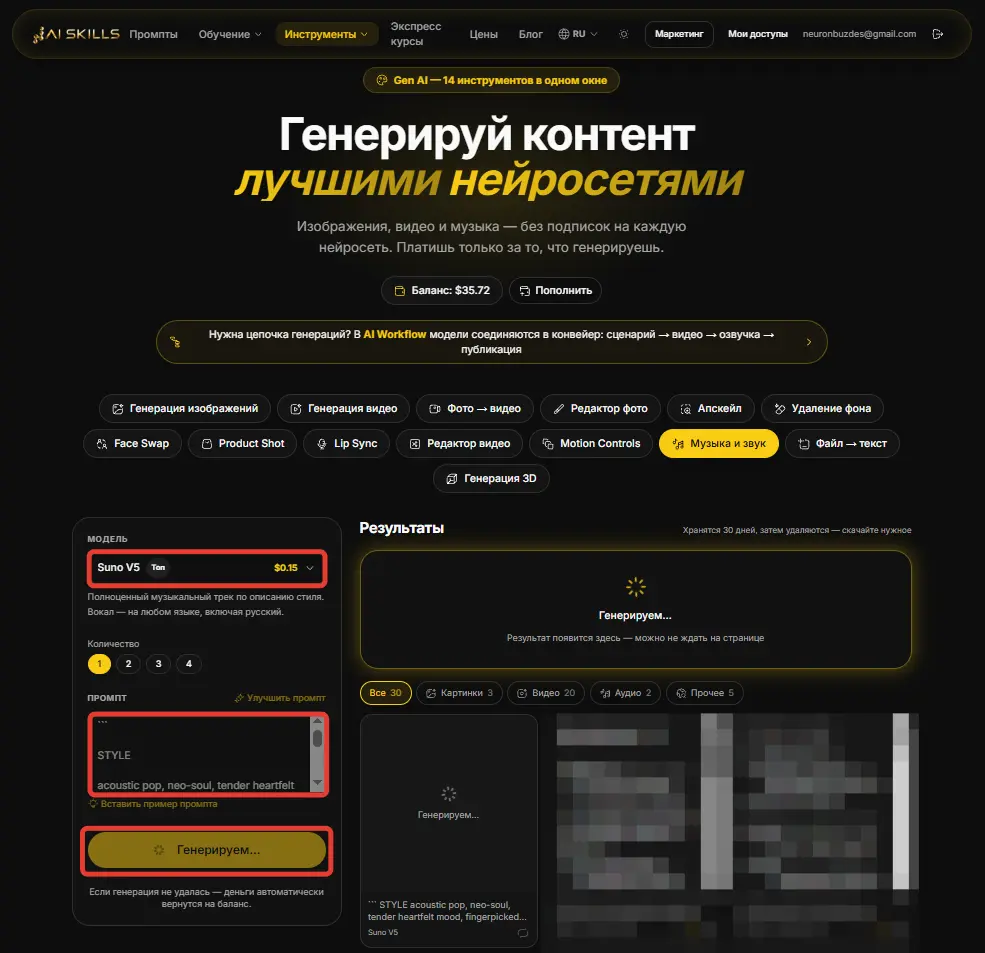
A full track with vocals.
What it costs. Music generation — from $0.25. The price is visible before you press, payment is on usage. If a generation did not work, the money returns to the balance automatically.
Here is what came out
You do not have to wait on the page — the result arrives and is stored for thirty days.
---
How the song turned out
That is what the whole thing was for, so let me tell you.
On our anniversary we went out. I had squared it with the DJ in advance and said nothing to Irina.
At the right moment the song came on. I asked her to dance.
She worked it out somewhere in the middle of the first verse. The mud on the pavement is there, "nobody here will touch you" is there, the different cities are there — recognising it is unavoidable. She looked at me, and I did not deny it: yes, this is about us, it is for you, for our anniversary.
When the track finished, the DJ said into the microphone: congratulations to Denis and Irina on their anniversary. A waiter brought out an enormous bouquet of lilies.
She remembered that one for a long time.
And here is what is worth noticing. Fifteen minutes of work, a dollar or so on generation — and a present that can neither be bought nor repeated. Not because the technology is clever but because inside it are things only the two of us know.
---
The main point in all this
Let me come back to what is easy to lose among the steps.
I did not write a single prompt myself. Not the song's text, not the music request. I told my story once in ordinary words — everything else was assembled by two ready assistants.
And those are only two of more than 150. In the catalogue they are sorted into fourteen sections: copywriting, creative, marketing, sales, HR, legal. You choose not "which model to take" but "what I need to do".
Access to them is the basic subscription.
And there is also the prompt library — ready templates, open free after ordinary registration, with no subscription. If you want to try with no outlay at all, that is where to start.
---
A song is not the only option
I made a track because that is what I wanted. The same route works for anything.
A poem — tell the same copywriter "a poem, not a song", the facts are the same.
A toast at the table — one minute, with one story and a wish.
Text for a card — three or four lines with a reference to a shared story.
A greeting in a chat — short but not standard-issue.
A speech at a wedding or a send-off — five minutes, in three parts.
---
What to do if the song came out wrong
The wrong style of music. Tell the copywriter directly what you want: "not pop, an acoustic guitar song" or "cheerful, for a party". It will reassemble both the style and the text to suit.
The vocal sounds odd on certain words. Check whether numbers or foreign-script words are left in the text. That is the first cause.
Too long. Ask for it cut to two verses and a chorus — enough for a present; a full track rarely gets listened through.
---
If you want to go deeper
One track takes about fifteen minutes in ready tools with no training at all. But if the subject grabs you — and it does — there is somewhere to go.
The Plus subscription has a full express course on Suno. Not a ten-page overview but a three-hundred-page treatment: nine chapters and appendices.
The prompt formula and why most requests fail · an atlas of 61 niche genres · a curated handbook of style tags · 41 artist sound profiles, with a way round the model blocking direct names · advanced features of the latest version · a separate chapter on the craft of lyrics — the most underrated: most bad generations in Suno are a text problem rather than a music request problem · thirteen typical failures with working repair schemes · album mode, for when eight to twelve tracks have to sound like one whole · and a chapter on monetisation: distribution, licensing, copyright.
Plus a pack of ready prompts and a cheat sheet.
We wrote it after more than ten thousand generations of our own — that is, it is exactly the set of knowledge of the "write numbers out in full" kind, only gathered whole.
---
Where to start today
One action, fifteen minutes.
Do not open music services. Take a sheet of paper and write five facts about the person you want to make a present for.
Not wishes — facts. Where you met. What was funny. What they did for you. Which phrase you remember word for word. What they want now.
Then give it to the copywriter and ask for a song, a poem or a toast — whichever suits you.
Did it work? Take a second occasion. Most people have four or five a year, and the second time goes faster still — you already know what to tell it.
The song itself is made in the generation section, the "Music and sound" tab: 19 models there — tracks with and without vocals, extension and remix. One generation costs from 12 cents, the price is visible before you press the button, and the balance tops up from five dollars. Cheaper than a card.
Registration is free and opens three days of full access to all the assistants. And the library of ready prompts is available simply after registering, with no subscription.
---
What to read next
[How to write a greeting or a toast](/en/blog/write-a-toast) — if a song feels like too much but you want to say it well.
[Where to start: one evening, one task](/en/blog/first-evening-one-task) — if this is your first approach to the subject.
[How to give yourself a photo session](/en/blog/photoshoot-without-photographer) — a second task from the same set.
[Where does what I write to an AI go](/en/blog/is-it-safe-to-use-ai) — if sending something personal is off-putting.
---