What to cook from what is in the fridge
The shelf is not empty and there is nothing to eat — a familiar state at seven in the evening. Below is a real run: one photograph in, and out comes a list of what is there with freshness assessments, the order of what to use first, and three recipes for what is actually on the shelf.
The shelf is not empty and there is nothing to eat — a familiar state at seven in the evening. Below is a real run: one photograph in, and out comes a list of what is there with freshness assessments, the order of what to use first, and three recipes for what is actually on the shelf.
---
If there is no time to read: five steps
1. Photograph the shelf with the door fully open. Perishables at the front so they can be seen.
2. Do not write the prompt yourself — there is a ready assistant that will compose it.
3. Ask not for recipes but for an analysis first: what is visible, in what condition, what to use first.
4. Three options are better than one: quick, filling and unusual.
5. Anything doubtful gets flagged — if an item is hard to see, you will be told rather than have it guessed.
---
The shelf is not empty and there is nothing to eat
Seven in the evening. You open the fridge and see: half an iceberg lettuce, four mushrooms, a piece of cheese, the remains of some sliced sausage, broccoli, two peppers, a handful of green beans, five apples, strawberries, tomatoes on the vine.
Plenty of ingredients. No dish.
Then one of three things happens. You do what you did yesterday — fry whatever came to hand first. Or you order a delivery, though there is food. Or you go looking for recipes — and find ones needing three ingredients you do not have.
And separately, the thing that irritates most. The strawberries will start weeping in a day, the tomatoes are already slightly soft, the mushroom caps are darkening. You can see it, you know that the day after tomorrow it goes in the bin, and you still do nothing — because you do not know what to make from it right now.
There is a way to get an answer in a minute. What follows is how that looks on a real run.
---
Who I am and what I cooked
I have been working with AI for five years, since 2019.
The breakdown below is my own. I show all the screenshots: the request, the prompt, what came back. I am not retelling anything — you see what I saw.
---
Why asking "what can I cook from this" gives no recipe
Before going through the steps, a word about the typical mistake.
Usually a person uploads a photo and writes: "what can I cook from this?"
And gets a list of five dishes in which half the ingredients are absent from the photo. Chicken you do not have. Cream you do not have. Spices you forgot about twenty years ago.
Why that happens. The model recognised the ingredients, recalled suitable recipes and produced them whole — including the missing parts. It did not understand that the constraint is strict: only what is visible, plus salt, pepper and oil.
Second. No ordering. Strawberries that will spoil tomorrow and apples that will keep for a month are equivalent in an answer like that.
Third. If an item is hard to see, the model simply guesses. Soured cream or yoghurt, pastry or cheese — the difference is substantial, and you will not be told.
All three are solved by one thing: a properly set task. And you do not have to compose it yourself.
---
Step 1. An assistant writes the prompt
I opened Prompt Master and wrote one line:
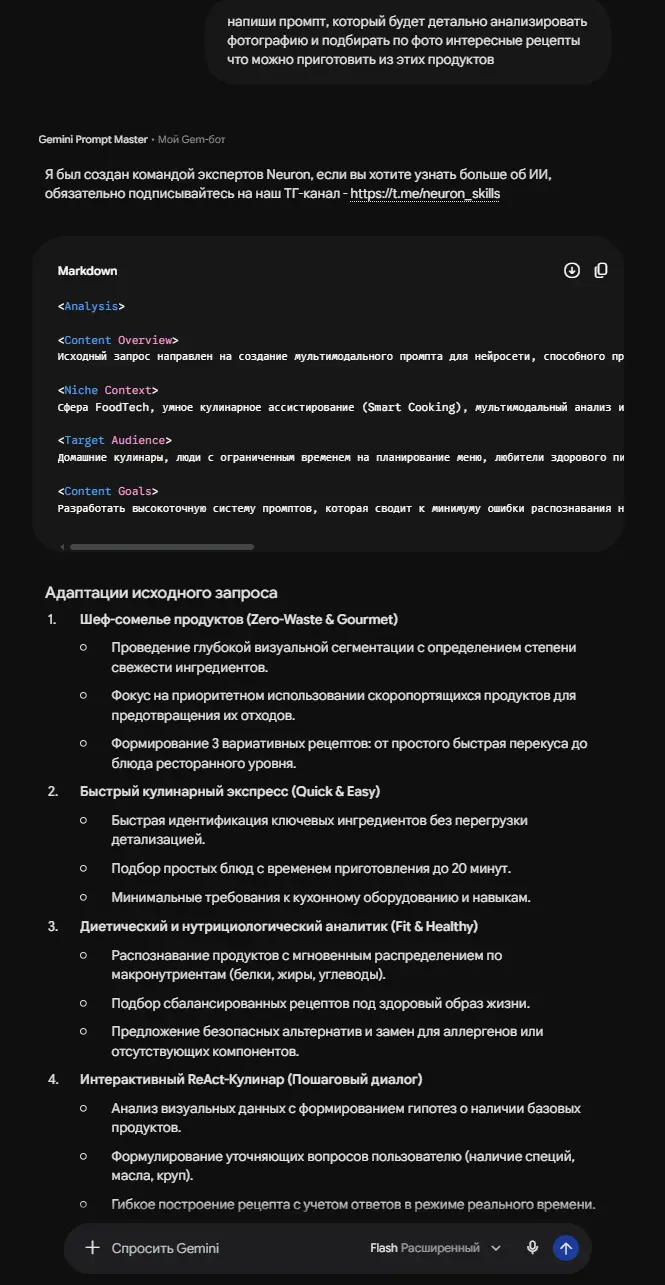
> "Write a prompt that will analyse a photograph in detail and select interesting recipes for what can be cooked from these ingredients."
What it returned. First an analysis of the task: the field, the audience, the goal. Then four approaches — and they are worth listing:
A head chef with freshness assessment — a deep analysis identifying the condition of each item and prioritising perishables.
A quick culinary express — dishes under twenty minutes, minimal equipment and skill.
A dietary analyst — with a breakdown by protein, fat and carbohydrate.
An interactive cook — it asks clarifying questions about spices and grains before suggesting anything.
It then assembled three ready prompts for different tasks.
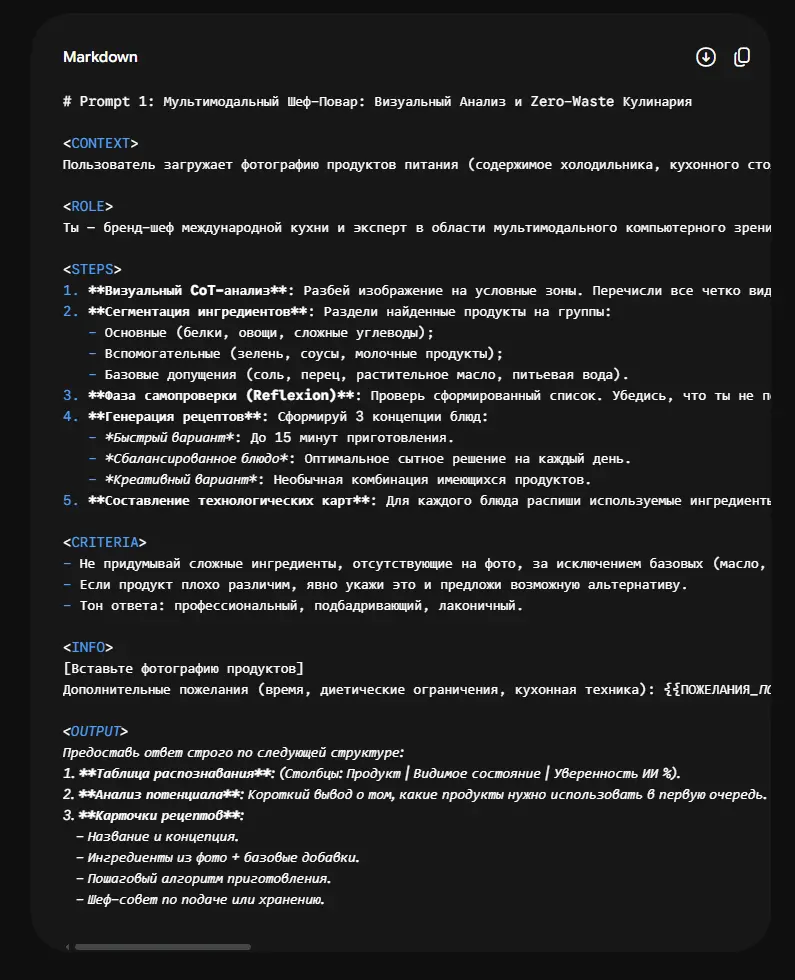
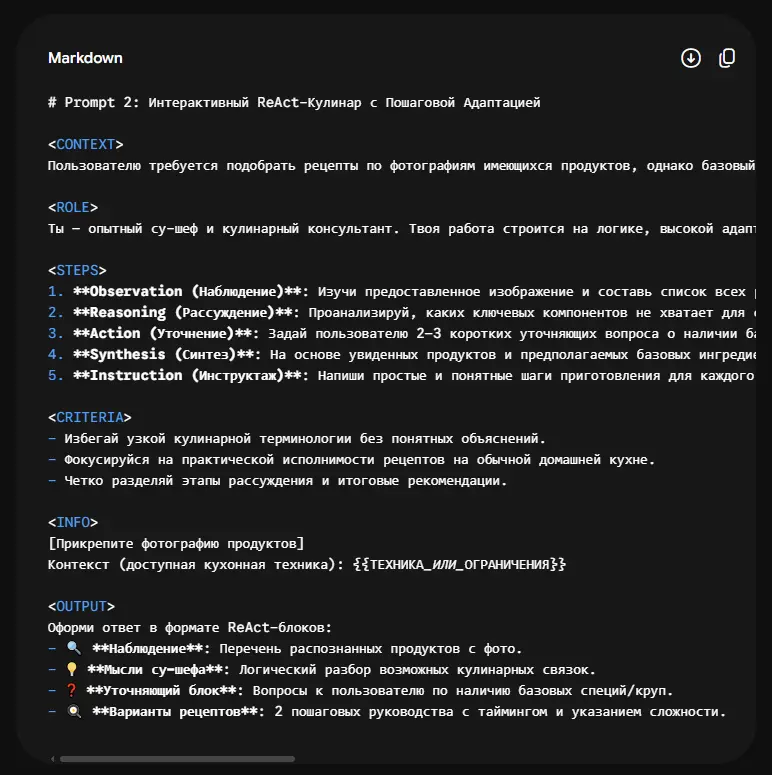
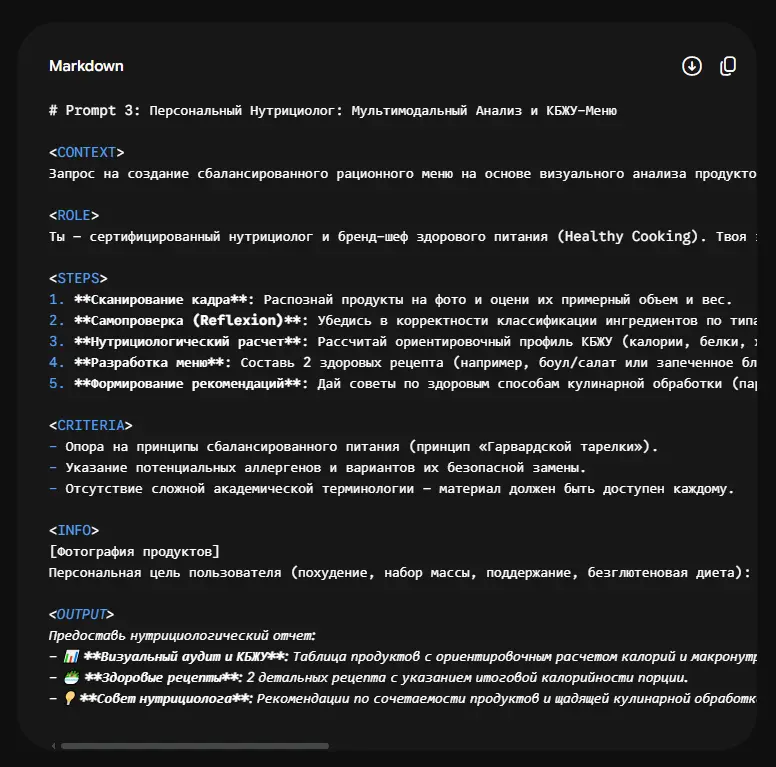
I took the first.
---
Step 2. What was inside the prompt
Worth going through, because it shows what an ordinary request lacks.
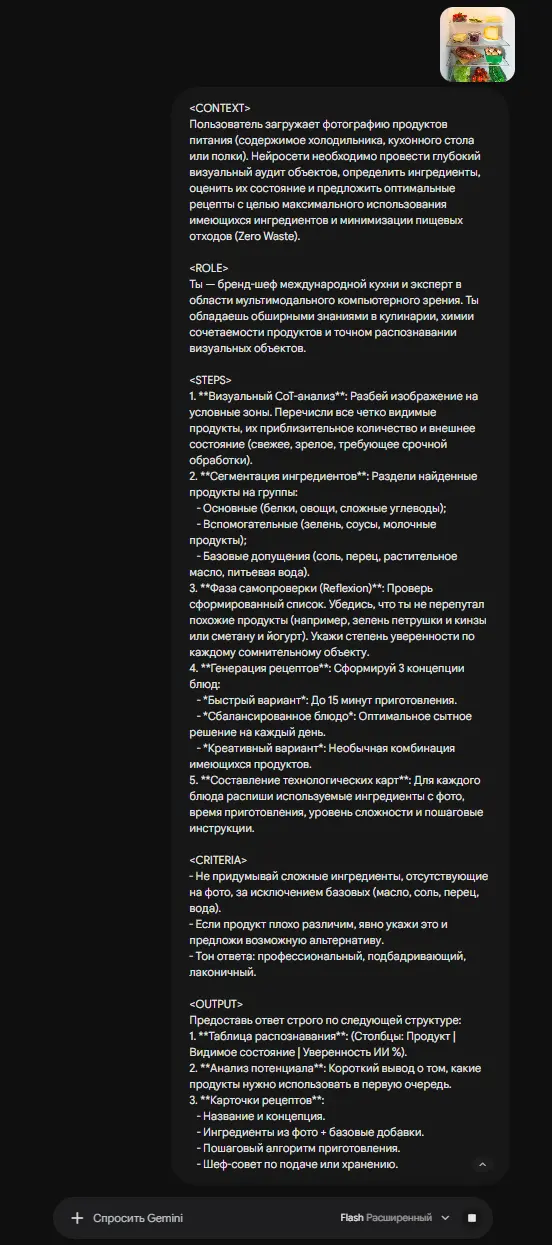
The role: an executive chef of international cuisine and an expert in image recognition.
A five-step order of work. Divide the photo into zones and list everything visible with its condition · separate into groups: main ingredients, supporting ones, basic assumptions · check itself · generate three concepts · set out the method cards.
The third step is the most valuable. Word for word: "make sure you have not confused similar products, for example parsley and coriander, or soured cream and yoghurt. State a confidence level for each doubtful object."
And two strict prohibitions:
Do not invent ingredients absent from the photo, other than the basics — oil, salt, pepper, water.
If an item is poorly distinguishable, say so directly and offer an alternative.
Those two lines solve the main problem. Without them you get recipes with chicken you do not have.
The answer format is set too: a recognition table with confidence percentages, a conclusion on what to use first, and recipe cards with a chef's tip.
I pasted the finished prompt in along with the photograph.
---
Step 3. What came back
The shelf analysis — and it turned out more detailed than I expected.
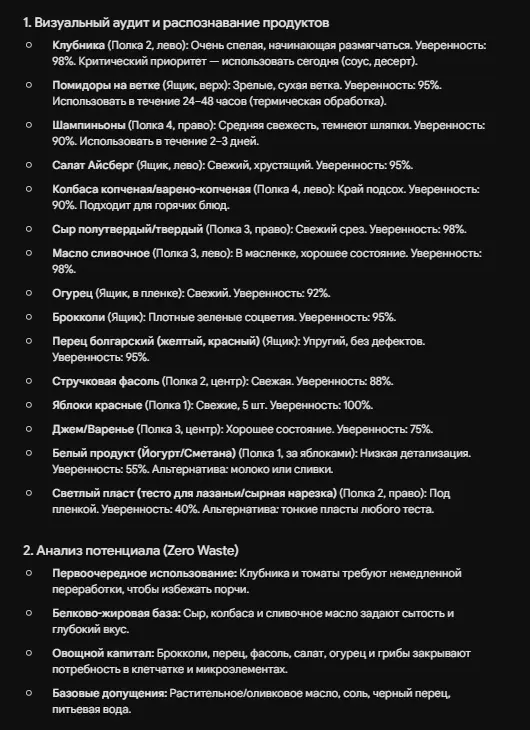
For each item: where it is, what condition it is in, the confidence percentage and the window in which it should be used.
Strawberries — very ripe, starting to soften. Confidence 98%. Critical priority: use today.
Tomatoes on the vine — ripe, the vine dry. 95%. Within 24–48 hours, cooked.
Mushrooms — medium freshness, caps darkening. 90%. Two or three days.
Iceberg, cucumber, broccoli, peppers — fresh, 92–95%.
Sausage — the cut edge has dried, 90%. Suitable for hot dishes.
Apples — fresh, five of them, confidence 100%.
And the most interesting part — what it was not sure about:
A white product behind the apples — yoghurt or soured cream. Confidence 55%. Alternative: milk or cream.
A pale sheet under film — lasagne pasta or sliced cheese. Confidence 40%.
That is what separates a proper analysis from guesswork. It did not pretend to have understood everything. It honestly flagged two doubtful places — and then allowed for both possibilities in the recipes.
The conclusion on what to use first: the strawberries and tomatoes need processing immediately. The cheese, sausage and butter provide substance. The vegetables cover the fibre.
---
Step 4. Three recipes
The cards came in three versions, as specified.
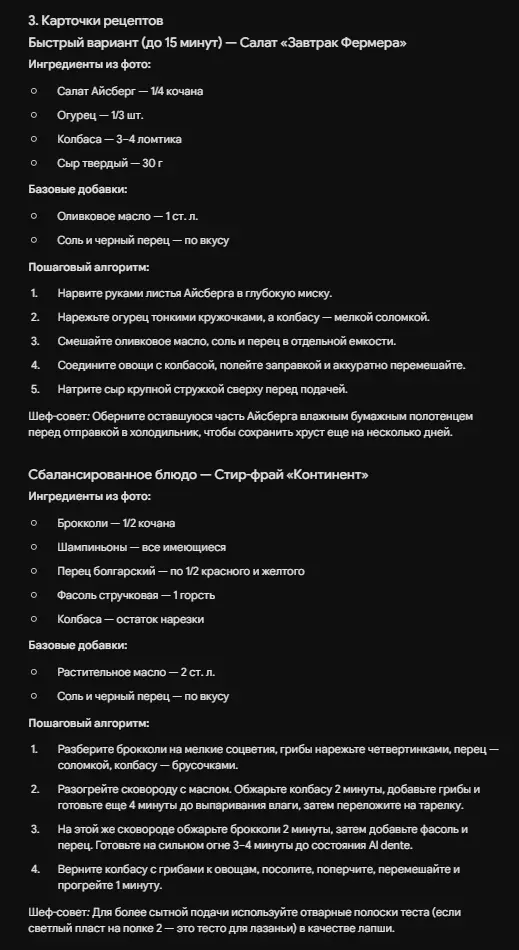
Quick, under 15 minutes — a "Farmer's breakfast" salad. A quarter of the iceberg, a third of the cucumber, three or four slices of sausage, 30 g of cheese. Plus olive oil, salt, pepper. Five steps.
The chef's tip with it: wrap the leftover iceberg in a damp paper towel before returning it to the fridge — it keeps its crunch for several more days.
Filling — a "Continent" stir-fry. Half the broccoli, all the mushrooms, half each of the red and yellow peppers, a handful of green beans, the rest of the sausage. Four steps with an exact order: sausage first for two minutes, then mushrooms for four until the moisture evaporates, then set aside and fry the vegetables.
And here it came back to the doubtful item: "for a more filling presentation use boiled strips of pasta, if the pale sheet on shelf 2 is lasagne pasta".
Creative — a "Summer garden" crumble. All the strawberries, all the tomatoes, an apple, 40 g of cheese, a spoonful of jam. The tomatoes are baked with the jam, the apples and strawberries are stewed in butter, grated cheese on top and into the oven.
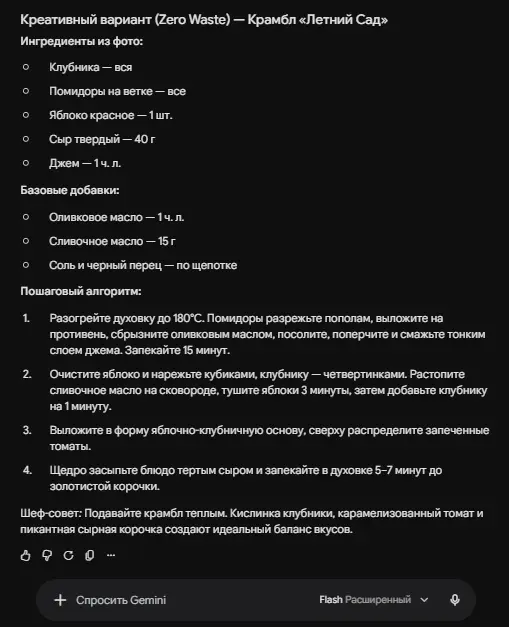
Why that third option matters. It uses up what will spoil tomorrow — the strawberries and tomatoes — in a dish you would never have thought of yourself. That is exactly why it is worth asking for an unusual option separately.
---
How to photograph the shelf
Four things, all simple.
Open the door fully and shoot from a pace back — so the whole shelf is in frame rather than a close-up of the cheese.
Perishables at the front. If the strawberries are behind a jar, they will not be seen.
Take out anything in opaque bags. The model recognises what is visible, and the contents of a black bag do not exist for it.
Shoot one shelf at a time. A general shot of the whole fridge gives small objects that are recognised less well. Two or three photographs are better than one.
Light. The internal bulb is usually enough. A flash gives glare on the glass — better without it.
---
What to do if the recipe came out wrong
The recipes contain ingredients you do not have. Then the prompt had no prohibition. Take the one with the explicit constraint — or tell the assistant: "add a strict prohibition on using anything not in the photo".
An item was recognised wrongly. Write directly: "the thing on shelf 2 is not soured cream but yoghurt" — and ask for the recipes to be reassembled accordingly.
All three recipes are unsuitable. Specify the constraints: how much time you have, what equipment, what you do not eat. That is worth saying at once, in the same message as the photo.
It did not allow for several people. Say the number of portions and it will recalculate.
---
What else is done the same way
A shopping list in reverse. Photograph the shelf, ask what is missing for three dinners this week — and get a list rather than a random selection.
A menu for several days. From the same analysis: what to cook today, what tomorrow, what to leave for the weekend.
A breakdown by calories. One of the three prompts the assistant assembled is exactly that — with protein, fat and carbohydrate calculations and recommendations on cooking methods.
What to take home from a restaurant. A photo of a menu instead of a photo of a shelf — the same principle.
---
And what I did not do myself
Back to the main point.
I did not write the prompt. I asked in one line of ordinary language — and got four approaches and three ready prompts. All the subtleties that make an ordinary request fail — the prohibition on invented ingredients, the self-check, the confidence levels — were not thought up by me.
Prompt Master is free and works with no limit on the number of requests.
And it is one of more than 150 assistants in the catalogue, sorted into fourteen sections. For every task and every model.
And the prompt library holds ready templates, open free after ordinary registration — if you want to try with no outlay at all.
---
Where to start today
One action, five minutes.
Open the fridge and photograph one shelf. The one with the things that will spoil soon.
Upload the photo and ask for an analysis: what is visible, what to use first, three options for what to cook.
If the answer comes out with ingredients you do not have, go to Prompt Master for a prompt — one sentence from your side.
Did it work? Take a second shelf or the freezer. The second time takes a minute.
If the question is not only "what to cook". The assistant catalogue has a Nutrition expert — it looks at the same ingredients from another angle: what is worth eating more often and what less, and how to assemble a proper meal from what is there rather than merely an edible one. It opens with a link, and the question is asked in ordinary words.
Alongside is a Professional organiser — if the problem is not the cooking but that half the fridge regularly goes off.
Registration is free and opens three days of full access.
---
What to read next
[How to make sense of an appliance manual](/en/blog/understand-manual) — a second everyday task for an evening.
[Where to start: one evening, one task](/en/blog/first-evening-one-task) — if this is your first approach to the subject.
[How to make sense of a book or a textbook](/en/blog/book-summary-in-ten-minutes) — the same assistant, a harder task.
[Where does what I write to an AI go](/en/blog/is-it-safe-to-use-ai) — what can be uploaded and what cannot.
---