How to check what a model tells you when a mistake costs your reputation
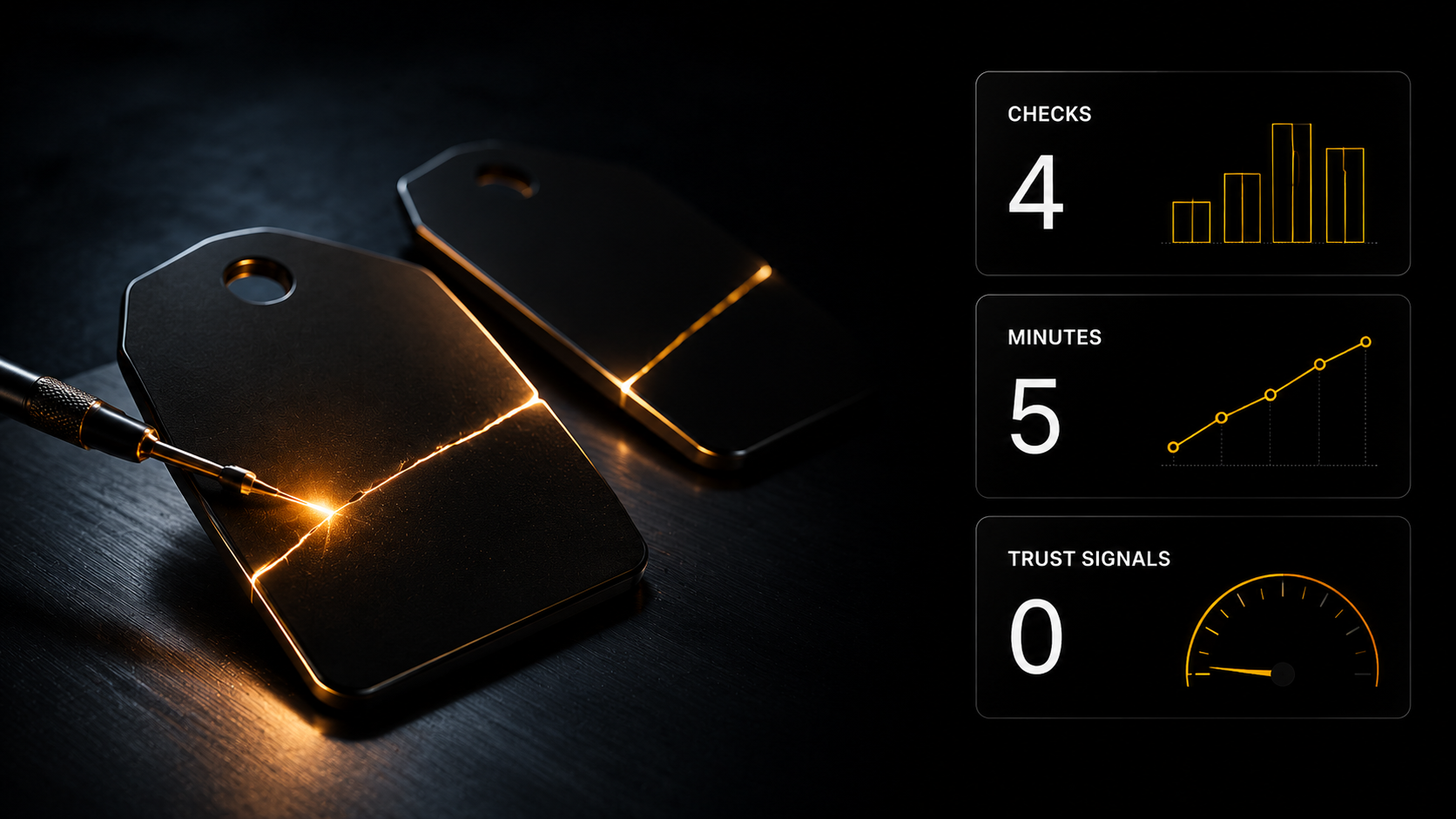
A model names non-existent rules and figures as confidently as real ones — in text they are indistinguishable. For a lawyer, a doctor, a finance professional or a writer that makes the tool unusable right up until there is a verification process. Below is one, and it takes minutes.
A model names non-existent rules and figures as confidently as real ones — in text they are indistinguishable. For a lawyer, a doctor, a finance professional or a writer that makes the tool unusable right up until there is a verification process. Below is one, and it takes minutes.
---
"I did a contract review in ten minutes" — and then the fear arrived
There is a distinct group of people for whom AI clicked quickly and well. Lawyers, doctors, accountants, HR specialists, procurement people. They did not learn "AI in general" — they brought the tool into their profession and got a result immediately.
From my survey: a contract analysis that used to take a day, done in ten minutes.
And then comes the thought that turns you cold: what if there had been a mistake in it? Not a typo — an invented clause, a non-existent rule, a transposed figure. The contract would have gone to the client. The assessment to the patient. The report to management.
In ordinary work a mistake costs time. In these professions it costs your reputation and sometimes your licence. So here you cannot "just try it and see" — here you need a protocol.
Why a model states untruths confidently
It is not that the model is bad, and not that you asked wrongly.
The root cause: a model is optimised for plausibility rather than for truth. It assembles an answer that looks correct — and where a fact is missing, it will assemble a correct-looking answer anyway. It does not do blanks.
From that follows the main property to remember: a mistake looks exactly like a right answer. You will get no signal saying "I am unsure here". A rule number will look like a rule number, a dosage like a dosage, a reference like a reference.
The most dangerous misconception here: "I'm a professional, I'll spot it". You spot things in your narrow area. And the mistake arrives where you are not the expert: an adjacent rule, a regional exception, a change made last year. Plus the fluency effect works: smooth text reads as verified.
And a second: "the better the model, the lower the risk". The risk changes quantitatively rather than qualitatively. Less often does not mean never, and what you need is a process that holds for the rare cases too.
The zero-trust protocol
One rule: nothing verifiable goes out unverified. Below is how that works step by step.
Step 1. Split the answer into two kinds of content
This is the key skill and it takes seconds.
Verifiable statements: rule numbers, dates, sums, names, dosages, references, quotations, statistics. Anything with a source outside the model.
Reasoning and structure: the logic of an argument, the order of sections, the phrasing, alternative readings.
The second you can judge with your own expertise. The first gets checked at source, always, with no exceptions. Even when it looks obviously right.
Step 2. Require sources in the request itself
Phrase it so the model separates facts from assumptions: "for each statement, state what it rests on; where there is no source, say plainly that it is an assumption".
That is not a guarantee — a reference can be invented too. But it gets you a list of what needs checking instead of a wall of text where everything does.
Step 3. Verify at source rather than by asking again
The most common mistake: asking the same model "are you sure?". It will agree or reverse itself — and neither means anything.
Verification goes outwards: the official text of the rule, a register, a reference work, the manufacturer's site. Open it, find it, compare. That is the work which cannot be delegated.
Step 4. Cross-check with two models where the cost of error is high
Different models make different mistakes. Matching answers do not prove correctness, but a discrepancy is a reliable signal that this is where to dig. It is a cheap way to highlight the risky places in a long document.
Step 5. Never hand over generated text as it stands
The final text always passes through you: you reread it and take responsibility for every statement. Not "the model wrote it" — you wrote it. If you are not prepared to answer for a sentence, it should not be in the document.
Where the risk is near zero and where it is unacceptable
This division saves the most time.
Almost always safe: drafts and structure, rephrasing something you already wrote, summarising a text in front of you, generating questions and checklists, translating the complex into plain language, finding contradictions inside a document you supplied.
Note the pattern: if you supplied all the material, the model has nothing to invent. That is the most reliable mode of working, and in professions with a high cost of error the main value comes from exactly those tasks.
Requires full verification: any rules, reference numbers, figures, dosages, deadlines, references and quotations, and anything that was not in the material supplied.
Not to be given to a model at all: a final decision with legal or medical consequences, and personal data that must not leave the building.
How long this actually takes
The main objection to a protocol is "checking takes longer than doing it myself". Usually untrue, and here is the arithmetic.
A contract review used to take a day. With a model it takes ten minutes plus verification. And you check not the whole text but the list of verifiable statements — usually five to fifteen items: rule numbers, dates, sums. A minute each is a quarter of an hour.
That is half an hour against a day. Even if the checking takes an hour, the ratio does not change qualitatively.
The saving disappears in one case only — when a text contains hundreds of verifiable statements. That is a sign the task was chosen wrongly: things like that do not get handed to a model whole, they get split up.
Separately on "they don't know at work"
Some people in this situation use AI quietly — because it is not accepted in their organisation, or is explicitly not permitted.
I will say it plainly: that is a separate risk and it is not technical. Work delivered with a tool nobody knows about becomes, at the first mistake, your personal problem twice over: the mistake plus the concealment.
The protocol above reduces the likelihood of a mistake. It does not settle the question of whether your employer knows how the work gets done. That is worth resolving separately — and it usually resolves more easily than expected if you arrive not with "I use AI" but with a result and a description of how it gets verified.
Three phrasings that reduce risk at the input
Verification is always compulsory, but some mistakes get cut off in the request itself.
"Work only from the text I attached. If the answer is not in it, say the data is insufficient." That is the strongest technique: it closes off the model's ability to draw on memory. It works for going through documents, contracts and reports.
"Separate facts from interpretation: first a list of statements with where each comes from, then your conclusions." You get a ready list to check instead of a wall of text.
"List what this document is missing and which questions remain open." The reverse request: instead of the model filling the gaps, it names them. For professions where an omission is more dangerous than an error, that is the most useful mode.
How to build this into your work
The platform has an express course devoted to exactly the method of verification — "Perplexity as an investigative tool". It is not about AI in general, it is about a skill: how to check a fact, a company, a figure or a reference in minutes rather than taking a text at its word. The same skill is what you need for checking models.
Alongside are more than 140 AI assistants across 14 categories, including legal and analytics: they work in the mode where you supply the material — the safest one.
Registration is free and opens three days of full Basic access — the course, all the assistants, the prompt texts and five more foundational courses.
Do one thing today. Take the last document you made with a model and find every verifiable statement in it — numbers, dates, sums, references. Check them at source. If it all matches, good, you now have a habit. If not, you have just avoided the thing this article was written for.
If you have a colleague who delivers documents without checking the figures, forward this to them.
---
Where the verification skill comes from
Verification is a method rather than intuition, and it gets taught separately.
Module 4, "Advanced prompting", covers sixteen methods in four groups: fundamentals and context · logic and reasoning · multi-step processes · autonomous methods.
The second group is directly about this: how to make a model reason step by step and show its working, so a mistake is visible in the process rather than only in the result.
The Perplexity mini-course is about a tool that searches and gives references. The key skill from it: how to read results critically, because a reference in an answer does not mean it supports what was said.
Agentic RAG from the automations archive is the next level: the system selects several sources, refines the query if the first result is weak, double-checks what it found and makes a second pass. That is verification built into the process itself.
Module 4 — Basic; Perplexity — Basic; Agentic RAG — N8N and Full.
---
What to read next
[Checking a fact with AI search](/en/blog/fact-checking-with-ai) — the tool that does this quickly.
[AI for lawyers](/en/blog/ai-for-lawyer) — the protocol for a profession with a high cost of error.
[AI for engineers](/en/blog/ai-for-engineer) — where calculations cannot be trusted.
[AI in medicine](/en/blog/ai-in-medicine) — the boundary of what is permissible.
[Best open LLMs 2026](/en/blog/open-source-llm-guide) — the full guide to open models.