Where does what I write to an AI go
You uploaded a contract to a chat — where did it go next? A fear that stops many people before their first attempt. Below is what actually happens to your text, the three different things usually lumped together, and a practical rule on what to black out before uploading.
You uploaded a contract to a chat — where did it go next? A fear that stops many people before their first attempt. Below is what actually happens to your text, the three different things usually lumped together, and a practical rule on what to black out before uploading.
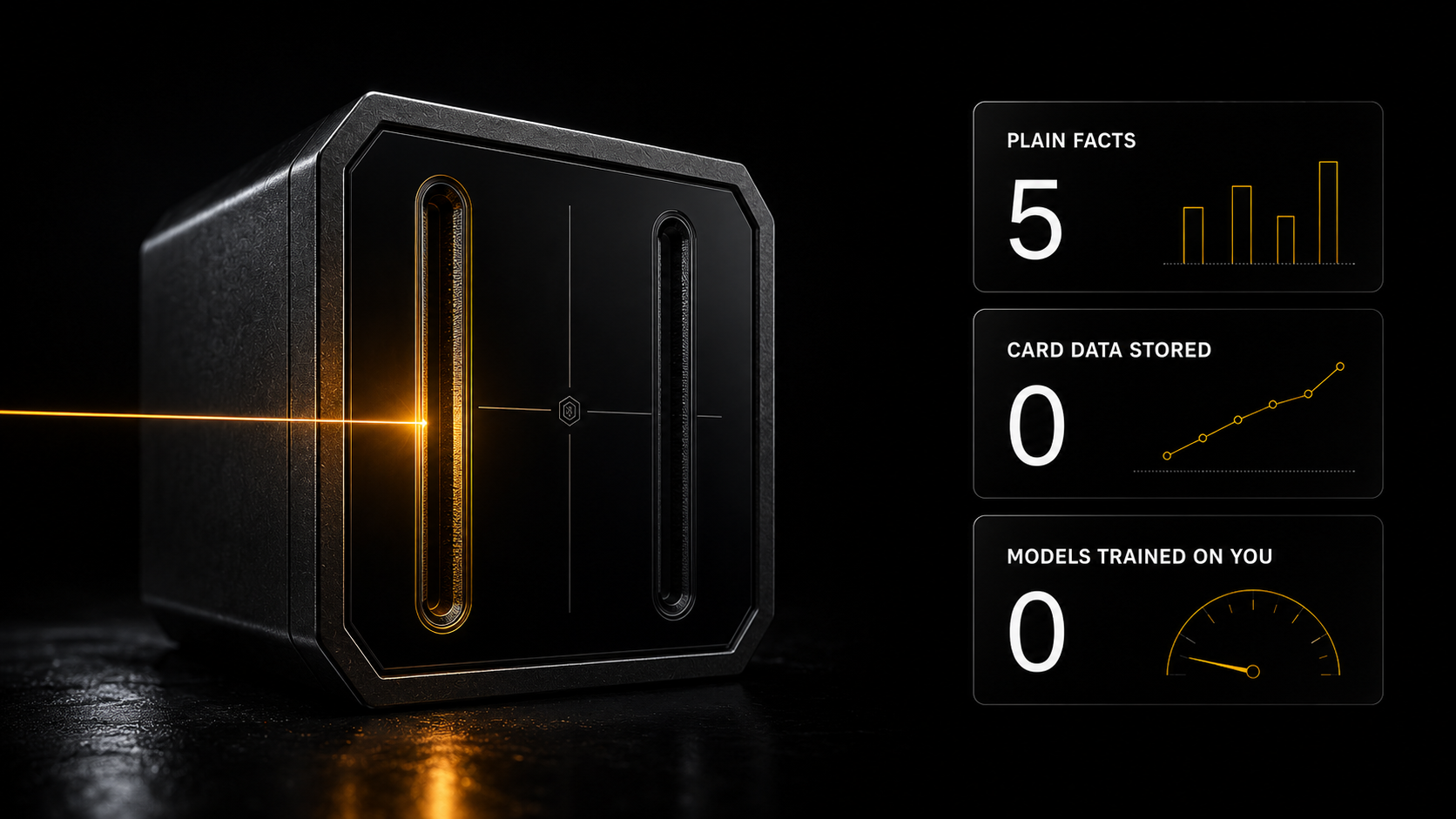
If there is no time to read: five facts
- Storage and training are different things. Your request is saved so the history can be shown and the charge calculated. That does not mean a model is being trained on it.
- The platform's own models are not trained on users' requests. The policy's direct wording.
- The request goes to a third-party model provider — they have their own rules and the platform does not control them. That is an honest caveat rather than small print.
- Card details never reach the platform at all — they are handled by the payment service.
- Before uploading a document, black out account and card numbers, identity document details and other people's data. That does not hinder analysis of the text.
The fear that stops people earliest
Somebody is ready to try. There is a task: make sense of a contract, understand a manual, write a letter. He opens the window, types the text — and stops.
"Where will this go?"
Imagination then paints anything: the text will end up in a database, people will read it, it will surface somewhere later. The tab gets closed and the task stays unsolved.
It is particularly worrying if the task involves documents. A contract is not just text; it has your surname, sums, sometimes identity document details. An appliance manual is harmless; a bank statement is not.
The fear is justified but usually aimed at the wrong thing. People fear a general "it will end up somewhere", when what is worth fearing is one specific thing, and it is solved by one action. Let us go through it in order.
Who I am and what I can say
I have been working with neural networks since 2019. I work with it daily and upload documents to it, including work documents.
Everything below is not my general reflections but specific provisions of our platform's privacy policy. Where the practice does not depend on us, I say so directly: we do not control third-party model providers and will not vouch for them.
Three things people confuse
The main cause of the fear is that three different processes are perceived as one. Let us separate them.
Storage
The service saves your request and the result received.
Why. So it can show you your history — you come back tomorrow and find what you did yesterday. So the charge for the operation can be calculated. So a failure can be investigated if something did not work.
Without storage there would be no history and no way of understanding what the money was taken for.
Training
An entirely different process: whether your text went into further training of a model.
That does not follow automatically from storage. A file can sit in your history and take no part in training whatsoever — those are two independent mechanisms, and they are what gets confused most often.
Transfer
Your request goes to a third-party model provider, which processes it and returns the result.
The construction matters here. The platform does not contain every model inside itself — it connects you to them. Each provider has its own processing rules.
It is the third point worth fearing rather than the first two. And that is exactly why the section on what not to upload comes next.
What actually happens: the facts
Now specifically, by the points of the policy.
What is stored
Your requests and results, the history of operations, saved material, learning progress.
Why exactly
To show the result · to keep a history · to calculate the charge · to investigate an error. Four reasons, all operational.
What does not happen
Requests and results are not sold, published or shown to other users. The only exception is if you published something yourself.
And the platform's own models are not trained on them.
I quote that wording precisely, because it is exactly what people fear: that their text will dissolve into a model and surface with a stranger.
An honest caveat also worth knowing
Third-party model providers work to their own terms. Corporate plans usually do not involve training on client data, but the platform does not control their practice and cannot guarantee it.
I write that deliberately. A statement that "everything is absolutely safe" would be untrue, and you have a right to know where somebody else's responsibility begins.
Retention periods
| What | How long it is kept |
|---|---|
| Account, requests, results, progress | deleted after 30 days from account deletion |
| Payment records | up to 7 years — a tax law requirement |
| Technical logs | a year |
| Support correspondence | two years |
Note the second line: payment records are not deleted on request, and that is the law rather than a whim of the platform.
Card details
The full card number, expiry date and code never reach the platform at all. They are handled directly by the payment service.
That is, even theoretically nothing can leak from the platform that is not on it.
What not to upload to an AI
The most practical section, and the main one.
The policy explicitly asks you not to send confidential, regulated, medical or financial data to an AI, nor other people's personal data.
That sounds like giving up half the useful tasks. In fact it is not — because analysing a document does not need that data.
The rule that settles the question
Before uploading, black out:
Account and card numbers — they do not affect the meaning of the document.
Identity document and similar details — the same.
Everything relating to other people — the surnames, telephone numbers and addresses of the other party to a contract, neighbours' details in a complaint.
Why that works. The assistant analyses the structure and meaning of the text: what the obligations are, what the deadlines are, where the contradictions are, what is missing. For that it does not need to know your name or that your account ends in 4417.
And what never went anywhere cannot leak from anywhere. That is the one guarantee that does not depend on anybody's policy.
How to black things out on a phone
Open the photograph or scan in the standard editor, take the pencil or fill tool and paint over the relevant places. Thirty seconds. For a PDF it is easier to take a screenshot of the page you need and paint over that. If there are many documents, there is the open-source Stirling-PDF: it can redact and runs locally on your side, without sending files to outside services.
Three levels of privacy
If a task is genuinely sensitive, the choice does not come down to "use it or not".
The first level — the ordinary service. Fast, nothing to configure. Suitable for most everyday tasks: texts, making sense of manuals, working with photographs.
The second — your own access key. You connect to a provider directly under your own account. An intermediate option, requiring minimal setup.
The third — a local model on your own computer. Nothing goes anywhere, because the internet is not needed for it to work at all. The model is downloaded once and runs on your machine.
Who needs the third level. Those with data that must not leave their own computer, by work or by obligation. For everyday tasks it is excessive.
What it requires. A compact model in compressed form fits into 8–20 gigabytes of video memory — that is, an ordinary home computer with a decent graphics card can cope. The details and requirements are covered in a separate piece.
What follows practically
Four conclusions that remove the original fear.
Everyday tasks are safe almost always. A greeting, an appliance manual, a recipe, an old photograph — there is nothing there worth protecting.
Documents — with blacking out. One thirty-second action and the task moves into the everyday category.
Other people's data is not yours to dispose of. That is the one place worth being strict about, not for your own sake but for other people's.
Anything truly sensitive — locally. If you are unsure whether your case counts, assume that it does.
Where to start today
One action, ten minutes.
Take the task you postponed because of this fear. Look at the document and mark what needs covering: numbers, identity details, other people's surnames.
Black it out. Upload it. Get the analysis.
Usually it turns out that two or three lines of the whole document need covering, and the rest is ordinary text with nothing personal in it.
Did it work? Take a second task of the same kind. The second time you already know what to look for, and it takes a minute.
What helps you not to think about this every time. In the assistant catalogue the role is already set for the task — you do not have to retell the whole context and attach more than necessary. You describe the situation itself rather than everything behind it.
Registration is free and opens three days of the Basic plan. And if the task is one that cannot go anywhere, start with the piece on local models; it covers what is needed.
What to take on the platform for this task
- PasteGuard — masking data before AI — Open Source: a local proxy that hides personal data and secrets before a request goes to a model
- Jan — an offline AI chat on your own computer — Open Source: open models run on your machine, data never leaves the device
- LocalAI — a local model server — Open Source: your own model server with an OpenAI-compatible API
- Stirling-PDF — Open Source: redacting and processing PDFs locally
- Legal assistant and Corporate lawyer — assistants for reading contracts (after redaction); Basic
Open Source descriptions are open to everyone; links to the repositories are from the Creator plan.
What to read next
Best open LLMs — how to run a model on your own machine and what it takes.
Local models for sensitive data — when this is not a preference but a condition.
How to verify a model's answers — the other half of trust: accuracy rather than privacy.
Where to start: one evening, one task — if the fear was the only thing stopping you.