"Subscriptions are very expensive, there's no room to experiment" — what it actually costs to try
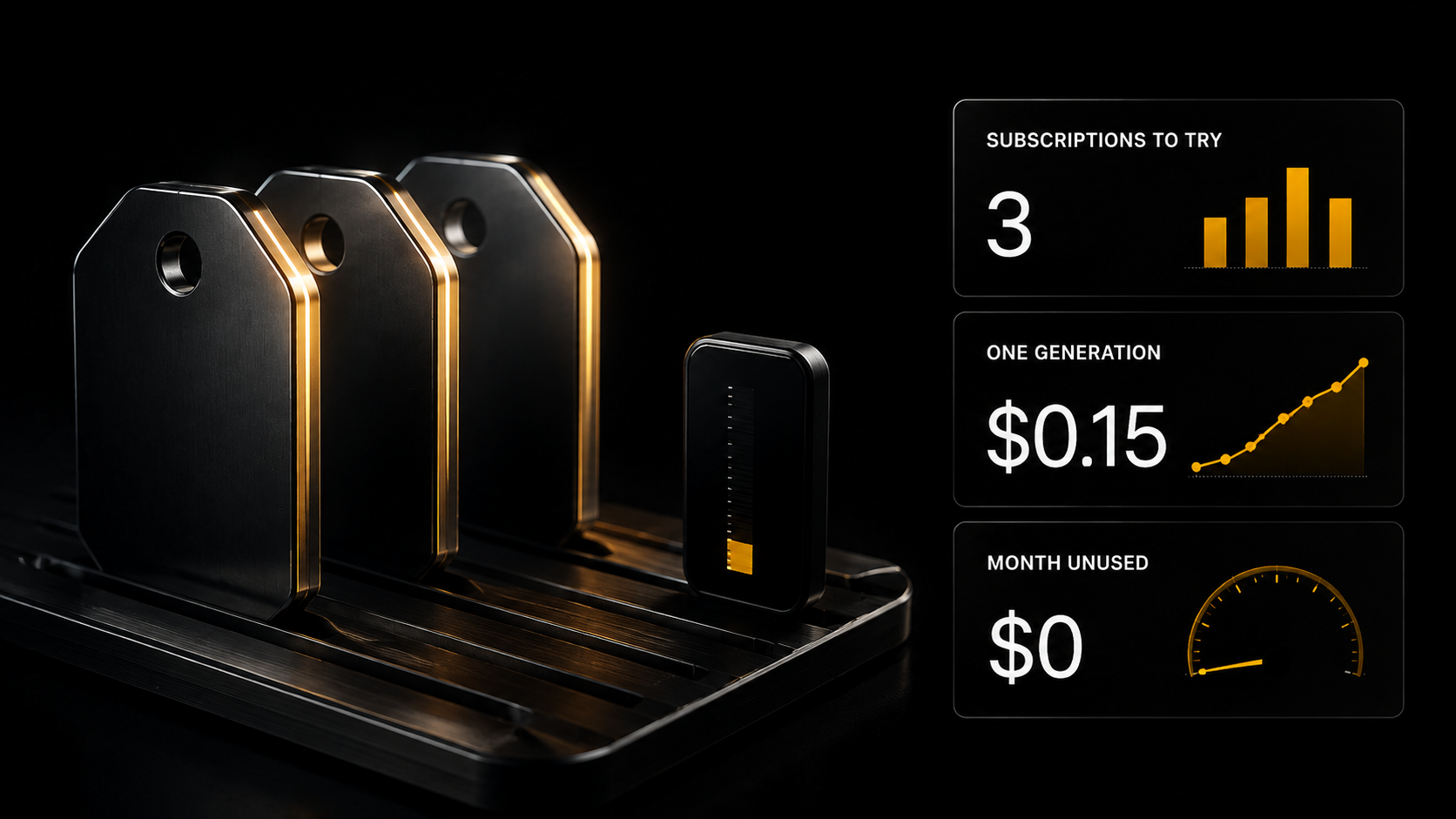
"The cost of these models is high, subscriptions are very expensive, there's no room to experiment" — that is a verbatim quote from my survey, and the person is right. To try three models you need three subscriptions, each charged in full. Below is why that breaks the way in, and what a different payment model changes.
"The cost of these models is high, subscriptions are very expensive, there's no room to experiment" — that is a verbatim quote from my survey, and the person is right. To try three models you need three subscriptions, each charged in full. Below is why that breaks the way in, and what a different payment model changes.
---
Three subscriptions you barely use
The objection from my survey, verbatim: *"the cost of these models is high, subscriptions are very expensive, there's no room to experiment"*.
The person is right about the main thing: with a subscription model, experimenting genuinely is unaffordable. To try one model for video, a second for images and a third for text you have to take out three subscriptions. Each is charged in full, every month, whether or not you opened it.
Then the predictable happens. You take out one — the best-known — and try to do everything in it. It goes badly, because every model has its own strengths. The conclusion the person draws is about themselves: "it's not working, I suppose I haven't figured it out".
And it is not working for a different reason. You are using one tool where three are needed, because there is no money for three.
And the second half of the problem: it is unclear what a specific task will cost. You do not know in advance what a clip will come to — you only know the subscription has been charged.
What is wrong with subscription as a model
The root cause: a subscription is payment for access rather than for work. You pay for the right to use, and you pay the same whether you made two images that month or two hundred. For somebody with a flow of jobs that is good value. For somebody trying it out, it is a straight loss.
The misconception: "first I'll buy the subscription, then I'll start earning". The order is the reverse. A subscription pays off when there is a flow. While there is none, it takes money and adds guilt: paid and not using it.
And a systemic layer. For most services a subscription is more profitable than per-use payment precisely because some people pay and do not use it. That is not a conspiracy, it is a business model — but it is worth knowing about.
How to count it differently
There is another model, and it removes the objection entirely: a wallet instead of a subscription.
Payment on use. Money comes off for work done rather than for a calendar month. Did not open it for a week — spent nothing.
The cost visible before you press. You see what an operation costs before running it rather than after. That changes the behaviour itself: you can compare two options on price and choose, rather than guess.
Topping up in small amounts. The entry threshold is a few dollars rather than a monthly subscription. With that money you can try five different models instead of one.
The difference is like a gym membership and a taxi. A membership pays off for somebody who goes three times a week. For somebody who goes once a month it is cheaper to pay per trip.
What is available with no money at all
Separately, because people usually do not know this.
The catalogues are open to guests. Descriptions of skills, prompts, assistants and templates are visible without registration — you can look at what exists before spending anything.
The blog is fully open, no registration needed.
Free registration gives three days of full Basic access. Not a demo and not a cut-down version — the full plan: chats with every assistant, the prompt texts, the skill files, six foundational express courses and the ten-lesson sales module.
Three days is enough to work through "Freelancer positioning" and come out with a finished pack of documents: a niche, a client avatar, a portfolio and profile texts. That is, testing not the tool but yourself — before paying for anything.
Experience converts into access. Advanced skills and templates open either with a plan, or one-off for $9, or for 1 000 experience points earned by working on the platform.
What one job actually pays
Worth looking at the spend from the other side — from the side of what the work pays.
From my scrape of 848 listings over 24 days the median for one-off work is $30–75. A short clip is $18–45, a logo $25–90, a multi-page website $245–730.
Now set that against the cost of generating. With per-use payment, an operation costs cents and single dollars rather than tens. So the very first job completed covers the cost of several dozen attempts.
The whole problem is the order. A subscription demands money before the first job. Per-use payment lets you start with a sum you do not mind and pay from what you earn.
How to spend sensibly once you do have money
Three rules that save more than any choice of plan.
One tool until the first payment. Until you have earned, no new services get tried at all. Every new tool is not only money but time, and at five hours a week there is none.
Count the spend per job, not per month. The right question is not "what does the subscription cost" but "what did this job cost me". If the job brought $40 and the spend was $3, the model works. If it is the other way round, the price of the subscription is not the issue.
Do not pay for something you need once a quarter. A one-off payment for the operation you need is almost always cheaper than a year of access for two uses.
Three more ways not to overpay
Free tiers cover more than people think. For text tasks, drafts and testing an idea, paid access is often not needed at all. Paying starts making sense where volume begins, or quality good enough to hand a client.
Do not pay for what is already included in something else. People regularly take out a separate subscription to a tool they already have access to inside something larger. Before paying, check what you actually do not have.
Count the spend as part of the job's quote. When you name a price, the cost of generating goes into it the way paper goes into a printer's quote. A freelancer who pays for tools out of their own pocket and does not build it into the price is working at a loss and not noticing.
What to do today
Check your current spending: open your list of subscriptions and see how many times you opened each in the last month. Usually it turns out money goes out for two or three and the work happens in one.
Then start with what is free rather than with choosing a plan. Registration costs nothing and opens three days of full Basic. Inside: more than 140 AI assistants across 14 categories (marketing, sales, legal, HR, e-commerce, analytics, creative, engineering), the sales module, six foundational courses including "Freelancer positioning", "Freelance 2.0" and an encyclopaedia of more than 190 vetted services.
The job of those three days is not to learn everything. The job is to choose one service, one tool and one place to look, and get to a first reply. Everything else gets bought later, out of money earned, rather than instead of it.
Having no money for subscriptions is a real constraint. But it constrains experimenting, not earning: to take a first job you need one working tool, not five.
If you know somebody who pays for three AI services and has earned nothing on any of them, forward this to them.
---
Prices by operation
So that "pay as you go" does not sound abstract — here is what the operations themselves cost.
| Mode | Models | Price per generation |
|---|:-:|---|
| Images | 30 | $0.12 – 0.25 |
| Text to video | 51 | $0.22 – 11.95 |
| Photo to video | 84 | $0.17 – 11.95 |
| Photo editor | 34 | $0.12 – 0.50 |
| Upscaling | 6 | $0.12 – 0.40 |
| Background removal | 1 | $0.12 |
| Product Shot | 2 | $0.12 |
| Lip Sync | 13 | $0.12 – 1.50 |
| Video editor | 39 | $0.12 – 11.95 |
| File to text | 4 | $0.15 |
What is immediately visible. Stills cost pennies: twenty images is a few dollars. Video is the one category with a fiftyfold spread, and that is exactly where quotes go wrong.
What a finished clip costs end to end
A guide based not on one generation but on a completed piece of work.
In a pipeline where the script, the photo, the animation, the voice and the assembly all run automatically, the cost of one clip is $2.50–3. That is with every step included, the video model and the assembly among them.
Compare with the market: a short clip sells for $18–45. The difference is your work.
---
What to read next
[LLM pricing and token economics](/en/blog/llm-api-pricing) — how the cost of a request is calculated.
[What a clip actually costs to make](/en/blog/video-production-cost) — what a real job comes to.
[Which plan to choose](/en/blog/which-plan-to-choose) — a breakdown by task rather than by tick boxes.
[It was expensive — now it's $9](/en/blog/was-expensive-now-nine-dollars) — what changed in the access model.
[What you can do from a phone](/en/blog/what-you-can-do-from-phone) — where the line runs if you have no computer.