What a clip costs you: the economics of a $45 job
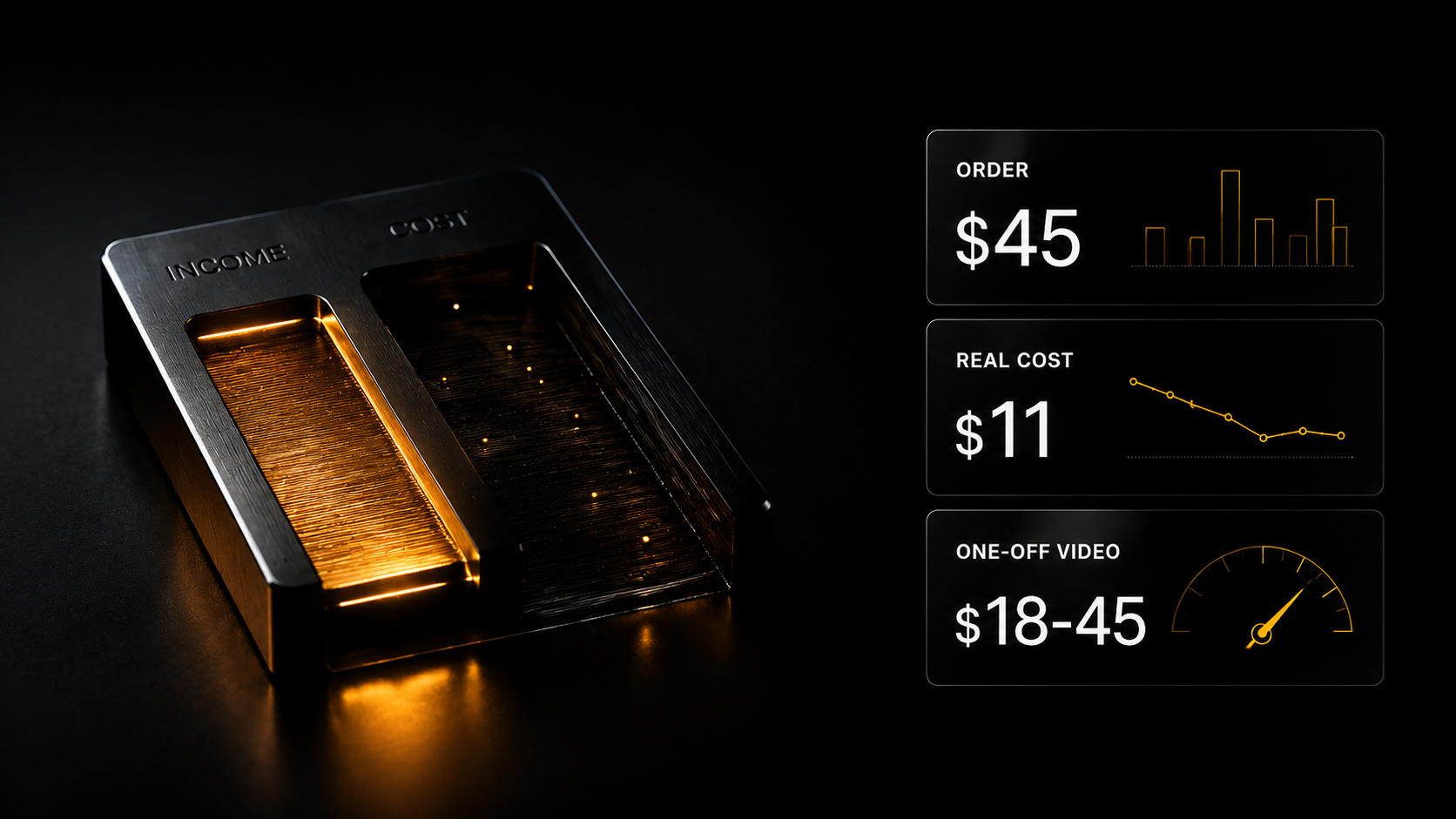
You know what to charge and not what you will spend — the cost is spread out and the profit gets counted as "what landed in the account". People work at a loss that way for months. Below is the other half of the equation: prices by operation and a real job worked through.
You know what to charge and not what you will spend — the cost is spread out and the profit gets counted as "what landed in the account". People work at a loss that way for months. Below is the other half of the equation: prices by operation and a real job worked through.
---
You know the price list and not the profit
You have looked at the market ranges and know what to charge. A short clip is $18–45, an image individually $12–35, a set of listing images $245–730.
That is half the equation.
The other half is what that job will cost you. And almost nobody counts it, because the spend is spread out: the subscription went out a month ago, the generations run in the background, and profit gets counted as "what landed in the account".
People work at a loss that way for months without noticing.
Let us go through the other half in figures.
What generation actually costs
The orders of magnitude for the main operations:
| Operation | Price per generation |
|---|---|
| An image | $0.12 – 0.25 |
| Photo editor | $0.12 – 0.50 |
| Background removal | $0.12 |
| Upscaling | $0.12 – 0.40 |
| Animating a photo | from $0.17 |
| Video generation | $0.22 – 11.95 |
| Lip sync | $0.12 – 1.50 |
| Music and sound | $0.12 – 1.80 |
| Transcription and recognition | $0.15 |
| A 3D model | $0.36 – 0.72 |
The first thing visible: stills cost pennies. Twenty generated images is a few dollars.
The second: video is the one category with a large spread. From twenty cents to almost twelve dollars per generation, depending on the model, the duration and the resolution. That is exactly where quotes go wrong.
Working through a real job
Not by one generation but by how many actually get used.
A short clip at $45
An honest cost includes the misses rather than only the successful frame.
- The script and copy — pennies
- Frames: 3–4 are needed, with attempts that becomes 10–12 generations
- Animation: 3–4 frames, with redos 6–8
- Sound or narration
- Upscaling the final
That comes to single dollars with careful work. With careless work, twenty attempts per frame and an expensive video model, it can run into the tens.
The difference between those two scenarios is your profit.
A set of listing images at $245–730
Twenty to thirty images with revisions and upscaling — the spend still stays in the single to low tens of dollars against a fee in the hundreds.
The conclusion for both: the cost is a few per cent of the fee. The problem is not that generations are expensive. The problem is that they do not get counted or built in.
Three things that wreck the economics
1. Generating on spec
Twenty attempts instead of four, because the task was not stated.
A precise description of what is needed is not pedantry but direct saving. Plus previews and intermediate checks: do not run the final frame at maximum resolution until you know the composition is right.
2. An expensive model where a cheap one would do
The spread on video runs from $0.22 to $11.95. That is a fiftyfold difference.
The rule: drafts and testing an idea on a cheap model, the final on whichever the quality requires. Running drafts on the top model is the fastest way to eat your margin.
3. Revisions with no limit
For generative video a revision often means regenerating, which means a new cost.
"We'll revise until you're happy" as a verbal arrangement is an open account at your expense. Two rounds of revisions in the quote is fine; beyond that it is separate work.
How to build the spend into a quote
One rule: the cost of generations goes into the client's price the way paper goes into a printer's.
No client asks a printer what the paper cost. They pay for the printed run.
The practical method. Estimate the spend for the task, multiply by two — for misses and revisions — and build it into the price. If it comes to more than five or seven per cent of the fee, either the job is too cheap or the process is too wasteful.
What not to do: put the spend as a separate line on the invoice. The client will start discussing the cost of generations rather than the result, and you will be in a conversation with nothing to win.
Why pay-as-you-go matters more than discounts
Separately, because it changes whether working is possible at all.
A subscription is payment for access. It gets charged the same whether you did two jobs that month or twenty. For somebody with no flow that is a straight loss.
A wallet is payment for work. Did not work for a week — spent nothing. A month of quiet costs zero.
Three properties that decide it:
The price is visible before you press. You see the cost of an operation before running it rather than after. You can compare two models and choose.
Money comes back for anything not delivered. A step did not complete — its cost returns to the balance automatically.
The entry threshold is small. You can start with a sum you do not mind and pay from what you earn.
That is a direct answer to the objection I hear from my audience verbatim: *"the cost of these models is high, subscriptions are very expensive, there's no room to experiment"*. The room appears exactly when an experiment stops costing as much as a monthly subscription.
What to count so you are not guessing
Three figures, and it will all be clear within a month.
The spend per job. Not per month but on a specific piece of work. The right question is "what did this job cost me" rather than "what does the subscription cost".
The spend as a share of the fee. The job brought $40 and you spent $3 — seven per cent, fine. You spent $20 — the issue is not prices but the process.
The number of attempts per usable result. The most useful figure. It shows where you are losing: in stating the task or in choosing the model.
What is available on the platform
Gen AI — 338 models in one place instead of a dozen subscriptions. The price is visible next to each. The models differ in quality and speed: different ones get used for a draft and for a final.
Prompt Master — the "improve prompt" button rewrites the phrasing to a methodology. That is direct saving: a precise request cuts the number of attempts.
AI Workflow — chains where each step's result becomes the next one's input. The quote gets calculated before the run: you see what the whole run will cost and what will be left on the balance. Charging follows the steps actually completed.
Marketing Studio — eight ready formats, from a reel to a marketplace listing card. The quote is visible before the run there too.
Registration is free and opens three days of full Basic access. Image generation and video model courses come with the Plus plan, or $9 one-off, or 1 000 experience points.
Where to start today
One action. Take your last completed job and count one figure: how many generations you made before getting the result you delivered.
Not how much money you spent — how many attempts there were.
Usually it turns out two or three were successful and the rest went on feeling out the task. That is your real profit reserve — and it is not in raising the price but in stating things more precisely and running drafts on cheap models.
---
The full table of modes
To build a quote you need all the figures at once.
| Mode | Models | Price per generation |
|---|:-:|---|
| Images | 30 | $0.12 – 0.25 |
| Text to video | 51 | $0.22 – 11.95 |
| Photo to video | 84 | $0.17 – 11.95 |
| Photo editor | 34 | $0.12 – 0.50 |
| Upscaling | 6 | $0.12 – 0.40 |
| Background removal | 1 | $0.12 |
| Face swap | 1 | $0.12 |
| Product Shot | 2 | $0.12 |
| Lip Sync | 13 | $0.12 – 1.50 |
| Video editor | 39 | $0.12 – 11.95 |
| File to text | 4 | $0.15 |
| 3D models | 8 | $0.36 – 0.72 |
The spread on video is fiftyfold. That is exactly where quotes go wrong: a draft on the top model eats your margin faster than anything else.
A real guide for a finished clip
A separate figure more useful than the per-operation ranges.
In a ready pipeline where the script, the photo, the animation, the narration and the assembly all run automatically, the cost of one clip is $2.50–3. That includes the video model and the assembly rather than only generating a frame.
Compare with the market: a short clip sells for $18–45, AI video end to end for $245–550.
---
What to read next
[LLM pricing and token economics](/en/blog/llm-api-pricing) — how this gets calculated systematically.
[AI freelancer price list](/en/blog/ai-freelancer-price-list) — the first half of the equation.
[AI video generation](/en/blog/ai-video-generation-guide) — what exactly you are generating.
[What it costs to try](/en/blog/how-much-to-try-wallet) — how pay-as-you-go works.
[AI video models in 2026](/en/blog/ai-video-models-2026) — which model for which task and what it costs.