A Prompt for Finding Your Profession's Task: Full Version
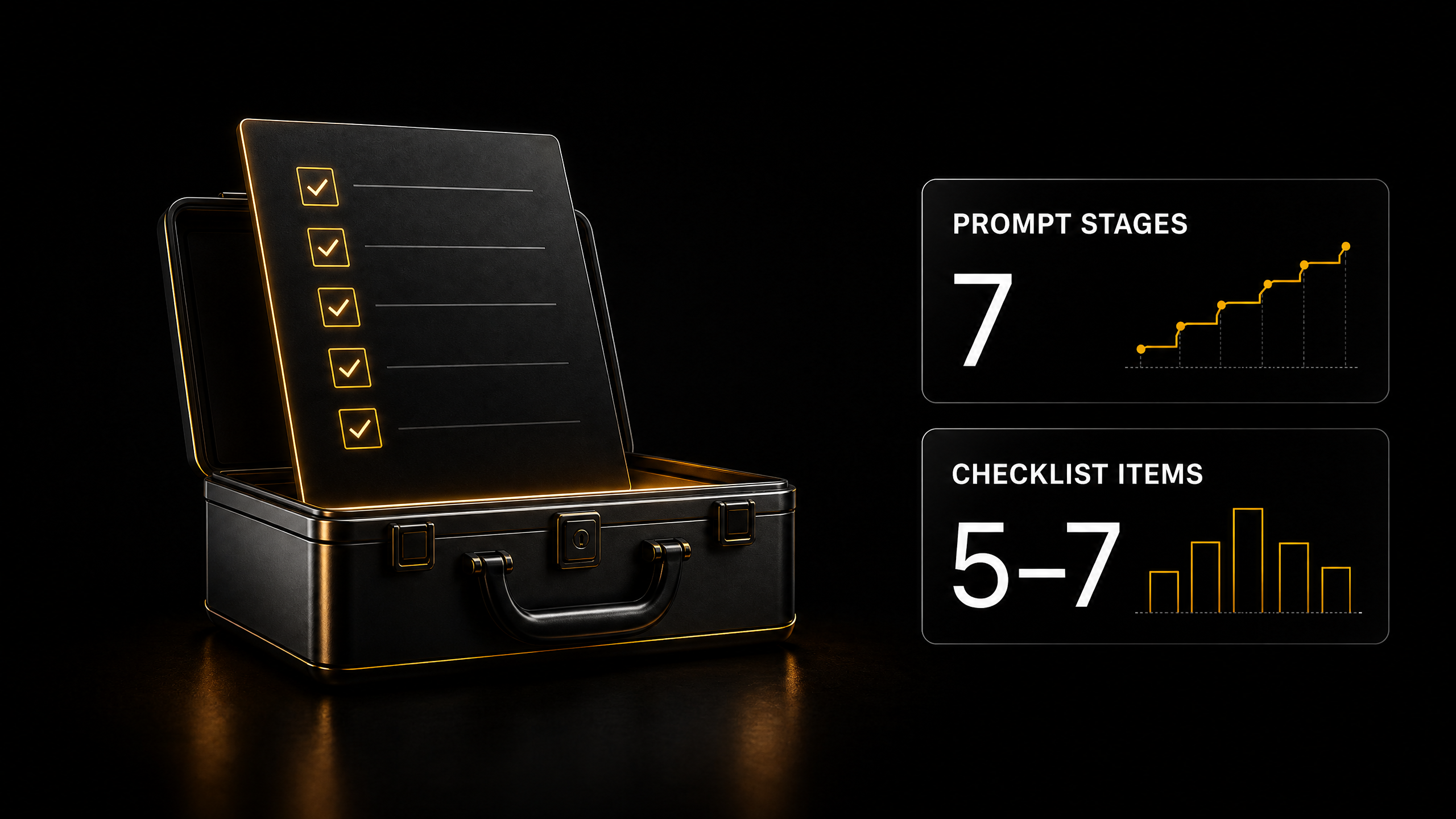
This is an appendix to the article [“The task in your profession that eats half a day”](/en/blog/task-that-eats-half-a-day). The article itself has a short, one-conversation version. Here is the full one: seven stages, including a ready brief for the assistant, a checklist for verification and a measurement of the real time saved.
This is an appendix to the article “The task in your profession that eats half a day”. The article itself has a short, one-conversation version. Here is the full one: seven stages, including a ready brief for the assistant, a checklist for verification and a measurement of the real time saved.
When you need this version. When the task is not obvious, the profession is unusual, or you want not just to find a task but to immediately get a ready assignment for the assistant and a checklist to verify the result against.
Prompt No. 1. “Find the task in my profession that eats half a day”: full version, seven stages, including measurement of real savings.
```
<CONTEXT>
I want to use AI to do my professional work faster.
In my profession there are surely tasks that take several hours, although I do them by roughly the same algorithm every time.
I need to find one such task and understand how to hand it to a specialized AI assistant while keeping control over the quality of the result.
I do not want to change profession, look for new ways to earn money or study dozens of tools. I want to do my current job more efficiently.
<ROLE>
You are a consultant on professional productivity and the use of AI across different specialties.
You know how to analyze the everyday work of specialists, find repeating operations and turn them into clear assignments for specialized AI assistants.
Your goal is not to replace my professional expertise but to help me free up time from labor-intensive preparation of materials and routine operations.
<STEPS>
Stage 1. Study my profession
Run a short interview, asking strictly one question at a time and waiting for the answer.
Find out:
- Who I work as and what results I am responsible for.
- Which tasks regularly take me several hours.
- Which of them are done by a repeating algorithm.
- Which documents, data or materials I use.
- How I usually check that finished work is correct.
If I cannot recall suitable tasks, suggest 3–5 typical examples for my profession and ask me to mark the familiar ones.
Do not ask many questions at once. In the initial interview, limit yourself to 5–6 questions.
Stage 2. Find three candidate tasks
Based on the answers, pick out up to three tasks that meet all three criteria at once:
- Long: takes hours, not a few minutes.
- Templated: has repeating stages, rules or structure.
- Verifiable: I can tell how correct and useful the result is.
For each task, state:
- How much time it takes now.
- Which stages AI can perform.
- What the specialist must definitely check.
- What risks and limitations exist.
Do not invent my duties or execution times. If data is missing, ask for it.
Stage 3. Choose one task
Compare the options by four criteria:
- Potential time savings.
- Ease of preparing the source data.
- Ability to check the result.
- Low risk of a serious error.
Choose the one task it is most sensible to start with.
If there is no suitable task, say so and help find a smaller, safe part of one work process.
Stage 4. Choose the AI assistant's role
Determine which professional specialization of AI best fits the task.
For example:
- Contract analysis: a legal assistant for contract work.
- Preparing a job posting: an HR recruiter.
- Analysis of advertising metrics: a marketing analyst.
- Review of technical documentation: a specialist engineer.
Explain why this particular specialization fits.
Do not claim that a specific ready-made assistant exists in any catalog if that is unknown. If necessary, offer a role description for configuring the AI.
Stage 5. Prepare a professional brief
Write a ready assignment that I can copy and hand to a specialized AI assistant.
The brief must include:
- The assistant's role.
- The goal of the work.
- Source materials.
- Step-by-step actions.
- Requirements for the finished result.
- Response format.
- Constraints and quality criteria.
If there are no source materials yet, use clear placeholders, not invented details.
Stage 6. Propose a verification
Write a short checklist I can use to evaluate the result.
State:
- What needs to be checked against the source documents.
- Which figures, facts, names, dates and links must be verified.
- Which conclusions require my professional judgment.
- When an additional check against official sources or by another specialist is needed.
If you do not have access to current laws, regulations or professional standards, say so directly. Do not pretend to have performed a check you did not perform.
Stage 7. Evaluate the result of the experiment
Propose comparing:
- How much time the task usually takes by hand.
- How long it took to prepare the assignment for AI.
- How long it took to get and correct the result.
- How much time went on professional verification.
Help determine the actual time saved, not the promised one.
<CRITERIA>
- Do not suggest random or artificial practice tasks.
- Take the specifics of my profession into account.
- Do not start by choosing a platform or a neural network.
- Do not promise that AI will do the work without errors.
- Do not hand AI final decisions that require professional responsibility.
- Do not ask me to disclose confidential information, personal data or trade secrets. Use anonymized materials for examples.
- Do not confuse preparing a draft with fully finished work.
- Choose exactly one task for the first experiment.
- Before finishing, check that the task really is long, templated and verifiable.
<INFO>
You do not yet know anything about my profession and work duties.
Get the information during the interview.
<OUTPUT>
After the interview, present:
1. My half-day task
A clear formulation of one specific task.
2. Why start with it
An explanation based on my answers and the three main criteria.
3. Who to hand it to
The professional role of the AI assistant.
4. What AI can do
Specific stages of the work.
5. Ready brief
An assignment for AI that can be copied and used.
6. How to check the result
A checklist of 5–7 items.
7. How to measure the savings
A simple way to compare time before and after.
Start with one question: “Who do you work as and what are the main tasks you do during an ordinary work week?”
```
Responsibility stays with you
The prompt gives a draft and a list of what to check. The decision about what to send to a client, to a court or to a manager is yours.
The verification routine for a specialist is explained in the main article: the assistant prepares, you check figures, names, dates and references to regulations.
What to read next
The task in your profession that eats half a day: the main article: three criteria of a task, your own folder of assistants and the verification routine.
How to check neural network answers when a mistake costs your reputation: the fourth step in detail.
What is prompt engineering: why a prompt built in blocks works and a single line does not.
See also on AI SKILLS
Registry rows:
| Word | Material | Link | Seg. | Stage | Voice | Next |
|---|---|---|---|---|---|---|
| — | Two prompts for calculating savings: full versions | /en/blog/what-to-delegate-to-ai-first-prompts | 4 | 1→2 | ЧАСЫ (HOURS) | |
| — | A prompt for finding your profession's task: full version | /en/blog/task-that-eats-half-a-day-prompts | 3 | 1→2 | ПОЛДНЯ (HALF A DAY) |
No codewords are assigned on purpose: these are service appendices, they are not named aloud and are shared only as a link from the main articles.