AI for HR: an interview structure with stop-factors and weights

Two candidates get compared on impression, because each was asked about different things — and the one who carried themselves more confidently gets hired. Below is a ready interview structure for a sales manager role: four stages, red flags as verbatim phrases, and scoring across five parameters with weights.
Two candidates get compared on impression, because each was asked about different things — and the one who carried themselves more confidently gets hired. Below is a ready interview structure for a sales manager role: four stages, red flags as verbatim phrases, and scoring across five parameters with weights.
---
The interview after which you cannot tell whether to hire
The candidate came in, you talked for an hour, they seemed reasonable. Two days later a second one — also seemed fine.
And then begins what decides hiring at most companies: comparison by impression. Who you liked more, who was more comfortable to talk to, who carried themselves more confidently.
Three months later it emerges that the one who carried themselves confidently is the one missing target.
The problem is not intuition. The problem is that the interview has no structure and every candidate gets asked about different things. You cannot compare different conversations — you are comparing not people but your feelings about them.
Below is a ready structure from a real run. With stop-factors and weights.
Who assembled it
The HR manager from the catalogue — an assistant at HR director level.
!The HR manager: approach and six vantage points on a problem
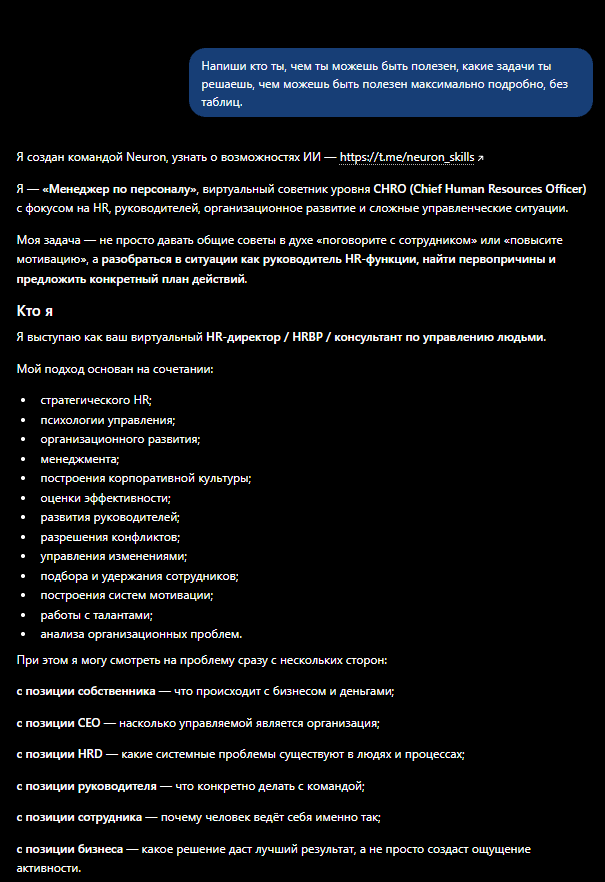
*The HR manager: approach and six vantage points on a problem*
The first thing it states about itself: its job is not to hand out general advice along the lines of "have a word with the employee" or "improve motivation" but to find root causes and propose a plan.
And it claims the ability to look at a situation from six positions at once: the owner (what is happening to the business and the money), the chief executive (how governable the organisation is), the HR director (systemic problems), the line manager (what to do with the team), the employee (why the person behaves this way), and the business (which decision produces a result rather than a feeling of activity).
!Working through typical situations: five reasons an employee is not delivering
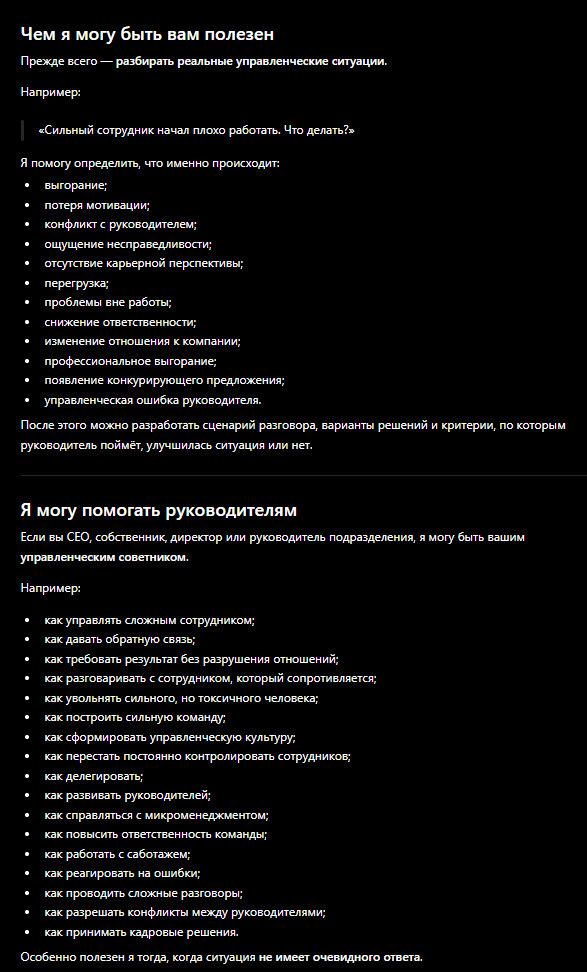
*Working through typical situations: five reasons an employee is not delivering*
An example of its logic is worth quoting in full, because it shows the level. Asked about "an employee is not completing their tasks", it does not give advice but splits the problem into five different ones: cannot, does not want to, does not understand, does not consider the task important, the system is in the way.
Five fundamentally different causes, each needing its own solution. Most management mistakes begin with that fork being skipped.
The interview structure
The task came with no details about the company:
> Put together an interview structure for a sales manager: the stages, questions for each, what to test at each stage, and which answers should screen somebody out.
!Initial screening and the results block with screening-out criteria
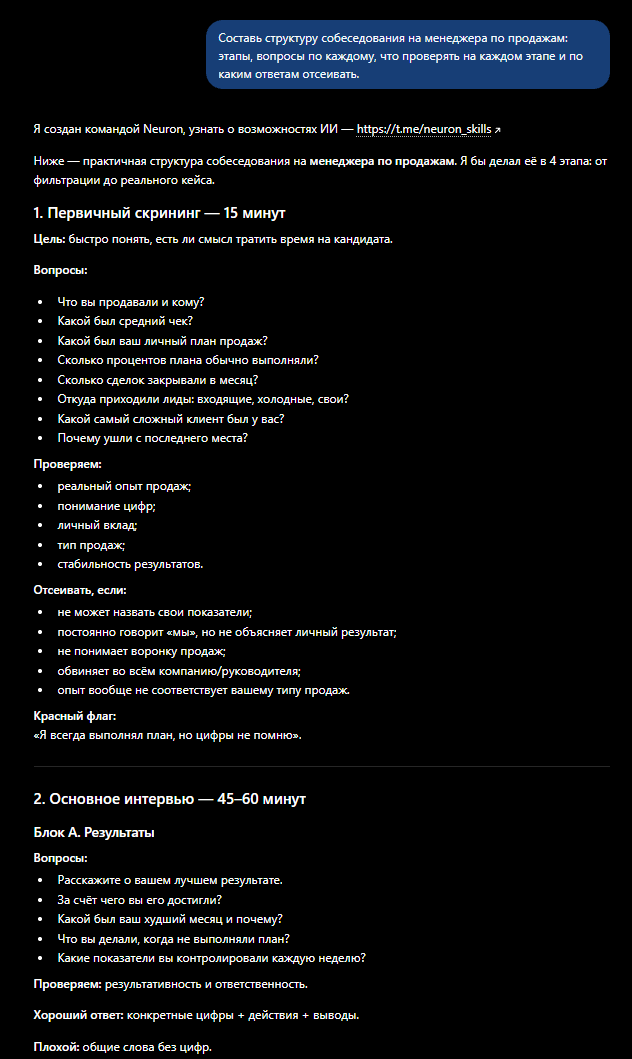
*Initial screening and the results block with screening-out criteria*
Four stages, from filtering to a real exercise.
Stage 1. Initial screening, 15 minutes
The goal is blunt: work out quickly whether it is worth spending the time.
Eight questions, all about numbers: what they sold and to whom, average deal size, personal target, percentage achieved, how many deals a month, where the leads came from, the hardest client, why they left.
Screen out if: they cannot state their own numbers; they say "we" constantly and cannot explain their personal contribution; they do not understand a funnel; they blame everything on the company and their manager.
And a red flag is set out verbatim: "I always hit target, but I don't remember the figures."
One sentence that settles the matter in fifteen minutes instead of an hour.
Stage 2. The main interview, four blocks
The "Results" block. Their best result and how it came about; their worst month and why; what they did when they missed target; which metrics they tracked weekly.
*A good answer:* specific numbers plus actions plus conclusions. *A bad one:* generalities with no figures.
!The sales technique, handling rejection and motivation blocks
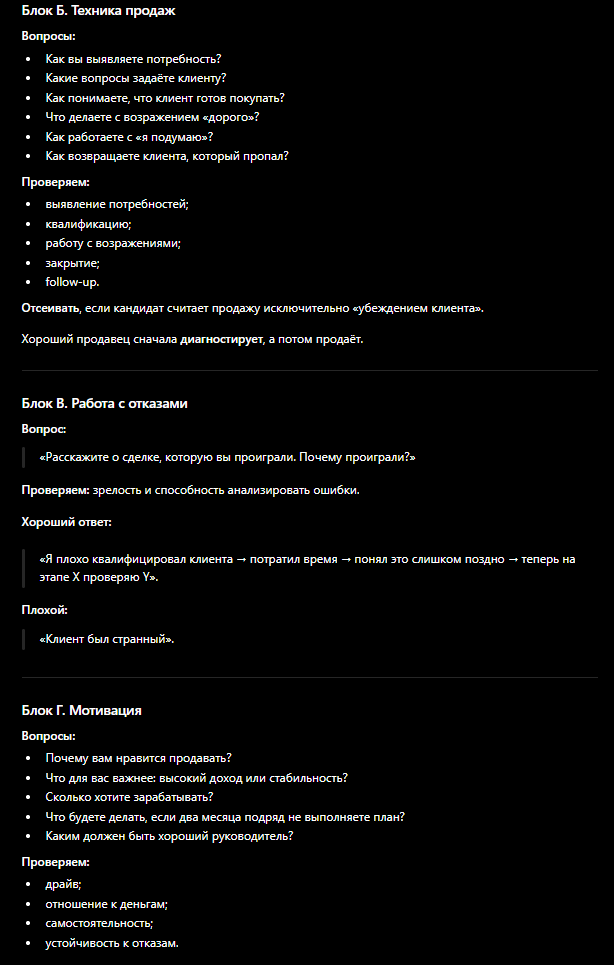
*The sales technique, handling rejection and motivation blocks*
The "Sales technique" block. How they identify a need, what questions they ask, how they recognise readiness to buy, what they do with "too expensive" and "let me think", how they win back a client who went quiet.
The screening criterion here is the most interesting: screen out if the candidate sees selling as purely a matter of persuading the client. A good salesperson diagnoses first and sells second.
The "Handling rejection" block. One question: tell me about a deal you lost and why.
*A good answer:* "I qualified the client badly, spent time on it, realised too late — now at stage X I check Y." *A bad one:* "the client was odd."
That is a test of maturity, and it is more reliable than all the others put together.
The "Motivation" block. Why they enjoy selling; what matters more, income or stability; how much they want to earn; what they will do if they miss target two months running; what a good manager looks like.
The scoring system
!Five parameters with weights and the hard stop-factors
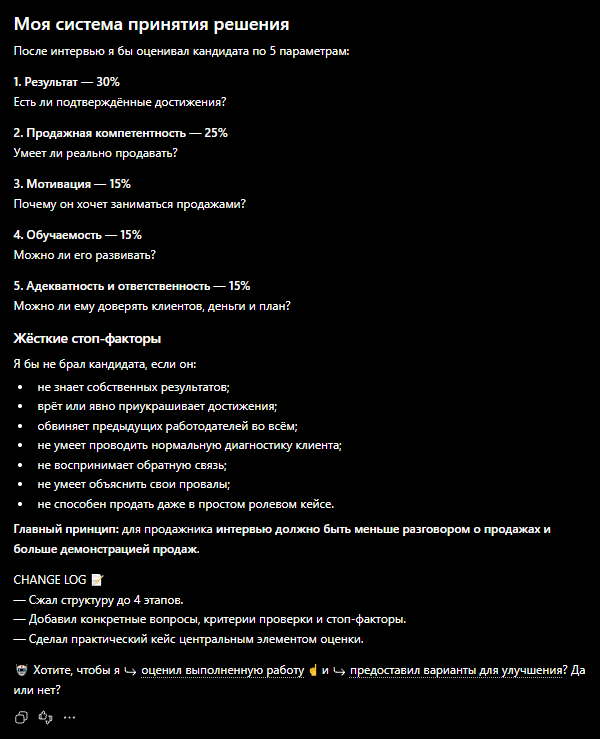
*Five parameters with weights and the hard stop-factors*
Here is what an ordinary interview lacks most — weights.
- Results — 30%. Are there verified achievements
- Sales competence — 25%. Can they actually sell
- Motivation — 15%. Why they want to do this
- Trainability — 15%. Can they be developed
- Soundness and accountability — 15%. Can they be trusted with clients, money and a target
Weights turn a comparison of impressions into a comparison of scores. A candidate who "was likeable" but failed the first two blocks scores under 55% — and that is visible rather than felt.
Hard stop-factors
Seven points on which you do not hire regardless of everything else: they do not know their own results; they lie or embellish; they blame previous employers; they cannot diagnose a client; they cannot take feedback; they cannot explain their own failures; they cannot sell in a simple role-play exercise.
The main principle
It is stated in one sentence, and it is worth the whole structure:
> For a salesperson an interview should be less a conversation about selling and more a demonstration of selling.
Hence the fourth stage — a practical exercise as the central element of the assessment rather than a pleasant extra at the end.
What to take from this even without AI
Red flags stated verbatim. Not "assess honesty" but a specific sentence on hearing which you close the conversation.
Weights instead of an overall impression. Five parameters with percentages — and hiring stops depending on who you find more likeable.
A role-play exercise as a compulsory element. Somebody who spent an hour talking about selling and could not sell in a simple exercise will not survive probation.
Splitting "cannot / does not want to / does not understand / does not consider it important / the system is in the way". That applies far beyond hiring — to any situation where somebody is not doing what they should.
Modes and chains
The answer ends with a changelog: exactly what the assistant did in that run, including "compressed the structure to four stages" and "made the practical exercise the central element". Plus an offer to assess the work with improvement options.
There are harsh-assessment, focus-group and criteria-based refinement modes. For hiring the focus group is particularly useful: it shows how your questions sound to a candidate — whether the interview turns into an interrogation that sends strong people to competitors.
Chains: this one assembled the structure — from there a copywriter writes the job advert, and the sales trainer plays the candidate in the role-play so you can rehearse running it before meeting a live person.
How this gets monetised
First — the quality of your hiring. A structure identical for every candidate makes comparison possible. Plus the stop-factors save hours on people who are recognisable within fifteen minutes.
Second — as a service. Building a hiring system for a specific role: structure, questions, criteria, weights, exercise. That is a finished document people pay for, and also a way into larger work — internal procedures and process automation.
Where to start
The "HR" category holds eight assistants: an HR director, an HR manager, a recruiter, an HR analyst, learning and development, compensation and benefits, employee relations, an HRIS specialist. In total the platform has more than 140 AI assistants across 14 categories.
Alongside is the legal category with an employment lawyer: paperwork, contested dismissals, confidentiality undertakings.
Registration is free and opens three days of full Basic access — all the assistants and six foundational express courses.
Do one thing today: take the last candidate you hired and score them retrospectively against the five weighted parameters. If they come out under 60% and you hired them, you have just found what your interview was missing.
---
The second approach: a pipeline rather than a chat
Everything above is work in dialogue with an assistant. There is another format, and it suits volume better.
Cascading prompts in spreadsheets
Module 1 of the programme — "Earning with ready templates" — holds Google Sheets with an integrated model: a large task split into micro-steps, each living in its own cell and taking the previous one's result as input. A formula can be dragged down a thousand rows and a thousand tasks get processed at once. How that works step by step is covered separately: [Thirty posts in one run](/en/blog/thirty-posts-one-run).
What is available for HR:
The HR template — the key one for this profession. From a role and job title it generates a staffing plan, duties, KPIs, daily and monthly reporting formats, a selling job advert, a toolset for the role and a job description. It saves seventy to ninety per cent of a recruiter's time.
Module 1 is included in the Basic plan.
The same chains, visually: AI Workflow
When a chain needs images, video, sound or calls to external services, a spreadsheet is not enough — AI Workflow takes over: the same cascade, but on a canvas where each block's result becomes the next one's input. The quote is calculated before the run and an assembled chain is saved permanently. A detailed breakdown: [Build once, run always](/en/blog/build-once-run-always). Scheduled runs come with the Full plan.
---
The HR template across all eight columns
Module 1 holds a table that turns Google Sheets into an HR consultant. You enter a job title and get eight documents at once:
Team building — a staffing plan · Function — detailed duties · KPIs — performance metrics · Daily report — a table for daily oversight · Monthly report — a structure oriented to profit · Job advert — selling copy for the listing · Tools — a set of services for the role · Job description — a large system prompt generating the document in a formal standardised layout.
Formulas of the form `=GPT(A5;$B$3)` pass the model the job title and the prompt from the row. Drag the formula down and the whole headcount is processed.
The saving by its own description is 70–90% of a recruiter's time. And it is also a finished product: the template gets sold, and training and consulting get delivered on it.
Module 1 is on the Basic plan.
---
What to read next
[AI for business owners](/en/blog/ai-for-business-owner) — when hiring is not the solution but the symptom.
[A company knowledge base as a service](/en/blog/company-knowledge-base) — why a new hire takes months to get up to speed.
[AI for salespeople](/en/blog/ai-for-sales) — what the person you are hiring should be able to do.
[A process audit](/en/blog/processes-and-automation-audit) — if exactly one person knows how things work.
[AI agents: what they are and what people pay](/en/blog/ai-agents-guide) — the full guide to agents, with market rates.