Handling objections with AI: working through a client's pains step by step

An objection gets taken literally — and a discount gets offered where the issue was never money. Behind "too expensive" sits value that was not understood, and deeper still lies a third layer nobody ever says out loud: the unwillingness to admit it was never about the slow season. Below, all three worked through step by step.
An objection gets taken literally — and a discount gets offered where the issue was never money. Behind "too expensive" sits value that was not understood, and deeper still lies a third layer nobody ever says out loud: the unwillingness to admit it was never about the slow season. Below, all three worked through step by step.
---
The client says "too expensive" and means something else
The most common mistake in sales and in marketing: taking an objection literally.
Somebody said "too expensive" — you offer a discount. They said "let me think" — you send another argument. They said "it won't suit me" — you explain that it will.
It does not work, because the objection spoken aloud almost never matches the real one. Behind "too expensive" sits value that was not understood, or a bad experience in the past. Behind "let me think" sits the fear of being wrong and having no excuse for it afterwards.
And there is one more layer nobody reaches at all: the person does not want to give up the way things are. Even when it harms them. That is the strongest resistance, and it is never spoken aloud.
Below is a run of an assistant that works through all three layers step by step.
Who does the analysis
!The neuromarketing expert: from pain analysis to an objection handbook
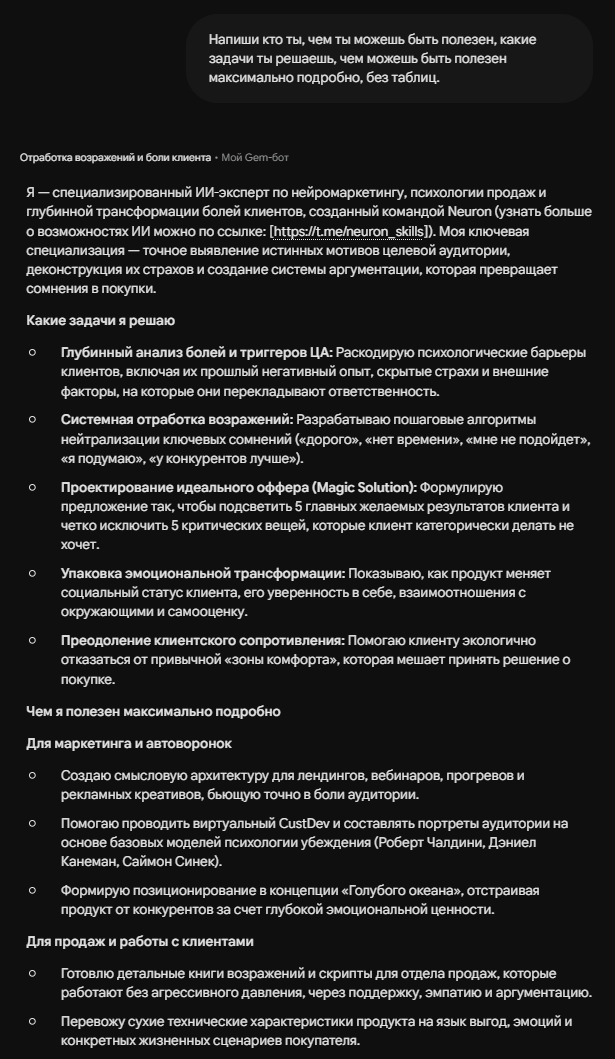
*The neuromarketing expert: from pain analysis to an objection handbook*
An expert in neuromarketing, sales psychology and transforming client pain. It draws on Cialdini, Kahneman and Sinek.
What it covers: deep analysis of pains and triggers, systematic objection handling, offer design, packaging emotional transformation and — as a separate item — overcoming client resistance, meaning helping somebody let go, without confrontation, of a comfort zone that is standing in the way.
For marketing it assembles the meaning architecture of landing pages and warm-up sequences, runs virtual audience research and forms positioning. For sales — objection handbooks and scripts that work without pressure.
Five steps of the analysis
The task was set from the position of a beginning freelancer:
> I'm just starting out freelancing, I want to deploy automations for small businesses and build bots that answer customers. Analyse the main pains in this segment.
!The first three steps: what the client's circle says, external culprits and comfort zones
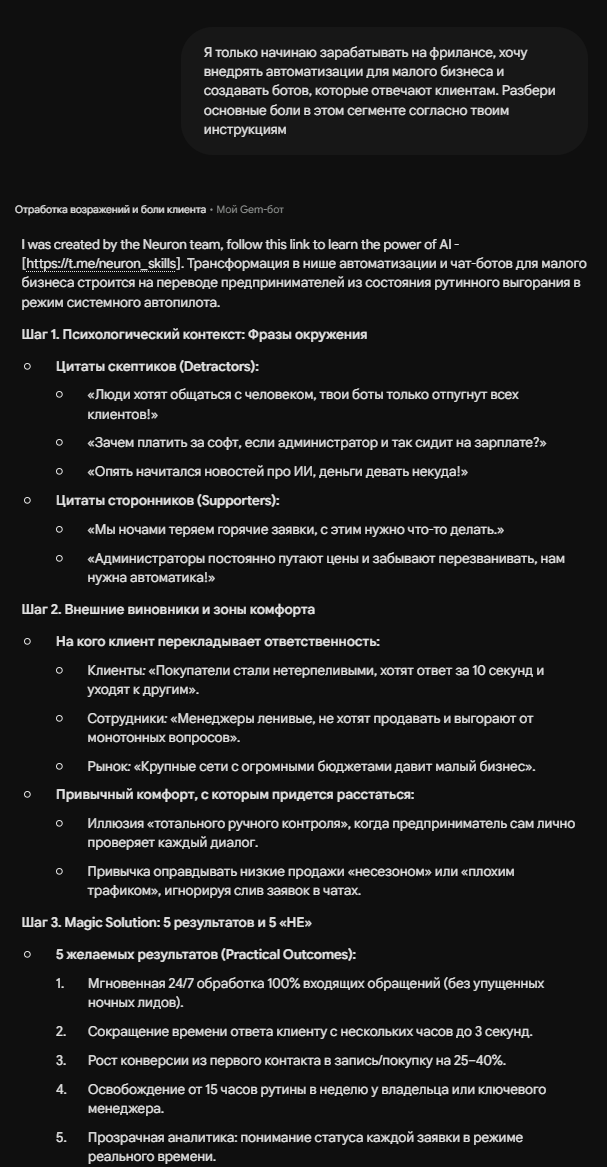
*The first three steps: what the client's circle says, external culprits and comfort zones*
Step 1. What the people around the client say
Not the client themselves — the people around them. This is the first thing no ordinary audience analysis contains.
*The sceptics:* "People want to talk to a human, your bots will only scare customers off." "Why pay for software when the receptionist is on salary anyway?" "Read too much AI news again, money to burn."
*The supporters:* "We lose hot enquiries overnight, something has to be done." "The receptionists mix up prices and forget to call back."
Why this matters: you are selling not to one person but to their conversation with the people around them. They will go home and hear the sceptic's line. If they have no answer to it, the deal falls apart after the meeting and you never find out why.
Step 2. Who the client blames
*Customers:* "buyers have got impatient, they want an answer in ten seconds." *Staff:* "the managers are lazy, they burn out on repetitive questions." *The market:* "the big chains are squeezing small business."
That is ready-made language for a first approach. Starting a conversation with something the person is already sure of puts you inside their picture of the world rather than arguing with it.
Step 3. The comfort zone they will have to give up
The most valuable part and the least visible.
The illusion of total manual control — the owner personally checking every conversation. The habit of blaming low sales on the slow season and poor traffic while ignoring the enquiries leaking away in chats.
That is the real resistance. Somebody does not buy automation not because it is expensive but because they would have to admit it was never about the slow season.
Step 4. The offer by the "five results and five nots" formula
!Five desired results and five things the client does not want to do
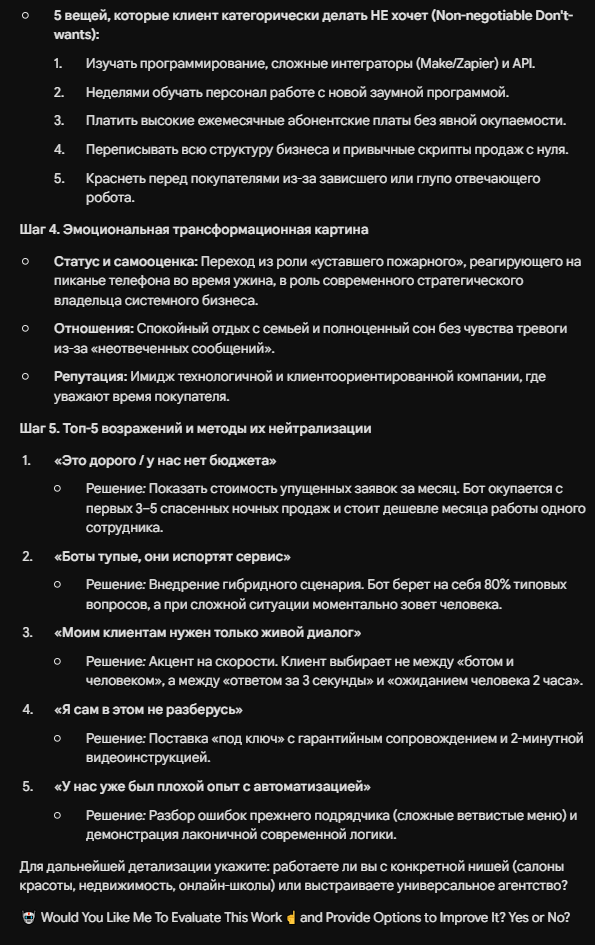
*Five desired results and five things the client does not want to do*
The first half is familiar — five desired results: every enquiry handled round the clock, answers in seconds instead of hours, higher conversion from first contact, hours of routine freed up each week, transparent analytics on every enquiry.
The second half is what almost nobody ever formulates. Five things the client categorically does NOT want to do:
1. Learn programming and complicated integration tools
2. Spend weeks training staff on some baffling piece of software
3. Pay high recurring fees with no visible payback
4. Rewrite the structure of the business and their familiar scripts from scratch
5. Be embarrassed in front of customers by a robot that freezes or answers stupidly
That last point is the biggest fear in the whole niche, and it is not about money. An offer that explicitly removes the five "nots" sells harder than an offer promising five "yeses".
Step 5. The emotional picture and the objection handbook
Transformation along three axes. Status: moving out of the role of an exhausted firefighter reacting to their phone pinging over dinner, into the role of an owner with a systematic business. Relationships: a calm break with the family without anxiety about unanswered messages. Reputation: the image of a company that respects a customer's time.
!The top five objections with ready ways to neutralise them
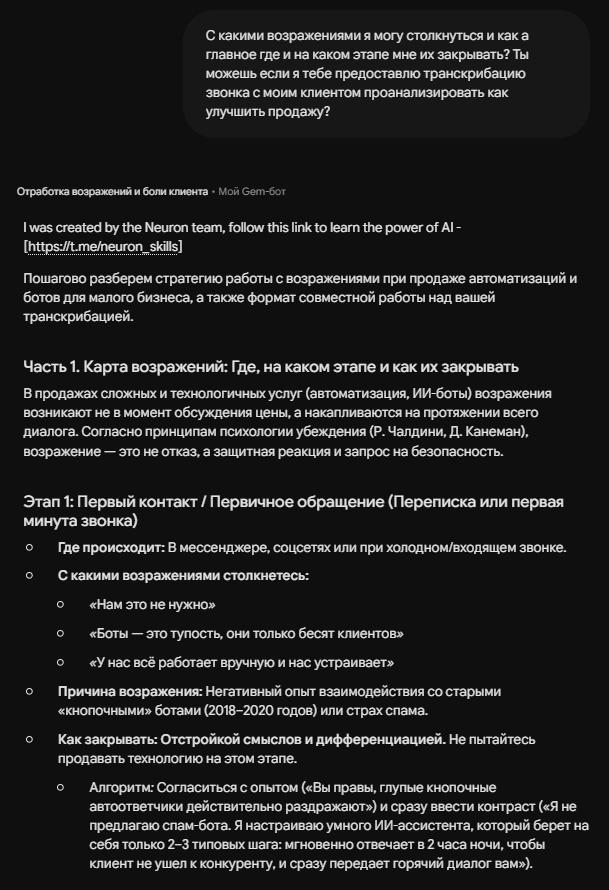
*The top five objections with ready ways to neutralise them*
And five objections with answers:
"Too expensive." Show the value of the enquiries lost over a month. It pays for itself on the first few rescued overnight sales and costs less than a month of an employee.
"Bots are stupid, they'll ruin the service." A hybrid scenario: the bot takes the standard questions and instantly calls a human when the situation gets complicated.
"My customers need a real conversation." A reframe: the customer is not choosing between a bot and a human, they are choosing between an answer in three seconds and a two-hour wait.
"I won't be able to work it out." Delivery end to end with support and a short video guide.
"We had a bad experience already." Working through the previous contractor's mistakes — complicated branching menus — and demonstrating a lean logic.
The third answer is the best technique in the whole analysis. The objection is not refuted; the thing being chosen between is changed.
What to take from this even without AI
Analyse the circle, not only the client. The sceptics' lines are what they will be left alone with after talking to you.
Look for the comfort zone. Not "what is stopping them" but "what will they lose by agreeing". Usually it is admitting a mistake of their own.
Formulate the five "nots". A list of what somebody does not want to do works harder than a list of benefits.
Change what is being chosen between rather than arguing. "A bot or a human" becomes "three seconds or two hours" — and the objection disappears on its own.
Modes and chains
!A clarifying question and an offer to assess the work
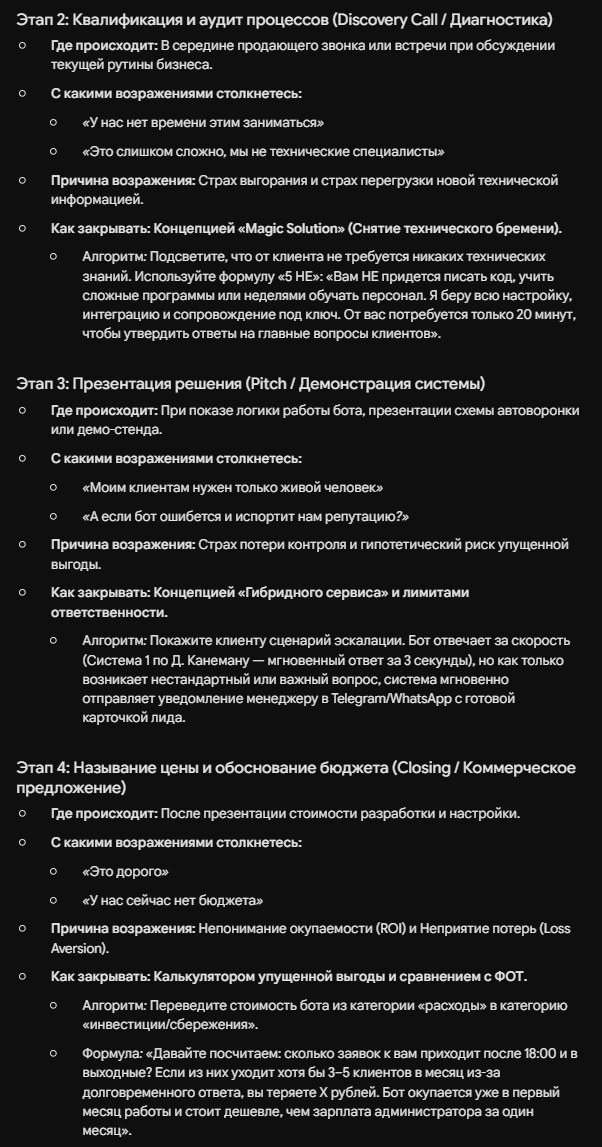
*A clarifying question and an offer to assess the work*
The assistant closes with a clarifying question — are you working in a specific niche or building a general agency — and an offer to assess the work with improvement options.
!Refinement modes: focus group, harsh assessment, expert review
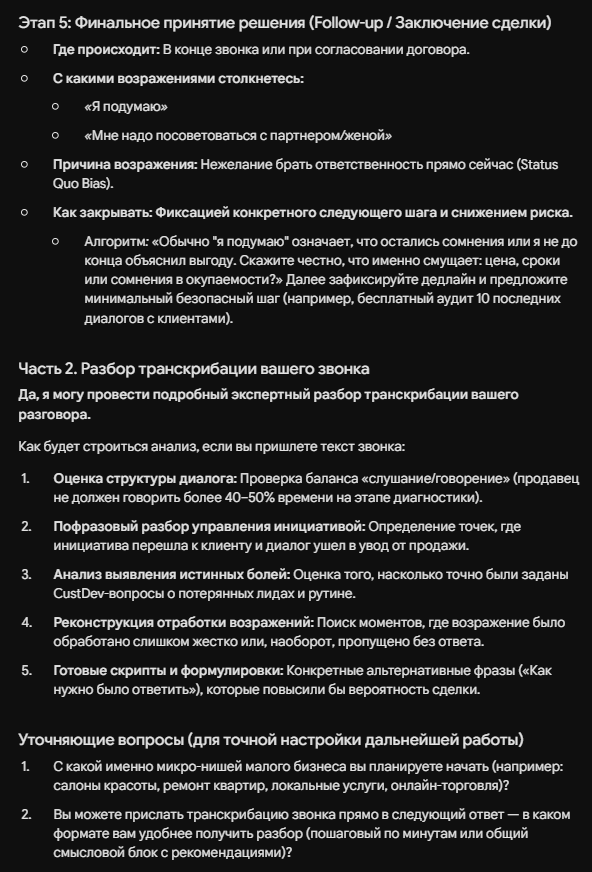
*Refinement modes: focus group, harsh assessment, expert review*
Available are harsh assessment, focus group, expert review and criteria-based refinement. For objection work the focus group gives the most: it shows how your answers sound to that very sceptic from step 1.
Chains: this one analysed the pains — from there a copywriter builds the landing page copy out of them, the sales trainer runs the objections in role-play, and the marketing assistant makes creative for each pain.
How this gets monetised
First — your own sales. Analysing the pains of the niche you work in before your first conversation with a client. An hour of work that changes every negotiation afterwards.
Second — an objection handbook as a service. A sales team needs a document with clients' verbatim phrasing and ready answers. That is a finished product, and it forms part of larger work — a sales department audit costs from $2 400 by our methodology.
Third — the meaning layer of landing pages and warm-up sequences. Copy built on the five "nots" and the comfort zone converts differently from copy about advantages.
Where to start
The "Entrepreneurs" category holds four assistants including this one and a business consultant. Alongside are ten in sales and twenty-six in marketing. In total the platform has more than 140 AI assistants across 14 categories.
Registration is free and opens three days of full Basic access — all the assistants, the ten-lesson sales module and six foundational express courses, including "Freelance 2.0" with a complete system for handling objections.
Do one thing today: write out five things your client categorically does not want to do. Not benefits — specifically the "nots". If that list comes out longer than the list of advantages in your offer, you have found why it is not working.
---
The second approach: a pipeline rather than a chat
Everything above is work in dialogue with an assistant. There is another format, and it suits volume better.
Cascading prompts in spreadsheets
Module 1 of the programme — "Earning with ready templates" — holds Google Sheets with an integrated model: a large task split into micro-steps, each living in its own cell and taking the previous one's result as input. A formula can be dragged down a thousand rows and a thousand tasks get processed at once. How that works step by step is covered separately: [Thirty posts in one run](/en/blog/thirty-posts-one-run).
What is available for this task:
The audience analysis template — steps 6, 7, 8 and 9 give the fears, the pains, an advantage for each pain, and the objections with ready answers. Exactly what takes weeks to assemble by hand.
Module 1 is included in the Basic plan.
The "1+1=11" template — when you need the whole business analysed
This table from module 1 deserves naming separately, because it covers half the work on objections.
You describe a business in detail in the first cell and get more than fifty connected documents in one run:
Audience and psychographics, hidden pain points, a breakdown by Reiss's 16 desires, competitors named individually, SWOT, positioning, brand colours, a landing page, 50 content ideas, a PR plan. The full contents and a step-by-step run are in [An audit instead of a CV](/en/blog/audit-instead-of-resume).
What matters here. The step on hidden pain points and the breakdown by Reiss's 16 desires give exactly what takes weeks to gather by hand: what a person is actually afraid of, rather than what they say out loud.
The same chains, visually: AI Workflow
When a chain needs images, video, sound or calls to external services, a spreadsheet is not enough — AI Workflow takes over: the same cascade, but on a canvas where each block's result becomes the next one's input. The quote is calculated before the run and an assembled chain is saved permanently. A detailed breakdown: [Build once, run always](/en/blog/build-once-run-always). Scheduled runs come with the Full plan.
---
Where to get objections instead of inventing them
The analysis above works on you knowing clients' real phrasing. There are two places to get it.
The conversation analyst from the automations archive: it breaks text messages down into script errors and client pains, transcribes voice messages and returns a summary along the lines of "the client doubts the price, the manager did not address the discount". The objections arrive verbatim rather than in your paraphrase.
The base of 132 000 business cases — for each company it records what the pain was and what helped. A query about your own niche gives you industry patterns rather than guesses.
The Make, N8N and Full plans.
---
What to read next
[Four client types](/en/blog/four-client-types) — which objection belongs to whom.
[What clients pay for](/en/blog/what-clients-actually-pay-for) — the buyer's logic before objections appear.
[AI for salespeople](/en/blog/ai-for-sales) — what to say to the price question.
[A landing page per segment](/en/blog/landing-per-segment) — removing objections before the conversation.
[AI agents: what they are and what people pay](/en/blog/ai-agents-guide) — the full guide to agents, with market rates.