AI for salespeople: a negotiation simulator and a review before the deal

The client's second message asks the price while the task has not been established — and more deals fall apart here than at every other stage. Below is a four-step formula for the answer, an explanation of why it works, and the self-checking modes that turn a first draft into a finished document.
The client's second message asks the price while the task has not been established — and more deals fall apart here than at every other stage. Below is a four-step formula for the answer, an explanation of why it works, and the self-checking modes that turn a first draft into a finished document.
---
The price question in the second message
The moment where more deals collapse than at all the others put together.
The client has written a second time and gone straight to it: how much? The task is unclear, the scope unknown, and you know nothing about their business.
Three reactions, and all three lose.
Name an exact figure. Without understanding the scope you will either work at a loss or frighten them with an unjustified number.
Dodge. "It's all bespoke, fill in this twenty-point brief" — this irritates people and makes it feel like you are stalling.
Ignore it and ask your own questions. The client senses manipulation.
There is a fourth option. Below is the breakdown from a real run, together with the psychological mechanics.
Who does the analysis
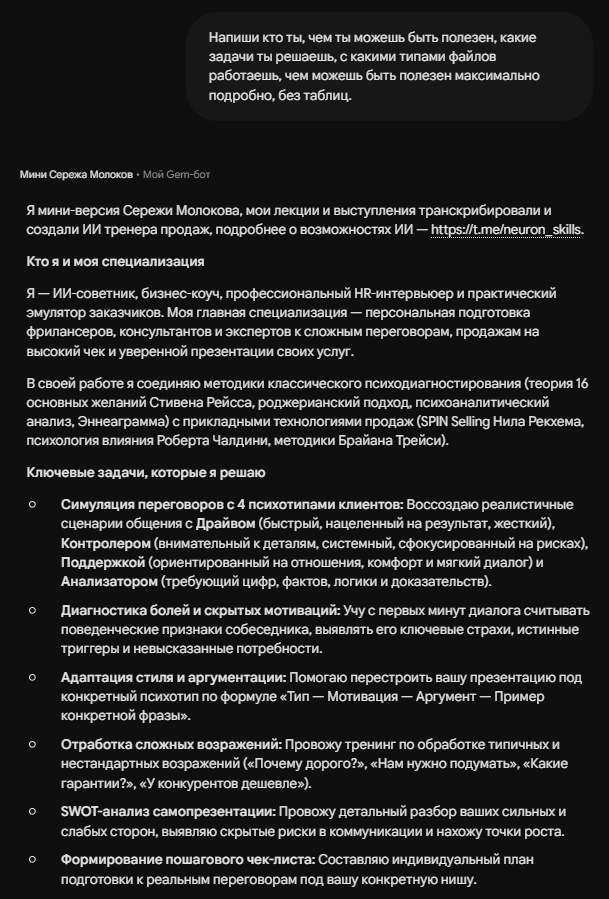
!The AI sales trainer: specialism, methods and the tasks it solves
*The AI sales trainer: specialism, methods and the tasks it solves*
The assistant is built on transcripts of lectures and talks by Sergey Molokov — the sales expert who runs our sales module. So it is not an abstract model but a specific practice laid out as a role.
At its base is a combination of psychological diagnosis (Reiss's theory of sixteen desires, the enneagram, the Rogerian approach) with applied sales technologies: Rackham's SPIN, Cialdini's influence, Tracy's methods.
What it can do by its own description: simulating negotiations with four client types, diagnosing hidden motivations, adapting the argument to the type, handling objections, a SWOT analysis of your self-presentation.
What it works with
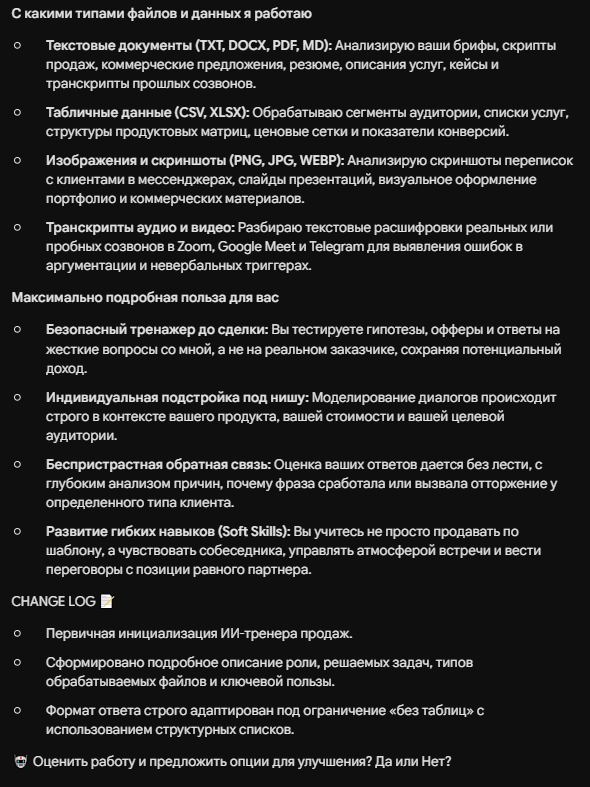
!File types: documents, spreadsheets, screenshots of message threads, call transcripts
*File types: documents, spreadsheets, screenshots of message threads, call transcripts*
This matters more than it appears. It accepts screenshots of client conversations and call transcripts — so it works on your real deal rather than on invented situations.
Show it a thread and you get an analysis of what to write next. Upload a transcript of a conversation and you get where you underperformed.
The formula for answering the price question
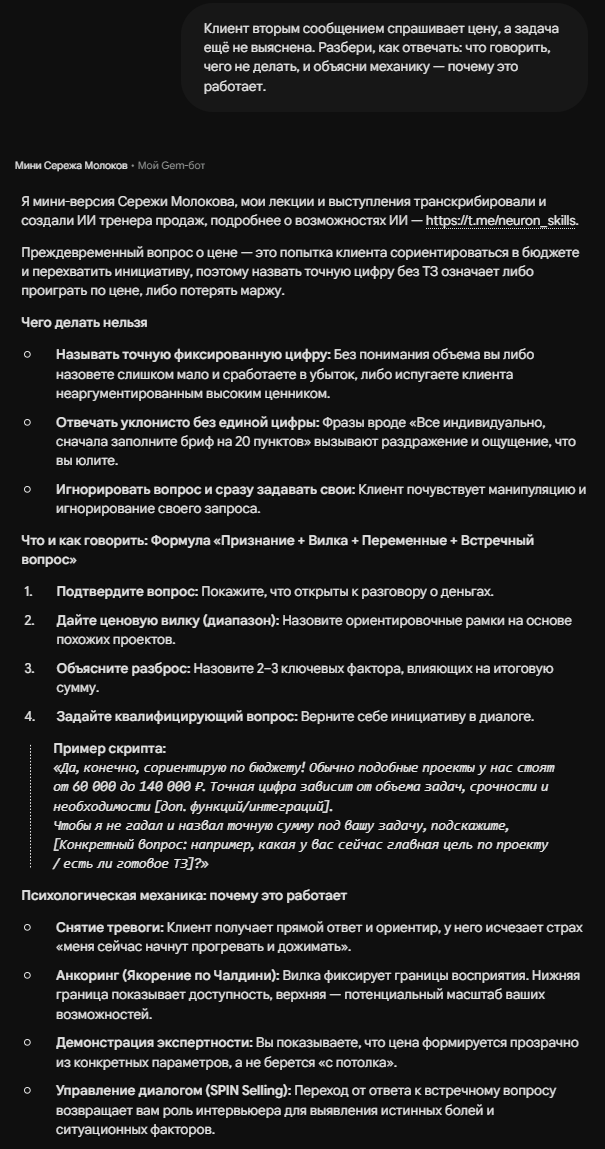
!The "acknowledge + range + variables + counter-question" formula with a ready script
*The "acknowledge + range + variables + counter-question" formula with a ready script*
Four steps, and the order matters.
1. Acknowledge the question. Show that you are open to talking about money. One sentence, but it removes half the tension.
2. Give a range. Indicative bounds based on similar projects. Not an exact figure and not silence — a range.
3. Explain the spread. Two or three factors the final number depends on: scope, urgency, additional integrations.
4. Ask a qualifying question. You take the initiative back.
How it sounds in full:
> "Yes, of course, let me give you a sense of the budget. Projects like this usually run from $700 to $1 700. The exact figure depends on the scope, the urgency and whether additional integrations are needed.
>
> So that I'm not guessing and can give you an exact number for your task — what is the main goal for the project at the moment, and is there a written brief?"
Why this works
The valuable part here is not the script but the explanation of the mechanics. Four effects, each with its own basis.
Relieving anxiety. The client gets a direct answer and a reference point. The fear of "now they'll start warming me up and pushing" disappears.
Anchoring. A range fixes the boundaries of perception: the lower end shows accessibility, the upper end the potential scale of what you can do. From then on any figure inside the range reads as justified.
Demonstrating expertise. The price forms transparently out of named parameters rather than being plucked from the air. For a client who counts money, that is the decisive signal.
Controlling the dialogue. Moving from an answer to a counter-question returns you to the role of interviewer — and from there the conversation follows your structure rather than theirs.
Nine refinement modes
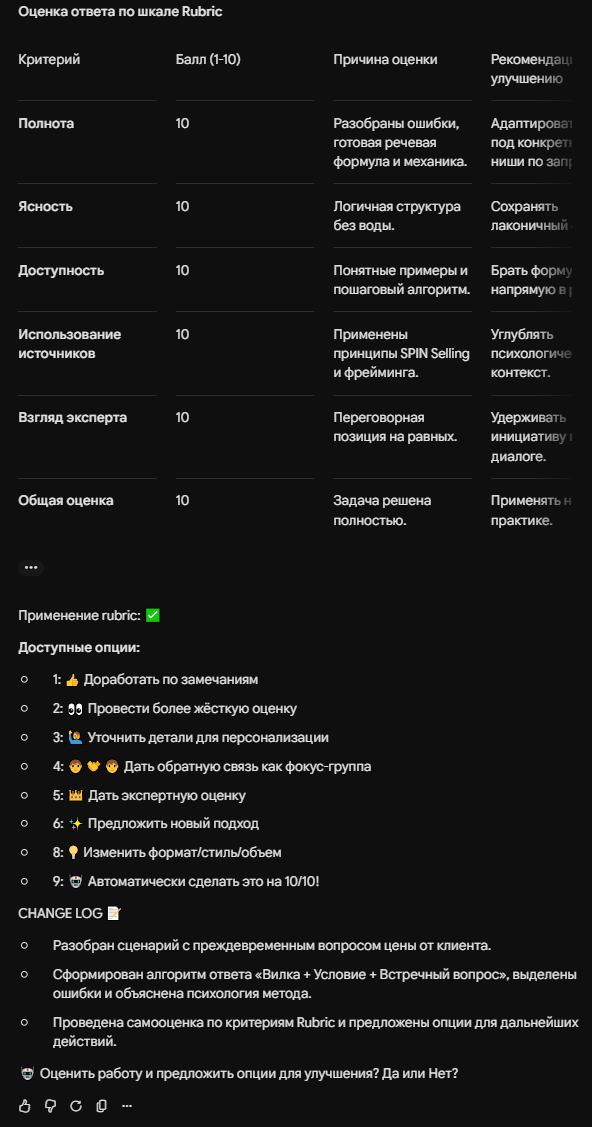
!Self-assessment against a rubric and the full list of available modes
*Self-assessment against a rubric and the full list of available modes*
Here is the thing almost nobody knows about, and it changes the whole way you work.
The assistant assessed its own answer against a rubric — completeness, clarity, accessibility, use of sources, expert perspective — with scores and reasoning for each criterion. And attached recommendations for improvement.
Then it offered nine modes:
- Refine against the notes
- Run a harsher assessment
- Clarify details for personalisation
- Give feedback as a focus group
- Give an expert assessment
- Propose a fresh approach
- Change the format, style or length
- Automatically take it to the maximum
Plus a separate changelog — exactly what was done in that answer.
The practical point. You do not rewrite your request ten times. You get the first answer, run the harsh assessment, then the focus group — and out comes a document that has been through three rounds of checking. Without your involvement beyond pressing a number.
For sales the focus-group mode is particularly useful: it shows how your script sounds to a client rather than to you.
A simulator instead of a live client
The most lucrative use and the reason to open this assistant at all.
It plays the client — with a specific type, their objections and their manner. A Driver decides on the fly and does not read to the end. A Controller demands deadlines and stages. A Supporter goes quiet under pressure. An Analyser takes time out and comes back with questions.
The same conversation gets run four times with four types. It becomes visible that the structure is the same and the tone is different — and where you were pushed over in each case.
A mistake in a simulation costs nothing. A mistake with a live client costs the deal.
Chains: how this fits into the work
The output of one assistant feeds the next.
Show it a listing and you get the client's type and a cover letter. Show it the client's reply and you get your next move. Run a call, upload the recording, and you get the analysis: what the client said about their losses, where you blurred the focus, which objection you failed to close. Out of that analysis the proposal gets built.
This is not a "clever chat". It is a process where each step eats the result of the previous one.
How this gets monetised
First — your own deals. Not freezing on the price question and leaving a call not with "we'll think about it" but with a next step agreed.
Second — auditing somebody else's sales department. A full transcription of recordings, tagging by conversation stage, the funnel inside a call, the point where it breaks, a bank of objections verbatim. Work like that costs from $2 400 — that is the price by our methodology, not market statistics. It used to be limited by person-hours; now an archive of three hundred conversations gets processed in hours.
Where to start
The "Sales" category holds ten assistants: a sales trainer, a sales expert, a sales analyst, a digital funnel analyst, selling through your immediate circle, a business development manager and others. In total the platform has more than 140 AI assistants across 14 categories.
Alongside is Sergey's own ten-lesson sales module: four client types, handling objections, rejections, burnout, shaping an offer around demand, selling without case studies.
Registration is free and opens three days of full Basic access — all the assistants, the sales module and six foundational express courses.
Do one thing today: take a thread where you were asked the price and everything went quiet, and show it to the assistant. The analysis takes a minute and usually names the exact step where you gave up the initiative.
---
The second approach: a pipeline rather than a chat
Everything above is work in dialogue with an assistant. There is another format, and it suits volume better.
Cascading prompts in spreadsheets
Module 1 of the programme — "Earning with ready templates" — holds Google Sheets with an integrated model: a large task split into micro-steps, each living in its own cell and taking the previous one's result as input. A formula can be dragged down a thousand rows and a thousand tasks get processed at once. How that works step by step is covered separately: [Thirty posts in one run](/en/blog/thirty-posts-one-run).
What is available for a salesperson:
The audience analysis template — steps 6, 7 and 9 give the fears, the pains and the objections with ready answers for each segment. That is a finished objection handbook assembled in a couple of minutes instead of a week.
Module 1 is included in the Basic plan.
The same chains, visually: AI Workflow
When a chain needs images, video, sound or calls to external services, a spreadsheet is not enough — AI Workflow takes over: the same cascade, but on a canvas where each block's result becomes the next one's input. The quote is calculated before the run and an assembled chain is saved permanently. A detailed breakdown: [Build once, run always](/en/blog/build-once-run-always). Scheduled runs come with the Full plan.
---
A ready solution: the conversation analyst
Going through threads and calls by hand is impossible — neither a salesperson nor a manager has the time.
The Telegram conversation analyst from the automations archive does it itself. A text message — the model breaks it down into script errors and client pains. A voice message — it gets transcribed, and back comes a summary along the lines of "the client doubts the price, the manager did not address the discount".
What that gives you. You see the weak points immediately rather than at the end of the month when the till is already empty.
And how it sells. Deploying an analyst like that in an online school or a sales department costs $360–1 200. You are not selling a bot — you are selling control over the revenue.
The Make and Full plans.
---
What to read next
[Four client types](/en/blog/four-client-types) — how to change your pitch for a particular person.
["How much does it cost" — what to say](/en/blog/what-to-answer-about-price) — three more techniques for the same question.
[The fifteen-minute client call](/en/blog/fifteen-minute-sales-call) — a conversation script across five stages.
[An X-ray of your calls: auditing a sales department](/en/blog/sales-calls-audit) — the same skill sold to a company.
[AI agents: what they are and what people pay](/en/blog/ai-agents-guide) — the full guide to agents, with market rates.