AI for journalists: from an hour-long interview to the structure of a piece
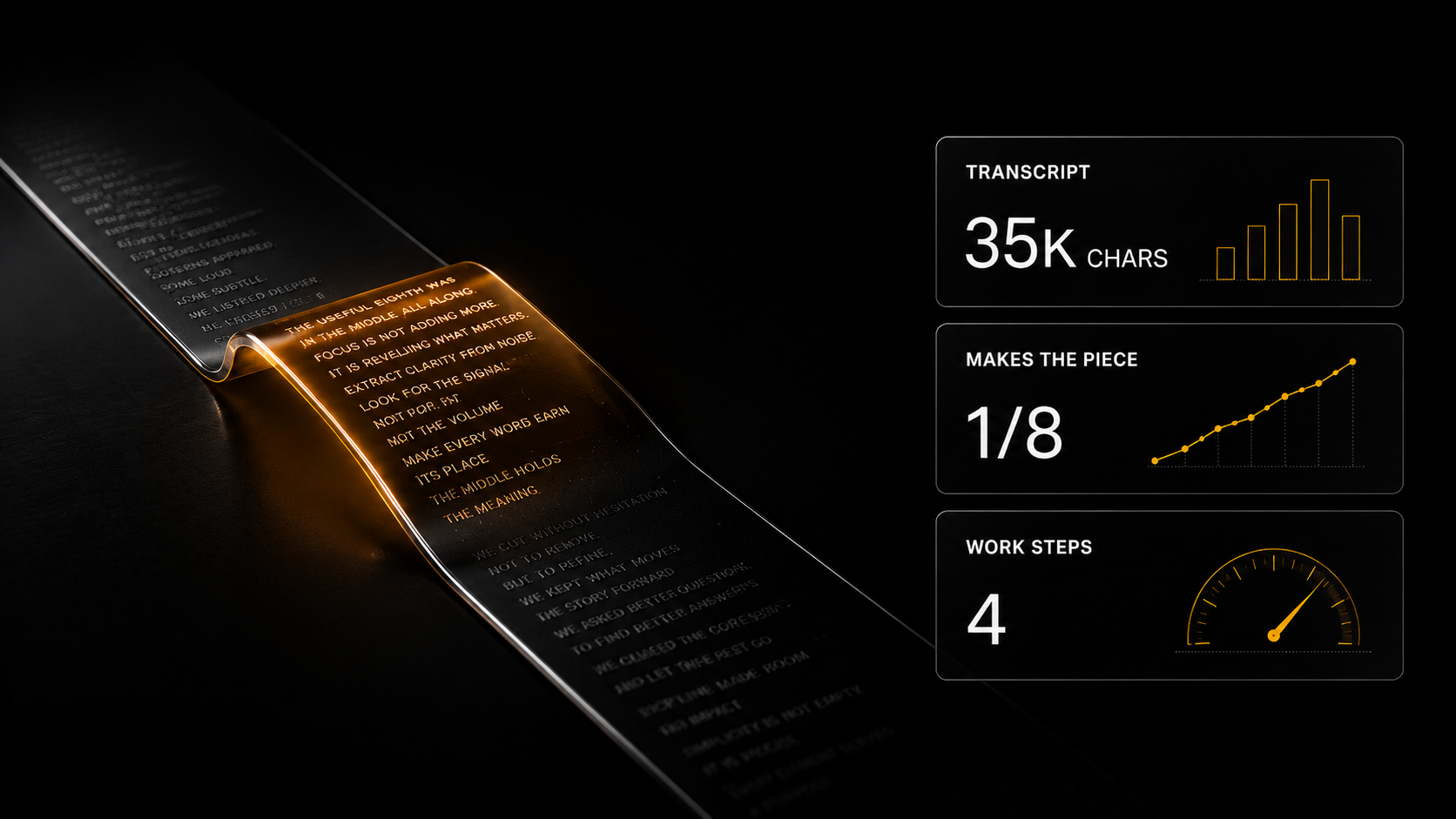
The transcript of an hour-long interview is thirty-five thousand characters of speech, of which an eighth will make the piece. Following the flow of the conversation does not work: the speaker said the important thing at minute forty-five. Below is the order of work, the rules for selecting quotes, and the signs by which you cut.
The transcript of an hour-long interview is thirty-five thousand characters of speech, of which an eighth will make the piece. Following the flow of the conversation does not work: the speaker said the important thing at minute forty-five. Below is the order of work, the rules for selecting quotes, and the signs by which you cut.
---
Forty thousand characters of transcript and no idea where to start
The interview went well. An hour of conversation, the speaker opened up, there are figures and living stories.
Then you open the transcript — thirty-five to forty thousand characters of speech — and realise there is at most an eighth of an article in there, and that eighth still has to be found.
Then begins what eats a day: reading straight through, trying to follow the flow of the conversation, copying out whatever appealed. By evening you have a retelling of the conversation in chronological order — and that is the worst possible format, because the speaker said the important thing at minute forty-five.
The mistake is in the approach itself. Chronology has to be thrown out immediately.
Who does the analysis
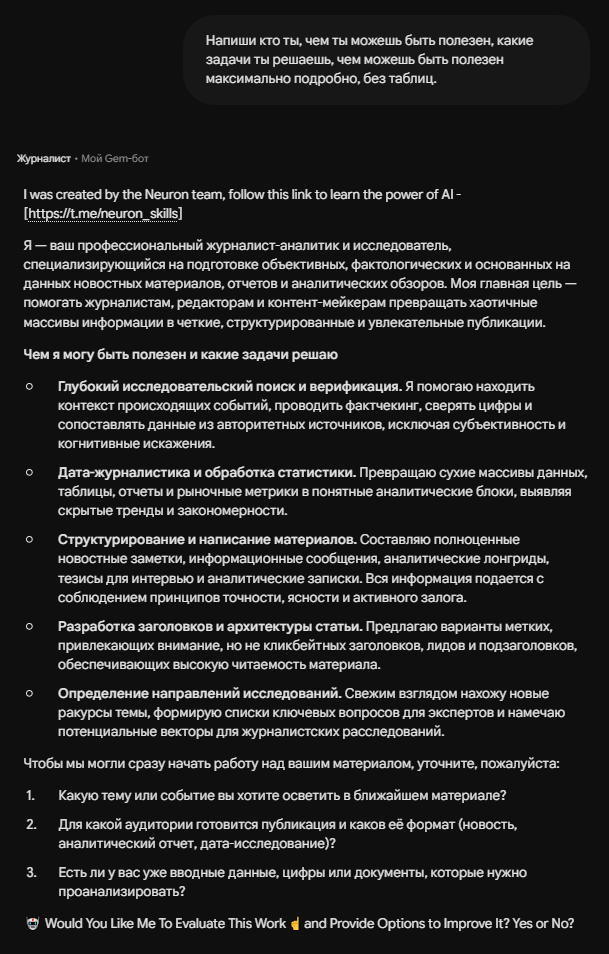
The analytical journalist from the catalogue.
!The analytical journalist: from fact-checking to article architecture
*The analytical journalist: from fact-checking to article architecture*
What it covers: research and verification, data journalism — turning tables and reports into analytical blocks, structuring and writing pieces, developing headlines and architecture, finding new angles on a subject.
Worth noting the wording on headlines separately: sharp and attention-grabbing but not clickbait. The constraint is written into the role itself.
And it immediately asks three questions: what is the subject, for which audience and in what format, and is there any input data to analyse.
The order of work
The task came with no transcript attached:
> Explain how to build the structure of a piece from an hour-long interview. The order of work, what to extract first, how to select quotes and on what basis to cut.
!Four steps for working with a transcript and extraction priorities
*Four steps for working with a transcript and extraction priorities*
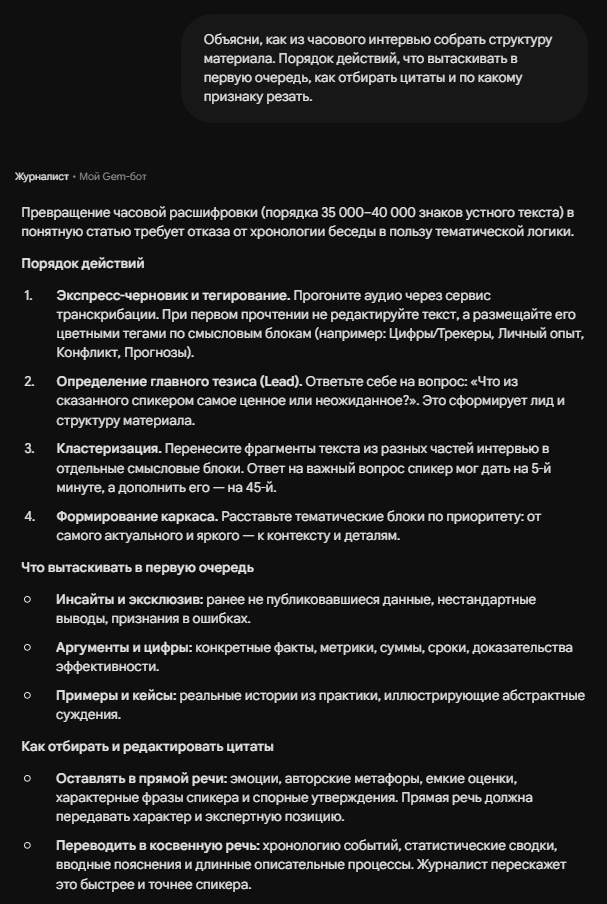
The first thing it stated was the principle: abandon the chronology of the conversation in favour of thematic logic. Everything else follows from that.
Step 1. Rapid pass and tagging
On the first read, do not edit. Only tag with colours by theme: figures, personal experience, conflict, predictions.
This is the key point and everybody breaks it. Trying to edit the text straight away means you get stuck on the second page and lose the overall picture.
Step 2. The central claim
One question to yourself: what of everything said is the most valuable or unexpected? The answer shapes both the intro and the whole structure.
Step 3. Clustering
Move fragments from different parts of the interview into shared thematic blocks. The assistant's phrasing is precise: the speaker may have answered an important question at minute five and added to it at minute forty-five.
That is exactly why chronology does not work: in speech a thought assembles from pieces scattered across the whole conversation.
Step 4. The frame
Arrange the blocks by priority — from the most current and vivid to context and detail.
What to extract first
Three categories, in order of value:
Insights and exclusives — previously unpublished data, unconventional conclusions, admissions of mistakes. The last is the most underrated: an account of one's own failure gives a piece a credibility no expert assessment will.
Arguments and figures — concrete facts, metrics, sums, timescales.
Examples and cases — real stories that illustrate abstract judgements.
How to select quotes
The rule is simple and almost nobody follows it.
Keep as direct speech: emotion, the speaker's own metaphors, pithy assessments, characteristic phrases and contentious claims. Direct speech carries character and position.
Convert to reported speech: chronologies of events, statistical summaries, introductory explanations, long procedural descriptions. Here a verbatim quote does harm — a journalist will retell it faster and more precisely than the speaker.
A piece where everything is in quotation marks reads heavily for exactly that reason: half the quotes carry no voice, only length.
On what basis to cut
!Four signs for cutting spoken text
*Four signs for cutting spoken text*
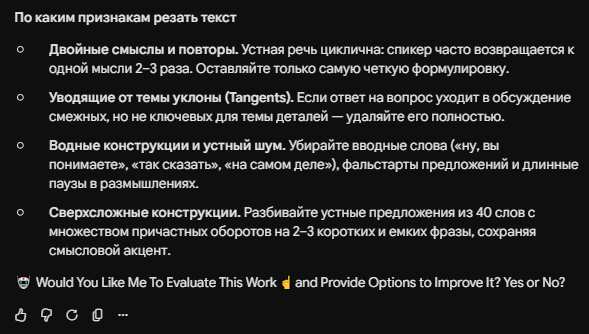
Four signs, and together they remove most of the length:
Duplicated meanings and repetition. Speech is cyclical — a speaker returns to one thought two or three times. Keep the clearest formulation.
Digressions. An answer that wandered into adjacent but non-essential detail gets deleted entirely rather than shortened.
Filler and verbal noise. "You know", "so to speak", "actually", false starts, thinking-out-loud pauses.
Over-complicated constructions. A spoken sentence of forty words with subordinate clauses gets broken into two or three short ones with the emphasis preserved.
What to take from this even without AI
Tag before editing. The first read is tagging only. Edits at that stage reliably eat a day.
Clustering instead of chronology. A thought assembles from pieces across the whole conversation.
Admissions of mistakes first. The most valuable type of material and the most rarely used.
Reported speech for facts, direct speech for voice. That rule alone cuts a piece by a quarter and makes it readable.
Where the assistant helps most
Handling volume. The whole transcript gets handed over, and that is the most reliable mode of working: when all the material comes from you, there is nothing to invent.
Clustering. Finding every fragment about one thing across forty thousand characters is mechanical work where a human tires and misses things.
Headline and intro options — with the anti-clickbait constraint written into the role.
And the thing humans do not do — finding contradictions inside the interview: where the speaker said one thing and something else forty minutes later. That is either a transcription error or the most interesting question for a follow-up call.
The compulsory caveat
Everything verifiable gets verified. Figures, dates, names, job titles, quotes — against sources, not against the model's memory.
Separately: the assistant must not invent anything that was not in the interview. Phrasing your request as "work only from the attached text; if the answer is not in it, say the data is insufficient" is compulsory for this profession.
Modes and chains
The answer ends with an offer to assess the work and suggest improvement options. There is a focus-group mode — how the piece reads through your audience's eyes — plus harsh assessment and refinement against criteria.
Chains: this one assembled the structure and the quotes — from there a copywriter makes versions for social media and the presentation assistant makes cards for the channels. One hour of interview becomes an article, a series of posts and a clip.
How this gets monetised
First — speed. A day of work with a transcript compresses to an hour, and the structure comes out better because it is built by priority rather than by the flow of the conversation.
Second — as a service. Processing interviews and podcasts for experts and companies: transcription, structure, article, cuts for each platform. From my scrape of 848 listings, this is work at the junction of text and content, and it sells as a package rather than by the piece.
Where to start
The "Media" category holds nine assistants: an analytical journalist, a general scriptwriter, a copywriter, an academic editor, a TED presentation specialist, a TED editor for Telegram, business presentations by the Minto method and others. In total the platform has more than 140 AI assistants across 14 categories.
Registration is free and opens three days of full Basic access — all the assistants and six foundational express courses, including "Perplexity as an investigative tool" for fact-checking.
Do one thing today: take your most recent transcript and tag it, editing nothing. Twenty minutes. Usually at that step alone it becomes clear the central claim was not where you thought.
---
The second approach: a pipeline rather than a chat
Everything above is work in dialogue with an assistant. There is another format, and it suits volume better.
Cascading prompts in spreadsheets
Module 1 of the programme — "Earning with ready templates" — holds Google Sheets with an integrated model: a large task split into micro-steps, each living in its own cell and taking the previous one's result as input. A formula can be dragged down a thousand rows and a thousand tasks get processed at once. How that works step by step is covered separately: [Thirty posts in one run](/en/blog/thirty-posts-one-run).
What is available for a journalist:
A copywriting template — from subject to finished text along a chain. A social media template — one piece of material unfolds for every platform.
Module 1 is included in the Basic plan.
The same chains, visually: AI Workflow
When a chain needs images, video, sound or calls to external services, a spreadsheet is not enough — AI Workflow takes over: the same cascade, but on a canvas where each block's result becomes the next one's input. The quote is calculated before the run and an assembled chain is saved permanently. A detailed breakdown: [Build once, run always](/en/blog/build-once-run-always). Scheduled runs come with the Full plan.
---
Ready pipelines for content
URL → script. You paste a link to a piece — the model visits the page, works through the content and writes a 30–45 second script. For a journalist that is a way to repackage somebody else's material into your own format quickly.
A smart digest maker — it gathers a fresh feed on a subject and updates a mini-site itself. For an analyst or an editor that is a permanently current selection with no manual digging.
Plus module 7, "Editing" — eighteen lessons, of which two matter most for somebody working in text: why 7 out of 10 clips get maximum reach, and a breakdown of the first two seconds. What determines whether people read to the end works the same way in text and in video.
The archive is on Make and Full; module 7 on Plus.
---
What to read next
[Transcription and file analysis](/en/blog/transcription-and-file-analysis) — the whole reverse direction of working with AI.
[Finding trends](/en/blog/finding-trends) — what to write about besides what the speaker already said.
[Editing expert video](/en/blog/expert-video-editing-pipeline) — what else comes out of the same recording.
[Checking a fact with AI search](/en/blog/fact-checking-with-ai) — the compulsory step before publishing.
[AI agents: what they are and what people pay](/en/blog/ai-agents-guide) — the full guide to agents, with market rates.