Editing expert video: putting a flow in place of manual work
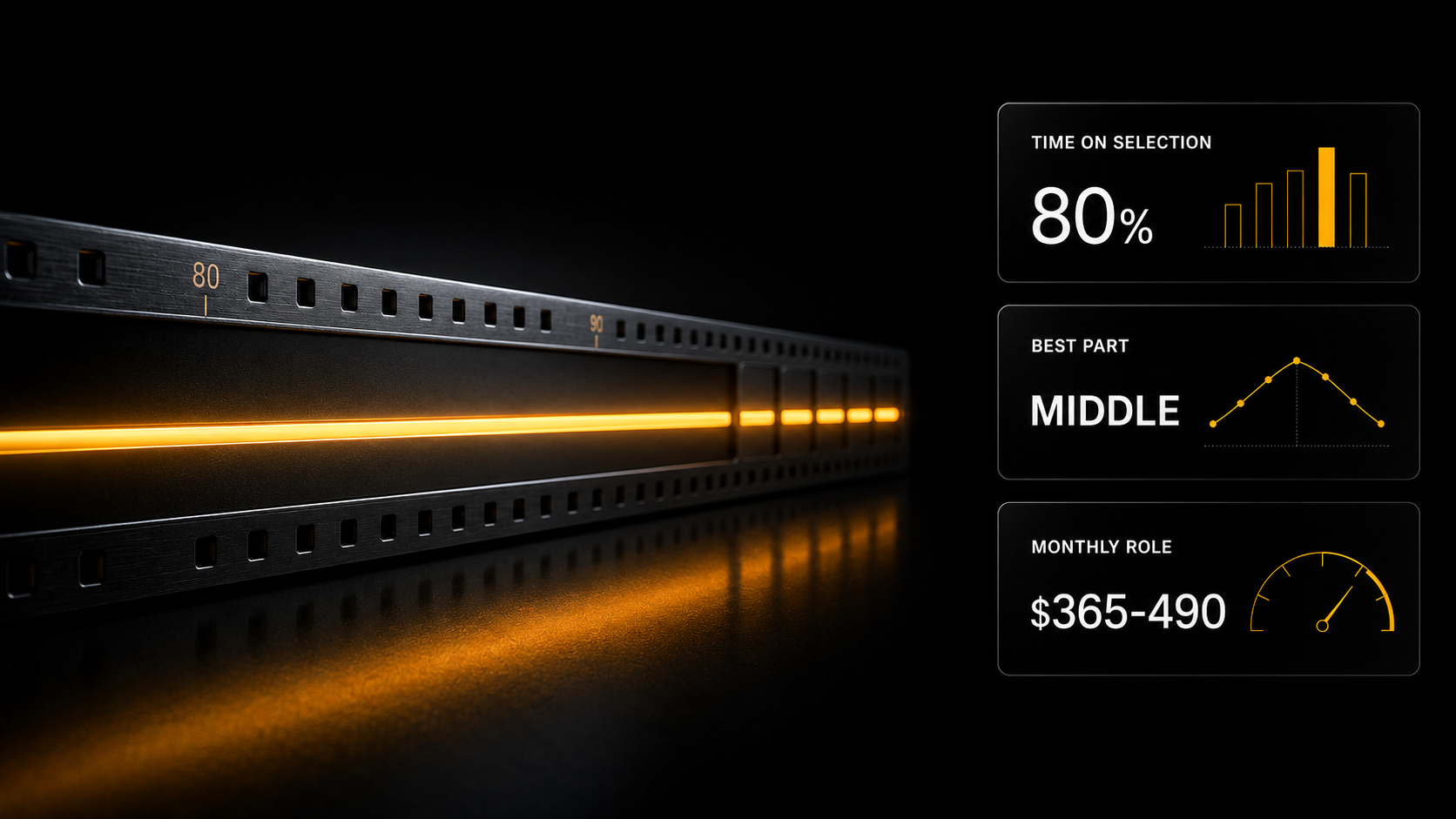
One hour of recording yields one or two clips, because cutting it takes a week. The most valuable material is usually in the middle, where nobody gets to. Below is where the time actually goes, and a pipeline that removes eighty per cent of the work.
One hour of recording yields one or two clips, because cutting it takes a week. The most valuable material is usually in the middle, where nobody gets to. Below is where the time actually goes, and a pipeline that removes eighty per cent of the work.
---
Filmed an hour, published one clip
A familiar story for an expert or whoever runs their social media.
You recorded an hour-long talk or interview. The material is good, there are plenty of thoughts. Now it has to be cut into short clips.
And it turns out that is a separate job: rewatch the hour, find self-contained fragments, cut out pauses and slips, add subtitles, pick a thumbnail, format for the platform.
One clip takes an hour to an hour and a half. Ten takes a working week.
So one hour of filming yields one or two clips and the rest sits there dead. And the most valuable part is often in the middle, which nobody reached.
Where the time actually goes
Let us break it down, because not everything needs automating.
Watching and finding fragments. The longest part. An hour of material has to be listened to in full, preferably twice.
Selection. Working out which piece stands alone and which is incomprehensible without context.
Rough cutting. Removing pauses, slips, filler, false starts.
Presentation. Subtitles, thumbnail, platform format.
Checking. Looking at what came out.
The first two parts are eighty per cent of the time and zero creativity. Those are the ones that get removed.
What the pipeline does
The order of steps, each handing its result to the next.
Step 1. Transcription
Audio or video becomes text with timestamps. An hour of material takes minutes to process.
What that changes immediately: from then on you are working with text rather than a video file. Text reads in ten minutes rather than taking an hour to listen to.
Step 2. Finding self-contained fragments
The model gets the transcript and looks for pieces that work apart from their context: a complete thought, comprehensible without the previous ten minutes.
The criteria worth setting explicitly: duration within the platform's format, a hook in the first seconds, a completed thought, no references to what came before.
Without explicit criteria the model will simply cut by subject and half the pieces will be unusable.
Step 3. Timestamps
For the fragments found, exact start and end timecodes.
This is where the manual work ends. From here you are not searching but collecting finished segments.
Step 4. Copy and thumbnails
From the same material, a headline for each fragment, a description, thumbnail text.
The first-seconds rule matters here: a figure in the first line, the failure shown first, the direction named. What decides whether somebody stops or scrolls.
Step 5. Presentation and assembly
Subtitles, the platform format, vertical or horizontal, duration.
Step 6. Publishing
The finished pieces go out to social media — that is a chain block too: Instagram, TikTok, YouTube, Facebook, X, LinkedIn, Threads, Pinterest.
What stays with a human
The honest part, because "fully automatic" does not work here.
Choosing from what is offered. The model found twenty fragments — which of them are yours is your decision. An "approval" block goes into the chain for that: it reaches the finished list, stops and waits for you.
Checking the meaning. A piece torn from its context sometimes reverses its sense. Only a human catches that.
A final look. Particularly if the material is expert and the cost of an error is reputation.
The right construction: everything automated except the decision. The machine does the volume, you make the decision.
What that gives in figures
Before: an hour of filming → a week of work → ten clips, half of which never went out.
After: an hour of filming → an hour of work → twenty fragments to choose from, ten of them into production.
The key point is not even the speed. It is that you finally reach the middle of the material. The most valuable pieces are usually there, and previously they simply did not survive to the cutting stage.
And a second consequence: filming becomes cheaper per unit of content. An hour of recording yielding twenty clips is entirely different economics from an hour yielding two.
How this sells
Who buys. Experts who speak and record but do not run their social media. Companies with webinars and recordings. Podcasts. Anybody with an archive sitting idle.
The argument that works. Not "I'll cut it up" but "you have an archive with six months of content in it". Clients like that always have an archive; they are aware it exists and unaware of its value.
What gets delivered: the transcript, a list of fragments with timecodes, the cut clips with subtitles, headlines and descriptions, a publishing plan.
The price range. By my scrape of 848 listings: editing supplied material — $12–35, a short clip — $18–45, AI video end to end — $245–550. The median for one-off work is $30–75.
The difference between the first and last lines is not about the difficulty of editing. It is about what gets sold: cutting one clip, or a flow put in place — the archive worked through, a publishing plan in place, the process repeating every month.
Where the money mostly is: in the flow. A one-off cutting job ends. Monthly processing of new recordings does not. In my dataset, 21.9% of clients are looking for somebody long-term and 20.3% mention a flow.
Separately: a salary rather than piecework
There is another format for this work that few people think about.
By my dataset, some clients hire not for a task but by the month. A short-form video manager and an online assistant — $365–490 a month. A content assistant — $100–180.
For somebody with no flow of clients but with cutting skills, that is a stable way in: one company, a clear volume, predictable money. And a first serious case study usually grows out of it.
What is available on the platform
Gen AI, the "file → text" mode — speech transcription with subtitles, recognising text from an image, analysing video and audio. The cost per generation is $0.15.
The video editor — 39 models: extending, editing adjustments, upscaling, working with watermarks.
AI Workflow — assembling the whole chain: transcription → finding fragments → copy → presentation → publishing. An "approval" block for stopping at your decision, an iterator for bulk-processing the list of fragments.
There is a ready "video by scenes" template of six steps, and "Telegram posts: cleaning out AI clichés" of ten — if the same material also has to produce copy.
The quote is visible before the run, charging follows the steps actually completed, money comes back for anything not delivered. The run continues on the server even if you close the tab.
Scheduled runs come with the Full plan. Useful if recordings appear regularly.
The media assistants — nine of them, including the analytical journalist: it works through a transcript and assembles a structure. From the Basic plan.
Registration is free and opens three days of full Basic access.
Where to start today
One action. Take one of your recordings — a talk, a webinar, an interview — and run it through transcription.
Do not cut it. Simply read the text and mark how many completed thoughts in it work on their own.
Usually there are fifteen to twenty in an hour-long recording. That is the archive that has been sitting dead until now.
---
What exactly the editing module covers
Eighteen lessons, and three of them change the result more than the rest.
Why 7 out of 10 clips get maximum reach. The rule is stated in one line: something has to happen in the video every second and a half to two seconds.
A push in, a pull out, large text, text behind the head, footage, a background sliding in — what does not matter, the frequency does. The reason is simple: a viewer's eye is used to clip thinking and starts getting bored on the third or fourth second if nothing changes.
An analysis of the first two seconds. Those are what catch somebody scrolling a feed. The lesson works through ten real clips, including one that got two million views, and techniques like revealing text in sequence with each new element receding and blurring.
Analyses of other people's editing — not theory but a frame-by-frame breakdown of what works for people with large reach.
Plus the rest: footage, masks, subtitles and fonts, background animation, transitions, sound effects, colour grading and retouching, composition from footage.
Module 7 comes with the Plus plan.
And the alternative when the volume will not go by hand
The digital department from the automations archive assembles a clip in full: script, photo, animation, narration, joining with subtitles, publishing. Cost $2.50–3, up to 100 clips a day.
What to choose. Expert clips with a live speaker get edited by hand — there the delivery decides. Bulk content for a network of accounts goes by pipeline. Those are different tasks and one does not replace the other.
---
What to read next
[Transcription and file analysis](/en/blog/transcription-and-file-analysis) — the technical basis of the pipeline.
[A short-form video manager: monthly work](/en/blog/reels-manager-salary) — who this skill sells to by the month.
[AI for journalists](/en/blog/ai-for-journalist) — how a structure gets built from a recording.
[Thirty posts in one run](/en/blog/thirty-posts-one-run) — how to process a whole recording at once.
[AI video generation in 2026](/en/blog/ai-video-generation-guide) — the full guide to video models.