"I'm not convinced there's money in this" — here is the market over 24 days, in full
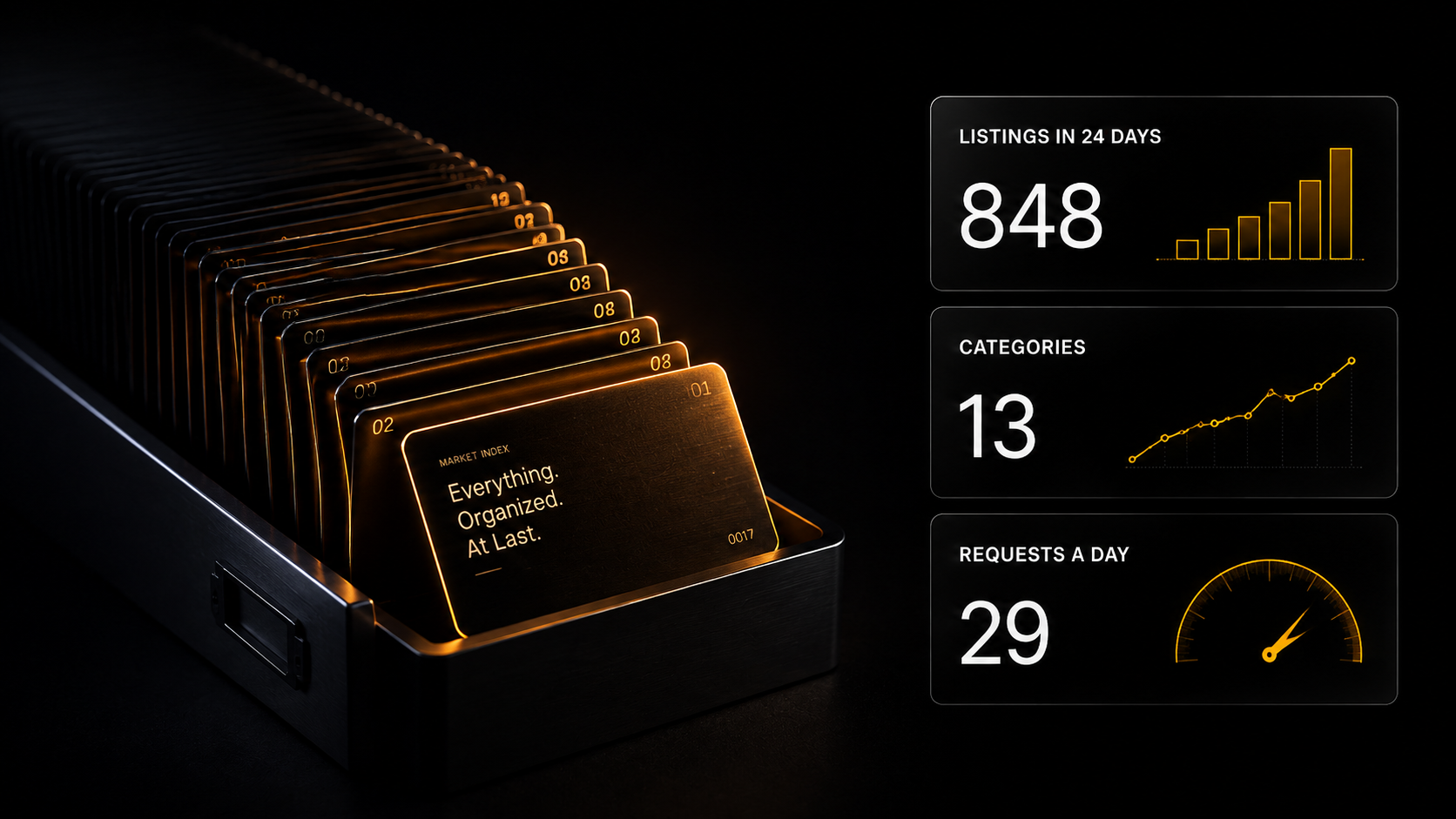
"I'm not convinced there's money in this" is an objection you answer with a dataset rather than with promises. Below is the market over 24 days in full: 848 listings, 13 categories, 29 unique requests a day, with prices and honest caveats about what in the data can be trusted.
"I'm not convinced there's money in this" is an objection you answer with a dataset rather than with promises. Below is the market over 24 days in full: 848 listings, 13 categories, 29 unique requests a day, with prices and honest caveats about what in the data can be trusted.
---
A doubt more honest than optimism
The objection from my survey, verbatim: *"I'm not convinced you can actually earn from this"*.
And you know what — that is a healthy doubt. Somebody sees a feed full of promises about easy money from AI and sees not one piece of evidence. Their own data says the opposite: of sixty-two respondents, 54.8% have not earned a dollar, another 37.1% only once, and for nobody has AI become their main income.
Answering that with motivation is pointless. The only honest answer is to show the market as it is and let the person decide.
So there will be no promises here. There will be a dataset.
What this data is
I wrote a scraper and take the job feed in full rather than sampling. 848 listings over 24 days across 13 categories. 29 unique jobs a day from one source.
The limits of the data first, so you know what to trust:
- An explicit budget appears in 6% of listings — 53 out of 848. In the other 94% the price gets named by the freelancer.
- By category there are between 2 and 15 observations with a budget. The overall median is reliable; the breakdown by row is a guide.
- 19% of listings are repeats: the same thing under different names. There are fewer real jobs than there are lines in the feed.
- The scraper has no "development" category, so the share of websites and apps is understated.
That is everything you need to read the figures below without illusions.
What gets commissioned and for how much
| Work | Range |
|---|---|
| Editing supplied material | $12–35 |
| An image individually | $12–35 |
| A short clip | $18–45 |
| A logo | $25–90 |
| A 2–3 minute animation | $25–110 |
| AI video end to end | $245–550 |
| A set of marketplace listing images | $245–730 |
| A multi-page website | $245–730 |
| A system or pipeline | $490–1 460 |
The median for one-off work is $30–75.
Separately, those hiring not for a task but by the month: a content assistant $100–180/month, a short-form video manager and an online assistant $365–490/month, an AI specialist $610–850/month.
How to read this properly
First: the upper bound is not your income tomorrow. The $1 460 for a system goes to somebody who has built systems before. You will start at the bottom of the table, and that is normal.
Second: the lower bound is a floor, not a recommendation. The dataset contains a client paying $9 for a clip and writing in the same text that this is above market. Against a median of $30–75. People agree because they have nothing to compare against.
Third: one-off work runs into hours. More money means more clips, and so on to the limit. The real jump happens not when you raise your per-item rate but when you change the unit: from a clip to a packaged service.
And fourth, the most important: 21.9% of clients are looking for somebody long-term and 20.3% mention an ongoing flow. A first $25 job with somebody like that is not $25, it is a place in the queue. That is where the money is, rather than in one-off jobs.
What else the dataset shows besides prices
Portfolios are asked for in 46.6% of listings, experience in 1.9%. Twenty-four to one. Clients almost never care how many years you have been in the profession — they care whether they have seen a result.
Adobe is mentioned in 28.5% of jobs, Figma in 18.5%. More often than any AI model. Tools get listed out of habit and results get bought. That also removes the fear of "what if they notice AI made this".
13.3% of listings are marked urgent. Urgency pays better, and it is one of the few legitimate reasons to raise a price.
19% are repeats. Before applying it is worth checking: take a phrase from the middle of a listing and search for it in other channels. Find the same thing under another name and close it — that is a mailout, not a job.
Why in 94% of listings you name the price
A consequence worth stating, because it shapes your income more than any range.
An explicit budget appears in 6% of listings. In the rest the client writes "send examples and your price" — and from there you guess in the dark while they compare your figures against others you cannot see.
Two practical conclusions follow. First: the lower bound of the range is your floor. Below it you are not negotiating, you are subsidising the client for the chance to work. Second: the price named in your first message becomes your rate. The "start cheap and raise it later" plan does not work: a client who bought at $9 will come back at $9 and bring friends with the same budget.
What is not in this table
There is no "earned a million in a month" story. Neither in my data nor in the survey did any such case turn up.
There is no guarantee the job will be yours. A good listing gets two dozen applications in an evening, and the client chooses on portfolio — asked for in 46.6% of listings, experience in only 1.9%.
There is no promise about timescales. How long until a first payment I do not know and will not invent. It depends on whether you have a showcase, whether you can read a listing, and how many applications you are willing to send.
Three scenarios visible in this data
The figures above add up to three different ways of working. Worth knowing which one you are in.
One-off jobs. A median of $30–75, a steady flow, the simplest way in. The ceiling is hard: income equals the number of items completed, and a person does not have many hours. Good as a start and as a way to build first case studies.
Monthly work. $100–850 a month depending on the role. Here you are no longer hunting for a job every week, and that is the main advantage — the most exhausting part disappears. It requires the client to trust you, so it usually grows out of a first one-off job.
A packaged service. The top of the table: a system or pipeline at $490–1 460. What gets sold is not work but a result with stages, timescales and documents at the end. It takes disproportionately less time and the price differs by an order of magnitude.
Moving between the scenarios is the real growth. Not "raise the price of a clip from $20 to $25" but stop selling clips.
What to do with this doubt
Test it with your hands rather than talk yourself round.
Open a job feed and look at the ten most recent listings in your category. Not to apply — to calibrate. Compare what is being asked for with what you can already do. Usually it turns out half the tasks are within your reach today.
Then send ten applications. Not five, not one perfect one — ten. One or two replies out of ten is normal conversion, and it will tell you more about the market than a month of reading.
The tools for doing that: a job feed that collects work from chats daily and sorts it by category with the client's contact. The sales assistant reads the client type from the text of a listing and writes the cover letter — ten letters in 5–10 minutes. It is one of more than 140 AI assistants across 14 categories.
"Freelancer positioning" closes the thing half of people trip over: the showcase. Seven assistants in sequence producing a niche, a client avatar, a portfolio and profile texts.
Registration is free and opens three days of full Basic access — all the assistants, the ten-lesson sales module, the prompt texts and six foundational express courses.
A doubt is not removed by an article or by a promise. It is removed by the first client reply — and before that lie ten messages and one evening's work.
If you know somebody convinced that the only people earning from AI are the ones selling courses, forward them the table. Let them look for themselves.
---
And the other half of the picture: what ready systems cost
The dataset shows what people pay for work. There is a second reference point — what finished solutions cost when a business buys them as a product.
| Solution | Deployment price |
|---|---|
| Ad campaign analyst | from $240 |
| 24/7 AI sales manager | $480 |
| Phone conversation analyst | $600 |
| Quote assistant | from $600 |
| Messenger conversation analyst | $360–1 200 |
| AI integration into a CRM | from $1 200 |
| Sales department monitoring system | from $9 600 |
Why this matters next to a median of $30–75. The difference is not the difficulty of the work — all seven exist ready-made and open configured. The difference is what gets sold: an operation, or a business problem closed.
---
What to read next
[AI freelancer price list](/en/blog/ai-freelancer-price-list) — nine kinds of work and a range for each.
[Where to find AI work](/en/blog/where-to-find-ai-orders) — how to see this feed without scrolling by hand.
[Five signs of a dead-end job posting](/en/blog/fake-job-posting-signs) — 19% of the dataset are repeats.
[First money: five stories with figures](/en/blog/first-money-real-amounts) — what people actually took out of this market.
[AI API pricing in 2026](/en/blog/llm-api-pricing) — what a request costs and how to work out your own costs.