What actually sells from vibe coding: eight formats
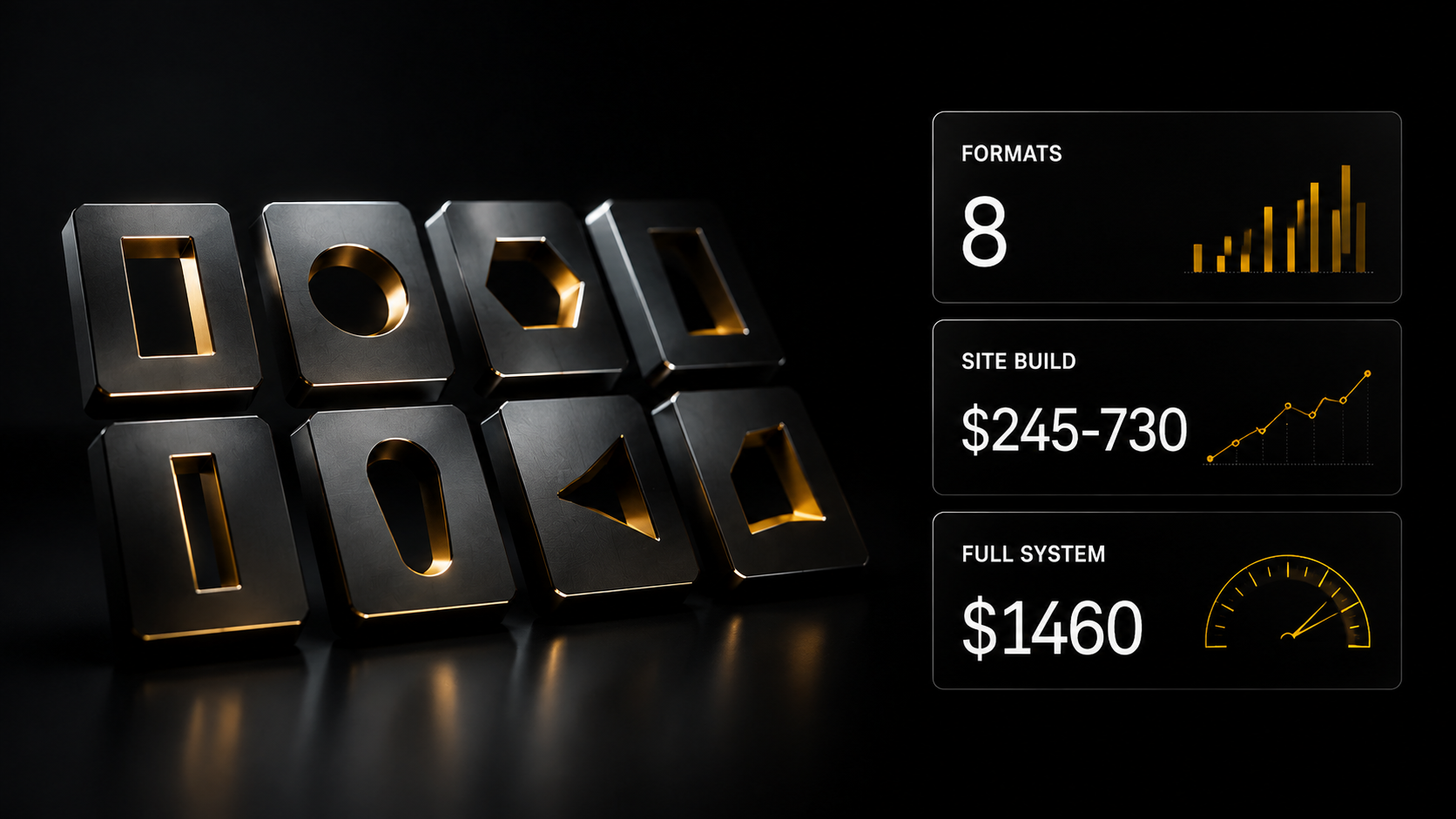
Vibe coding is a method rather than a service. A service is a specific result for a specific type of client. Below are eight formats people genuinely buy, with who the client is, what it costs and where the catch is in each.
Vibe coding is a method rather than a service. A service is a specific result for a specific type of client. Below are eight formats people genuinely buy, with who the client is, what it costs and where the catch is in each.
---
I can build, I don't know what to offer
Somebody has learned to build. It works: pages, forms, small applications.
And then a dead end. What exactly do you sell? "I make websites" is what everybody says. "I build applications" sounds too large, and a client will ask about something you cannot deliver.
The problem is that vibe coding is a method rather than a service. A service is a specific result for a specific type of client.
Below are eight formats people genuinely buy. For each: who the client is, what gets delivered, the price range and where the catch is.
The prices come from my scrape of 848 job listings over 24 days. A caveat: an explicit budget appears in 6% of listings, and the scraper has no separate "development" category, so the web ranges are a guide taken from adjacent categories and practice.
---
1. A landing page for a launch
Who buys: an expert with a date set. A course, a webinar, an intake for a programme.
What gets delivered: a one-page site collecting enquiries, with the data going somewhere it will not get lost.
Price range: the upper part of the range for a one-pager, because the deadline is hard.
The key word in the conversation is the deadline. The first question to the client: "what date do you need it by?" That immediately separates you from people who start by discussing design.
The catch: the launch slips and you have held a week for it. Fix the date and the terms for moving it in the quote.
---
2. A website for a business with none
Who buys: a car repair shop, a dental practice, a children's centre, a coffee shop, a local retailer. There is no website at all, or something a decade old is hanging there.
What gets delivered: a multi-page site with prices, services and a way to get in touch.
Price range: $245–730.
How to approach it: not with an offer of a website but with an observation. "People are searching for you by this query and finding a competitor." Specific and verifiable.
The catch: a client like that often does not see why they need a website and will ask "what else will I be paying for". Name the recurring costs before payment rather than after.
---
3. Testing an idea
Who buys: somebody testing an idea who wants figures before building a product.
What gets delivered: a page with a form and clear data collection, built quickly.
Price range: $490–1 460 — people pay more here because the decision at stake is an order of magnitude larger.
The key word is speed. "I'll build it in a week, you look at the figures and decide whether to build further."
The catch: the client may get carried away and start adding features. Hold the frame: this is a test, not a product.
---
4. An internal tool
Who buys: a small company where something gets calculated by hand in spreadsheets.
What gets delivered: a calculator for their formulas, a record-keeping form, a simple tracker.
Why this is a good format: there are plenty of such tasks, they do not get commissioned from a developer — expensive and slow — and so they get done by hand for years.
The catch: the formulas and rules have to be extracted from people. That is an interview, and it takes longer than the building.
---
5. A specialist's personal website
Who buys: an expert, a coach, a doctor, a lawyer, a designer. Somebody who needs a page rather than an account.
What gets delivered: a portfolio site: who, for whom, what they can do, examples, a way to get in touch.
Why the format is underrated: the barrier is low and demand is steady — specialists keep appearing.
The catch: the most frequent endless haggling. Work to a fixed structure rather than "make it look nice somehow".
---
6. A shop window or catalogue
Who buys: somebody with a product and no shop. Or one that exists and is awkward.
What gets delivered: product pages, search, a way to place an order.
An important catch: as soon as payment collection appears, that is outside your zone unless you have that experience. Say honestly: I build the shop window, a specialist does the payments.
---
7. A prototype for a pitch
Who buys: somebody who has to show an idea to an investor, a partner or management.
What gets delivered: a clickable mock-up that looks and behaves like a product.
Why this is profitable: it needs no data, no payments and no error handling. The least work, high value — because a decision gets made on that presentation.
The catch: put in writing without fail that this is a prototype. Otherwise in a month the client will ask you to "just launch it" — and that is a different project.
---
8. Rebuilding what already exists
Who buys: somebody with a website that does not work.
What gets delivered: an analysis of where visitors get lost, and a rebuild.
Why this is the best way in to a client: you arrive not with an offer but with an observation about their own website. Three precise comments work better than any commercial proposal.
The catch: somebody else's project can turn out harder than building from scratch. Look before you name a price.
---
How to choose one
You do not have to offer all eight. The one-tool rule applies here too.
Take the one whose client type you understand from the inside. Worked in catering — go to coffee shops. Know how a private practice runs — go to specialists.
Understanding the domain matters more than the building skill: it determines whether you land on a real pain or offer a pretty page.
And build from a description rather than by request. A project with no document falls apart at the third revision, and there will always be revisions.
What ships with the work
Four things separating a contractor from a hired pair of hands. They also justify the price.
Credentials registered to the client, not to you.
A short guide: how to change the text, where to see enquiries, what to do if something breaks.
What they pay for themselves afterwards — domain, hosting, services, with amounts. Named in advance it causes no complaint; discovered later it always does.
Support terms: whether it is in the price, what a change costs.
What is available on the platform
Website templates — 343 prompts, laid out along exactly these formats: hero sections — 80, landing pages — 61, SaaS — 33, agencies — 10, portfolios — 8, shop windows — 8. Plus 80 standalone sections — pricing, testimonials, footer, log-in form — and 23 animated backgrounds.
Each prompt is a full brief averaging 10 000 characters, the most detailed up to 75 000. The preview is visible before you run it. The prompts are not tied to a service and paste into any environment that writes code.
The Plus plan.
Skills for Claude Code — more than 10 000. The catalogue is open to everyone, the files come with Basic.
The assistants — engineering for the building, marketing for analysing somebody's website before approaching them, legal for the contract. From Basic.
Registration is free and opens three days of full Basic access.
Where to start today
One action. Choose one of the eight formats — the one whose clients you understand best.
Then write out five specific companies or people of that type whose problem is visible from outside: no website, an outdated one, no page for a launch.
Five minutes of work, and you have five addresses where you are not competing with twenty applications on a marketplace.
---
One more model not on the list
The eight formats above are selling a result. There is a ninth option and it is about something else.
Selling access rather than work. One of the archive's ready pipelines describes this model directly: you wrap a working process in a simple interface and sell access to small business owners who need the result and have no time to work it out.
How that differs from the eight formats. There you do work for money. Here you build a tool once and sell a subscription to it.
What you need to be able to do. Exactly what is described in the article: build an interface, connect payments, sort out access. All of that is the four layers from the prototype-to-product article.
And an honest assessment. That is the slowest of the nine models in time to first money and the most interesting in its ceiling. Not worth starting with, but worth keeping in mind.
Plus module 5, the "building websites" lesson
A separate lesson on building websites through working with files — the practical part for the first formats on the list.
Module 5 — Plus; the pipelines — Make, N8N and Full.
---
What to read next
[A specialist's portfolio site](/en/blog/specialist-portfolio-site) — the lowest barrier of the eight.
[From prototype to product](/en/blog/prototype-to-product) — what separates deliverable from built.
[A 30 000-character brief](/en/blog/prompt-30000-characters) — how to stop getting the average result.
[AI freelancer price list](/en/blog/ai-freelancer-price-list) — what to check your figures against.
[Skills for Claude Code](/en/blog/claude-code-skills-guide) — the full guide to skills.