A thirty-thousand-character brief instead of "make me a landing page"
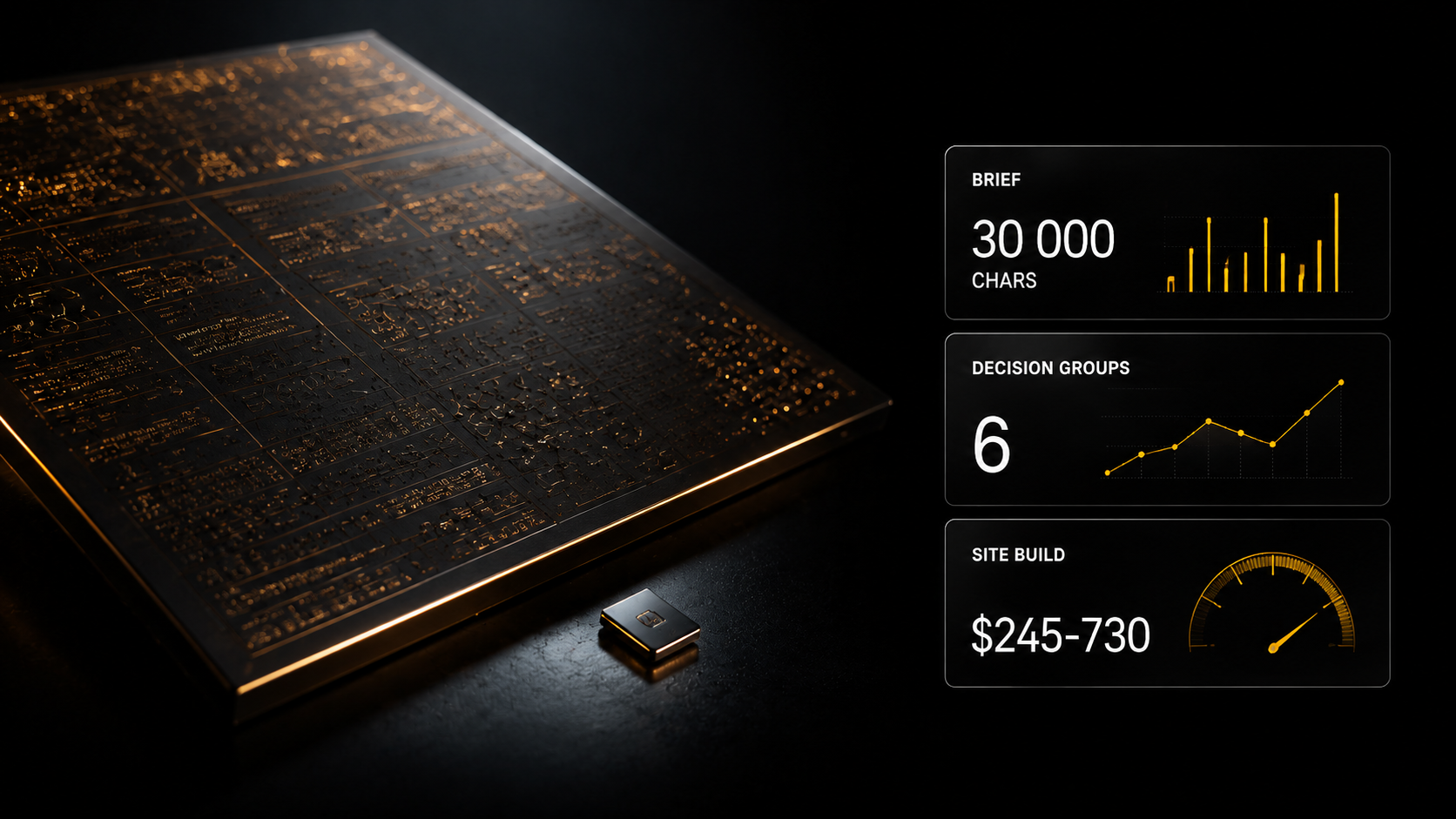
"Make a nice landing page" produces a nice landing page in general — because one screen holds hundreds of decisions and every unnamed one gets decided on average. Below are the six groups of decisions determining the result, and what a description with them all set looks like.
"Make a nice landing page" produces a nice landing page in general — because one screen holds hundreds of decisions and every unnamed one gets decided on average. Below are the six groups of decisions determining the result, and what a description with them all set looks like.
---
"Make a nice landing page for my product"
That is how nine people in ten phrase it. And they get exactly what they asked for: a nice landing page in general.
The standard first screen with a large headline, three benefit blocks with icons, testimonials, a form, a footer. It works. It looks respectable. It is no different from any other.
Then the person starts refining: change the colour, use a different font, add animation, remove that block. Twenty attempts, and by the tenth the project starts falling apart — every revision breaks something previous.
The cause is not the model. The cause is that you gave it three words and a landing page holds hundreds of decisions. Everything you did not name it decided for you — and decided on average.
How many decisions are in one screen
Let us take the first screen, so it becomes visible.
What has to be determined before it comes out as anything but average:
Structure. What sits above, what below, what is visible before scrolling, where the screen ends on different devices.
Typography. Typeface, sizes, weight, letter spacing, line height, how that changes on mobile.
Colour. Background, text, accent, the proportion between them, behaviour on hover.
Space. Gaps between blocks, the width of the text column, the margins.
Motion. What appears on load, what responds to hover, what happens on scroll, at what speed.
Behaviour. What happens with an empty form, on a slow connection, on a narrow screen.
That is six groups with several decisions each — for one screen. On a page of seven blocks there are hundreds.
When you write "make a nice landing page", you are delegating all of those decisions. The result will be average not because the model is weak but because averaging is the only thing possible with no direction.
What a real brief looks like
Not a paragraph but a document.
In the website templates catalogue the prompts average around 10 000 characters, the most detailed running to 75 000. That is not a line saying "make a landing page" but a full specification of dozens of pages, with every screen written out.
What is inside:
The whole structure — which sections, in what order, what is in each.
Typography with specifics — not "a modern font" but the typeface, the weights, the sizes and how they change.
A colour scheme with exact codes and a proportion rule.
Animation behaviour — what happens on hover, on scroll, on load, over what duration.
Adaptation — how this rebuilds on a tablet and a phone rather than simply compressing.
The difference in result is not cosmetic. A brief with six groups of decisions gives you a website that looks designed rather than assembled.
Why you should not write it yourself
A fair question: if it is known what belongs in a brief, why not write one?
Three reasons, all practical.
The volume. Ten thousand characters of meaningful technical text is several hours, even if you know exactly what you want.
Knowing what to want. The hardest part of working with generation is not phrasing but understanding what needs phrasing. Margins, line height, hover behaviour — nobody who has not done design thinks about those.
Checking. Having written a brief, you find out whether it is good only after generation. Ready prompts come with a preview: you see the result before anything gets run.
That is exactly why a catalogue of 343 prompts saves you not money but the month it takes to work out what you should have written.
How to use this properly
A prompt is not a finished website. It is a starting point, and it has to be worked with in a certain order.
Step 1. Choose by preview rather than by description. Look at the result rather than reading the category name.
Step 2. Do not rewrite the whole prompt. Change the content — copy, names, images — and leave the structural and stylistic decisions. Those are the value.
Step 3. If you change the style, change it coherently. Changed the accent colour — check it has not broken the contrast in blocks with text on it.
Step 4. Make changes by address. Not "make it better" but "in the pricing section change the order of the columns, do not touch anything else". A model given a precise address makes a precise change. One given "fix it" rewrites half.
Step 5. Keep a list of untouchables. Every revision request ends with what must not be changed. One line that prevents most breakages.
Where this works
The prompts are written for a standard stack and are not tied to any particular service.
They paste into any environment that can write code: development environments with AI assistants, generation-based builders, editors with plugins. Or simply into a chat, with the code moved across by hand.
There is no tool constraint: a prompt is text, not a project.
What follows for your work
The practical part.
Speed stops being the client's argument. "I'll build it myself in an evening" — yes, they will, an average one. The difference between average and designed is visible, and it is what people pay for.
You are selling not the building but the selection and the fitting. Out of 343 options, picking the right one for the task, adapting it to the brand, filling it with content, checking it.
The price range. By my scrape of 848 listings: a multi-page website — $245–730, against a $30–75 median for one-off work. A caveat: the scraper has no separate "development" category, so the ranges are a guide from adjacent categories and practice.
And what separates a contractor from a pair of hands at delivery: credentials to the client, a short guide, the recurring costs named, and support terms.
What is available on the platform
Website templates — 343 ready prompts. Three subsections: websites — 240, standalone sections — 80, animated backgrounds — 23.
Website categories: hero sections — 80, landing pages — 61, SaaS — 33, agencies — 10, portfolios — 8, shop windows — 8, plus creative, AI, 3D, fintech, automotive, presentations, travel, Web3.
The sections are grouped by purpose: pricing, testimonials, footer, log-in form, call to action, about.
The preview is visible before you run it. The Plus plan.
Skills for Claude Code — more than 10 000. The catalogue is open to everyone, the files come with Basic, advanced ones with Creator+.
The creative assistants — an art director, a web designer, a UX designer, prompt generators. From Basic.
Registration is free and opens three days of full Basic access.
Where to start today
One action. Take your last request for generating a website and count how many of the six groups of decisions you named in it: structure, typography, colour, space, motion, behaviour.
Usually one or two are named. The model decided the other four for you.
That is the difference between your result and what comes out of a ten-thousand-character prompt. Not the quality of the model.
---
Where the habit of describing precisely comes from
A ten-thousand-character prompt is a particular case of a skill taught separately.
Module 4, "Advanced prompting", covers sixteen methods in four groups: fundamentals and context · logic and reasoning · multi-step processes · autonomous methods.
The third group is directly about this: how to break a large task down so every step is described sufficiently and does not reuse the previous one's guesses.
And module 3's lesson on cascading prompts gives the underlying principle. The phrasing from the lesson: you lead the model along a clear plan, like a scriptwriter. Break the task into stages, check the intermediate answers, direct what comes next.
The example straight from it is building a landing page: first the structure, then the headlines, then the block copy, then the detail.
What that changes. A ten-thousand-character prompt is not a feat of diligence. It is the result of somebody knowing how many decisions a task consists of.
Modules 3 and 4 — the Basic plan.
---
What to read next
[Look first, generate second](/en/blog/preview-before-generate) — choosing by result.
[Why a project falls apart at the third revision](/en/blog/spec-coding) — a description as the source of truth.
[What of this actually sells](/en/blog/what-sells-from-vibecoding) — where to take the result.
[A landing page per segment](/en/blog/landing-per-segment) — what should be on the page.
[Skills for Claude Code](/en/blog/claude-code-skills-guide) — the full guide to skills.