How an AI influencer earns: four revenue models
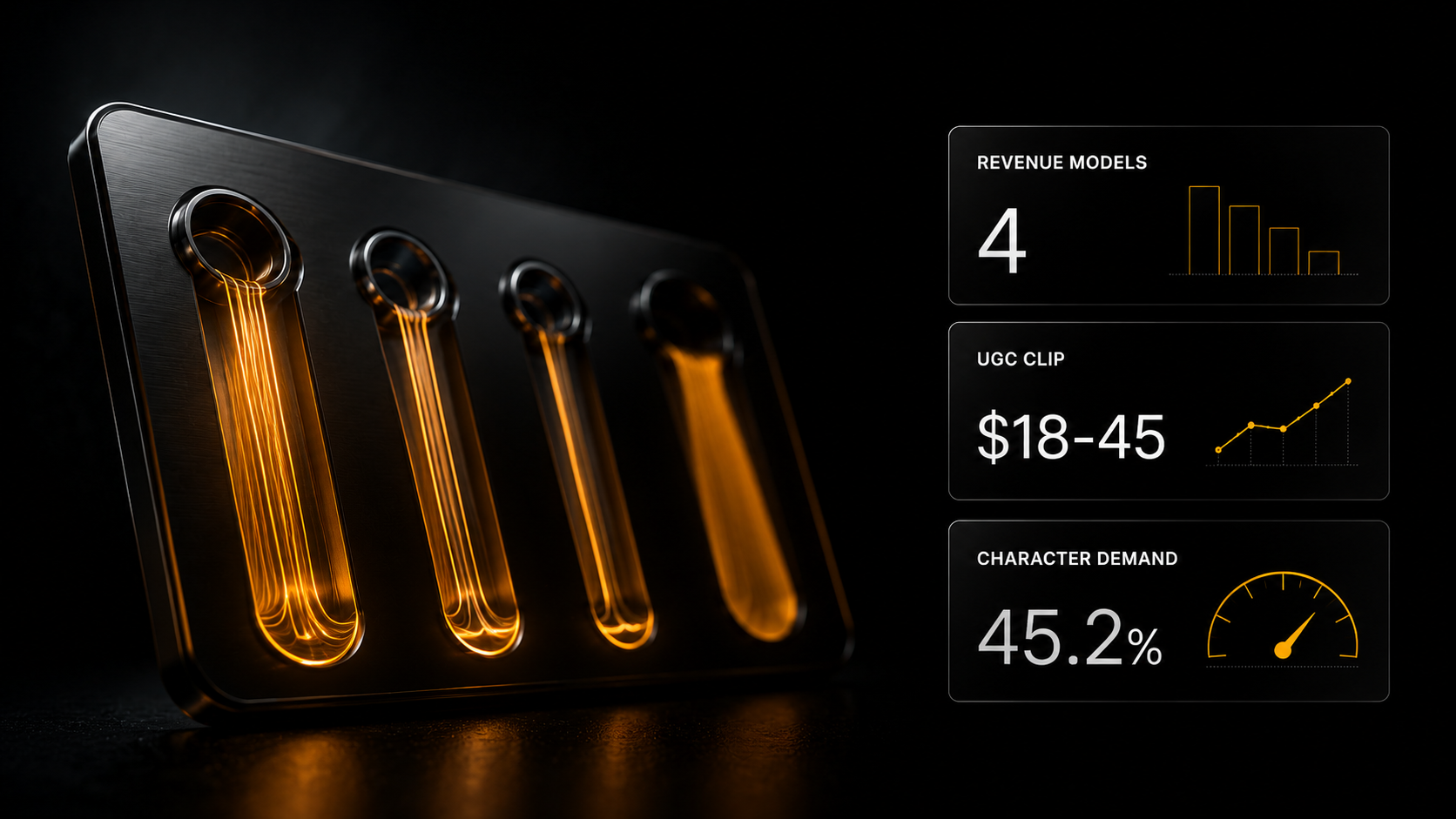
AI characters are the second most-wanted subject, and almost everything written about them stops at the technology. Below is the money: four revenue models with honest timescales and ceilings, including the one that does not work the way people promise.
AI characters are the second most-wanted subject, and almost everything written about them stops at the technology. Below is the money: four revenue models with honest timescales and ceilings, including the one that does not work the way people promise.
---
"I started an AI influencer" — and then silence
AI characters are the second most-wanted subject in my survey: 45.2% are interested in exactly this.
And almost everything written about it stops at the technology: how to generate a face, how to hold it across a series, how to make it talk.
About money, almost nothing. Somebody learns the generation, starts an account, publishes attractive frames and gives up two months later because it is unclear what for.
Meanwhile there are four revenue models here, and they differ fundamentally in timescale, effort and ceiling. Let us go through each honestly, including the one that barely works.
Model 1. Advertising on your own character
The most obvious and the slowest.
How it works. You grow an account with a virtual character, build an audience and sell integrations.
What you need: a consistent character who does not change from frame to frame, regular content and time. A lot of time.
The honest timescale. An audience accumulates over months. First money comes no sooner than the account becomes noticeable, and that is not a question of picture quality.
The main constraint nobody mentions: an advertiser wants numbers, not beauty. A virtual character with a thousand followers is worth the same as a live blogger with a thousand followers — that is, almost nothing.
Who it suits: people prepared to run a project for a year and not expect a return in the first months.
Who it does not suit: most people. This is not a way to start earning, it is a way to build an asset.
Model 2. A character for somebody else's business
The most underrated and the fastest to money.
How it works. You do not grow your own account — you make a permanent character for somebody else's brand. A face the company uses in advertising, listings and social media.
Why people buy it. A business has three alternatives: shooting with a model — expensive and starting from scratch every time; using stock — faceless, and competitors have the same; working with no face — losing recognisability.
A trained character solves all of it at once: the same face across any quantity of material, with no shoots and no rights in somebody else's person.
What gets delivered to the client: the trained character, a set of starter materials, instructions for use, and the rule that from then on material gets generated in the same form.
The price range. By my scrape of 848 listings: an image individually is $12–35, while a set of marketplace listing images is $245–730. A character for a brand is not per-item work; it is closer to the second category.
Who it suits: people who want money this month rather than in a year.
Model 3. UGC content for products
The largest demand of the four.
How it works. A brand needs a clip that looks like an ordinary customer filmed it: the character holds the product and talks to camera. Hook, demonstration, call to action.
Why this specifically. Studio advertising has stopped working in feeds — people recognise it and scroll past. A live review works. And filming live reviews with real people is expensive, slow and does not scale.
How large this is: in my dataset the UGC format is 40.3% of all jobs. The biggest category.
What you need: a character with rights, the product in a photo, the ability to hold a series. And an understanding that the clip has to look unprofessional — that is the whole point of the format.
The price range: a short clip $18–45, AI video end to end $245–550. The difference is that the second sells not a clip but a set for a campaign.
Who it suits: people who can already make a talking character and are prepared to work in series.
Model 4. Selling an asset
The narrowest, but with an interesting mechanic.
How it works. You train characters and styles and sell them as a finished asset: not work but a tool.
What that can be: a trained character for a particular niche, a visual style (LoRA), a voice clone.
An honest limit: the market is narrow. The buyer has to be able to generate themselves — otherwise what they need is not an asset but finished material, meaning model 2 or 3.
Who it suits: people working with other freelancers rather than with end clients.
Which of these to choose
A simple rule by timescale.
Need money this month — model 3, UGC. The largest demand, the lowest barrier, a clear fee.
Need a steady flow — model 2. One client with a trained character comes back for new material constantly. In the dataset 21.9% of clients are explicitly looking for somebody long-term.
Building an asset over years — model 1, your own blog. With your eyes open about how slow it is.
Working inside a professional community — model 4.
And above all: do not try all of them at once. The one-tool rule works here as everywhere: one revenue model until the first payment, the rest later.
What you need technically
Three things without which none of the four models works.
A consistent character. Not a reference but a trained one, stored in your profile and dropped into any generation with an unchanging appearance. Without it a series cannot be assembled, and all commercial work is series.
Rights in the face. Somebody else's cannot be used in any form. There are three legal sources: your own photo, your own trained character, or a ready avatar from the gallery — ten characters, all generated by us, not stock people and not somebody else's faces.
A voice, if the character talks. A voice clone or generated narration plus lip synchronisation.
Cost and fee
Generation is paid from your wallet on use, the price visible before you press, money returned for anything not delivered.
The order: an image — $0.12–0.25, animating a frame — from $0.17, lip sync — $0.12–1.50, music and narration — $0.12–1.80.
Against a fee of $18–45 for a short clip and $245–730 for a set, the cost runs to single-figure percentages. Build it into your quote the way a printer builds in paper — a freelancer who pays out of their own pocket and does not count it is working at a loss and not noticing.
What is available for this
Gen AI — 338 models: image generation, photo animation, lip sync, music and sound. Plus character, LoRA and voice training.
AI Workflow — chains where each step's result becomes the next one's input. Thirteen templates, including "UGC advertising from a product photo" and "From a selfie to an advert".
Marketing Studio — if you do not want to assemble a chain: the offer as text, a product photo, a choice of character — out comes a vertical clip with sound. Eight formats.
Generation and video model courses come with the Plus plan, or $9 one-off, or 1 000 experience points. They are not in the three free days of Basic.
Registration is free and opens three days of Basic — every assistant, marketing and creative among them, and the ten-lesson sales module.
Where to start today
One action. Open a job feed and find three listings with the word UGC or "product review".
Look not at the price but at what is being asked for: duration, format, how many clips. Usually it turns out what is needed is fifteen seconds vertical with a person and a product — and that is exactly what gets made today.
Choose one revenue model out of the four. Not two.
---
Three pipelines this runs on
The four revenue models above are about what people pay for. Next, what produces it.
The digital department. A robot takes a subject from your spreadsheet, writes the script and the voiceover text, generates a hyperrealistic photo, animates it into a five-second video, narrates it through ElevenLabs, joins it with subtitles and publishes it to the chosen platform. A link to the finished clip arrives in Telegram.
The cost is $2.50–3 per clip. The scale is up to 100 clips a day, simply by filling a spreadsheet with ideas.
The AI influencer with memory. A name, a biography, a reference face → the planner builds a week's content plan → the visual engine makes selfies and reels at 1080p. The system holds facial consistency and plans by itself.
ViralForge and the viral pipeline. They patrol news feeds, catch fresh trends and stamp out clips with no editing.
What that changes about the four models
A content agency of a new kind. Instead of $500 for running one account you offer an unlimited package of short videos. The margin rises because production is automated.
A factory of faceless channels. Dozens of niche accounts on different subjects — psychology, crypto, life hacks. Managing the network takes fifteen minutes a day.
SaaS for small businesses. You wrap the pipeline in a simple interface and sell access to people who need content and have no time to film.
Digital ambassador services for brands wanting stable, inexpensive advertising faces.
And an honest caveat
Fully unattended automation does not exist, and that is deliberate. In the Freelance 2.0 system the generators do not write text until you have chosen the hook, and do not assemble a carousel without the subject confirmed. The approval points are built in on purpose.
The pipelines — Make, N8N and Full.
---
What to read next
[AI accounts: what gets banned](/en/blog/ai-account-what-gets-banned) — the limits for anybody running their own.
[Face rights in advertising](/en/blog/face-rights-in-ai-ads) — a condition of commercial work.
[A clip from a product photo](/en/blog/ad-video-from-product-photo) — the largest of the four models.
[AI freelancer price list](/en/blog/ai-freelancer-price-list) — what work like this pays.
[AI video generation in 2026](/en/blog/ai-video-generation-guide) — the full guide to video models.