AI video models in 2026: what they can actually do and what of it sells
Some say generative video is replacing filming, others that it is a toy. Both are right; they are simply talking about different tasks. Below is what genuinely changed, where the line runs, and why the pay gap between a clip and an end-to-end job is tenfold.
Some say generative video is replacing filming, others that it is a toy. Both are right; they are simply talking about different tasks. Below is what genuinely changed, where the line runs, and why the pay gap between a clip and an end-to-end job is tenfold.
---
Why there is so much argument about AI video
Not long ago generative video was a fairground attraction. Five to ten seconds, strange physics, faces drifting between frames, no sound. Amusing to watch, impossible to show a client.
Today the situation is different, and hence the confusion: some say "this already replaces filming", others "still a toy". Both are right; they are simply talking about different tasks.
Let us go through the substance: what genuinely changed, where the line is, and which of these jobs people buy.
What changed
Three things, none of them a revolution on its own but together a move from attraction to instrument.
Resolution and stability. The frame holds: objects do not smear and the physics has stopped producing obvious errors. The material can now go into a commercial clip rather than only into a compilation of oddities.
Synchronised sound. Models generate video together with an audio track. That removes a whole stage of the work and, more importantly, removes the main marker of artificiality: silent video with music laid over it used to give itself away instantly.
Length and multi-shot work. A single continuous shot got longer, and more importantly it became possible to assemble scenes with one character across several shots. That moves generation from "one striking shot" into "a small clip with a script".
Western and Chinese models
The division currently shaping the choice.
The Western line — a strong base: frame quality, synchronised sound, predictability of the result. That is where it makes sense to start: fewer surprises, easier to get a usable result on the first or second attempt.
The Chinese line — broke through elsewhere: visual stability over longer stretches, clip length, cinematic control and editing already-finished video.
The practical conclusion. It makes sense to start with the base and move to the advanced models when you hit a specific constraint — length, stability on a long shot, the need to correct something finished. Learning it all at once is a way of never making a single clip.
Where the limits of use are
Honestly, because what you can take on depends on it.
Works confidently: short advertising clips, inserts and cutaways, visuals for social media, backgrounds and atmospheric shots, product clips with no complex handling of the object, animating static images.
Works with caveats: scenes with people where expression matters; long continuous shots; exact correspondence to a reference.
Does not work: anything needing a real product in real conditions, documentary accuracy, or legally significant footage. Plus text in frame — still a weak point of generative models.
And separately on the economics. Generation is not free. Video is the most expensive category by spend, and the price of a task has to be worked out before rather than after. The sensible approach: the cost of generations goes into the quote the way paper goes into a printer's.
What the workflow looks like
Generating is only part of the work, and not the longest. The full cycle for a commercial clip looks like this.
The script and storyboard. What happens in shot, how many shots, what is in each. Skipping this step is the main reason people generate by the dozen and get no clip: with no plan every frame lives on its own.
Generating shot by shot. Recording what worked: the description, the parameters, the reference. Otherwise repeating what you liked will not happen.
Assembly. The cut, the rhythm, the transitions, the titles. Ordinary editing works here and has not gone anywhere.
Sound. Even if the model produces a synchronised track, the final mix is a separate step.
The format for the platform. Vertical, horizontal, duration, a particular platform's cropping requirements.
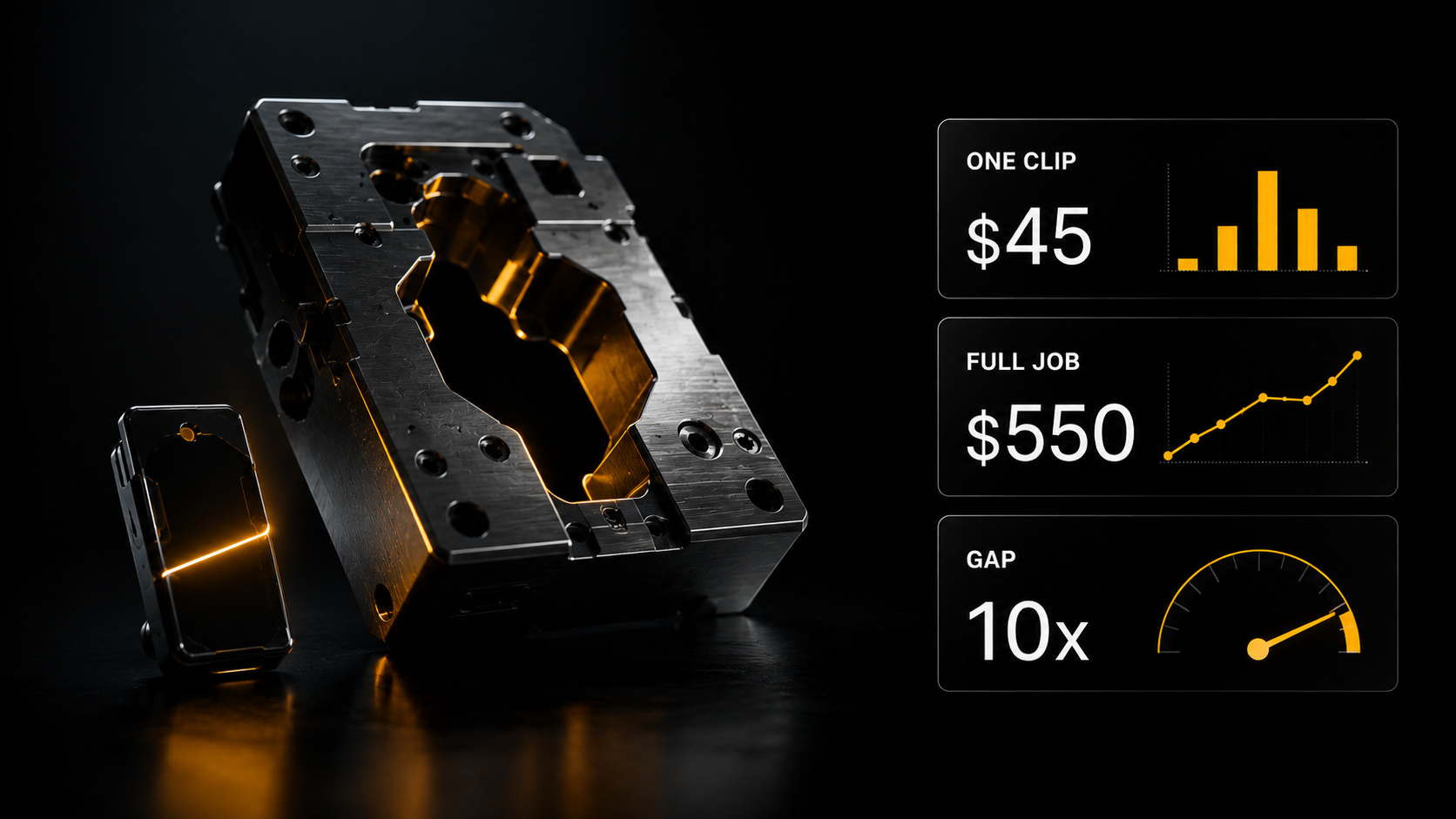
Generating takes the smaller part of the time. Most of it goes on the first and third points — and those are exactly what the difference between $45 and $550 gets paid for.
What of this gets bought
From my scrape — 848 job listings over 24 days across 13 categories.
Editing supplied material — $12–35. A short clip — $18–45. A two to three minute animation — $25–110. AI video end to end — $245–550.
The median for one-off work — $30–75. A separate line: up to $610 for a finished clip on a per-piece arrangement — the top of the market for solo work.
A caveat: an explicit budget appears in 6% of listings, with between two and fifteen observations per category. The median is reliable; the breakdown is a guide.
What those figures show. The gap between "a short clip" and "end to end" is more than tenfold. The difference is not the quality of the generation but that the second sells the whole result: the script, the assembly, the sound, the platform format, the revisions. Somebody who can only generate stays on the bottom line.
What to check before taking a job
Three questions asked before agreeing rather than after.
Where the clip is going. The platform sets the format, the duration and the sound requirements. Fifteen seconds vertical and a minute horizontal are different jobs.
Are there strict requirements on likeness. If a specific product, a specific room or a recognisable person is needed, generation does not suit, and it is more honest to say so immediately.
How many rounds of revisions are in the price. For generative video that is critical: a revision often means regenerating, which means a new cost. Two rounds in the quote is fine; "we revise until you're happy" is not.
Where to start
The "Google Veo 3 — making commercial video" express course — the base: 1080p, synchronised sound, cinematic control. What comes out is finished clips with one character and a directed picture rather than a set of striking accidents.
The "Video models 2.0 — East against West" express course — the advanced level for people who have done the base: Chinese models, long clips, multi-shot scenes with sound, and editing finished video.
Both cost $9 and are included in the Plus plan. Important: they are not in the three free days of Basic — that is Plus level.
Three routes to them: a one-off purchase at $9, the Plus plan, where they sit alongside courses on generating and editing images and the website templates, or 1 000 experience points.
What is free right now: the catalogues and descriptions are open to guests with no registration. Registration gives three days of Basic — with 140+ AI assistants across 14 categories, creative and media among them, and an encyclopaedia of more than 190 vetted services showing which model suits which task.
Generation is paid from the wallet — on use, the cost visible before you press, money returned on a failure. For video that is fundamental: you see the price of a frame before running it.
Do one thing today: find three video listings in a job feed and look at what is actually being asked for. Usually it turns out what is needed is not cinema but fifteen seconds for a particular platform in a particular format — and that gets done today.
---
What the courses cover and what is ready immediately
Module 6 — nine lessons from the basics of generation to Higgsfield, plus four mini-courses: Midjourney, ChatGPT Images and Nano Banana, Google VEO, Kling 3.0 and Seedance 2.0.
Gen AI holds three video modes with exact figures: text to video — 51 models, $0.22–11.95 · animating a photo — 84 models, $0.17–11.95 · the video editor — 39 models.
And ready pipelines if you need volume
The digital department — a subject from a spreadsheet becomes a finished clip with a script, narration and subtitles. Cost $2.50–3, up to 100 clips a day.
Wan 2.2 Turbo on Modal — your own generation server: five seconds at 720p in forty seconds.
Text-to-Avatar — an article becomes a clip with a digital face.
Module 6 — Plus; the pipelines — Make, N8N and Full.
---
What to read next
[AI video generation](/en/blog/ai-video-generation-guide) — a full breakdown of the models and prompts.
[Lip sync: making a character talk](/en/blog/lip-sync-talking-character) — what moves you into the upper price line.
[What a clip actually costs to make](/en/blog/video-production-cost) — what one job comes to.
[A clip from a product photo](/en/blog/ad-video-from-product-photo) — eight ready formats.