7 Kling 4 VFX effects with your face: Time Stop, clones, Sticker, prompts and previews
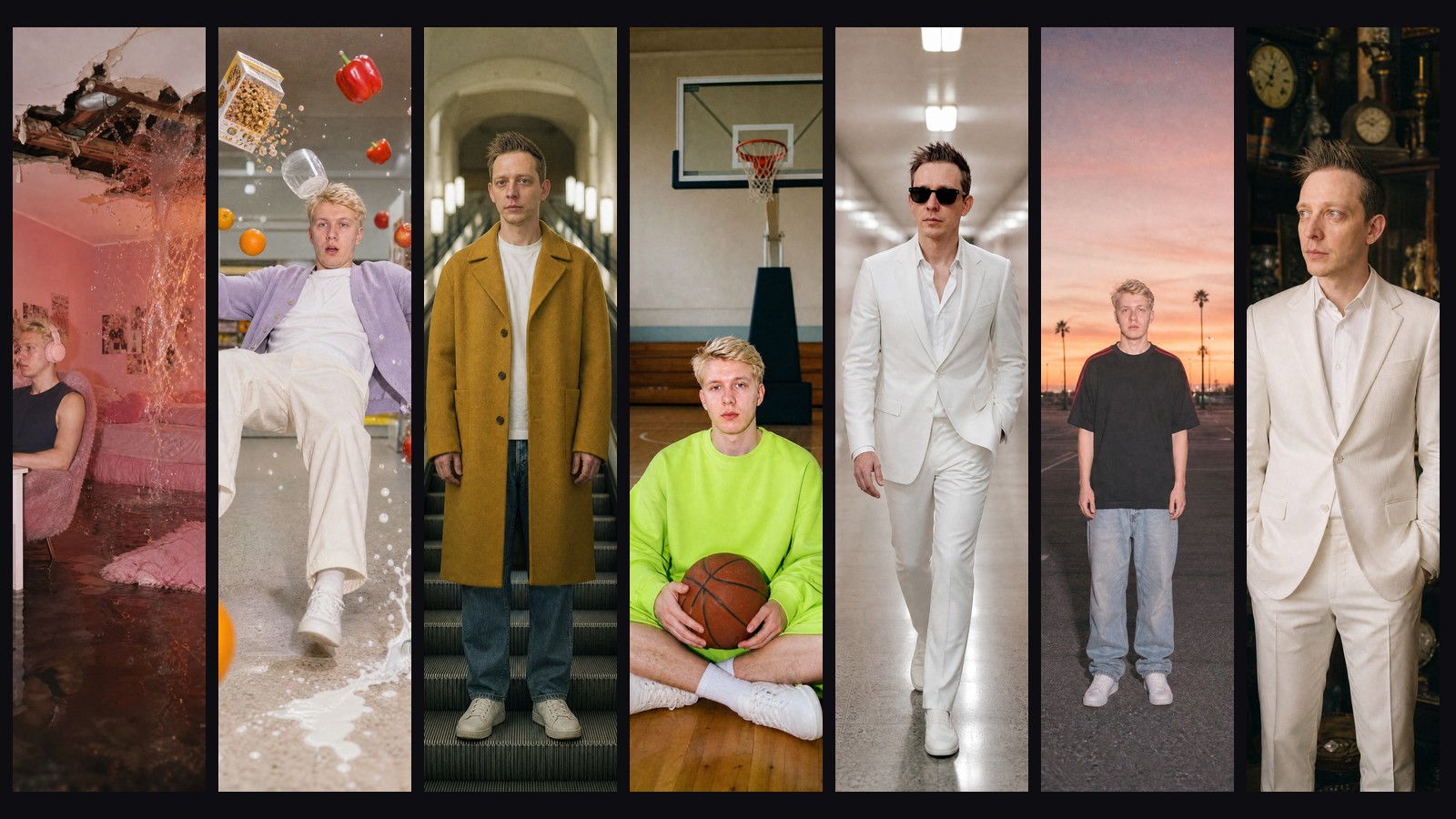
Seven VFX templates on Kling 4 with your face: Time Stop, Frozen Time, Sticker, Gym Clones and more. Start frames, both prompts in full, prices from $1.38.
A VFX template in an AI tool is a ready-made effect from a clip with your face dropped in: you upload a photo, the model draws you into the scene, and Kling 4 animates the frame from a tested prompt. Below are seven new effects from Magnific's guide "Trendy VFX effects": Time Stop, Frozen Time, Sticker, Gym Clones, Warp Zoom, Mega Scale and Gravity Lift. All of them are already on the platform. At the end there is a bonus: "The Stadium", a 15-second blockbuster on Seedance 2.5 with sound. Each comes with our start frame, the finished video, both prompts in full, the price and a launch button.
Short on time: five points
- Half of these effects are "time stands still, only the camera moves." The model badly wants to animate water, fire and falling objects. Keeping the scene frozen is the main job of the prompt.
- Don't copy the typos in the guide. In the guide, the "Sticker" prompt is a copy of the "Frozen Time" prompt, and "Paper Flip" is a copy of "Fish Eye." We wrote the Sticker effect from scratch, frame by frame, from the reference.
- Spell out the face orientation in words. Without it, when the camera rises above the character it swings around to the back of the head, and the face ends up upside down in the frame.
- The start frame sets the scale, not the video prompt. If the frame shows a huge empty hall, the copies of the character will be tiny no matter how you describe them.
- A video costs $1.38–2.14. That is three steps from your balance: character card, start frame and video, with no subscriptions to separate services.
All seven templates: open the video templates.
Where the effects come from and what we changed
Magnific's guide "Trendy VFX effects" is written for the Seedance 2.0 Mini model: nine effects, each with a frame and a prompt. We took the seven where a person is at the center and built them on Kling 4, the same model as the first five templates. That way all templates share one logic and one price per second.
The guide's prompts describe a scene in general terms ("the camera glides smoothly," "the copies gradually appear"). For a vertical video with any face, that is not enough. So we wrote every prompt out second by second and checked the results against the reference videos frame by frame: not every 4th frame, but every frame. Five of the seven effects had to be regenerated. Below, for each one, we say what exactly broke and how it was fixed.
How a template works
Three generations in a row, each with its own price. Inside the template the prompts are hidden and you only see buttons. Here we show them.
Step 1. Character card — GPT Image 2, $0.12. From one to three of your photos it makes a sheet: face from the front, three-quarter view, profile, and full body from the front and back. The next step uses it to draw you in any scene without losing your face. The card prompt is the same for all templates:
```
Professional character reference sheet of the EXACT same person from the photo(s), for consistent use in AI video. Clean neutral light-grey studio background, soft even daylight lighting, photorealistic, sharp focus. Layout on one horizontal sheet: left — large front-facing head-and-shoulders portrait looking straight into the camera; center — three-quarter view portrait and strict side profile; right — full-body standing view front-on and full-body back view. Preserve the identity exactly: same face shape, eyes, nose, lips, skin texture, age, facial hair and the same hairstyle and hair colour. Wardrobe: the same clothes as in the photo; if only the upper body is visible, continue the outfit naturally with matching trousers and shoes. Natural neutral expression. No text, no labels, no logos, no watermarks.
```
Step 2. Start frame — GPT Image 2 from the card and your photo, $0.12. This is where the outfit, the place and the scale are set. You can add the location in your own words (up to 300 characters) and the composition of the effect stays intact.
Step 3. Video — Kling 4.0 Keyframes from the start frame, $0.19 per second. The @first_frame tag in the prompt is a reference to the start frame.
1. Time Stop: the room burns and floods, and you keep playing
What happens. A pink room: the curtains are on fire, the ceiling has collapsed, water pours down from above, the floor is flooded. Time is frozen. The camera sweeps around the frozen flames, shoots up to the broken ceiling, dives along the waterfall to the mirror-like water and flies up to the character, who sits at an old computer in headphones, noticing nothing.
What broke. In the first version the water honestly poured and splashed on the floor, so there was no "frozen time." What helped was the wording "the whole room is a frozen 3D photograph, and from the first frame to the last only the point of view changes," plus a direct ban on splashes and ripples.
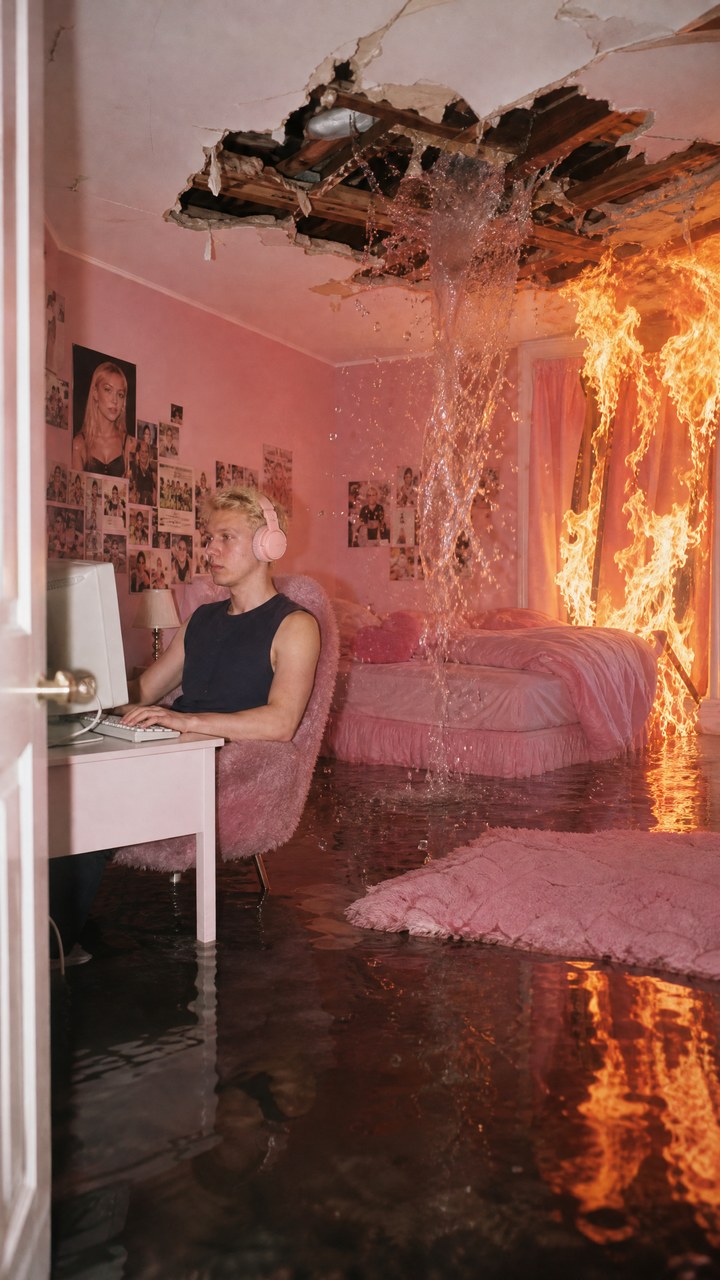
Start frame prompt:
```
Use the character sheet and photo(s): the EXACT same person, identical face, eyes, nose, lips, skin, age and hairstyle. Wardrobe: a navy sleeveless top or t-shirt, big pastel-pink over-ear gaming headphones. Create one ultra-photorealistic vertical cinematic film still, frozen in time. A dreamy pastel-pink teenage bedroom seen wide from the doorway at standing height: on the RIGHT, the pink curtains of a tall window are on fire with huge bright orange flames frozen like sculptures; in the TOP of the frame the ceiling has collapsed into broken wooden beams and plaster, and a thick column of water pours down from it, frozen in mid-air with suspended droplets; the whole floor is flooded with still, mirror-like water reflecting the fire; a pink bed and fluffy pink rug float half-submerged. On the LEFT, the person sits calmly at a desk with an old white CRT computer monitor, in a fluffy pink chair, shown in three-quarter profile, wearing the headphones, hands on keyboard and mouse, completely unaware of the disaster. Posters and photos on the pink walls. Dreamy direct flash, analog film grain, soft pastel palette, subtle lens bloom, premium editorial cinematography, surreal realism. No text, no logos, no watermarks.
```
Video prompt:
```
Hyper-cinematic FREEZE-FRAME sequence from @first_frame. TIME IS STOPPED — CRITICAL: the whole room is a FROZEN 3D PHOTOGRAPH. The flames on the curtains are solid frozen sculptures that never flicker; the column of water from the broken ceiling is a frozen glass-like sculpture, every droplet hanging still in mid-air, NOT falling, NO splashes appearing, the water never reaches further down; the flooded floor is still like polished glass with no ripples; the person at the computer is a statue frozen mid-game. Nothing in the room changes from the first frame to the last — only the point of view changes. ONLY THE CAMERA MOVES — fast, energetic and precise, like a drone flying through a frozen photograph. ONE CONTINUOUS SHOT, no cuts.
0.0–1.6 s: rapid push-in from the wide room straight into the frozen burning curtains, orbiting close around the motionless sculptural flames.
1.6–3.0 s: whip UP to the collapsed ceiling: broken beams, frozen dust clouds, and the frozen water column with droplets suspended like crystal beads.
3.0–4.2 s: the camera dives DOWN along the frozen water column to inches above the still mirror-like floor and glides fast across it past the static reflections of the fire.
4.2–5.8 s: it sweeps toward the desk, past the back of the fluffy pink chair, and snaps into an intimate close-up PROFILE of the frozen person wearing the pink headphones, lit by the CRT screen.
5.8–8.0 s: racks focus down to the hands frozen on the keyboard and mouse and the glow of the CRT monitor; hold.
STYLE: dreamy direct flash, analog film grain, soft pastel palette, subtle lens bloom, premium editorial cinematography, surreal realism.
NEGATIVE: no falling water, no pouring, no splashes, no ripples, no flickering or moving flames, no smoke movement, no movement of the person, no blinking, no cuts, no identity change, no extra people, no text, no logos.
```
Price: about $1.76 (8 seconds). Make Time Stop with your face
2. Frozen Time: a fall in a supermarket
What happens. You slipped between the shelves and time stopped: oranges, peppers, a bouquet, a cereal box and splashes of milk hang in the air. The camera drifts slowly, like a museum visitor, past your face, down the body to a broken bottle and up to the bouquet.
A trap we caught during review. When the camera rises to the bouquet, the fruit in the frame seems to move down, as if it were falling. We checked every frame: the objects' positions relative to each other do not change. It is parallax from the camera movement, with nearer objects simply shifting faster than distant ones. There is no defect. Still, just in case, the prompt includes "every object keeps its position relative to the shelves and the character."

Start frame prompt:
```
Use the character sheet and photo(s): the EXACT same person, identical face, eyes, nose, lips, skin, age and hairstyle. Wardrobe: a soft lilac cardigan over a white t-shirt, cream wide trousers, white sneakers. Create one ultra-photorealistic vertical cinematic film still, frozen in time. Inside a bright supermarket aisle, the person has slipped and is caught MID-FALL, body floating diagonally about half a metre above the floor, leaning back, arms spread wide, legs forward, with a surprised face. Everything around is frozen in mid-air: oranges, red peppers, apples, a bouquet of pink and yellow flowers, a cereal box, a plastic cup, splashes and droplets of milk; a glass milk bottle lies on the floor with milk frozen mid-pour. The camera looks slightly DOWN at the person from about 1.5 metres in front, full body visible, the person filling the middle of the frame, a big orange floating close to the lens. Shelves of colourful products recede on both sides. Soft direct flash, pastel supermarket lighting, analog film grain, shallow depth of field, premium fashion editorial, surreal realism. No text, no logos, no watermarks.
```
Video prompt:
```
Surreal frozen-time sequence from @first_frame: time has COMPLETELY STOPPED at the exact moment the person slipped in the supermarket. The person, the oranges, peppers, apples, the flower bouquet, the cereal box, the cup, the milk splashes and droplets and the milk pouring from the bottle are ALL ABSOLUTELY MOTIONLESS for the whole shot, LOCKED IN PLACE in mid-air like objects in a photograph — nothing falls, nothing drifts, every object keeps exactly the same position relative to the shelves and to the person. No blinking, no breathing, no hair or clothing movement, no flowing liquid. ONLY THE CAMERA MOVES, slowly and smoothly like a museum visitor, with elegant rack focus. ONE CONTINUOUS SHOT, no cuts.
0.0–0.8 s: the camera holds on the frozen scene with a barely noticeable push-in.
0.8–2.2 s: slow push-in toward the person's frozen surprised face; a suspended orange passes very close to the lens, sharp, while the background goes soft.
2.2–3.6 s: the camera tilts DOWN along the frozen body and legs toward the floor, gliding low over the floor.
3.6–4.8 s: rack focus to the glass milk bottle lying on the floor with milk frozen mid-pour and droplets suspended in the air, in extreme close-up at floor level.
4.8–6.0 s: the camera slowly rises and racks focus to the frozen flower bouquet hanging motionless in mid-air, ending on it, the aisle melting into bokeh; the suspended fruits around stay perfectly still.
STYLE: soft direct flash, analog film grain, pastel supermarket lighting, shallow depth of field, premium fashion editorial, surreal realism, quiet and dreamlike.
NEGATIVE: no falling fruit, no falling objects, no gravity, no motion of the person or objects, no flowing milk, no blinking, no breathing, no cuts, no fast camera, no shake, no identity change, no extra people, no text, no logos.
```
Price: about $1.38 (6 seconds). Make Frozen Time with your face
3. Sticker: you get peeled off an escalator
What happens. The camera stays still. A huge hand enters the frame, picks you up by the top of the head and peels you off the escalator like a vinyl sticker: under you is a white paper backing, behind you is an empty escalator. A second later the hand puts you back as a real sticker with a white border and holds it in the center of the frame.
What broke. In the second run the sticker came back as a blank white sheet and "developed" right in the hand, which looks like an editing mistake. One phrase fixed it: "the printed side always faces the camera and is visible from the first moment." One more fix was size: without "two thirds of the frame height," the sticker came out half the size of the person.
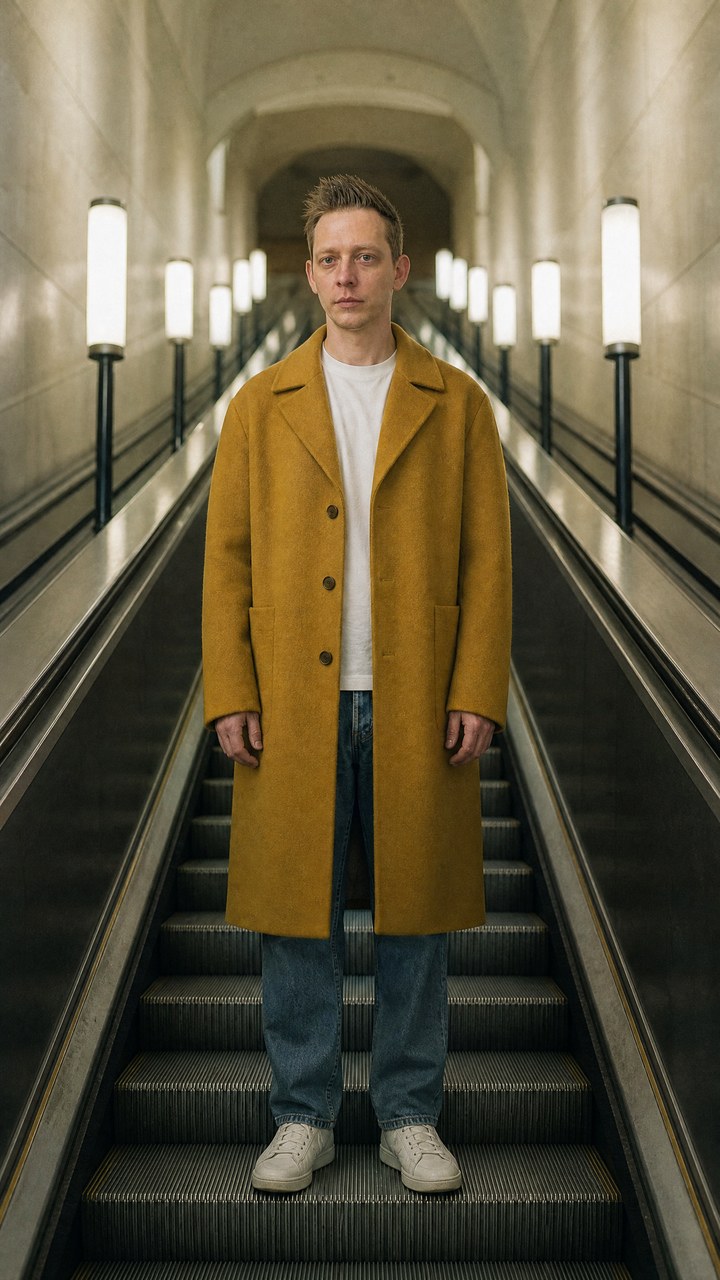
Start frame prompt:
```
Use the character sheet and photo(s): the EXACT same person, identical face, eyes, nose, lips, skin, age and hairstyle. Wardrobe: a long oversized mustard-yellow wool coat over a white t-shirt, straight blue jeans, white sneakers. Create one ultra-photorealistic vertical cinematic film still. The person stands still in the CENTER of a long metro escalator going down, facing the camera, full body from head to sneakers, filling about 70% of the frame height, calm neutral face, hands down. The camera is FIXED, straight-on, at chest height, symmetrical composition: dark escalator handrails on both sides, rows of lamps and pale tiled walls receding upward behind the person, deep perspective. Empty escalator, no other people. Soft even light, muted green-grey palette, analog film grain, shallow depth of field. No text, no logos, no watermarks.
```
Video prompt:
```
Surreal paper-sticker effect from @first_frame. FIXED STATIC camera for the whole shot, no camera movement, no zoom. The person stands perfectly still on the escalator. ONE CONTINUOUS SHOT, no cuts.
0.0–0.3 s: a giant realistic human hand is already entering from the top-right edge of the frame, moving fast.
0.3–1.0 s: the hand pinches the top of the person's head with thumb and finger, as if lifting the corner of a sticker.
1.0–3.0 s: the hand PEELS the person off the scene like a vinyl sticker, from the head down to the feet: the peeled part curls over and shows a flat WHITE PAPER BACKING, the person becomes a flat curling sheet; behind it the EMPTY escalator is revealed, clean and complete. The hand pulls the whole sticker away out of the bottom-right edge of the frame.
3.0–3.4 s: the empty escalator for a brief moment.
3.4–4.6 s: the hand comes back from the bottom-right holding a DIE-CUT STICKER of the same person with the PRINTED PHOTO SIDE ALWAYS FACING THE CAMERA — the full-body photo of the person with a thick white border is fully visible from the very first moment it enters the frame, never blank, never turning around. The sticker is LARGE, about two thirds of the frame height. The hand lifts it into the center of the frame.
4.6–8.0 s: the hand holds the big sticker upright in the middle of the escalator between thumb and finger at its top edge, the sticker gently swaying, until the end.
STYLE: realistic, soft even light, muted green-grey palette, analog film grain, the hand and paper look real.
NEGATIVE: no camera movement, no zoom, no cuts, no blank white sticker, no image appearing or morphing on the sticker, no tiny sticker, no second person, no tearing, no change of face or clothes on the sticker, no cartoon, no text, no logos.
```
Price: about $1.76 (8 seconds). Make Sticker with your face
4. Gym Clones: you and six copies of you
What happens. You sit on the floor with a ball. The camera slowly moves forward, and one after another your copies in the same outfit appear around the gym: one dribbles, another shoots in mid-jump, a third dunks from above and hangs on the rim, and one more walks up to the camera, waves and passes by the lens.
What broke. In the first version the camera stayed in place and the copies ran around as tiny figures deep in a huge hall, so the dunk was impossible to make out. Changing the video prompt did not help here: we redid the start frame, with a small gym, the hoop five meters behind the character, and a low camera. We also added to the prompt "the camera never stands still, it moves two meters forward."
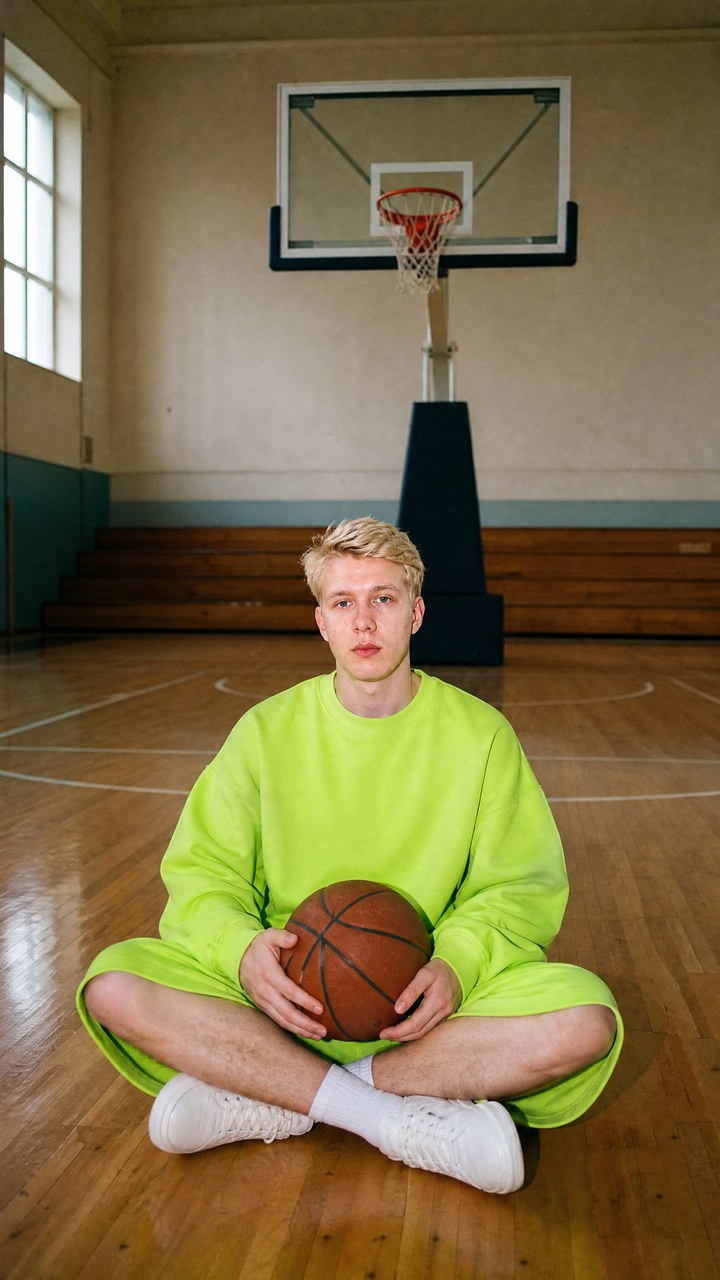
Start frame prompt:
```
Use the character sheet and photo(s): the EXACT same person, identical face, eyes, nose, lips, skin, age and hairstyle. Wardrobe: an OVERSIZED bright neon lime-green sweatshirt and matching lime-green wide shorts, white socks, sneakers. Create one ultra-photorealistic vertical cinematic film still of a surreal fashion film. A small, cosy old school gymnasium with a polished wooden floor. A full-size basketball hoop with a glass backboard stands CLOSE, only about 5 metres behind the person, filling the upper third of the frame; low wooden bleachers along the back wall just behind the hoop, a tall window with soft daylight on the left. The person sits on the floor in the bottom center foreground, legs crossed, holding a basketball in the lap, calmly looking at the camera, head and body big in the frame. The camera is low, at about 1 metre height, 3 metres in front of the person; the free court space between the person and the hoop is big and clearly visible. Dreamy direct flash, soft gym light, pastel palette, analog 35mm film grain. No other people, no text, no logos, no watermarks.
```
Video prompt:
```
Surreal duplication fashion film from @first_frame. The ORIGINAL person stays seated on the floor in the bottom center holding the basketball for the whole shot, calm, looking ahead. CAMERA — CRITICAL: the camera is never static; it performs a slow, continuous DOLLY FORWARD of about 2 metres toward the hoop from the first to the last second, rising slightly, with elegant parallax, one continuous shot, no cuts, no flashes.
IDENTICAL COPIES of the same person — exactly the same face, blond hair and lime-green outfit — appear naturally in the gym one after another at MID-DISTANCE, 3–6 metres from the camera, LARGE and clearly readable, never tiny in the background, simply present in the space, never popping:
0.0–1.5 s: a copy walks across the court behind the original dribbling a ball; another copy leans on the bleachers watching.
1.5–3.0 s: a copy on the left takes a jump shot; the ball flies toward the hoop.
3.0–4.6 s: a copy runs in from the right and DUNKS the ball into the hoop, hanging on the rim for a moment, then lands under the basket.
4.6–6.4 s: a copy walks straight toward the camera, smiles subtly and casually WAVES, getting very close.
6.4–8.0 s: the waving copy passes right next to the lens and out of frame to the right; the camera keeps gliding forward, the seated original still visible.
None of the copies notice each other; each lives in its own timeline. Occasional rack focus between copies.
STYLE: dreamy direct flash, soft gym light, pastel palette, analog 35mm film grain, subtle lens bloom, shallow depth of field, cinematic realism, premium fashion editorial.
NEGATIVE: no static camera, no tiny distant figures, no different faces, no different outfits, no original disappearing, no flashes, no teleport effects, no cuts, no strangers, no distorted bodies, no text, no logos.
```
Price: about $1.76 (8 seconds). Make Gym Clones with your face
5. Warp Zoom: three places in one pass
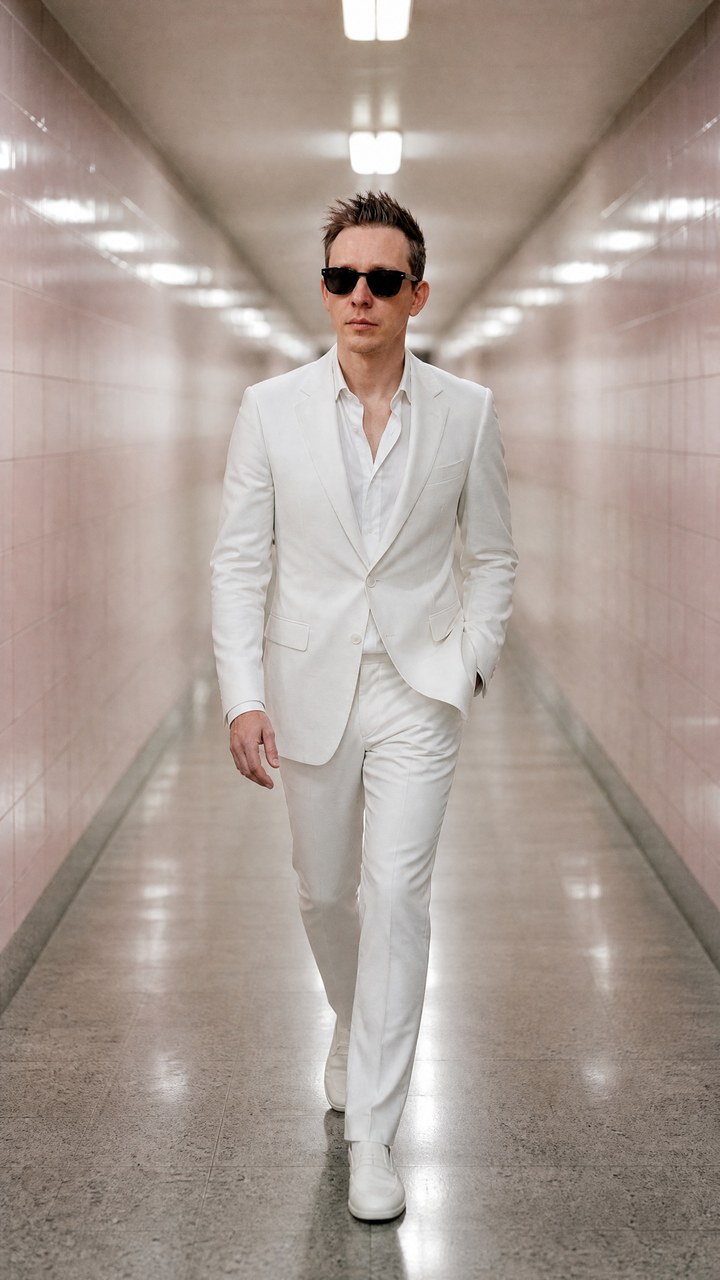
What happens. You walk straight at the camera at an even pace, in a white suit and dark glasses. The world around you gets pulled into a funnel: walls, tiles and lamps stretch into radial streaks, and the underpass turns, with no cuts, into an empty subway car and then into an aisle of an old library.
What worked right away. This effect came out on the first run. The key is separation: only the surroundings blur and warp, while the character stays sharp, keeps the same walking speed and stays in the center.
Start frame prompt:
```
Use the character sheet and photo(s): the EXACT same person, identical face, eyes, nose, lips, skin, age and hairstyle. Wardrobe: a perfectly tailored white suit with a white shirt open at the collar, black sunglasses, white shoes. Create one ultra-photorealistic vertical cinematic film still of a fashion film. The person walks confidently straight toward the camera down the CENTER of a long, narrow, empty pedestrian underground corridor with glossy pale pink tiled walls, a row of fluorescent ceiling lights and a reflective floor that converge to a deep vanishing point behind the head. Full body visible, mid-stride, one hand in a pocket, about 70% of the frame height, symmetrical one-point perspective. Soft direct flash, subtle film grain, muted pastel tones, shallow depth of field, cinematic realism. No other people, no text, no logos, no watermarks.
```
Video prompt:
```
Continuous cinematic fashion shot from @first_frame: the exact same person, face, sunglasses and white suit. ONE CONTINUOUS SHOT, no cuts. The person walks calmly and confidently straight toward the camera at the SAME natural pace from the first frame to the last, never pausing, never speeding up, always centered and perfectly sharp. The camera retreats in front of the person with a slow steady ZOOM OUT so the person stays the same size.
WARP TRANSITIONS — CRITICAL: the environment behind and around the person is pulled backward at incredible speed into a vortex: walls, floor tiles and ceiling lights stretch into long radial motion-blur streaks and bend inward, then the place seamlessly MORPHS into a new one while the person keeps walking on the same line:
0.0–3.0 s: the empty pale pink tiled underground corridor.
3.0–4.0 s: first warp: the corridor streaks and folds away and becomes the inside of an EMPTY SUBWAY CARRIAGE.
4.0–7.0 s: he walks down the center aisle of the empty carriage: stainless steel poles, empty seats, fluorescent lights, long perspective lines.
7.0–8.0 s: second warp: the carriage streaks and folds away and becomes a tall OLD LIBRARY AISLE.
8.0–10.0 s: he walks down the aisle between endless wooden bookshelves with warm lamps, until the end.
Only the environment is blurred during warps; the person is never blurred, never distorted.
STYLE: dreamy analog atmosphere, soft direct flash, subtle film grain, muted pastel tones, shallow depth of field, cinematic realism, premium fashion editorial.
NEGATIVE: no cuts, no fade to black, no blur on the person, no distortion of the person, no change of face or outfit, no other people, no stopping, no running, no text, no logos.
```
Price: about $2.14 (10 seconds). Make Warp Zoom with your face
6. Mega Scale: a giant on a tiny planet
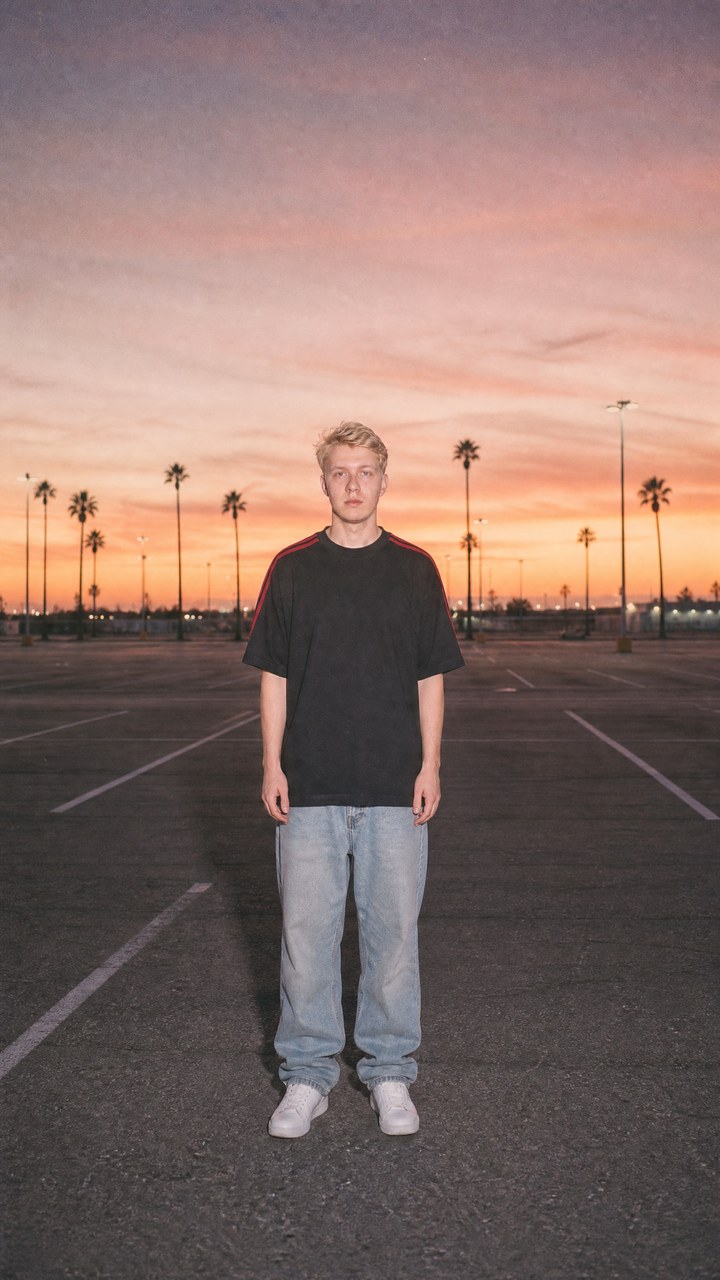
What happens. You stand in the middle of an empty parking lot at sunset. The camera rises in front of you, the lens turns into a fisheye, and the picture curls into a circle: your face in the center, and the parking lot, palm trees and sunset wrapping around your head in a ring like a tiny planet.
What broke, twice. The first time the camera went over the character from behind, and the face ended up upside down in the frame. The fix is plain text: "the camera is always in front of the person, the face is always upright, forehead on top, chin at the bottom." The second time a dark shadow appeared on the face, as if cast by the camera itself. The fix is a line about even flash lighting and a ban on shadows on the face.
Start frame prompt:
```
Use the character sheet and photo(s): the EXACT same person, identical face, eyes, nose, lips, skin, age and hairstyle. Wardrobe: an oversized black t-shirt with red stripes on the shoulders, loose light jeans, white sneakers. Create one ultra-photorealistic vertical cinematic film still. The person stands still in the middle of a huge empty outdoor parking lot at sunset, full body, facing the camera, hands at the sides, looking DIRECTLY into the lens with a calm, emotionless expression, about 60% of the frame height. White parking lines on grey asphalt, rows of tall palm trees and street lamps on the low horizon, a pastel pink-orange sunset sky. Camera at chest height a few metres away. Dreamy direct flash, soft haze, analog film grain, subtle lens bloom, nostalgic atmosphere. No other people, no text, no logos, no watermarks.
```
Video prompt:
```
Surreal "mega scale" shot from @first_frame: the exact same person, face and outfit. The person stands perfectly STILL for the whole shot and keeps looking DIRECTLY into the lens with a calm, emotionless face. ONE CONTINUOUS SHOT, no cuts.
CRITICAL ORIENTATION: the camera always stays IN FRONT of the person, never goes behind or over the back of the head. The face is ALWAYS UPRIGHT in the frame — forehead at the top, chin at the bottom — never upside down, never rotated.
LIGHT: the face is evenly lit by soft direct on-camera flash for the whole shot — no shadows on the face, no dark patches on the forehead or nose.
0.0–0.8 s: the camera starts a slow push-in toward the person at chest height.
0.8–2.5 s: the camera RISES up in front of the person and tilts down toward the face while the lens gradually turns into an ultra-wide 8mm FISHEYE: straight lines bend, the image becomes a circle with a dark vignette around it; the person raises the chin and looks UP into the lens.
2.5–4.0 s: forced-perspective illusion: the person's face and shoulders grow huge and fill the center of the circle, close to the lens, while the parking lot, palm trees, street lamps and the pink sunset horizon curve all the way around the head into a TINY PLANET ring — a miniature city wrapping around the face.
4.0–6.0 s: final frame held: extreme fisheye view from above and in front, the upright, evenly lit face fills the middle of the circle, the miniature world and the sunset sky wrap around it in a ring; the camera slowly keeps pulling up and gently rotating a few degrees.
STYLE: dreamy direct flash, pastel sunset sky, soft haze, analog film grain, subtle lens bloom, ultra-wide fisheye distortion, surreal realism, nostalgic atmosphere.
NEGATIVE: no shadow on the face, no camera shadow, no upside-down face, no view from behind, no cuts, no literal growing body, no change of face, no smile, no extra people, no text, no logos.
```
Price: about $1.38 (6 seconds). Make Mega Scale with your face
7. Gravity Lift: antiques rise into the air
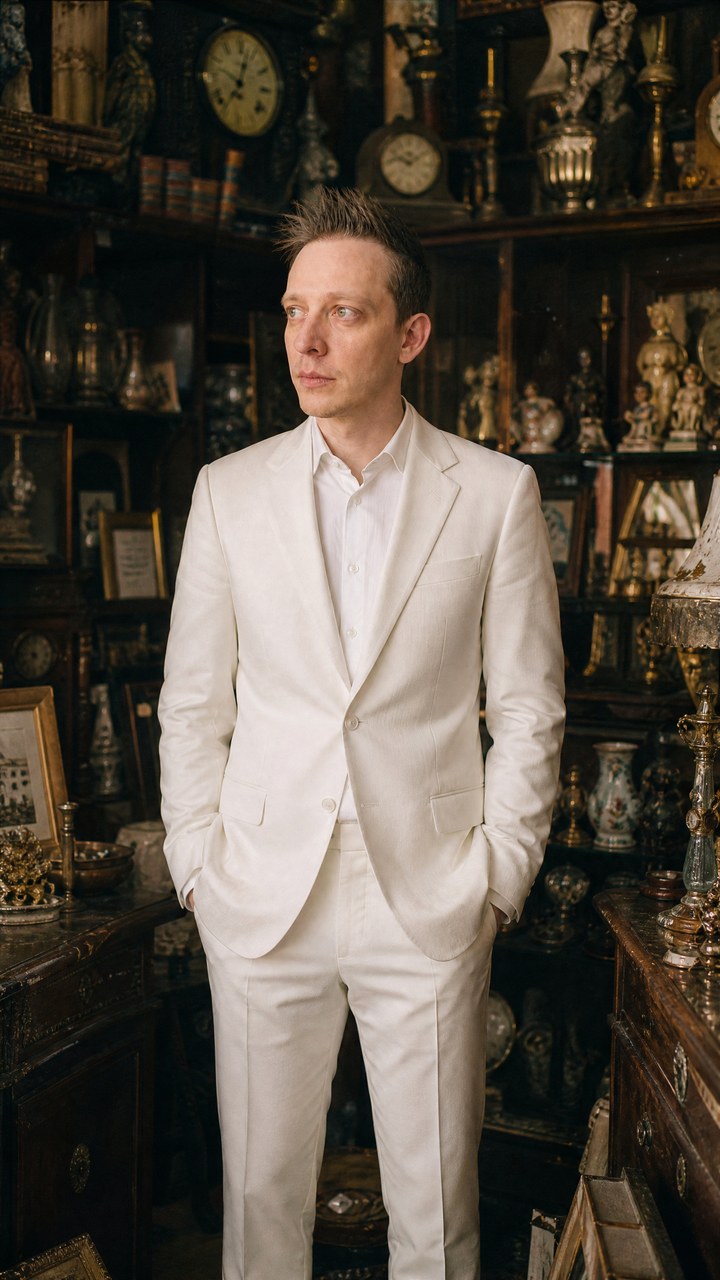
What happens. You stand in a white suit in the middle of a cramped antique shop. Gravity disappears: first a book, then a mantel clock, picture frames, postcards and porcelain figurines lift off the shelves and slowly float around you. You barely move, only following them with your eyes.
What worked. The effect came together on the first try thanks to the "one at a time" order: the prompt spells out which object rises at which second. Without that, the model lifts everything at once, and you get an explosion instead of magic.
Start frame prompt:
```
Use the character sheet and photo(s): the EXACT same person, identical face, eyes, nose, lips, skin, age and hairstyle. Wardrobe: a perfectly tailored white suit with a white shirt, hands in the trouser pockets. Create one ultra-photorealistic vertical cinematic film still of a quiet surreal fashion film. The person stands calmly in the CENTER of a small, cluttered vintage antique shop, full body from head to knees, about 65% of the frame height, looking slightly up and to the side with quiet curiosity. All around: dark wooden shelves and glass cabinets packed with antiques — old leather books, porcelain figurines, brass lamps, ornate mantel clocks, framed photographs, glass bottles, postcards, small ornaments; a dark wooden counter in the foreground left and right. Nothing is floating yet. Warm window light mixed with soft direct flash, dust in the air, pastel-warm palette, analog 35mm film grain, shallow depth of field, premium editorial cinematography, nostalgic atmosphere. No other people, no text, no logos, no watermarks.
```
Video prompt:
```
Quiet surreal sequence from @first_frame: the exact same person, face and white suit, in the vintage antique shop. The person stands almost completely still with hands in pockets, the emotional center of the shot. ONE CONTINUOUS SHOT, no cuts. The camera slowly pushes in and gently drifts around the person.
GRAVITY DISAPPEARS — antiques gently lift off their shelves ONE BY ONE and float weightlessly, rotating slowly as if underwater, never abruptly:
0.0–1.2 s: stillness, dust particles in the warm light.
1.2–2.8 s: an old leather book rises from the counter in the foreground and floats up past the person's shoulder; the person follows it with the eyes.
2.8–4.2 s: an ornate mantel clock lifts off the shelf and drifts in the air beside the person.
4.2–5.6 s: framed photographs float up from a cabinet and turn slowly in the air near the person; the person tilts the head slightly with quiet curiosity.
5.6–8.0 s: postcards, glass bottles and small porcelain figurines join them; the shop fills with dozens of floating treasures around the calm person, a dreamlike floating museum; one picture frame drifts close to the lens.
The person never reacts dramatically, only follows the objects with the eyes.
STYLE: dreamy direct flash mixed with warm window light, pastel-warm palette, analog 35mm film grain, soft lens bloom, subtle haze, shallow depth of field, elegant rack focus, magical realism.
NEGATIVE: no objects falling or crashing, no fast motion, no person floating, no change of face or suit, no cuts, no extra people, no text, no logos.
```
Price: about $1.76 (8 seconds). Make Gravity Lift with your face
Bonus. "The Stadium": a 15-second blockbuster on Seedance 2.5
What happens. Five scenes, 3 seconds each. You fall from the sky through the clouds onto a giant stadium and land in the only empty seat. A hundred thousand spectators turn to look at you at once, and your face fills the screen. The field splits open with blue lightning, and a 20-meter double of you rises out of black smoke and holds out a ball. A kick, and the stadium flips over, the crowd floats up weightless, and the double crumbles into sparks. The camera flies off into space, and the stadium turns out to be the pupil of a huge living eye, which blinks. The finale is a referee's whistle in the dark.
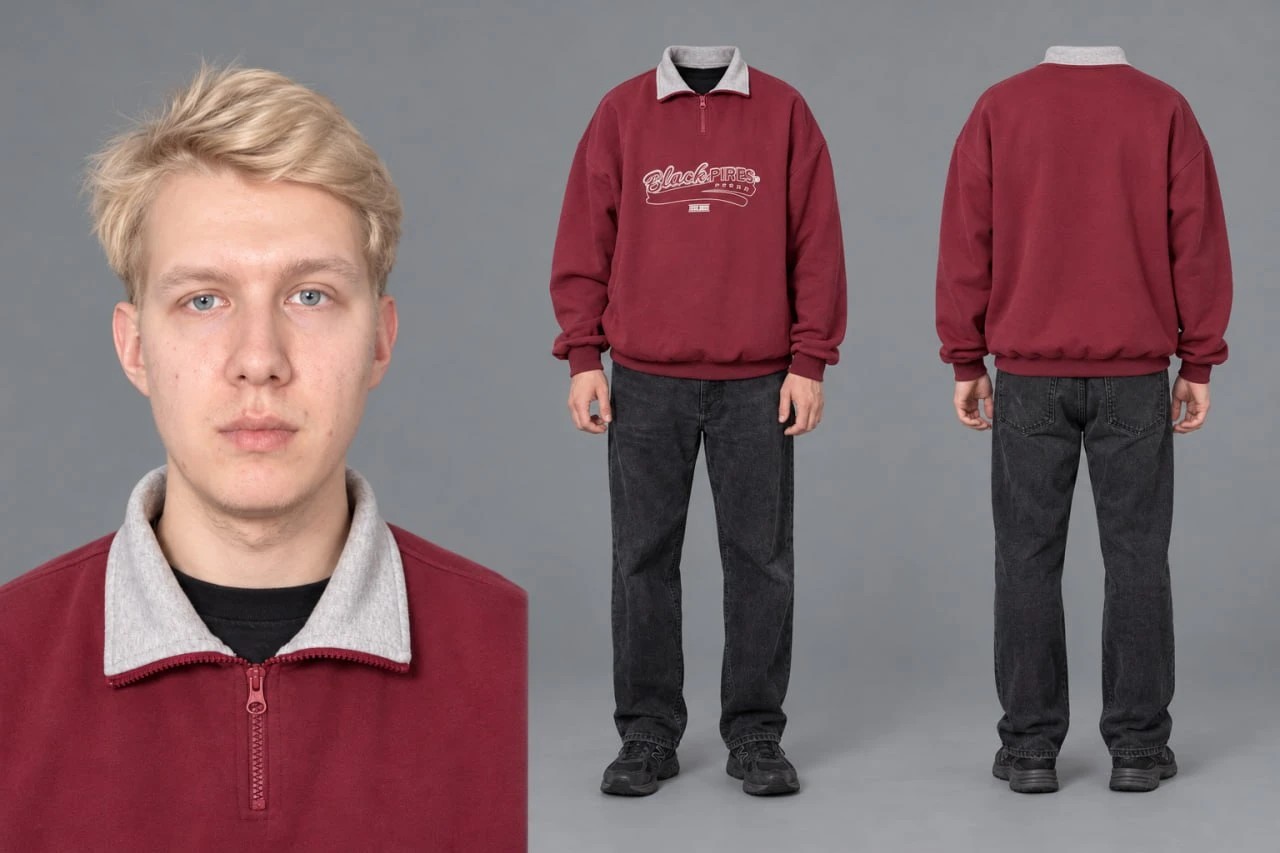
How it differs from the other templates. There is no starting frame here: the Seedance 2.5 Omni model builds all five scenes itself, straight from the character card. That is why the card is different: a large front-facing face plus the outfit from the front and the back, so the giant double comes out in the same clothes. The video has sound from the start: wind, the roar of the stands, silence, the kick, the whistle.
What to keep in mind. Seedance 2.5 Omni accepts a prompt of up to 4000 characters, and the original was 5670. We shortened it without cutting a single scene: we removed repetition and described the sound more briefly. Also, video models write Russian on-screen text unreliably: in our run the screen showed «НАКОНЕТЬ-ТО ТЫ ЗДЕЕСЬ» (a misspelling of «НАКОНЕЦ-ТО ТЫ ЗДЕСЬ», "finally, you're here"), and «ТВОЙ ХОД» ("your move") never appeared. If the text matters, add it during editing, not in the prompt.
Character card prompt for this template:
```
Professional character reference sheet of the EXACT same person from the photo(s), for consistent use in AI video. Plain medium-grey studio background, soft even daylight, photorealistic, sharp focus, one horizontal sheet with three panels. LEFT PANEL (large, about 40% of the width): a passport-style head-and-shoulders portrait, strictly frontal, looking straight into the camera, neutral expression, the face filling the panel. CENTER PANEL: the full outfit worn by the person, front view, from the collar down to the shoes, standing straight with arms relaxed at the sides, the head cropped out of the frame at the collar. RIGHT PANEL: the same outfit from the back, from the collar down to the shoes, the head cropped out at the collar. Preserve the identity exactly: same face shape, eyes, nose, lips, skin texture, age, facial hair and the same hairstyle and hair colour. Wardrobe: the same clothes as in the photo with all colours, collars, prints and logos kept; if only the upper body is visible, continue the outfit naturally with matching trousers and shoes. No text labels, no watermarks.
```
Video prompt (the @image1 image is the card):
```
15-second ultra-photorealistic surreal sci-fi blockbuster, Hollywood-level VFX, IMAX-scale cinematography, realistic physics, immersive sound. VERTICAL 9:16 frame for a phone screen, 24fps, dramatic contrast, natural motion blur. Exactly 5 shots of 3 seconds each, a hard cut or clear angle change every 3 seconds. No narration, no subtitles.
MAIN CHARACTER @image1 — ABSOLUTE IDENTITY CONSISTENCY: @image1 is the character sheet of the hero: use exactly this person — the same face, hairstyle, age and body — wearing exactly the same clothes with the same colours, collar and prints as on the sheet. Face, hair, clothes and proportions identical in every shot. The hero's giant double is the exact same person in the same clothes, 20 meters tall.
00:00–00:03 THE FALL: midair above the clouds, the hero falls at extreme speed toward a gigantic football stadium with 100,000 spectators. Aggressive FPV ultra-wide camera chases the hero through clouds, wind distortion, a brief barrel roll. Hard cut to a top-down crash zoom into the packed stands revealing exactly one empty seat; the hero lands perfectly seated in it. Huge impact, camera shake, drinks and debris fly, then sudden stillness.
00:03–00:06 THE CROWD TURNS: abrupt silence. Tight close-up of the hero's stunned face, smooth 360-degree orbit: all 100,000 spectators turn their heads toward the hero at the same instant. End over the hero's shoulder on the giant stadium screen showing a live close-up of the hero's face and glowing Russian text "НАКОНЕЦ-ТО ТЫ ЗДЕСЬ". Deep sub-bass tremor; the hero looks around in fear.
00:06–00:09 THE GIANT DOUBLE: the stadium shakes violently, the pitch splits with a jagged crack releasing blinding electric-blue light and debris. The seat catapults the hero to the center of the pitch, where the hero lands on both feet, barely balancing. Behind the hero black smoke forms a colossal 20-meter duplicate of the hero in exactly the same clothes. Low-angle tilt up for scale. The giant leans down and presents a normal football. The screen reads "ТВОЙ ХОД".
00:09–00:12 THE KICK: extreme close-up of the ball on the grass; the hero kicks it with full force, dramatic speed ramp, realistic ball deformation, dirt and grass particles. The strike flips the whole stadium upside down, camera rolls 180 degrees, thousands of spectators float in zero gravity above the inverted stands. The hero stands still at the center. The giant double disintegrates into millions of glowing blue-white particles.
00:12–00:15 THE EYE: hard cut to a perfectly centered top-down shot of the stadium, impossibly fast hyper-zoom pullback through clouds, beyond the atmosphere into space: the whole stadium is the black pupil of a gigantic living eye of a cosmic being, iris with organic radial textures, wet reflections, terrifying scale. It stares at the viewer, then suddenly blinks — total black.
CAMERA: FPV, crash zooms, top-down God's-eye framing, low-angle monumental reveals, 360 orbit, controlled shake, speed ramps, optical roll, cosmic hyper-zoom. Tone: absurd accident → surreal stadium horror → cosmic twist.
SOUND: roaring wind and loud stadium ambience, massive landing impact; at 00:03 near-total silence, synchronized crowd movement, sub-bass tremors, cracking concrete, energy surge from the rupture; hard kick impact then vacuum drop; low rumble and shimmering particles in zero gravity; silence and one sharp referee whistle in darkness at the end.
CONTINUITY: strict character consistency, the giant clearly the same person, coherent massive stadium architecture, physically believable supernatural events, seamless unmistakable stadium-to-eye reveal, Russian text spelled exactly.
NEGATIVE: no cartoon or game look, no costume change, no inconsistent face, no extra protagonists, no distorted anatomy, no wrong Russian text, no subtitles, no logos, no watermarks.
```
Price: about $6.24 (card $0.12 + 15 seconds of video with sound $6.12, which is what our run cost). Make "The Stadium" with your own face
Who to sell this to and what it costs
One video costs $1.38–2.14 to make. The next question is who needs such an effect:
- Freelancer taking orders. Warp Zoom and Sticker are ready-made clips for a musician, a clothing brand or a shoe store: the outfit in the start frame is swapped for the client's product. To work out your own price, see the breakdown of video production cost.
- Business. Frozen Time in a client's store or Gravity Lift among their products gives you an ad video without a shooting day. If the product itself needs to be the star, take a look at eight video formats from a single product photo.
- Specialist or expert. One such video a week is a hook for Reels: people watch to the end when a familiar face is in an impossible situation. How to turn that into a salary rather than one-off jobs is covered in the article on the Reels manager.
- For yourself. Gym Clones with a friend in the lead role for $1.76 is a gift people forward.
Don't use someone else's face without consent: the template will happily make a video from any photo, but the responsibility is yours. More on this in the piece about face rights in advertising.
Where to look next
- Kling 4 video templates: the first five effects — Multiverse, Echo Crowd, Hyperloop, City Silhouette, Fluid Jump, and the formula for an effect prompt.
- AI video generation in 2026: how it works and how to write a prompt — the basics, if the prompts above still look like spells.
- AI video models in 2026: what they can really do and what sells — where Kling 4 is stronger than other models.
- Hollywood for $0: four movie special effects made with AI — the same approach to effects, but for film.
The templates are open on every plan, including the free one: you need an account and a balance, each step is paid for as it runs, and the minimum top-up is $5. You can build your own effect from scratch in Gen AI: it has the same GPT Image 2 and Kling 4.0 Keyframes, the prompts from this article paste in as they are, and the start frame is attached as an image.
An assignment for tonight
Make Mega Scale with your own photo. It is the shortest and cheapest of the seven templates. Then step through the video frame by frame and check three things: the face is upright the whole time, there is no shadow on the face, and the ring of the "planet" is closed. If even one of them is off, you have found the same thing we did, and you know which line of the prompt to strengthen.
FAQ
What is a VFX template for video?
It is a ready-made visual effect from a clip with your face dropped in. From your photo the AI makes a character card, then a start frame of the scene, then a video model animates the frame from a tested prompt. You don't have to write prompts yourself.
Why does the guide use Seedance while the templates run on Kling 4?
Magnific's guide is written for Seedance 2.0 Mini, while all of our video templates are built on Kling 4.0 Keyframes, so they share one logic and one price per second. We rewrote the prompts for Kling and checked them against the videos.
How do I make sure nothing moves in a time stop effect?
State outright that the scene is a frozen photograph and that only the camera's point of view changes from the first frame to the last. Then list in the prohibitions everything the model likes to animate: falling water, splashes, ripples, fire, blinking.
How much does a template video cost?
From $1.38 to $2.14, depending on length: the character card and start frame are $0.12 each, and the Kling 4.0 Keyframes video is $0.19 per second. Money is taken from your platform balance as each step runs.
Can I use these prompts in another service?
Yes, the prompts work anywhere GPT Image 2 and Kling 4 are available. In another interface, replace the @first_frame tag in the video prompt with the attached start frame.
Want to learn to write prompts like these yourself, without templates? Message the bot with the word НЕЙРОВИДЕО (Russian for “AI video”) and I'll send a breakdown, "AI video generation in 2026: how it works, the models and how to write a prompt": https://t.me/consultant_ai_skills_bot?start=NEIROVIDEO_blog