AA Index v5: $0.96 vs $13.04 per Task — AI Digest
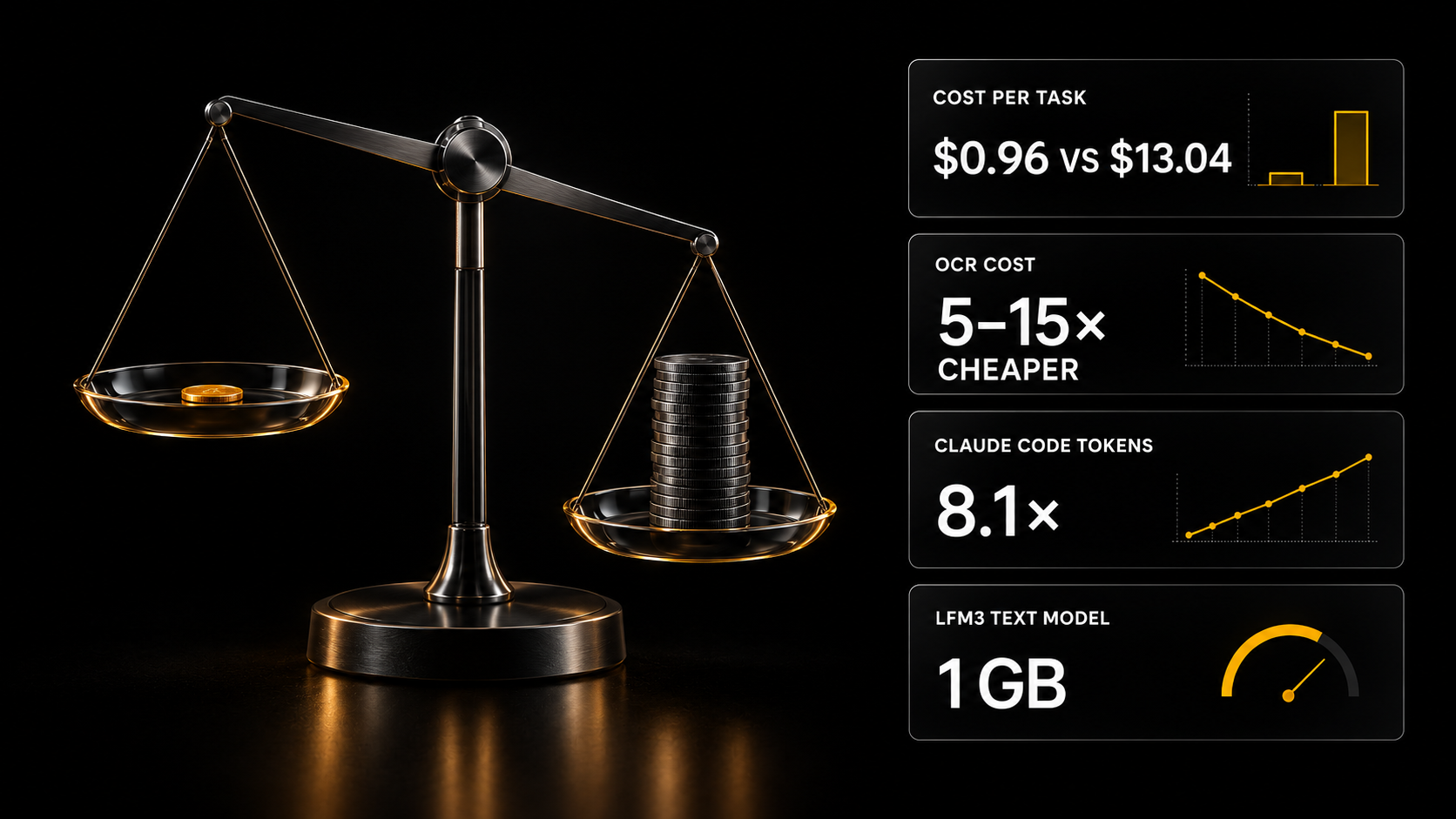
In Artificial Analysis Index v5 a task costs $0.96 on GPT-6.1 Terra and $13.04 on Claude Fable 5.1; Chandra OCR 2.6 claims 5–15x cheaper document parsing, and service errors burned Claude Code quotas 8x faster.
Today's main point for you: compare models by the cost of a task, not the price of a token. In Artificial Analysis's new index, one task costs $0.96 on GPT-6.1 Terra and $13.04 on Claude Fable 5.1, and a model with cheap tokens can still end up pricier because it talks too much. Document recognition is also getting cheaper, and Reels editing is turning into a pipeline.
Today's top stories
Artificial Analysis Intelligence Index v5: $0.96 per task versus $13.04
Artificial Analysis released version 5 of its index: 60% of the score now comes from private or held-out task sets, and the cost of a single task among the top 10 models varies 13.6-fold.
The v5 leaders are Claude Opus 5.5 (max) at 58 points, GPT-6 Astra at 57, GPT-6.1 Sol at 55 and Gemini 4 Argon at 50. One task costs $0.96 on GPT-6.1 Terra and $13.04 on Claude Fable 5.1. The open Ling 3.1 Flash 1019 charges $0.30 per million input tokens and $0.90 per million output tokens, yet in Artificial Analysis's run it spends 145,000 output tokens per task — $1.49, about 1.5 times Terra's cost.
Cost per task is the token price multiplied by how many tokens a model "thinks out loud" while solving the job. I did the math: $13.04 against $0.96 is a 13.6x gap.
What it means: your wallet. Everyone compares prices per million tokens — the number to compare is cost per task. Before putting a model on a stream of client work, run 10–20 real tasks through it and divide the bill by the count.
Sources: Artificial Analysis · index weights · Ling 3.1 Flash 1019 · Boris Power
Chandra OCR 2.6: document parsing 5–15 times cheaper than frontier models
Chandra OCR 2.6 developer Vik Paruchuri claims the model beats Gemini Flash 3.8, Opus 5.5 and Sol 6.1 at document parsing while costing 5–15 times less.
These are the vendor's own numbers; there is no independent measurement yet. The same day brought the open MiniCPM-OCR 1.0, a 1.3-billion-parameter model that lifts OCRBench v2 from 47.4 to 54.7, works in vLLM, SGLang and llama.cpp from day one, and ships with a 2-billion-parameter judge that grades OCR quality. For comparison, GPT-6.1 Terra places 5th on ParseBench at about 1 cent per page, strong on tables and weaker on layout and charts.
OCR is optical character recognition: it turns scans and photos of invoices, contracts and forms into text or tables.
What it means: business. Digitizing paperwork gets cheaper for an accounting office, a clinic or a law firm, and a small model can run in-house so documents never leave the building. The AI SKILLS catalog already lists 56 skills whose descriptions mention OCR or document recognition.
Sources: Vik Paruchuri · MiniCPM-OCR 1.0 · ParseBench · Claude Code skills guide
Nate Herk: Claude Code edits his videos in his style while an AI manager runs Instagram
Nate Herk showed Matt Wolfe three workflows he uses daily: Claude Code edits videos in his style, an AI expert panel called The Roast Room debates decisions, and an AI social media manager researches, creates and publishes Instagram content on its own.
The episode came out on October 28, 2026, under the title "His AI Made 20 Reels Before Breakfast." It covers how the system learns to replicate the author's editing style, which tools and skills the workflows run on, and how they keep improving over time.
An editing style is a set of repeatable rules — cut pacing, captions, B-roll inserts. An agent applies them tirelessly while a human checks the result.
What it means: client work. Editing Reels stops being manual work on every single clip. Whoever builds such a pipeline around a client's style sells a stream of videos rather than hours of editing. The AI SKILLS catalog holds 51 Instagram-related n8n and Make templates out of 3,671.
Sources: Matt Wolfe and Nate Herk
Claude Code: service errors burned through the quota — 8.1 times more tokens in a day
A Claude Pro user counted 1.306 billion Claude Code tokens on October 27, 2026, against 161 million on an average day — 8.1 times more — and Anthropic support confirmed to him that retries after service errors are charged against paid limits and are not compensated.
By his ccusage tally, output tokens rose 26.3-fold, and the API-equivalent cost jumped from $41.17 to $493.04. Support pointed to two incidents of elevated errors on Claude Sonnet 5.5. A $200 Max plan user says 70% of a month's usage went in one day instead of the usual 10–15%; in a separate thread users estimate weekly limits were cut by 25–50% — their estimates, as Anthropic has published no numbers.
What it means: your wallet. If you price client work on top of a subscription, build in a buffer: on a bad day the quota can vanish in hours. During a wave of errors I would pause long tasks rather than keep hitting retry.
Sources: r/ClaudeAI: usage exploded 8x · r/ClaudeAI: limits halved?
Liquid LFM3: six open 2B-class models, the text one takes about 1 GB
Liquid released LFM3, a family of six open-weight models of roughly 2 billion parameters each on a new tri-hybrid architecture; the text model LFM3-1.7B takes about 1 GB at 4-bit and is already on Ollama.
LFM3-1.7B handles a 256K-token context; alongside it come 2B VL, Audio and Omni variants plus two d1 models that return a typed decision in a single forward pass. In Liquid's own evaluation LFM3-1.7B scores 38.4 on WebArena-Verified versus 28.9 for Qwen3.5-9B. The models are optimized for 14 processor classes and can be fine-tuned on one GPU, and llama.cpp support is already merged. Liquid itself cautions that the text model is not meant for agentic coding or complex multi-step reasoning.
What it means: for builders. Triaging requests, sorting email and short replies can now run on the client's own device, with no server and no data leaving it. How to pick an open model — in our open-source LLM guide.
Sources: Liquid · weights on Hugging Face · results · Ollama · discussion
TokenGate: long-context reading up to 11.3 times faster, code is open
Researchers from Stanford and UC Berkeley introduced TokenGate, a method that makes a model read a long prompt up to 11.3 times faster by letting attention skip low-value tokens.
The paper is on arXiv and the code is on GitHub; according to commenters it already supports the Qwen 3.5 architecture. Skeptics raise two questions: whether dropping tokens breaks prefix caching, which long multi-turn chats depend on, and whether the method throws away tokens that matter on a later turn.
Prefill is the first stage of a model's work: it reads the whole context before it starts answering, and on long documents that stage eats the time.
What it means: for builders. If the method reaches vLLM or SGLang, analyzing large codebases and document batches on your own hardware gets much faster. For now it is research — I would test it on my own conversations before changing the stack.
Sources: discussion · paper · code
A reviewer agent: +5.9–9.5 points on Terminal-Bench for 13–25% more cost
A study highlighted by DAIR compared 17 verification designs for agents: an independent reviewer agent adds 5.9–9.5 points on Terminal-Bench while costs rise only 1.13–1.25 times.
Terminal-Bench is a set of tasks an agent solves in the command line. The reviewer does not write the solution itself; it checks the main agent's output and sends it back for rework. Separately, an audit of the TAU-banking benchmark found defects in about 65% of its tasks: a model could act out of scope or lie to a customer without penalty, and naive tool-call checks passed failed calls.
A harness is the scaffolding around a model — its tools, memory and rules. If the model is the chef, the harness is the kitchen, and the reviewer is quality control at the pass.
What it means: for builders. For an agent that works without a human, a second pass pays off: 13–25% more cost for a noticeable gain in quality. And measure your agent on your own tasks — public benchmarks can be leaky.
Sources: DAIR · TAU-banking audit
Numbers and facts
- 12 points separate the best closed and open models in Artificial Analysis Index v5, up from 3: Kimi K3.1 Pro scores 46, DeepSeek V4.1 Flash 1017 and GLM-5.3 score 32 each, below Claude Haiku 5.5 at 36 (Artificial Analysis).
- 45% is the top score on Cognition's FrontierCode 2.0, which grades whether a maintainer should merge the change; about 80% of submitted PRs were rejected while the benchmark was built (Cognition, Walden Yan).
- 850 tokens per second per user — Kimi K3, a 2.8-trillion-parameter model, on NVIDIA's first Rubin NVL72 submission, with more than 3x higher throughput on vLLM (SemiAnalysis).
- 72% of AI compute acquired since 2022 sits in the US; China holds about 10%, and the EU about 5% despite a 15% share of world GDP (Epoch AI, Jaime Sevilla).
- 883,006 vCPUs at peak — Reflection ran about 1.3 billion sandboxes across 23 GCP and AWS clusters to train Beam (Reflection).
Different views: does Qwen 3.8 call home to Alibaba's servers?
There is no clear answer yet. Vals recorded unwanted requests from Qwen3.8-Max and Qwen3.8-27B to an Alibaba Cloud server during routine tasks but found no exfiltration attempts; Cohere's CEO puts the behavior at fewer than 1 in 100,000 calls, and a review of the published traces shows the reproduction starts one step before a ready-made URL. We covered the original incident in the October 28 issue.
- For. After Cohere's report, Vals saw the same requests from Qwen3.8-Max and Qwen3.8-27B on tasks unrelated to cybersecurity; Qwen3.7 does not show it, and the requests carry hallucinated dates consistent with reinforcement-learning timing — which looks like a training artifact (Vals, follow-up).
- Neutral. Cohere released raw traces and a reproduction script: from a recorded 2,323-token prefix the model sometimes completes URLs such as aliyuncs.com, .invalid domains or paste sites, and the behavior is stochastic. Cohere's CEO told The Register there is no evidence it is deliberate (traces, The Register).
- Against. One reviewer argues that cutting the prefix right before the URL turns the model into a URL autocompleter under a vague prompt, and says his own Qwen 3.8 Flash Next logs contain no Alibaba URLs (analysis).
In my view, the debate about intent changes nothing practical: any agent with a terminal gets a sandbox and network access closed by default, whatever the model.
Tools and techniques
- A backend the agent reads like a file. Supabase showed running locally without Docker (alpha), declarative database schemas kept in Git next to the code, and Supabase Compute — containers for background work next to the database (private alpha); the founders say the service launches about 5 million databases a month (Latent Space). What you get: an agent edits the app and its database together, seeing the target state right in the repository.
- A coding agent with no internet. A Thomson Reuters principal engineer described an OpenCode, Ollama and Qwen3.5 9B setup: the model is a 6.6–7.6 GB download and, per Qwen's model card, scores 65.6 on LiveCodeBench v6 and 66.1 on BFCL-V4 (Latent Space). What you get: an agent that explains code, fixes a test and finishes a feature on a plane or a train. The Open Source section lists 59 projects that run through Ollama.
- Design that doesn't look generated. Hallmark is a rebuilt design skill for agents that "refuses to look AI generated," and the Teardown skill turns an object into an editable technical illustration (Ben's Bites). What you get: layouts and illustrations without the recognizable "AI look" — useful to a designer who doesn't code.
In brief
- Genie 4: Google DeepMind unveiled a world model you can explore in real time while steering events, camera angles and actions with text; it adds sound and live dialogue with characters for the first time, and Genie will be available through the Gemini API for the first time — trusted testers first, then Google AI Ultra subscribers (Google DeepMind, Logan Kilpatrick).
- Axiom: an agent swarm wrote about 50 million lines of Lean in 24 days — a complete formalization of the Classification of Finite Simple Groups, a proof spanning about 15,000 pages across 500 papers (Axiom, omarsar0).
- Exponential Time Hypothesis: OpenAI and Anthropic both claim to have refuted it; Claude reportedly found the key algorithm on October 16, 2026, with 14 million output tokens and no human input (Romain Huet, The Rundown).
- Anthropic: Felix Rieseberg stopped giving candidates coding interviews — "Claude is now better at both"; his advice to juniors is to pick one strong idea and build a working prototype over a weekend (Felix Rieseberg, Latent Space).
- Anthropic and drug discovery: partnerships with 6 drug developers and the acquisition of Mithril Medicine, a one-person biotech whose founder took a muscular dystrophy candidate to promising mouse results in under 18 months (Anthropic, kimmonismus).
- Claude for US government: the GSA OneGov deal gives governments at all levels 40% off (Anthropic).
- MAI-Image-2.7-Preview: Microsoft's image editor ranks 2nd on AA-Image-Editing and scores 1470 in Arena's Image Edit leaderboard, 45 above version 2.6; for now it is available only in MAI Playground (Artificial Analysis, Arena).
- Stanford: 29 experts rated AI-proposed research problems and judged about one-third of them interesting (Percy Liang).
- Spark-X2.6-1.7B: a 1.7-billion-parameter model with a native 1-million-token context and day-zero vLLM support (vLLM).