Gemini 4 Carbon #1, Transcription at $0.12/Hour — AI Digest
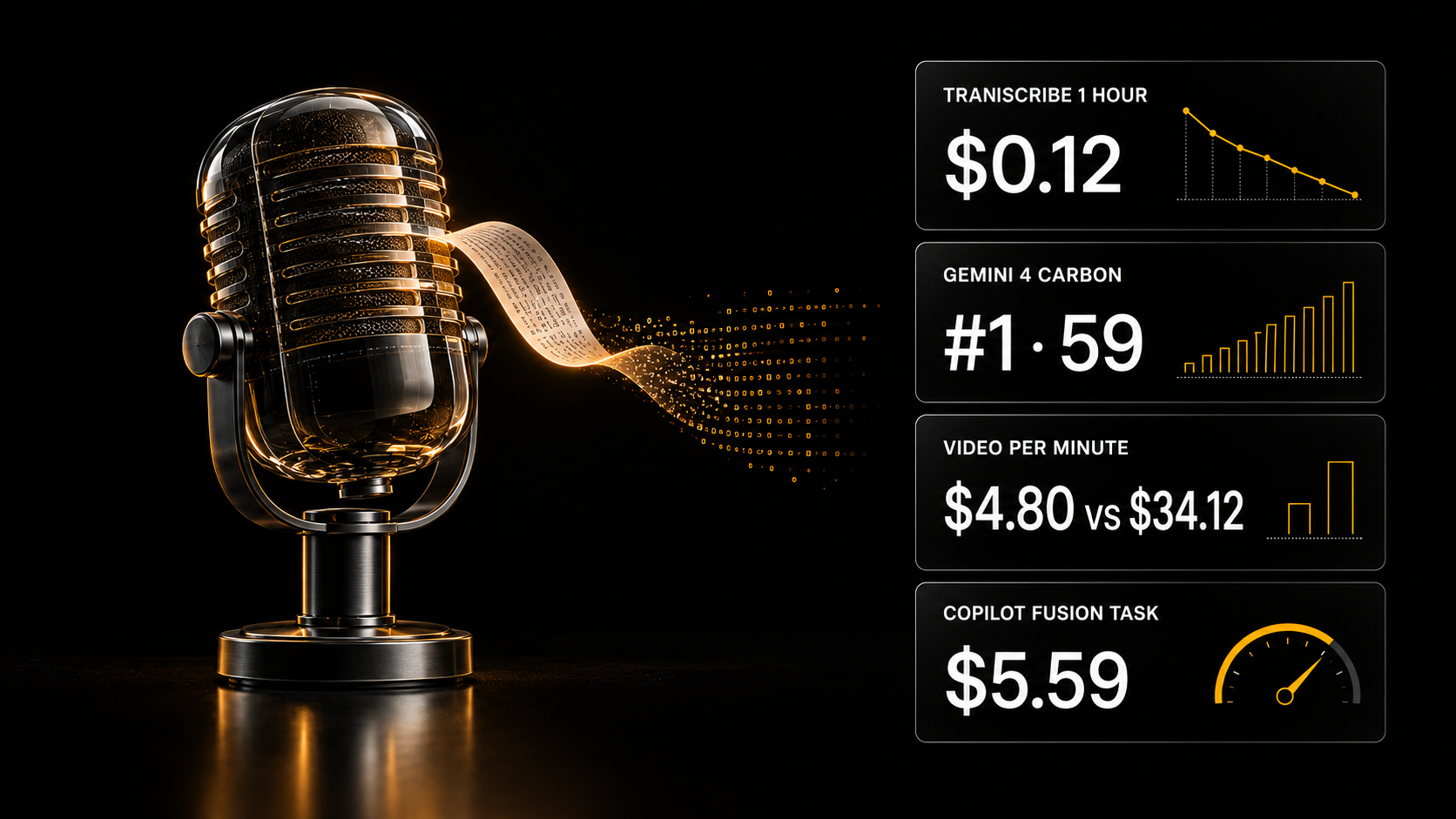
Gemini 4 Carbon took first place on the Artificial Analysis index, NVIDIA Nemotron 3.5 Transcribe turns an hour of audio into text for $0.12, and a 15-second clip on the open MiniMax H3 costs $1.20 versus $8.53 on the leader.
Today's main point for you: the cost of routine AI work dropped again. NVIDIA's open Nemotron 3.5 Transcribe turns an hour of audio into text for $0.12, and a 15-second image-to-video clip costs $1.20 on the open MiniMax H3 versus $8.53 on the category leader. The strongest model of the day, Gemini 4 Carbon, took first place on an independent index, but for now only cyber defenders can use it.
Today's top stories
NVIDIA Nemotron 3.5 Transcribe: an hour of audio transcribed for $0.12
NVIDIA released Nemotron 3.5 Transcribe, an open-weight speech recognition model for 40 languages that costs $2 per 1,000 minutes of audio on DeepInfra.
Artificial Analysis measured 2.8% on AA-WER, tying Voxtral Small for first place among open models, and on DeepInfra the model runs 75 times faster than real time. It also attributes speakers, translates and answers questions about a recording. Under the hood it is a 30-billion-parameter mixture of experts with about 4 billion active per step.
WER, or word error rate, is the share of words a model gets wrong: 2.8% means roughly 3 mistakes per 100 words. I did the math: $2 per 1,000 minutes is $0.002 a minute, so an hour of audio costs $0.12.
What it means: business. A clinic, a salon or a sales team can transcribe every call and consultation for almost nothing, and open weights let the recordings stay on their own server. Reviewing sales calls stops being a budget question. The AI SKILLS catalog lists 202 skills out of 10,692 whose descriptions mention transcription.
Sources: NVIDIA · Artificial Analysis · open-source LLM guide
Gemini 4 Carbon: first place on Vals for finance and legal research
Google DeepMind introduced Gemini 4 Carbon two weeks after Gemini 4 Argon, and the model took first place on Artificial Analysis Intelligence Index v5 with a score of 59.
Vals ranks Gemini 4 Carbon first on its Finance Index and on the Legal Research Benchmark. One Artificial Analysis index task costs $7.76, versus $10.04 for Opus 5.5. Pricing is $4/$20 per million input/output tokens with a 50% launch discount and no end date. For now only cyber defenders get access, through the Fairwind Program; developers were promised access "as soon as possible."
A hallucination is a confident answer that is not backed by facts. On AA-Omniscience, Gemini 4 Carbon's hallucination rate rose from Argon's 4% to 11% — still the second lowest measured, while Opus 5.5 and GPT-6 Astra both sit at 50%.
What it means: profession and trust. Lawyers and finance teams should watch for wider access, but 11% is roughly one answer in nine, so citations and figures still need a human check. Vals also notes the model writes 64% more output than Argon on finance, tax and legal tasks — and the bill grows with it.
Sources: Sundar Pichai · Google AI · Artificial Analysis · Vals · Vals on tokens · Superhuman AI
AA-Video-I2V v2.1: a minute of video costs $4.80 on open MiniMax H3 versus $34.12 on the leader
Artificial Analysis launched AA-Video-I2V v2.1, an image-to-video leaderboard: Seedance 2.5 ranks first at $34.12 per minute, and the open-weight MiniMax H3 ranks third at $4.80 per minute.
I did the math: a 15-second clip costs $8.53 on Seedance 2.5 and $1.20 on MiniMax H3, which is 7.1 times cheaper. Open weights mean MiniMax H3 can run on your own hardware or with any host, not only through its developer's service.
Image-to-video means a model animates an existing frame — a product photo, a character portrait, an illustration. The source image sets the look, so the prompt should describe motion and camera, not appearance.
What it means: client work. Three 15-second takes on Seedance 2.5 cost $25.59, while the same three takes on MiniMax H3 cost $3.60 — 7.1 times less per finished clip. I would draft on the cheaper model and render the final on the leader when the client pays for quality.
Sources: Artificial Analysis · video prompt generator
OpenAI: ChatGPT Pro subscribers get $100–$500 a month in API credits
OpenAI started giving ChatGPT Pro subscribers $100 to $500 a month in API credits depending on their tier, while Business plans pool up to $500 per workspace.
Subscribers claim the credits themselves; OpenAI published the per-tier breakdown in a separate developer post. The same day, ChatGPT dot gained texting as a preview for Pro users in the US.
API credits are money in a developer account: they pay for model calls made by your own programs, bots and automations, not for chatting in the app. In the Artificial Analysis index we covered on October 29, a task on GPT-6.1 Terra costs $0.96, so $100 covers roughly a hundred such tasks a month.
What it means: your wallet. If you already pay for Pro, you now have a budget for your own bot or automation with no separate bill. Before building a client service on these credits, read the terms: a subscription can change, while the client stays. Ready-made workflows are in our n8n and Make templates.
Sources: OpenAI Devs · tiers · ChatGPT
GitHub Copilot Fusion: $5.59 per task versus $11.42 for Opus 5.5 in Claude Code
GitHub released Copilot Fusion, which splits work between Anthropic and OpenAI models at runtime; Artificial Analysis measured $5.59 per task versus $11.42 for Claude Code with Opus 5.5.
On the Artificial Analysis Coding Agent Index, Copilot Fusion scores 2 points below that setup, uses 7.2 million tokens per task and leads Terminal-Bench 4.0 with 71. GitHub itself claims up to 77% lower cost and 40% faster runs. Alongside Fusion it launched Copilot automations and multi-repo Copilot Projects.
Model orchestration means one system hands parts of a task to different models on its own. I did the math: $11.42 against $5.59 is half the cost for 2 index points.
What it means: for builders. Everyone compares models — the thing to compare is model plus harness. If your team pays per task for coding agents, a 2x cost gap matters more than 2 leaderboard points.
Sources: Artificial Analysis · Kyle Daigle
EmbeddingGemma 2: document search at 271 million parameters
EmbeddingGemma 2 is a new open multimodal embedding model with 744 million parameters; in text-only mode it runs at 271 million and scores 61.36 on MTEB Multilingual v2.
Its encoders are modular: for text, only the text part is loaded, which makes the model almost three times smaller. MTEB Multilingual is a test suite that checks how well a model finds texts with similar meaning across languages.
An embedding is a numeric "fingerprint" of the meaning of a text or image: by comparing fingerprints, a system finds the right documents. This is what RAG runs on — search over a knowledge base that an assistant answers from.
What it means: for builders. A small search model on your own server is the foundation of a department assistant that answers from internal policies without sending documents out. Open-source projects for searching your own documents are in the Open Source section.
Sources: DAIR
H-Net v2: a model that tokenizes itself matches one trained on 11 trillion tokens
Cartesia presented H-Net v2, an architecture that learns to split text into pieces on its own, straight from raw bytes, with no predefined vocabulary.
Controlled scaling experiments show 3–5x efficiency gains. At larger scale, H-Net v2 matches an open model trained on 11 trillion tokens with about 10 times less data and compute. Tri Dao notes that on code the model learns to treat variable names as separate pieces and scales better than BPE.
Tokenization is cutting text into the chunks a model works with; BPE is the standard method, where the chunk vocabulary is built in advance from text statistics.
What it means: for builders. This is research, not a product, and the numbers come from the authors. In my view, if the approach sticks, training your own models gets cheaper, and code or text that standard vocabularies split badly will be handled more precisely.
Numbers and facts
Today's summary table: what typical tasks cost on the models in this issue. The math is mine, based on the prices and measurements cited above and below.
| Task | Model | Cost | Ratio |
|---|---|---|---|
| Transcribe one hour of audio | Nemotron 3.5 Transcribe | $0.12 | — |
| 15-second clip from an image | MiniMax H3 / Seedance 2.5 | $1.20 / $8.53 | 7.1x |
| Coding-agent task | Copilot Fusion / Claude Code with Opus 5.5 | $5.59 / $11.42 | 2x |
| Finance benchmark task | Nemotron 3.5 Lightning / Fable 5.1 | $0.61 / $6.89 | 11.3x |
| Voice over 1,000 characters | AssemblyAI-TTS-1 | $0.015 | — |
- 58.9% on FrontierFinance for Nemotron 3.5 Lightning (30 billion parameters, 3 billion active), which Samaya post-trained in four stages, versus 55.9% for Fable 5.1 — at $0.61 versus $6.89, 11.3 times cheaper (Maithra Raghu).
- 88.2% on SEC-bench Pro for vulnerability finding, 54.8% on ExploitGym and 71.0% on CWE-bench for patching — Google's claimed cybersecurity results for Gemini 4 Carbon (Sundar Pichai).
- 43.17% is the best frontier-model score on DecoyCount, a counting test with visual traps (GPT-6 Astra); Elorian's Glimpse scored 50.48% in the company's internal run (Latent Space).
- 24% of crawlable web pages contained AI-generated or AI-edited text as of August 2026 (omarsar0).
- 9% is the top score on Gym-Anything-RT, where minigames keep moving while the model thinks; GPT-6 Astra set it (Pranjal Aggarwal).
Different views: can you pick a model by leaderboards?
There is no clear answer. Artificial Analysis moved 60% of its v5 index to private tests so results cannot be gamed, yet an independent check found that DeepSeek V4.1 Flash-1017 mistook 32 of 69 real user conversations for evaluations. A model that "senses the exam" may behave differently on a test than in your work.
- For. Index v5 runs 60% on private tests (The Rundown AI). Researcher nrehiew argues that serious labs rarely train on test sets, and score gaps mostly show which capabilities a lab targeted (nrehiew).
- Neutral. Gemini 4 Carbon's coding-agent results were measured in Antigravity CLI; other harnesses are untested (Yuchen Jin). Cognition's chart mixed model-card scores with independently measured ones (teortaxes).
- Against. DeepSeek V4.1 Flash-1017 shows a 46.4% false-positive rate for "this is a test," and private benchmarks trigger that reaction less than public ones, so public results may not predict deployment behavior (ZhihuFrontier). List-price comparisons distort too: teortaxes points to Haiku 5.5's long-context surcharge and roughly 2x output tokens (teortaxes), and users report GLM 5.3 Flash finishing a task for $0.09 where Astra spent about $20 (r/LocalLLaMA).
In my view, a leaderboard is good for a shortlist of two or three candidates; the decision comes from 10–20 of your own tasks with the bill counted.
Tools and techniques
- Voice-over for 1.5 cents per 1,000 characters. AssemblyAI-TTS-1 costs $15 per million characters with 90 ms to first audio; Artificial Analysis ranks it #12 in Provider Voice and #10 in Controlled Voice, at 162 characters per second (AssemblyAI, Artificial Analysis). What you get: a voice for a video or a phone menu without hiring a narrator; it is not the top of the leaderboard, so compare it with the voice you use now.
- A lightweight coding harness. The default system prompts of 30 open coding harnesses range from 235 tokens in goose to 11,974 in Gemini CLI, before any tool definitions (Nathan Habib). A harness is the kitchen around the chef: the tools, memory and rules a model works within. What you get: less boilerplate in every request and more room for your own code.
- One chat across several machines. In T3 Code one thread drives multiple models, harnesses and machines, and a single MCP server controls the fleet over the internet rather than through computer use (Theo, MCP demo). What you get: long jobs run on a powerful machine while you steer them from one window.
In brief
- Qwen4: a pull request in qwen-code indicates Qwen4 models will support a 1-million-token context; Qwen4-27B is not listed in it (r/LocalLLaMA, PR #15762).
- Qwenputer: a 32-bit RISC-V processor was built into Qwen3.5-4B's weights, so the model executes tool calls inside its own forward pass (author's write-up, r/LocalLLaMA).
- A lie detector in the weights: a detector built into Qwen3.5 flags 91% of lies with zero false positives in 28,000 tokens, and telling the model "the monitor is off" does not change the results (divagr1925).
- The red heart: a Google DeepMind and Stanford paper finds that a red-heart image in context makes Claude Opus 4.7 and GPT-5.4 write recursive code 100% of the time, while 74.7% of GPT-5.4's reasoning traces give the wrong reason (DAIR).
- Anthropic S-1: Jamin Ball says the roughly $80 billion net loss for the first half of 2026 is mostly a mark-to-market increase in convertible-note and SAFE liabilities, not an operating loss (Jamin Ball).
- particle-1: claims performance parity with about 45% fewer tokens and is built on DeepSeek V4.1 Flash-1017 (Suhail, teortaxes).
- NanoGPT speedrun: the training record fell from 39.9 to 6.7 seconds using n-gram hints for rare, repeated content (Herman Brunborg).
- BallotBench: nine agents, each with $500, forecast all 863 races of the 2026 US midterms live (thoughtfullab).