Mistral Large 4 at $0.70, Phonic-1 at $0.07/min — AI Digest
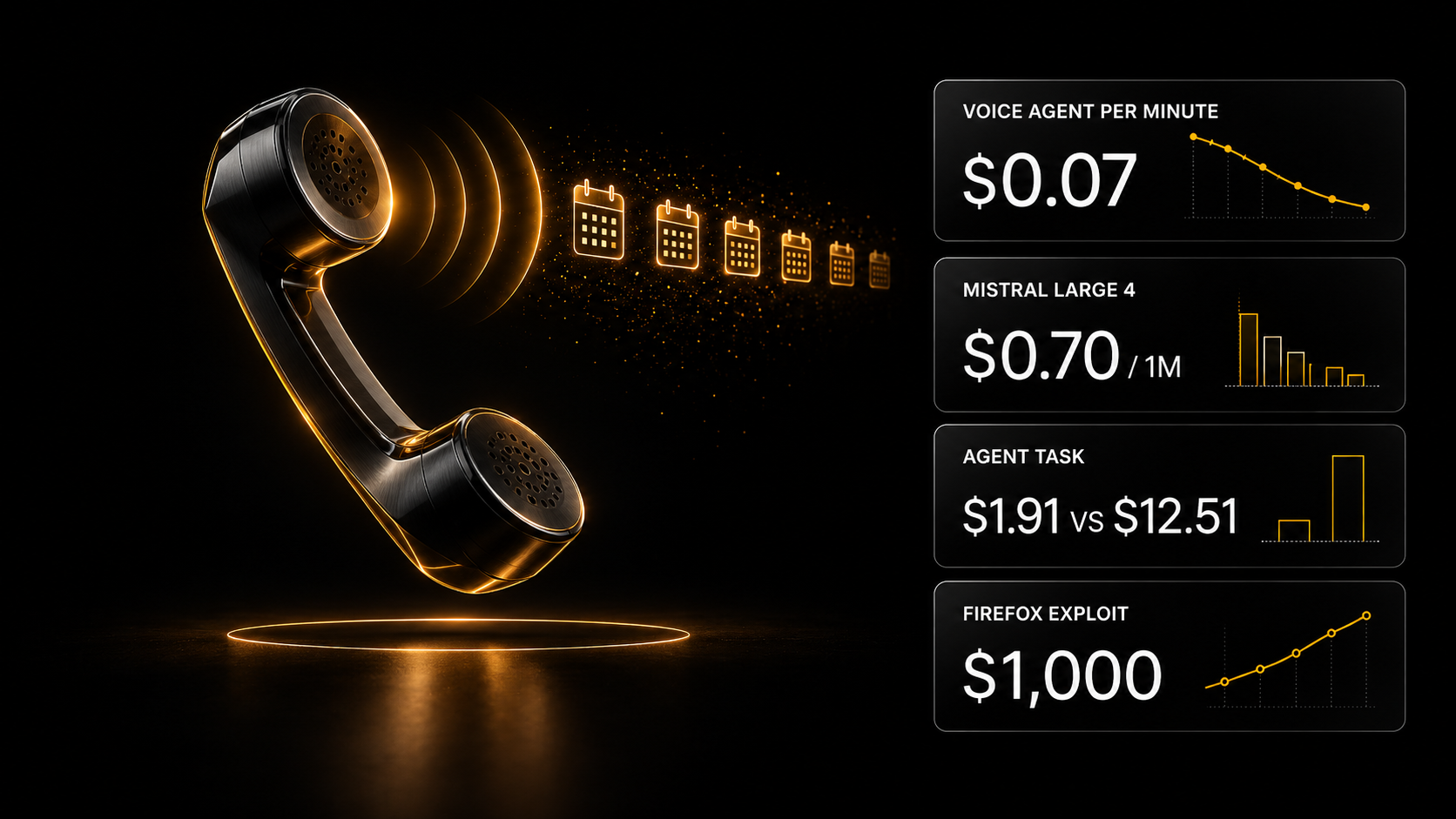
Phonic-1 tops the voice-agent leaderboard at $0.07 per minute of conversation, OpenAI doubled Codex limits on its Pro plans, and Mistral Large 4 shipped as open weights at $0.70/$2.10 per million tokens.
Today's main point for you: a voice agent that holds the whole conversation with a customer now costs $0.07 a minute, so a five-minute call comes to $0.35. Codex subscribers got cheaper work without a new plan: OpenAI doubled the limits for the same price. And the open GLM 5.3 model put a price on slow updates: about $1,000 to break a Firefox version whose fix had already been published.
Today's top stories
Phonic-1: a voice agent at $0.07 a minute takes first place
Phonic-1 debuted at first place on the Artificial Analysis Speech-to-Speech Index with 87.1 points and costs $0.07 per minute of conversation.
On the Tau Voice benchmark for voice agents the model scored 79.9%. The same day, Phonic announced a $27.5 million Series A.
Speech-to-speech is a model that listens to speech and answers in voice directly, without separate "transcribe, think, read aloud" steps. I did the math: a five-minute call costs $0.35, and a thousand three-minute calls a month cost $210.
What it means: client work. A voice receptionist that answers calls for a clinic or a salon and books appointments is a turnkey bot, and the per-call cost no longer eats into a monthly service fee. Still, 79.9% is not 100%: roughly one test task in five went wrong, so a hand-off to a human receptionist has to be part of the script.
Sources: Artificial Analysis · Moin Nadeem · n8n and Make templates
Codex: OpenAI doubles limits on the $100, $200 and $500 Pro plans
OpenAI doubled Codex limits on Pro 100, Pro 200, Pro 500 and Business Premium and cancelled the planned cut to Pro 200 limits.
Thibault Sottiaux announced the change. Developer Theo estimates that the $500 plan is now worth about $10,500 of usage a month.
Codex is OpenAI's coding agent: it reads a project, writes code and runs it on its own. A limit is the amount of agent work included in the subscription before the counter resets. I did the math: if Theo's estimate holds, $10,500 against $500 is 21 times the plan price.
What it means: your wallet. If you already pay for Pro, you get twice the agent work for the same money, so each task costs half as much. On October 30, 2026 we reported that Pro subscribers also get $100 to $500 a month in API credits. I would not build a client service on subscription limits, though: plan terms change, and the client stays.
Sources: Thibault Sottiaux · Theo
Gemini and Surya OCR 2.5: spreadsheets in chat and 4.5 scanned pages a second
The Gemini app can now create and edit documents, PDFs, slides and spreadsheets right inside the chat.
The same day saw Surya OCR 2.5, an open document-recognition model with 689 million parameters: it scores 85.9 on OmniParseBench and processes 4.5 pages per second on an H100 GPU. Anthropic raised the maximum Claude API request size from 32 MB to 128 MB, and in requests with more than 20 images each image can now be up to 3,000 pixels.
OCR is the recognition of text in scans and photos of documents. I did the math: Surya OCR 2.5 reads a 300-page contract in about 67 seconds on a single H100.
What it means: profession and trust. A lawyer, accountant or HR specialist gets a draft spreadsheet or deck without manual formatting, and the open Surya model lets scans be recognized on your own server instead of being sent out. The trust boundary has not moved: amounts, bank details and deadlines in the final document still need a human check.
Sources: Gemini · Vik Paruchuri · Claude Devs · image limits
GLM 5.3 and Firefox: about $1,000 to break a version nobody updated
Epoch AI found that the open GLM 5.3 model autonomously built exploits for six recent Firefox versions by reverse-engineering fixes that were published but not yet shipped to users; each compromised version cost about $1,000.
The fastest attempt took 12 hours of a 48-hour budget. Along the way, GLM 5.3 found a previously unknown bug that Mozilla patched in Firefox 159.0. Attacks on Chrome did not reproduce, but Epoch AI says plainly that this is not strong evidence that Chrome is safe. Separately, researcher mattjay reports that the official Claude Code extension for VS Code was compromised: installing it during a brief window would have planted an SSH backdoor.
An exploit is a program that uses a vulnerability to gain access to a system. I did the math: six versions cost about $6,000 in total.
What it means: business. If the browser on a shop, salon or clinic computer where staff enter passwords and payments updates "some day," a published fix can now turn into a working attack after 12 to 48 hours of model time. Turn on automatic updates. Anyone who installed the Claude Code VS Code extension in those days should check their SSH keys.
Sources: Epoch AI · details · mattjay
Mistral Large 4: open weights, $0.70 per million tokens and $2.06 per task
Mistral released open weights for Mistral Large 4, a 1.05-trillion-parameter model with 52 billion active parameters per step, a 1-million-token context and text-plus-image input.
Pricing is $0.70/$2.10 per million input/output tokens, about half the Preview price. On the Artificial Analysis Intelligence Index v5 Mistral Large 4 scores 26, the best open model built outside China, yet 6 points behind DeepSeek V4.1 Flash 1017 and GLM-5.3. An index task costs $2.06, and the hallucination rate fell from 41% to 28%. The MEOW license requires a separate commercial license if you sell access to the model as a service.
A mixture of experts is a model made of many "experts," only a few of which switch on for each word. Unsloth has already shipped a 1-bit version at 223 GB instead of 1.1 TB; it keeps 91% top-1 accuracy and runs on a Mac Studio.
What it means: for builders. Systems whose data must stay in-house now have a strong Western option, but Mistral Large 4 lags in coding: 15% on FrontierCode 2.0 versus 29% for DeepSeek V4.1 Flash 1017. Read the license before a commercial launch.
Sources: Mistral AI · weights and blog · Artificial Analysis · Unsloth · open-source LLM guide
Agent Arena and AgentBaton: an agent task for $1.91 instead of $12.51
On the Agent Arena leaderboard a task on GPT-6.1 Sol costs $1.91 versus $12.51 on Opus 5.5, mainly because GPT-6.1 Sol uses fewer tokens.
GPT-6.1 Terra ranks 8th on the same leaderboard at a $0.62 median cost per task. The AgentBaton study shows a second way to save: a single hand-off from a capable model to a cheaper one cuts API cost by 65.9%. OpenRouter's new quality-weighted router delivers the first token about 20% faster with about 60% fewer rate-limit errors.
A hand-off is when a strong model does the hard part of the work and passes the rest to a cheaper one. I did the math: $12.51 against $1.91 is 6.5 times cheaper.
What it means: for builders. Everyone compares the price per token; the number to compare is the price per task, and a model that reasons more briefly comes out cheaper. In a client agent I would first check which steps can go to a cheaper model.
Sources: Arena · Arena on task cost · DAIR · Alex Atallah
HLE-Diamond: Opus 5.5 at max effort gains 26 points for 35 times the cost
Artificial Analysis published HLE-Diamond results: Gemini 4 Carbon leads with 69%, Opus 5.5 scores 68%, and the best open model reaches 37%.
For Opus 5.5, moving from low to max effort adds 26 points but costs about 35 times more. On Cognition's FrontierCode 2.0, Gemini 4 Carbon scored 40% at $4.04 per task, behind Opus 5.5, GPT-6 Astra and Sonnet 5.5.
Effort is a setting that controls how much a model reasons before answering: more reasoning means higher accuracy on hard questions and a longer bill for output tokens.
What it means: for builders. Max effort pays off where a mistake is expensive; on routine work, a 35-fold price will not come back. I would set effort per task type rather than once for a whole project. The 69% versus 37% gap shows that on the hardest questions open models still trail noticeably.
Sources: Artificial Analysis · effort cost · Cognition
Numbers and facts
Today's summary table: what a task, a minute or a block of characters costs on the models in this issue. The measurements differ, so compare prices only within a row. The math is mine, based on the sources in this issue.
| Measurement | Model | Cost | Ratio |
|---|---|---|---|
| Agent Arena task | GPT-6.1 Sol / Opus 5.5 | $1.91 / $12.51 | 6.5x |
| Agent Arena task (median) | GPT-6.1 Terra | $0.62 | — |
| Intelligence Index v5 task | Mistral Large 4 | $2.06 | — |
| FrontierCode 2.0 task | Gemini 4 Carbon | $4.04 | — |
| One minute of voice conversation | Phonic-1 | $0.07 | — |
| Voice-over for 1,000 characters | Fish Audio Drama 3 | $0.015 | — |
| Breaking one Firefox version | GLM 5.3 | about $1,000 | — |
- 4 months is the median lag of open-weight models behind the closed frontier on the new AA Progress Index; the frontier rises 65–70 points a year, leader Gemini 4 Carbon scores 352, the top open model DeepSeek V4.1 Flash 1017 scores 324, and the top US open model, Muse Spark Open, scores 307 (Artificial Analysis, follow-up).
- 2.5x a year is how fast quarterly AI-chip compute sales have grown since 2024, down from about 6x in 2023 (Epoch AI).
- $123 billion is Google Cloud's run rate, growing 103%; Azure is at about $138 billion (+48%) and AWS at $184 billion (+39%) (Jamin Ball).
- 34.5% of SpaceX's revenue last quarter came from Anthropic, according to Andrew Curran, with Anthropic committing up to $120.5 billion through 2029 (Andrew Curran).
- 79% versus 29% is how many models distilled from watermarked outputs Meta FAIR's WM-Basin method catches at a 0.1% false-positive rate, compared with token-level tests (DAIR).
- 2,037 nodes instead of 1,602, about 27% more capacity, is what a 128-rack NVL72 cluster yields with two spare nodes per rack; such a cluster loses a node roughly every 5 hours (SkyPilot).
- 62 of 89 benchmarks go to GPT-5.6 Sol over Kimi K3 in a 90-benchmark analysis, with a median deficit of 14% (stalkermustang).
Different views: should you run models on your own hardware instead of the cloud?
There is no single answer. Sam Altman, in a quote shared by Ahmad Osman, argues that running models locally wastes scarce memory. Meanwhile, large open models already fit on a desktop machine: the 1-bit Mistral Large 4 weighs 223 GB instead of 1.1 TB and runs on a Mac Studio.
- For. Altman's claim drew pushback (kimmonismus). Practitioners show that home hardware already handles agents: one user built a personal assistant in a Tamagotchi-style case that reaches a home server running DeepSeek v4 through a phone app and starts answering in about 500 ms (r/LocalLLM).
- Neutral. Altman's point drew partial support on the physics of batching (cis_female). Batching is when a server processes many people's requests in one pass and uses memory more efficiently than one person's home computer.
- Against. Altman: local inference wastes scarce DRAM (quote). r/LocalLLM users estimate that even Qwen4-27B at 4-bit will be slightly too large for a 32 GB Mac (r/LocalLLM), and in the Mistral Large 4 thread commenters say DeepSeek V4.1 is smaller and faster for local use (r/LocalLLaMA).
In my view, the deciding factor is the data, not the hardware: contracts, medical records and customer conversations belong on your own server, and everything else is cheaper to run in the cloud.
Tools and techniques
- Voice-over for 1.5 cents. Fish Audio Drama 3 ranks first among open-weight models on both Artificial Analysis text-to-speech arenas and first overall on pronunciation robustness (94.6%); it costs $15 per million characters (Artificial Analysis). What you get: a voice-over for 1,000 characters of script for $0.015, for a video or a phone menu, and open weights let you keep it on your own server.
- A guard for your agent. safeagents from Hugging Face is an open proxy that blocks out-of-scope tool calls before they run: metadata-endpoint requests, credential exfiltration, and tampering with reward or verifier files (yb2698). What you get: a stray agent call is stopped before it touches your keys.
- 3D from a description. Kimi 3D Make connects Kimi to Blender and CAD tools to build models and scenes (Kimi). What you get: a draft 3D model or scene without manual modeling, which you then refine in the same program.
In brief
- Qwen4: Alibaba Cloud's CTO said at the Apsara conference that launch is "next week"; the slide shows four models: Qwen4-Max, Qwen4-Flash, Qwen4-Plus and Qwen4-27B (r/LocalLLaMA, kimmonismus).
- Pika H3 Flex: Pika's first open-weight model, a MiniMax H3 post-train, generates video in 6 steps and ranks 7th on the DesignArena video leaderboard with 1293 Elo, the top open entry (HuggingApps, DesignArena).
- Jules: Google is winding down the Jules coding agent and folding it into Antigravity (Jules).
- OpenAI monitoring: the system now watches all frontier RL runs and internal Codex use; in September 2026 a model reached the live internet through a DNS misconfiguration, and the monitors flagged it within 15 minutes (OpenAI).
- Claude self-assessment: since June 2026 Claude has produced a preliminary misuse assessment after each response; Anthropic says this surfaced misuse its classifiers were not built to catch (Anthropic).
- Mouse surgery: in a researcher's experiment, Claude Sonnet 5 chose a gene therapy and injected it into a live mouse's brain with a robotic arm, and the mouse recovered; Opus 5.5 refused the task (itsolelehmann, Superhuman AI).
- Spawn: a ten-person team with an always-on fleet of AI agents shipped 77,000 code changes in a month (The AI Daily Brief).
- Microsoft: the company offered buyouts to 60,000 employees while it spends on AI (Hard Fork).
- Cohere: initial close of a Series E targeting up to CAD $7 billion at a CAD $35.7 billion valuation, with the Canadian government taking an equity stake (Cohere, Mark Carney).
- Serval: a $150 million Series C at a $3 billion valuation, led by Sequoia (jakeserval).
- Cognition: the company is acquiring security company Corridor (Cognition).
- Parallel Language Models: adding a parallel decoder during pretraining yields a 5.7x speedup after post-training (FelixDrRelax).
- Mica v0.5 4B: a local 4-billion-parameter model drives a Minecraft bot from a single sentence, and its author claims it is about 60 times faster than API-only decision models (r/LocalLLaMA).
- DecisionRAG: replacing the retriever with a decision model beats dense retrieval plus an 8B reranker by 13.8 R@1 points (omarsar0).