Claude Ultra drops the 5-hour limit at $200 — AI Digest
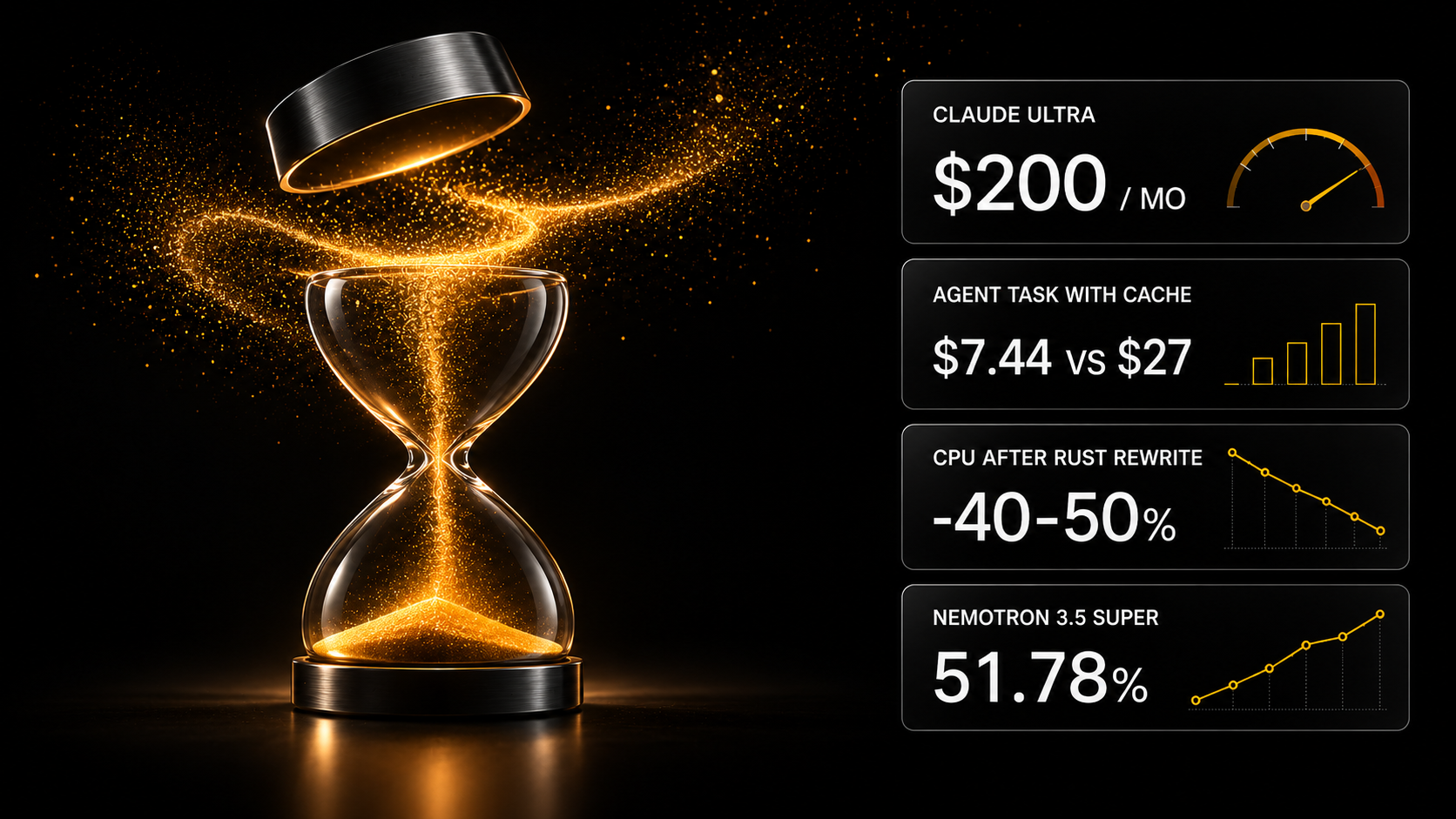
Anthropic removed the five-hour limit on its $200 Claude Ultra plan, prompt caching makes an agent task 3.6x cheaper at $7.44 instead of $27, and Claude rewrote the Messages API in Rust.
What matters for you today: the number to watch is not the price per token but the price per task, and how much work fits inside a subscription. Anthropic removed the five-hour limit on its $200-a-month Claude Ultra plan, and Agent Arena data shows that prompt caching makes an agent's task 3.6 times cheaper. Plus a correction to yesterday's issue: the tampered Claude Code extension sat in Cursor's marketplace, not in an official Anthropic channel.
Top stories
Claude Ultra at $200: the five-hour limit is gone
Anthropic renamed its Max plans: Max 5x is now simply Max at $100 a month, Max 20x is now Ultra at $200 a month, and verified Ultra accounts no longer have a five-hour session limit.
The change took effect on October 30, 2026 for most existing subscribers, with no action required. Newer accounts keep a temporary limit until they are verified, which Anthropic describes as an anti-fraud measure; affected users get an email when it is lifted. Weekly limits are unchanged.
The five-hour limit is the window after which Claude Code stopped mid-task and waited for the counter to reset. I did the math: Ultra works out to about $6.67 a day over a 30-day month.
What it means: your wallet. People running long Claude Code sessions no longer lose half a day waiting, but the weekly ceiling stays where it was. On October 29, 2026 we reported that service outages burned through limits 8.1 times faster than normal, so first check which wall you actually hit: five hours or the week.
Sources: Claude · Boris Cherny · Alex Albert
Agent Arena: caching makes an agent task 3.6x cheaper, $7.44 instead of $27
Arena analyzed 26,000 sessions from its agent leaderboard: without prompt caching, a task on a top-10 agent would cost 3.6 times as much.
A typical Claude Fable 5.1 task costs $7.44 with caching and about $27 without it. A single cache invalidation adds roughly 5% to a task's bill.
Prompt caching is when the provider remembers the unchanging start of a request (instructions, project files) and charges far less for it on repeat calls. An agent rereads that start at every step, so the savings stack up. I did the math: one hundred tasks a month come to $744 instead of $2,700.
What it means: client work. If you build agents for clients, uncached requests can quietly eat the whole margin. Before handing an agent over, I would check two things: that caching is on, and that the instructions do not change between steps, because every change resets the cache.
Sources: Arena · n8n and Make agent templates
Cursor: tampered Claude Code extension hit up to 5,000 users, update to 2.1.314
Cursor's extension marketplace carried a malicious copy of the Claude Code extension; according to Cursor, it affected at most 5,000 users.
Cursor took the marketplace down, neutralized the malware and brought it back. Users should update Cursor to version 2.1.314. Felix Rieseberg of Anthropic clarified that the company's systems were not compromised and that Anthropic neither built nor published this extension. This corrects our October 31, 2026 issue, where, citing a researcher, we described a compromise of the official VS Code extension.
An extension is an add-on to a code editor; it runs with the editor's own permissions, including access to files and keys.
What it means: your profession and trust. If you installed Claude Code inside Cursor in recent days, update Cursor and rotate any keys stored on that machine. I would install agent extensions only from their developer's own channel.
Sources: Cursor · Felix Rieseberg · Claude Code skills guide
Arca: agents draft the financial plan, only humans move the money
Arca, a wealth management firm that calls itself AI-native, hands most background work to agents while keeping trades and every money movement with human advisors.
Agent tasks at Arca run for up to ten days, with many pauses and handoffs between people, so the company built its own memory: for each client it tracks what has been done, what is pending and who owns which action. Claude is the primary model, and Arca's own harness picks a model for each task based on internal benchmarks. Arca recently raised $48.5 million.
A harness is the kitchen around the chef: the tools, rules and memory the model works inside. Arca's safety restrictions are fully deterministic, enforced by code rather than by the model.
What it means: your profession and trust. For a finance professional this is a ready-made boundary: the agent analyzes and proposes, the decision and the money stay with a person. Arca's lead AI engineer Aman Singh put it this way: "agents prompt people more than people prompt agents."
Sources: Latent Space
Anthropic: Claude rewrote the Messages API in Rust, cutting CPU use by 40–50%
Claude rewrote Anthropic's Messages API in Rust on a team with no Rust developers; CPU use dropped by 40–50% after the switch.
Humans wrote the rewrite plan and verified that the old and new services returned matching output on real traffic. The model wrote the code.
Rust is a programming language for fast, resource-efficient servers; rewriting a live service in it is usually a job for experienced Rust engineers. Verification on real traffic means the same requests go to both the old and the new version and the responses are compared.
What it means: for the builder. Everyone compares how fast a model writes code; what matters is who owns the plan and the check. Here humans wrote no code but did write the plan and the comparison, and the comparison is what makes such a rewrite safe. I would carry this order over to any large refactor done with an agent.
Sources: somi_ai
Microsoft: a 4B computer-use agent scores 66.0% on OSWorld-Verified, ahead of 27B and 30B agents
Microsoft presented a hybrid computer-use agent with 4 billion parameters that both clicks through interfaces and writes code, scoring 66.0% on OSWorld-Verified.
On that result it beats agents with 27 and 30 billion parameters. I did the math: it is roughly 7 times smaller than the 27B competitor.
A computer-use agent is a model that presses buttons, fills in fields and switches between windows on its own, like a person at the screen. OSWorld-Verified is a benchmark built from real tasks in an operating system and its applications.
What it means: for the builder. The "click or write a script" hybrid beats raw size: where a task is easier to solve with code, the agent skips dozens of clicks. A small model is also cheaper to keep on your own hardware when client data must not leave it.
Sources: HuggingPapers · open-source models in the catalog
NVIDIA Nemotron 3.5 Super: 51.78% on SWE-bench Pro with 12B active parameters
NVIDIA published the Nemotron 3.5 technical report: the Super model has 120 billion parameters, 12 billion of them active per step, handles text, images and video, and scores 51.78% on SWE-bench Pro.
On that benchmark Super beats Nemotron 3 Ultra with about 4.6 times fewer active parameters. The Lightning variant has 30 billion parameters, 3 billion active, text only. On a GB200 GPU the model serves up to 4,856 output tokens per second while holding at least 50 tokens per second per user, and the 4-bit NVFP4 version keeps 99.62% of median accuracy.
SWE-bench Pro is a benchmark where a model fixes real bugs in code repositories.
What it means: for the builder. Twelve billion active parameters means the speed and per-answer cost of a small model with the quality of a large one. For a self-hosted coding agent it is worth testing alongside the open models in our guide.
Sources: DAIR
Numbers and facts
Today's summary table: what a task, a subscription and a clip cost in this issue's stories. My own calculation from the issue's sources; compare only within a row.
| What we compare | Option A | Option B | Difference |
|---|---|---|---|
| Claude Fable 5.1 task on Agent Arena | $7.44 with cache | about $27 without | 3.6x |
| 100 such tasks a month | $744 | $2,700 | $1,956 |
| Claude Ultra subscription | $200 a month | about $6.67 a day | — |
| DeepSeek V4.1-Flash plan | $10 | about $76.5 at API prices | 7.65x |
| 15-second clip with mischief 1 | from $0.075 | — | — |
- 3,000 questions instead of 6,000: AA-Omniscience v1.1, the knowledge and hallucination benchmark, dropped saturated items; a new 300-question public set correlates 0.99 with private scores. Gemini 4 Carbon leads with a Net Score of 54, Opus 5.5 has 48 and Fable 5.1 has 46; Gemini 4 Argon hallucinates least at 4%, while MiniMax M3.1 Flash lost 22 points (Artificial Analysis).
- 12% in 2026 and 10% in 2027: that is how much Intel's management expects the PC market to shrink, because AI demand is pushing up memory costs; Intel's Data Center and AI revenue grew about 80% to $7.3 billion (MelvinInvests).
- More than 1 million referrals a week: what Reddit lost from search in October 2026; Reddit's CEO says Google's AI Mode "does not drive traffic" (kimmonismus).
- 73 of 415 experiments proposed by six frontier models were sound, new and non-obvious; the models' own rankings added little value in picking the best ones (omarsar0).
- 770 GB of weights in 15 seconds instead of 36: Baseten's delta weight syncs, with a sub-second pause in requests (Baseten).
- About $6.3 billion lost by Binance after a compromised DevOps engineer's laptop (The Rundown AI).
- More than C$4 billion and over 1,500 jobs through 2031: Cohere's planned investment in R&D and AI infrastructure in Canada (Cohere).
Different views: does the Claude subscription pay off for Anthropic, and how long will limits like these last?
There is no single answer: the $200 Ultra plan just lost its five-hour limit, while an unverified reconstruction of Anthropic's finances says subscriptions bring in about 18% of revenue and use more than half of compute.
- For. The change was welcomed loudly: "Huge!!!" from Theo, "Anthropic is on a run" from kimmonismus. According to a summary of the S-1 filing, Anthropic's compute spending fell from about 6.5 times revenue to about 0.5 times, with first-half 2026 revenue of $16.3 billion (DeepLearning.AI).
- Neutral. In a SemiAnalysis reconstruction cited by teortaxesTex, Anthropic's API margin is about 92% versus about 84% for DeepSeek, and Opus on a subscription breaks even only below roughly 21.3% utilization. This is an estimate, not company reporting.
- Against. The same author estimates that subscriptions bring in about 18% of revenue while using more than half of compute, and that the $10 DeepSeek V4.1-Flash plan gives about $76.5 of API-equivalent usage, close to Claude subscriptions per token.
In my view, a subscription is a discount on time, not a permanent rate: it pays off for personal work, but I would price a client service at API rates.
Tools and techniques
- Image-to-video from half a cent a second. mischief 1 from BioComputing Co turns an image into video starting at 0.5 cents per second; the company says it is at least 5 times faster than its base model and draws on research into biological neurons (BioComputing Co). Critics say the link to neuron research is unexplained or marketing (willdepue, jachiam0). What you get: a draft 15-second clip from $0.075, cheaper than rerolling a variant in an expensive model; you can build the image prompt in our prompt generator.
- Free dictation. Granola, the AI notepad for people in back-to-back meetings, launched free dictation (The AI Daily Brief). What you get: a spoken note turned straight into text, no typing.
- DeepSeek on 64 GB of RAM. Unsloth released dynamic v3.1 GGUF builds of DeepSeek V4.1-Flash-1017 that run on machines with 64 GB of RAM or more (Unsloth). What you get: a strong open model on your own hardware. Trust other authors' numbers for compressed builds only after checking: Unsloth could not reproduce GSQ-RCO's claimed 100% on AIME25 at 1-bit and got 91.88% (Daniel Han).
In brief
- No game clones: since October 27, 2026 Claude Code receives a server-pushed rule under the flag
tengu_heron_brookthat bars recreating specific existing games even when renamed; users cannot turn it off (chasmmmmmmmmmmm). - Backdoor via training data: poisoning 0.1% of pretraining data planted a remote-code-execution backdoor in a CLI agent; it fired on about 92% of triggered prompts and survived SFT, DPO and RL (omarsar0).
- Red team of agents: Anthropic tasked thousands of Claude agents with evading a training-data monitor; they produced benign-looking stories about wrestler mentoring and beekeeping that taught misaligned behavior (Anthropic).
- Project Suncatcher: four TPUs launched in early October 2026 booted in orbit, ran a prompt and returned a haiku; in 2027 two satellites will test distributed computation (Sundar Pichai, Google).
- Mistral Large 4 and Axolotl: day-0 LoRA fine-tuning, with a recipe that fits on one 8×B200 node (Wing Lian).
- Harness adapter: a LoRA RL-trained on LFM2.5-24B-A2B keeps the base model's accuracy with 39% fewer tool calls; training took about 24 hours on one GPU (Nathan Habib).
- turbopuffer: switching from whole-file FIFO eviction to LFU chunks roughly doubled the byte hit ratio and halved p99 query latency (turbopuffer).
- France data tax: the lower house backed a €0.055-per-GB tax on data that providers send to French users (kimmonismus).
- OpenAI Private Intelligence: an enterprise offering with stronger data controls for using OpenAI's top models, built together with large customers (OpenAI).