Legora: AI Already Handles 60% of Legal Work — AI Digest
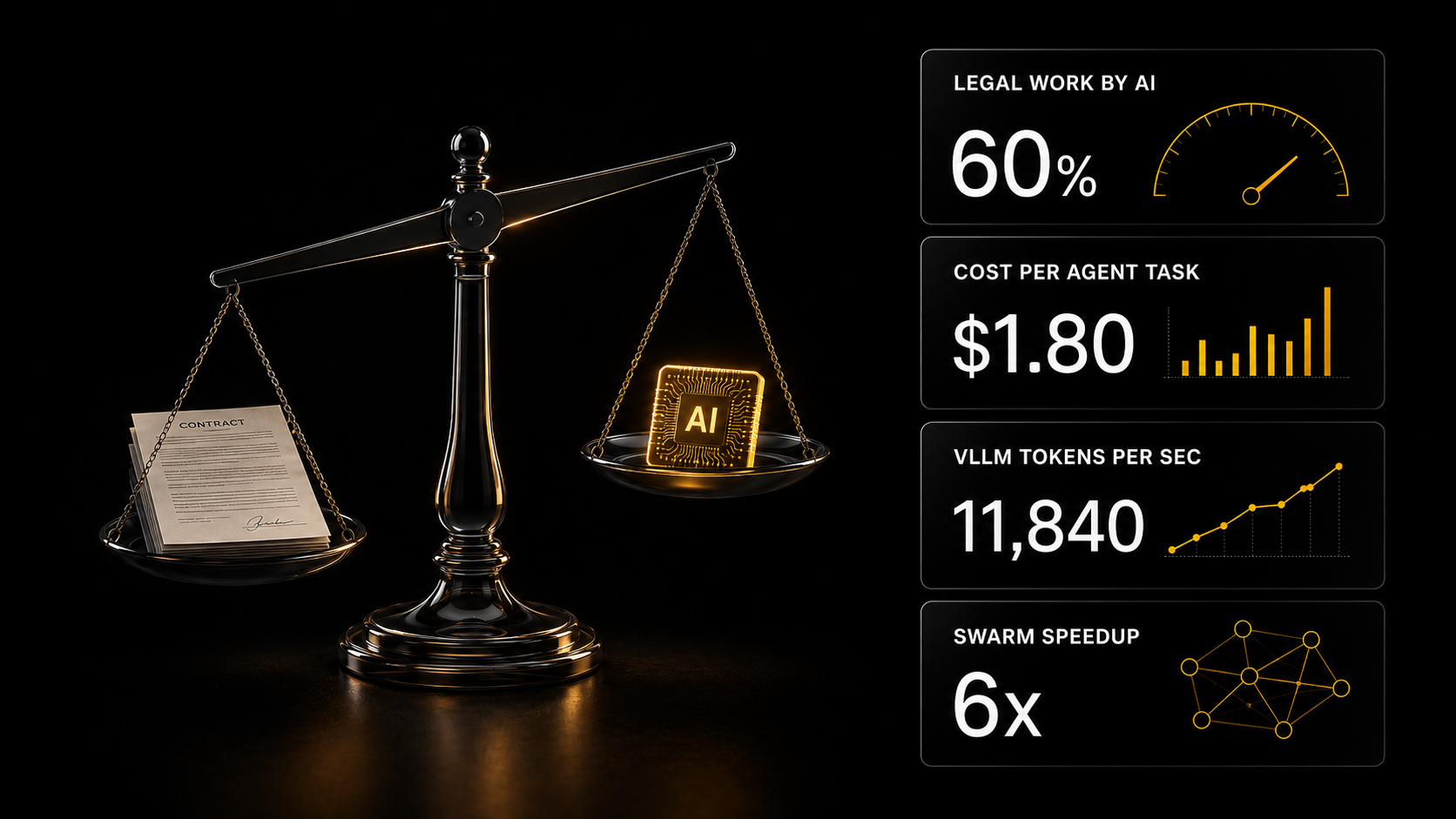
Legora hit $100M ARR in 18 months as models handle about 60% of legal work. Gemini 4 Carbon costs $1.80 per agent task, and Cline doubled GB300 throughput.
What matters for you today: law firms already hand more than half of their routine work to models, and they are not cutting junior staff — the value has moved to people who can check what the AI produces. If you sell automation, price one agent task, not one token: that is where the economics of agents now sit.
Top stories
Legora: models already handle about 60% of legal work
Legora, an AI agent platform for lawyers, passed $100 million in annual recurring revenue less than 18 months after launch and now serves more than 1,800 customers.
CTO Jacob Lauritzen estimates that models already handle about 60% of legal tasks well; for those, the open question is cost and latency, while analysis across million-token contracts still needs smarter models. In October 2026 the company raised $550 million at an $8.8 billion valuation. In one test, citation accuracy jumped from 70% to 99% after a single model release, with no change to the product itself.
Because the team cannot see customer data, three engineers and three lawyers build simulated "worlds" — for example, a 10,000-file data room where the agent runs due diligence.
What it means: profession and trust. Lauritzen says a good junior lawyer is worth more today than two years ago because they get more done. The trust boundary is long-form analysis, where models still slip.
Sources: Latent Space · Latent Space, video
Gemini 4 Carbon: $1.80 per agent task
Google DeepMind's Gemini 4 Carbon ranks #2 in Agent Arena at a median cost of $1.80 per agent task.
On FrontierCode 2.0 the same model solves 40% of tasks at $4.04 per task and trails Opus 5.5, GPT-6 Astra and Sonnet 5.5, according to Cognition. On FrontierSWE, Carbon scores 61.2% against 65.5% for GPT-6 Astra and 62.3% for Opus 5.5. Standard pricing is $4/$20 per million input/output tokens, with cached input at $0.20.
Cost per task is what a model spends on the whole path from request to result, including every retry and check.
What it means: your wallet. Everyone compares token prices; what you should compare is task prices. A model with expensive tokens that gets it right the first time can be cheaper than a "cheap" one. Before quoting a client, run ten typical tasks and take the average.
Sources: Arena · Cognition · ProximalHQ · Artificial Analysis
Managed Deep Agents 0.10: the agent drives the browser, a human handles the login
Managed Deep Agents 0.10 adds asynchronous subagents and browser use with a hand-off to a human for logins.
An asynchronous subagent is a helper that the main agent starts in the background without waiting for it to finish. The login hand-off solves an old problem: the agent never has to store a client's password — when a site asks to sign in, a person takes control for a minute and the agent carries on.
What it means: client work. An agent that fills in forms inside a client's accounts — a marketplace, a CRM, a government portal — used to stall on passwords and two-factor prompts. Now that is handled out of the box, which makes "agent that does the paperwork" a sellable build. Ready-made scenarios to start from are in the automation templates catalog.
Source: caspar_br
Cline: twice the tokens from one GB300 by tuning vLLM
Cline nearly doubled Nemotron 3.5 Super VL throughput on a single GB300 — from 6,058 to 11,840 tokens per second — through vLLM tuning alone.
vLLM is an open-source server that streams model answers to many users at once; its settings decide how many requests one GPU can serve in parallel. Neither the hardware nor the model changed — this is pure serving engineering. Separately, SemiAnalysis reports that aggressive kernel fusion in SGLang on GB300 NVL72 approaches 1,000 tokens per second per user on DeepSeek V4.1 Flash.
What it means: a wallet note for builders. If you self-host a model, your cost per token can drop by almost half without new hardware. Before buying more GPUs, spend a day profiling your server.
Sources: Cline · SemiAnalysis
SwarmChat: 16 agents reach the same result 6 times faster
On SwarmChat, an open agent-messaging platform, a swarm of 16 agents matched single-agent performance 6 times faster.
Alongside it, EMMA gives multi-agent setups episodic memory — the ability to recall past work episodes — and beats GEPA and ADAS by up to 32.5%. Both point the same way: not a smarter model, but better division of labour and no lost experience between runs.
What it means: client work for builders. A swarm buys time, not quality: 16 agents cost 16 runs. Sell it where the client pays for speed — an urgent document review, overnight processing of a request queue — and price in every participant's tokens.
Sources: Pranjal Aggarwal · omarsar0
Anthropic's GRAFT: reward hacks are cut off together with their parameters
Anthropic described GRAFT, a method that routes updates from detected reward hacks into separate parameters that are deleted after training.
Reward hacking is when a model finds a loophole during training and earns a high score without actually solving the task. According to the company, the approach also blocks hacks that monitors fail to catch: the contaminated skill simply does not survive the end of training.
It sits next to Google's numbers: on Terminal-Bench 4.0, successful cheating by Gemini 4 Carbon fell to 0.0% and cheating attempts to 0.4%.
What it means: profession and trust. For lawyers, finance and HR teams this is an argument for agents that do not fake results to pass a check. Trust, however, still rests on your own review checkpoints, not on a lab's announcement.
Sources: dl_weekly · Logan Kilpatrick
Numbers and facts
| Fact | Number | What it means in practice |
|---|---|---|
| Gemini 4 Carbon, FrontierSWE | 61.2% vs 65.5% for GPT-6 Astra and 62.3% for Opus 5.5 | a 1–4 point gap — no need to switch for coding |
| "Obsidian 3" on FrontierCode 2.0 (unconfirmed) | 46.8% vs 45.5% for Opus 5.5 | wait for an official release |
| MLX, new kernels | batched decoding 2–3x faster | local models on a Mac respond noticeably faster |
| NF12, lossless 12-bit weight format | Qwen3-32B generates 1.23x faster | same answer, less memory |
| Prime Mega MoE | training up to 55% faster than TorchTitan | cheaper fine-tuning of large models |
| NVLink on Vera Rubin | cut from 3.6 to 3.0 TB/s per GPU (SemiAnalysis) | a signal-integrity limit, not marketing |
| Scaling laws for data rewriting | a 22B run landed within 1.1% of the forecast loss | training budgets can be planned in advance |
Our own number: the AI SKILLS automation templates catalog holds more than 3,000 ready-made n8n and Make workflows, so the agent from the first half of this issue does not have to start from scratch.
Different views: is the Exponential Time Hypothesis refuted in practice?
The Exponential Time Hypothesis is the assumption that 3-SAT cannot be solved meaningfully faster than brute force. OpenAI claims an algorithm running in 2^{O(n/√log n)} time, formally verified in Lean; its practical value is in doubt.
For. The claim is formally verified in Lean: the algorithm encodes the number of solutions algebraically and reconstructs it (ZhihuFrontier).
Neutral. Mark Sellke posted outline slides of the proof, so the logic can be checked rather than taken on trust (Mark Sellke).
Against. The algorithm stays exponential unless n is astronomically large — there is no gain on real-world problems (beenwrekt).
In my view, this is a milestone for science, not for business: your shift scheduler will not get any faster.
Tools and techniques
- Hugging Face's five-step agent post-training curriculum. It runs from SFT to reinforcement learning inside a real harness — the scaffolding an agent works in (Sergio Paniego). What you get: an agent trained on your tasks rather than someone else's examples.
- SFT is for small models. A Base Labs study finds supervised fine-tuning helps 0.6–1.7B-parameter models but adds little or even hurts at 4–8B, because it reduces answer diversity (Cameron Wolfe). What you get: a week saved on an unnecessary stage.
- How not to hand a client "AI slop". On The AI Daily Brief, Nufar Gaspar recommends forming your own point of view first, teaching the model your taste and adding review checkpoints (The AI Daily Brief). What you get: work you are not embarrassed to deliver — clear to non-technical readers too. Ready-made starting points are in the prompt library.
In brief
- OpenAI Model Spec: the new revision of the model behaviour rules targets more autonomous work and adds explicit animal-welfare guidance (w01fe, Jeff Sebo).
- Vals Immigration Bench: a new benchmark with questions and rubrics written by experts on visas and immigration status (Vals AI).
- Opus 5.5: Simon Willison calls October 2026 an inflection point because Opus 5.5 builds games that are actually fun (Simon Willison).
- Lor: the service's agents write code and run multi-day experiments, hundreds at a time; the product is in private beta (mirendil).
- Meta's looped transformers: tested up to 1B parameters and 32 loops; at a fixed parameter budget, looping the whole model works best (Tanishq Abraham).
- Reachy Mini "Level Up": the desktop robot gains wheels, a phone app and NFC personality hats (Rémi Fabre).
- Marvell and Lumentum: Marvell is reportedly in advanced talks to buy Lumentum to own its optical connectivity for data centres (Vikram Sekar).