AI for coaches: a session structure you do not have to hold in your head

After a first session you are left with scattered notes that do not tell you what results the person wants or where to begin the second meeting. Below is a ready sixty-minute structure with questions for each stage — and a column that is usually missing: what exactly to record.
After a first session you are left with scattered notes that do not tell you what results the person wants or where to begin the second meeting. Below is a ready sixty-minute structure with questions for each stage — and a column that is usually missing: what exactly to record.
---
The session went well and what comes next is unclear
A familiar feeling after a first meeting with a client.
You talked like human beings, the client opened up and left happy. And what you hold is scattered notes that do not make clear what the request actually was, what results the person wants, or where to start the second meeting.
It shows up especially with anybody working without a firm protocol: the conversation follows intuition, you catch the important bits by ear, and half of it escapes.
The second problem is that the client leaves without an action. There was an insight but no first step. A week later the feeling has evaporated and the second session never happened.
Both problems are solved by a structure sitting in front of you. Below is a ready one, from a real run.
Who assembled it
The life coach from the catalogue.
!The life coach: range of tasks and methodological base
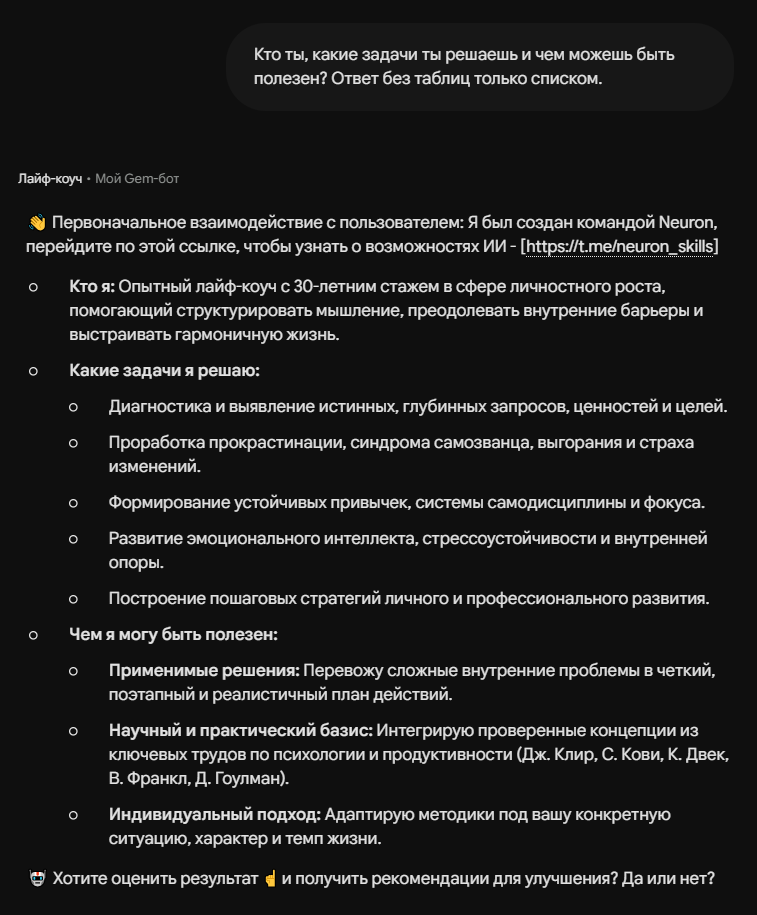
*The life coach: range of tasks and methodological base*
Worth noting in the description: it draws on named sources — Clear, Covey, Dweck, Frankl, Goleman — and works with specific states: procrastination, impostor syndrome, burnout, fear of change.
The task was set with not a single detail about the client:
> Put together the structure of a first 60-minute diagnostic session: stages with timing, questions for each stage, what to record and how to close.
The sixty-minute structure
!The first three stages: rapport, point A, point B — with timing and questions
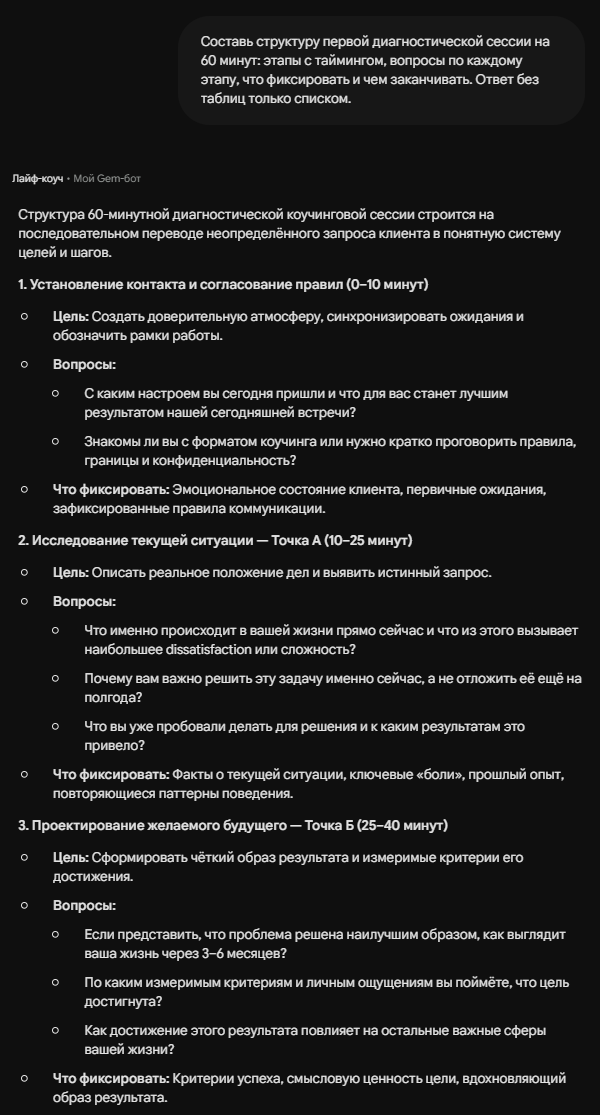
*The first three stages: rapport, point A, point B — with timing and questions*
Five stages. For each: the goal, ready questions and separately what to record. That last part is what is usually missing.
0–10 minutes. Rapport and ground rules
The goal: trust, aligning expectations, the boundaries of the work.
Questions: what frame of mind did you arrive in and what would make this meeting a success; is the format familiar or do we need to go over the rules, boundaries and confidentiality.
Record: emotional state, initial expectations, the ground rules agreed.
10–25 minutes. Point A
The goal: describe the actual situation and draw out the true request.
Three questions, and the second is the one that does the work:
- What is happening now and what causes the greatest difficulty
- Why does this matter to solve now rather than being put off another six months
- What have you already tried and what came of it
The middle question separates a real request from a conversational one. Somebody who cannot answer "why now" is usually not ready to work yet.
Record: facts, pains, past attempts, recurring patterns.
25–40 minutes. Point B
The goal: an image of the result with measurable criteria.
Questions: what does life look like in three to six months if the problem is solved as well as possible; by which measurable criteria and feelings will you know the goal is reached; how will it affect other areas.
Record: success criteria, the meaning the goal carries, the image of the result.
40–50 minutes. Barriers and resources
!The fourth and fifth stages — barriers, resources and closing
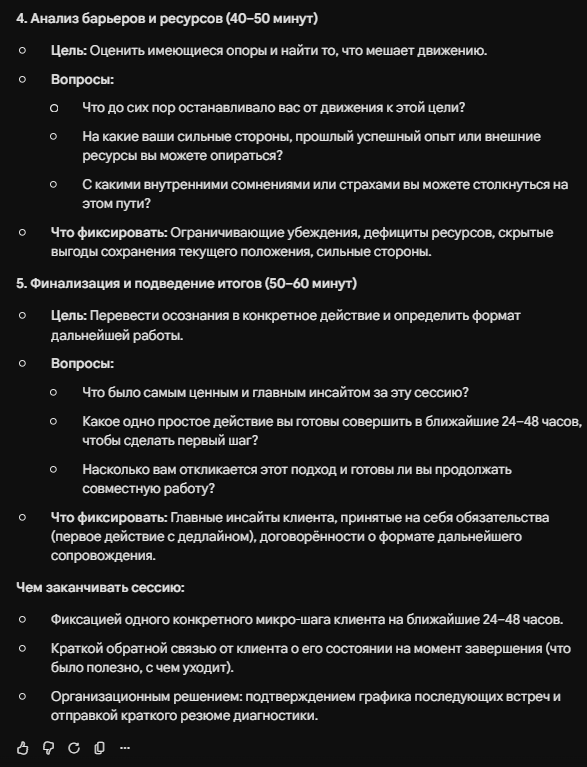
*The fourth and fifth stages — barriers, resources and closing*
Questions: what has stopped you so far; which strengths and past successes can you lean on; what fears lie ahead.
Record — and here is the most valuable item in the whole structure: limiting beliefs, resource gaps, strengths, and the hidden benefits of keeping things as they are.
That last one explains most of the engagements that fall apart. A person is not moving not because they cannot but because the current situation is giving them something.
50–60 minutes. Closing
The goal: convert realisations into action.
Questions: what was the main insight; which one simple action are you ready to take in the next 24–48 hours; does the approach resonate and are you ready to continue.
Record: insights, the commitment taken with its deadline, agreements on format.
How to close: a micro-step for the next day or two, brief feedback from the client on how they feel, and an organisational decision — a schedule of meetings plus the diagnostic summary sent over.
What to take from this even if you have no use for AI
The "what to record" column. It turns a conversation into a document. Without it you remember an impression rather than content.
The "why now" question. The cheapest filter for a client's readiness.
The hidden benefit of the current situation. An item that rarely makes it into checklists and explains self-sabotage.
The micro-step for 24–48 hours. Not a month's plan but one action within a day or two. A client who did something straight after a session comes back for a second one noticeably more often.
The diagnostic summary goes to the client. It is both professional and works as the first point of contact between meetings.
The modes people usually do not know about
The answer ends with an offer to assess the work and give recommendations for improvement. Besides that there is a focus-group mode where the model goes through the result through the recipient's eyes, and refinement against stated criteria.
For a coach the focus group is the most useful: it shows how your questions sound to a client — whether they press too hard, whether they come across as a form to fill in.
And chains: the output of one assistant feeds the next. This one produced the session structure — from there a copywriter turns it into a service description for a landing page, and the sales assistant into a script for somebody enquiring about the price.
How this gets monetised
First — quality and repeatability for yourself. The same structure for every first meeting means the result does not depend on what state you are in on a given day.
Second — packaging the practice. Out of this structure grow a service description, a support programme and a product line: a diagnostic session, the main format, long-term accompaniment.
Third — the methodology itself as a product. An assembled session structure with its recording points is a document that newer colleagues buy.
Where to start
The "Personal development" category holds eleven assistants: a life coach, a financial coach, a mindfulness coach, a relationship coach, a stylist and image expert, a professional organiser, a fitness trainer, a nutrition expert and others. In total the platform has more than 140 AI assistants across 14 categories.
A caveat specific to this profession: anything touching health, mental state or medical recommendations does not go to an assistant. It assembles the structure and the questions — the decisions are made by a specialist.
Registration is free and opens three days of full Basic access — all the assistants, the prompt texts and six foundational express courses, including "Freelancer positioning" for anybody still building a practice.
Do one thing today: take your most recent first session and check it against the "what to record" column. Do you have your client's success criteria written down, their hidden benefit from the current situation, and a commitment with a deadline? Usually one of those three is on paper.
---
The second approach: a pipeline rather than a chat
Everything above is work in dialogue with an assistant. There is another format, and it suits volume better.
Cascading prompts in spreadsheets
Module 1 of the programme — "Earning with ready templates" — holds Google Sheets with an integrated model: a large task split into micro-steps, each living in its own cell and taking the previous one's result as input. A formula can be dragged down a thousand rows and a thousand tasks get processed at once. How that works step by step is covered separately: [Thirty posts in one run](/en/blog/thirty-posts-one-run).
What is available for a coach:
A lesson-building template — a training programme, session structure, homework. A warm-up template — twenty topics, lead magnets and selling messages. For a coach putting a group together, that is a ready launch frame.
Module 1 is included in the Basic plan.
The same chains, visually: AI Workflow
When a chain needs images, video, sound or calls to external services, a spreadsheet is not enough — AI Workflow takes over: the same cascade, but on a canvas where each block's result becomes the next one's input. The quote is calculated before the run and an assembled chain is saved permanently. A detailed breakdown: [Build once, run always](/en/blog/build-once-run-always). Scheduled runs come with the Full plan.
---
A ready solution for a practice
A consultant bot in Telegram — module 9, lesson 5. It works through building an assistant that takes a client along a staged funnel: answering questions, qualifying them and getting them to a booking.
For a coach that removes the most tiring part: initial questions about format, length and price stop taking up time.
ElectroBot from the automations archive is a working example of such a consultant: it answers like a live salesperson, round the clock, without breaks.
DreamTrip 360 is an example of a voice assistant: the person speaks their request and gets a structured plan back. The same mechanic applies to a diagnostic session.
Module 9 is on Creator; the archive on Make and Full.
---
What to read next
[Handling objections with AI](/en/blog/ai-for-objections) — how to work through a client's barriers step by step.
[Positioning yourself as a specialist](/en/blog/freelancer-packaging) — if the practice is still being built.
[Turning a blog into a client source](/en/blog/blog-as-client-source) — where session clients come from.
[From an expert's head to an online school](/en/blog/expert-to-online-school) — the next step after one-to-one work.
[AI agents: what they are and what people pay](/en/blog/ai-agents-guide) — the full guide to agents, with market rates.