AI for marketers: a social media audit and a virtual focus group

A social media audit usually ends with "you need to post more actively" — the owner reads it and has no idea what to do on Monday. Below is a real run of an assistant on this task: a checklist built on named frameworks, a table of repair priorities, and a mode in which the model reads the account through the eyes of three different customers.
A social media audit usually ends with "you need to post more actively" — the owner reads it and has no idea what to do on Monday. Below is a real run of an assistant on this task: a checklist built on named frameworks, a table of repair priorities, and a mode in which the model reads the account through the eyes of three different customers.
---
The audit that ends with "post more actively"
A local business asks somebody to look at its social media. The marketer looks and writes a conclusion: the content is irregular, the presentation is weak, post more and engage the audience more actively.
The owner reads it and has no idea what to do on Monday.
The problem is not competence. The problem is that an audit without structure turns into a collection of impressions. People look at whatever caught their eye rather than working through a system, and set priorities by feel.
Below is a run of a real assistant on this task. Two things in it are worth taking even if you never use AI: the structure of the audit, and a mode almost nobody knows about.
Who does the analysis
The AI social media manager from the catalogue.
!The assistant introduces itself and immediately asks four clarifying questions
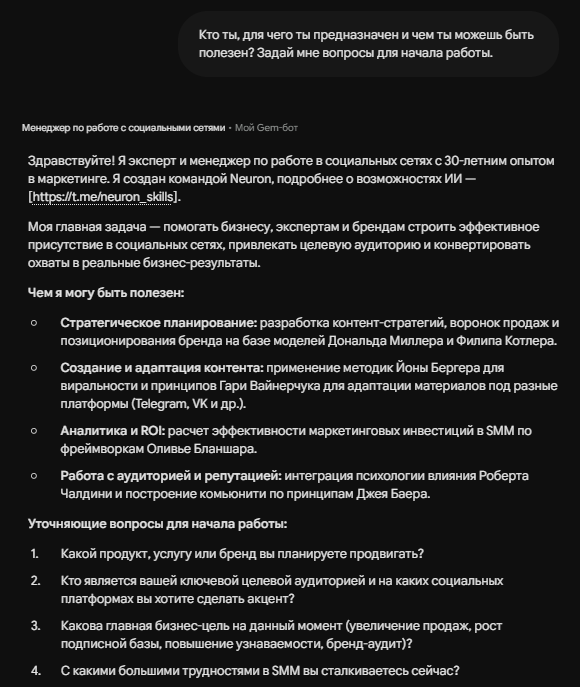
*The assistant introduces itself and immediately asks four clarifying questions*
Note two things in that very first reply.
It works from named frameworks — Donald Miller's StoryBrand for packaging, Gary Vaynerchuk's principle for content, Cialdini's psychology of influence for trust, Olivier Blanchard's ROI model for conversion. Not "from experience" but from methods you can check.
And it asks the questions itself. It does not try to guess — it asks about the product, the audience, the platforms, the main business goal and the current difficulties. That is what separates a ready assistant from an ordinary chat: it has its own procedure for entering a task.
The audit checklist
The task was set in one sentence, with no data at all:
> Put together a social media audit checklist for a local business — a coffee shop, a salon, a studio. What to check and in what order, which signs indicate a problem, and what to fix first.
!Four audit blocks — what to check and the signs that reveal a problem
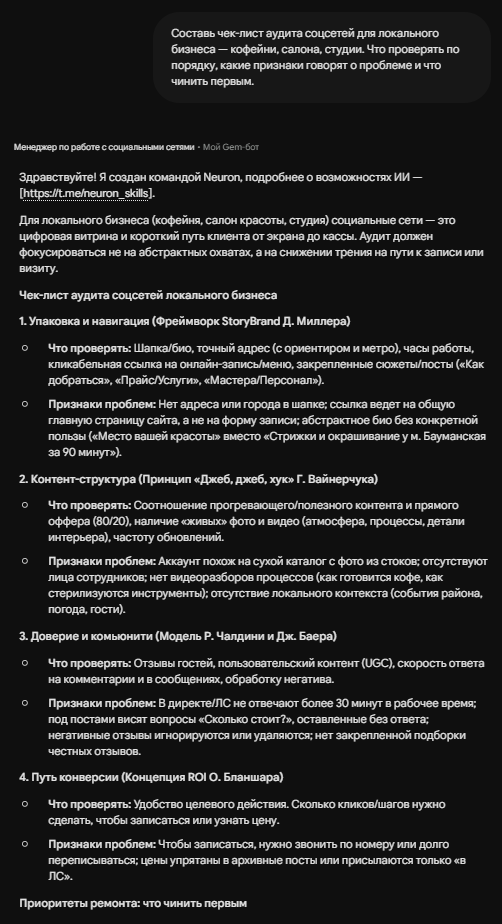
*Four audit blocks — what to check and the signs that reveal a problem*
The first thing it did was narrow the frame: for a local business, social media is a shop window and a short path from screen to till, so the audit looks not at reach but at friction on the way to a booking.
Then four blocks, each with "what to check" and "signs of a problem".
Packaging and navigation. An address with a landmark and how to get there, opening hours, a clickable booking link, pinned sections. The most frequent sign of a problem: an abstract bio instead of a concrete benefit — "a place for your beauty" instead of "cuts and colour by the station, 90 minutes".
Content structure. The ratio of useful to promotional, real photos and video instead of stock, staff faces, local context. The sign: the account looks like a dry catalogue.
Trust and community. Response speed, handling negative feedback, user-generated content. The sign: questions asking "how much is it" sit unanswered under the posts.
The conversion path. How many steps to a booking. The sign: to book you have to phone, and prices are only sent by direct message.
Repair priority
!The priority table: what to do urgently, what on schedule, with the expected outcome
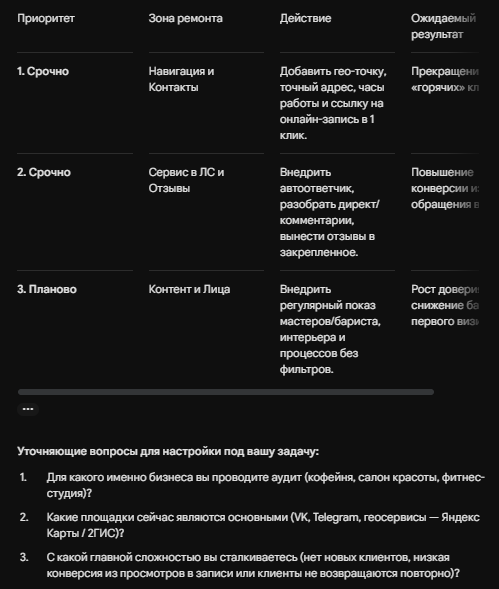
*The priority table: what to do urgently, what on schedule, with the expected outcome*
Here is what audits usually lack: a table with a queue. Urgent — the map pin, the address, the hours and one-click booking. Urgent — an auto-reply, triage of incoming messages, reviews pinned. Scheduled — showing people, the interior and the process regularly.
Exactly what an owner can open on Monday and start doing.
What happens after the clarification
Next I answered its questions in one line: a coffee shop, Telegram and Instagram, low conversion from views to bookings.
!An answer for the specific situation: conversion drop-off points and solutions per platform
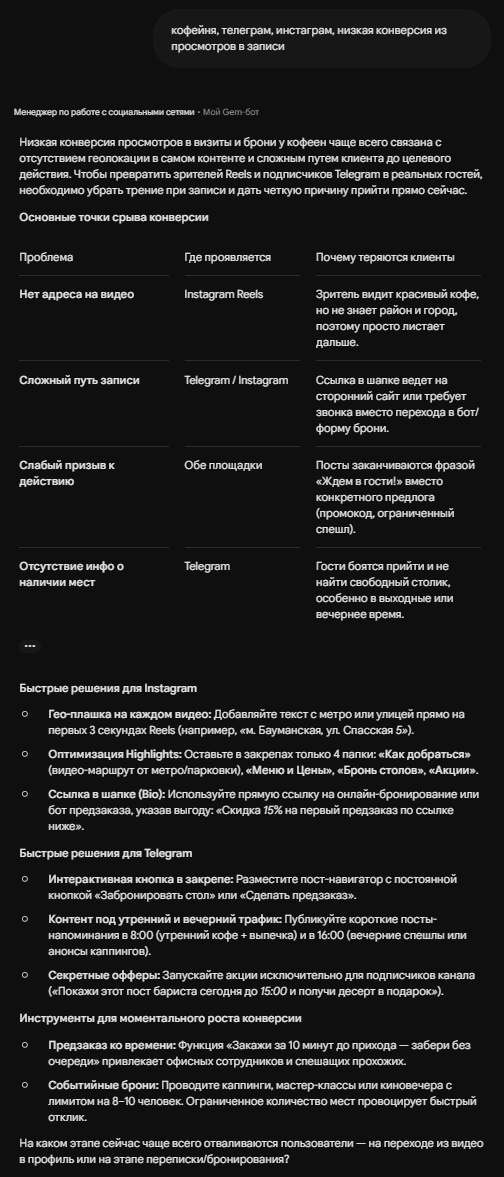
*An answer for the specific situation: conversion drop-off points and solutions per platform*
The answer narrowed to specifics. A table of drop-off points: no address on the video, a complicated booking path, a weak call to action, no information on availability. And solutions separately for each platform — a location badge in the first three seconds of a clip, four pinned folders instead of twenty, a booking button pinned in the channel, posts timed to morning and evening traffic.
Not one piece of advice of the "post more often" variety.
The mode almost nobody knows about
Here is the main thing to take away from this article.
The assistants have built-in modes: self-assessment, refinement against stated criteria, and a focus group. It was the last one I ran.
!Focus-group mode: three virtual customers analyse the account from their own side
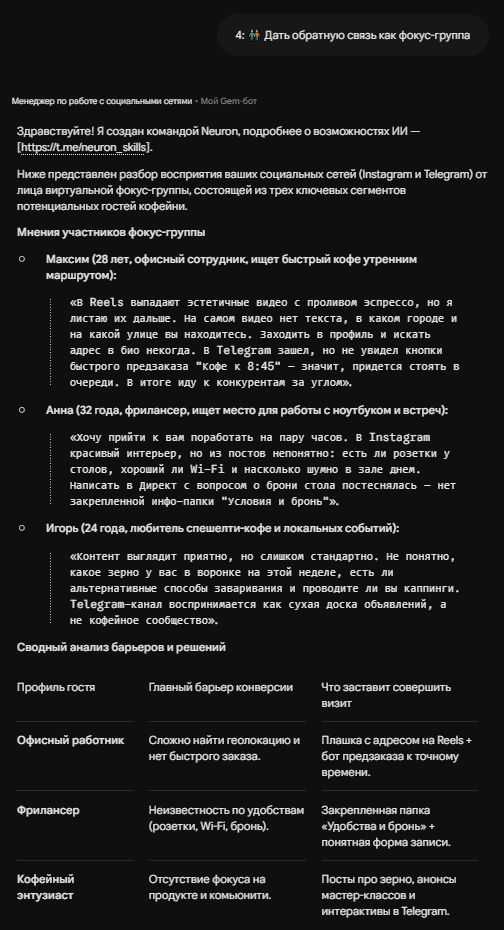
*Focus-group mode: three virtual customers analyse the account from their own side*
The model went through the coffee shop's account as three different customers, and each named their own barrier.
An office worker on their morning route: sees a handsome video of an espresso pour and scrolls on, because the clip itself does not show the city or the street. Went into the channel, did not see a pre-order button for "coffee by 8:45" — so there will be a queue. Goes to the competitor round the corner.
A freelancer looking for somewhere to work: the interior is attractive but it is unclear whether there are sockets by the tables, what the Wi-Fi is like and how noisy it gets during the day. She was too shy to ask — there is no pinned "conditions and booking" folder.
A speciality coffee enthusiast: the content is pleasant but generic. It is unclear which beans are on this week, whether there are alternative brewing methods, whether there are cuppings. The channel reads as a noticeboard rather than a community.
Three people, three different barriers and three different solutions. Not one of them sits in the plane of "post more often".
That is the difference between an audit and an impression: you get not an expert's opinion but the reaction of segments, each of which leaves for its own reason.
One more technique: a chain of assistants
The output of one feeds the input of the next. This one produced the audit and named what to fix — from there a copywriter writes the texts for the pinned posts from those conclusions, and the prompt generator produces the prompt for the visual.
That is how a process gets assembled rather than an answer. Which is exactly why ready assistants work differently from one universal chat: each has its role, and they hand the work on.
How this gets monetised
First — faster for yourself. An audit that used to take a day assembles in half an hour and comes out more structured, because it follows frameworks rather than impressions.
Second — as a service to a business. A social media audit for a local company with a repair priority is a finished product you can sell on its own. And it is also the best way in to a client: you arrive not with an offer to run their social media but with a finished analysis of their account.
Package work grows out of that: a content system, a funnel, sales. A full positioning package costs around $1 900 — that is the price by our methodology, not market statistics.
Where to start
The "Marketing" category holds twenty-six assistants — the largest on the platform: an SEO specialist, an ad campaign specialist, a copywriter, a brand manager, email marketing, lead generation, B2B marketing, influencer marketing and others. In total there are more than 140 AI assistants across 14 categories.
Registration is free and opens three days of full Basic access — all the assistants, the prompt texts, the skill files, the ten-lesson sales module and six foundational express courses.
Do one thing today: take an account — your own or a client's — and run it through focus-group mode. Not through the audit but specifically through the focus group. One of the three virtual customers usually names a barrier nobody on the team had thought about.
---
The second approach: a pipeline rather than a chat
Everything above is work in dialogue with an assistant. There is another format, and it suits volume better.
Cascading prompts in spreadsheets
Module 1 of the programme — "Earning with ready templates" — holds Google Sheets with an integrated model: a large task split into micro-steps, each living in its own cell and taking the previous one's result as input. A formula can be dragged down a thousand rows and a thousand tasks get processed at once. How that works step by step is covered separately: [Thirty posts in one run](/en/blog/thirty-posts-one-run).
What is available for a marketer:
An audience analysis template — you describe the client's niche in a couple of sentences and the table, over eleven steps, produces segments, their jobs, fears, pains, objections with answers, and selling headlines for each segment. A warm-up template — twenty warm-up topics, lead magnets and calls to action for each, a plan for a free twenty-lesson course, twenty selling messages adapted for Telegram. A template for running every social channel at once — one input, material for each platform.
Module 1 is included in the Basic plan.
The "1+1=11" template — when you need the whole business analysed
This table from module 1 deserves naming separately, because it covers half a marketer's work.
You describe a business in detail in the first cell and get more than fifty connected documents in one run:
Audience and psychographics, hidden pain points, a breakdown by Reiss's 16 desires, competitors named individually, SWOT, positioning, brand colours, a landing page, 50 content ideas, a PR plan. The full contents and a step-by-step run are in [An audit instead of a CV](/en/blog/audit-instead-of-resume).
What this changes about your work. An account audit answers "what to fix in the content". "1+1=11" answers "what the communication is built on at all" — and does it before you have written a single post.
Ready solutions that sell as a service
An ad campaign analyst. It pulls the data for 7 and 14 days, compares them, and Claude writes a report with concrete advice — which combinations to scale, which to switch off. Not a table you have to interpret but a conclusion.
Instead of three to five hours on Monday exporting to Excel, live analysis in Telegram every week. Setting up a system like that sells for $200–500, and as a "24/7 AI monitoring" service it raises an agency's fee two- or threefold.
An AI trend analyst. It finds top-performing Reels and TikToks, analyses virality, collects links and produces scripts. From $240 on the market.
Both are ready templates and open pre-configured. The Make and Full plans.
The same chains, visually: AI Workflow
When a chain needs images, video, sound or calls to external services, a spreadsheet is not enough — AI Workflow takes over: the same cascade, but on a canvas where each block's result becomes the next one's input. The quote is calculated before the run and an assembled chain is saved permanently. A detailed breakdown: [Build once, run always](/en/blog/build-once-run-always). Scheduled runs come with the Full plan.
---
What to read next
[AI for marketplace sellers](/en/blog/ai-for-marketplace-seller) — why a listing gets impressions but not purchases.
[AI for designers](/en/blog/ai-for-designer) — how an art director and a prompt generator work as a pair.
[Audience segmentation as a service](/en/blog/audience-segmentation-service) — the same analysis, sold to a business for money.
[An audit instead of a CV](/en/blog/audit-instead-of-resume) — how to use an analysis to get in to a client.
[AI video generation in 2026](/en/blog/ai-video-generation-guide) — the full guide to video models.