AI for designers: a chain of two assistants instead of one prompt
Generating a good-looking image is easy; assembling a series of five is not — each one comes out different. What holds a series together is not a lucky phrasing but a system. Below is a real run in which an art director sets the constants and variables, and a second assistant turns that into a prompt with exact parameters.
Generating a good-looking image is easy; assembling a series of five is not — each one comes out different. What holds a series together is not a lucky phrasing but a system. Below is a real run in which an art director sets the constants and variables, and a second assistant turns that into a prompt with exact parameters.
---
Generating something attractive is easy, assembling a series is not
A designer picks up generation in an evening. Described it, got a picture. Sometimes an excellent one.
Then a job arrives and it turns out the task is built differently. What is needed is a series of five thumbnails that read as one line. Or a set of listing images in a single style. Or one character across different shots.
And here generation breaks down: each time something new comes out. Attractive, but foreign to the one before.
The cause is not the tool. The cause is that you have no system, you have a prompt. A series is held together not by a lucky phrasing but by deciding in advance what never changes and what changes shot to shot.
Below is what that looks like when one assistant sets the system and a second turns it into a prompt.
Step one: the art director
!The art director: five working modes and the methodological base
*The art director: five working modes and the methodological base*
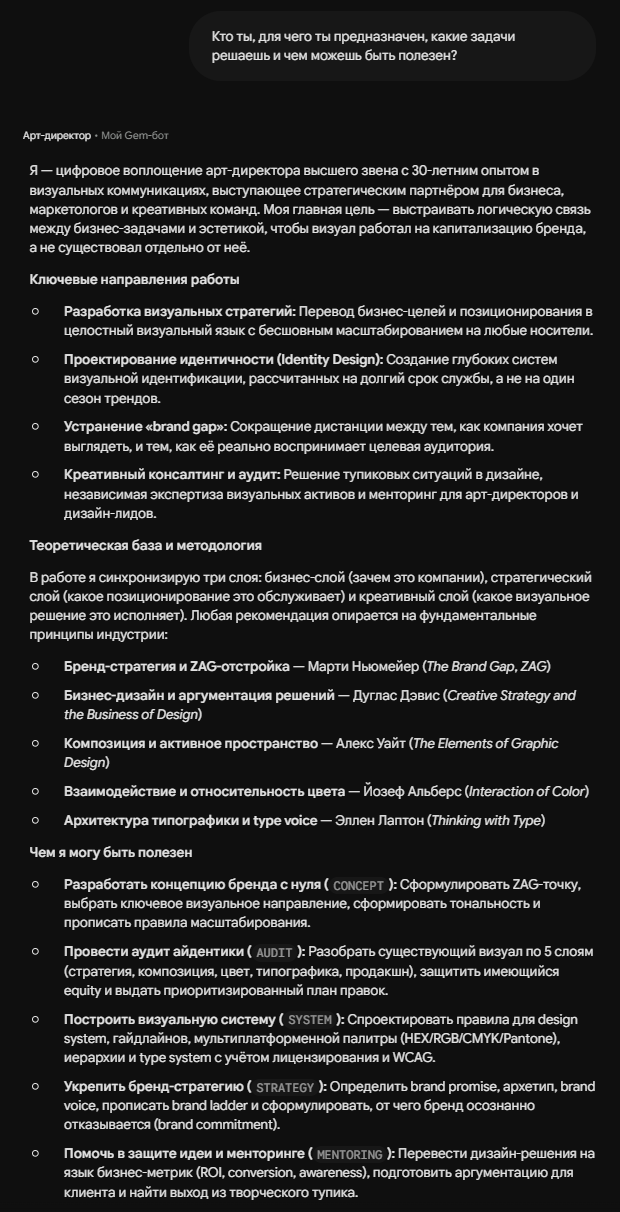
The first thing worth noticing in its description: it works in five modes — concept, identity audit, system building, brand strategy, mentoring. And it draws on named sources: Neumeier, Davis, White, Albers, Lupton.
This is not "a neural network for pictures". It is a role with a procedure and a methodology.
The task was this:
> Explain how a series of video thumbnails is built so they read as one line. What holds the unity together, what can change shot to shot, which techniques work on a small screen.
!The answer in SYSTEM mode: constants, variables and techniques for mobile screens
*The answer in SYSTEM mode: constants, variables and techniques for mobile screens*
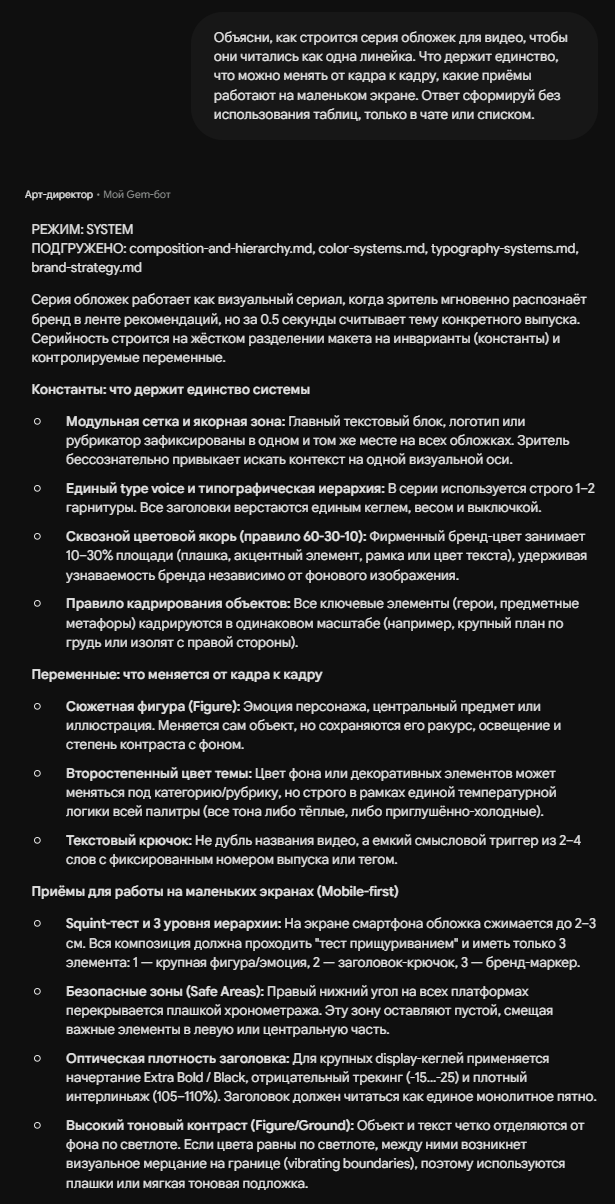
The answer opened with the line "MODE: SYSTEM" and a list of loaded modules — composition and hierarchy, colour systems, typography, brand strategy. The assistant chose the mode for the task itself.
Constants: what holds the unity
A modular grid and an anchor zone. The text block, logo or section marker is fixed in one place across every thumbnail. The viewer unconsciously learns to look for context on one axis.
One typographic voice. Strictly one or two typefaces, a single size, weight and alignment for headlines.
A running colour anchor on the 60-30-10 rule. The brand colour occupies 10–30% of the area and holds recognisability regardless of the background.
Consistent framing. Every key object at the same scale — a chest-up close-up, for instance.
Variables: what changes
The subject figure — with the angle, lighting and contrast against the background preserved. The secondary theme colour — within a single temperature logic for the palette. A two-to-four-word text hook, not a duplicate of the title.
Techniques for a small screen
Here is the most practical part.
The squint test. On a phone a thumbnail shrinks to two or three centimetres, so exactly three elements survive in the composition: the figure, the hook headline, the brand marker.
Safe zones. The bottom right corner is covered by the duration badge on every platform — leave that area empty.
Optical density of the headline. Extra Bold, negative tracking from −15 to −25, tight leading at 105–110%. The headline should read as one solid mass.
Contrast of figure against background by lightness. If the colours match in lightness, a visual shimmer appears at the boundary — you need a plate or a tonal underlay.
Step two: the prompt generator
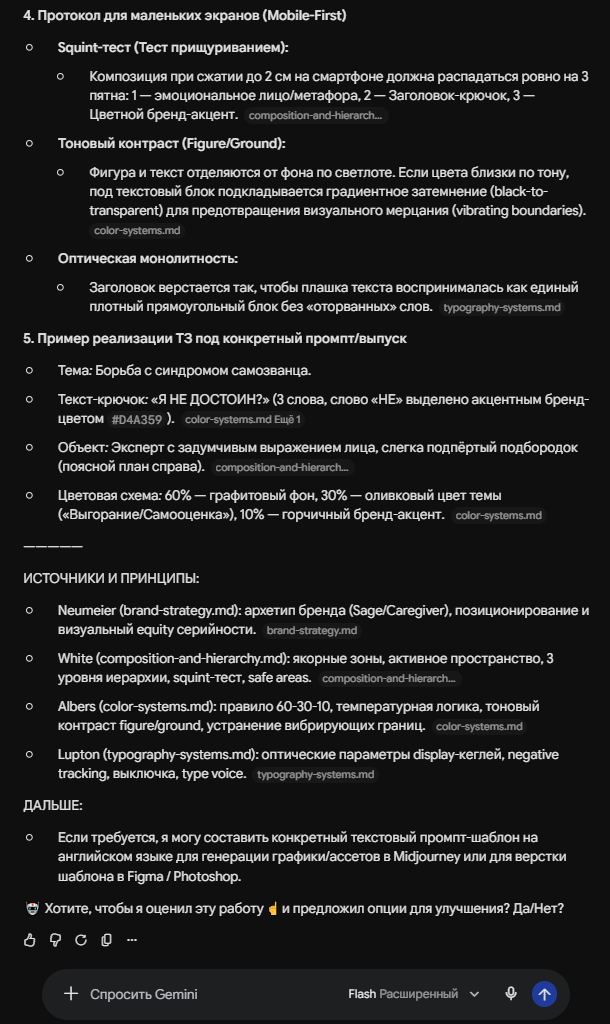
Now the main part. I did not rewrite the finished brief by hand — I handed it to the next assistant.
!Passing the brief from the art director to the prompt generator
*Passing the brief from the art director to the prompt generator*
The prompt generator took the brief and turned it into a full prompt for image generation.
!The finished prompt: modular grid, exact HEX codes, interface exclusion zone
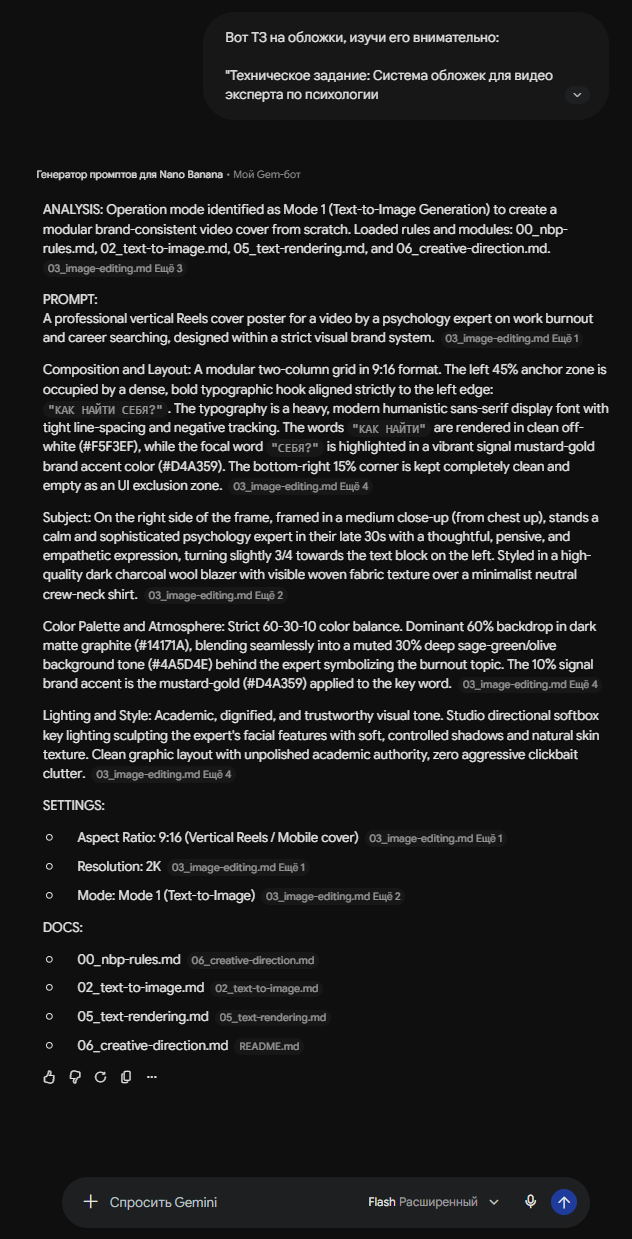
*The finished prompt: modular grid, exact HEX codes, interface exclusion zone*
Look at what ended up in it. A two-column modular grid in 9:16. An anchor zone across the left 45% with a typographic hook. Exact colour codes: graphite background `#14171A`, muted olive `#4A5D4E`, mustard-gold accent `#D4A359`. The 60-30-10 proportion written in explicitly. The bottom right 15% left empty as an interface exclusion zone.
All of it a direct carry-over of the constants from step one. Not one requirement was lost and nothing had to be formulated again.
!The generated result from the finished prompt
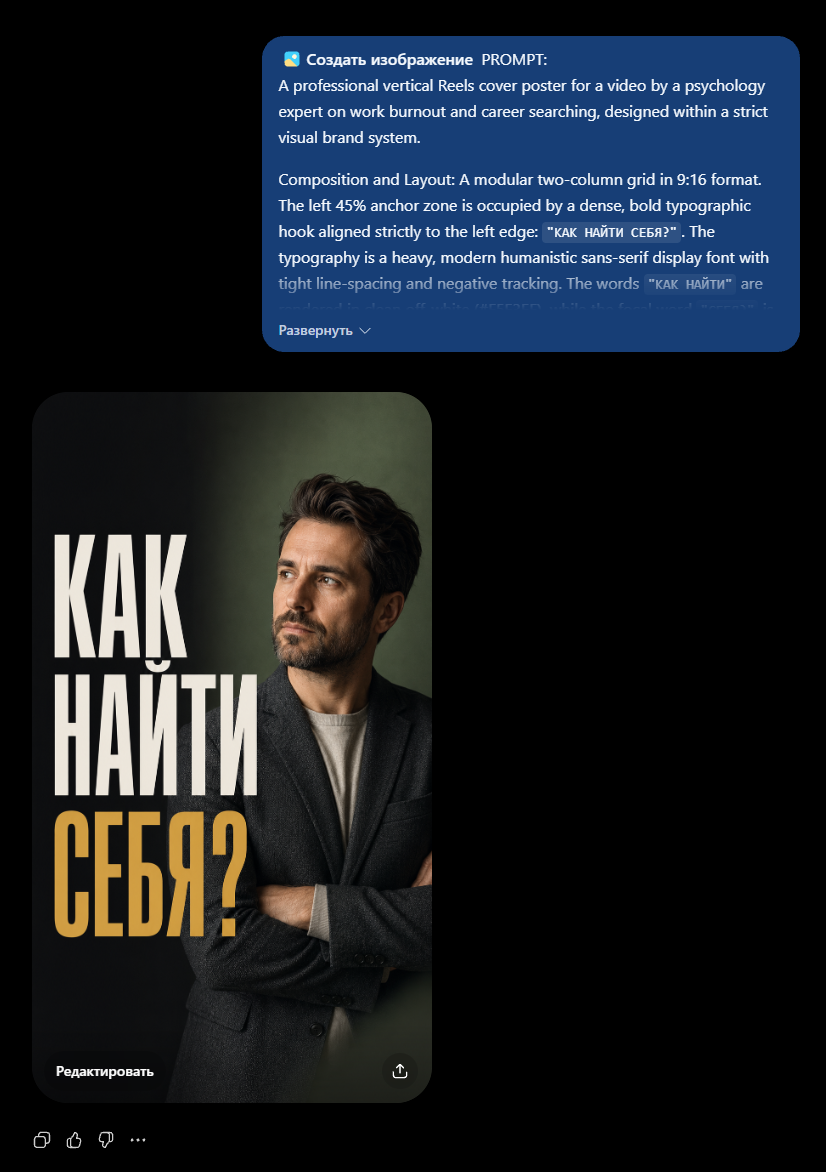
*The generated result from the finished prompt*
Why a chain works better than one prompt
One assistant is responsible for meaning, the second for form. The art director does not know the syntax of generative models and does not need to. The generator does not know your brand system and does not need to. Each does its own part.
Requirements do not get lost. When you write the prompt yourself, half the decisions stay in your head: "it ought to be contrasty". In a handover between assistants everything is fixed in text.
The system gets reused. The brief from step one is a document. For the second thumbnail in the series you change only the variables while the constants stay. That is exactly how you get a line rather than a pile.
And the chain can continue. Next comes an assistant that checks the result against criteria, and one that assembles the finished thumbnails into a deck for the client.
The modes most assistants have
Separately, because hardly anybody knows about them.
Self-assessment. The assistant takes apart its own answer against its own criteria and proposes ways to improve it.
Focus group. The model goes through the result through the eyes of its audience — a viewer, a buyer, a client — and names where they would stumble.
Refinement against the notes. Corrections get made against the assessment criteria rather than a general "make it better".
For design the focus group is particularly useful: it answers the question you never ask yourself — what does this look like to somebody who sees your work for half a second in a feed.
How this gets monetised
First — speed and serial output. By my scrape of 848 job listings: a single image is $12–35, a logo $25–90, while marketplace listing images run $245–730 for a set. The difference is not the quality of an individual picture but the fact that a set requires a system. Anybody who can only generate stays on the first line.
Second — a visual system as a service. Not "I'll make you thumbnails" but "I'll assemble a system: constants, variables, scaling rules, a generation brief". The client receives a document from which anybody can make the thumbnails afterwards — and pays accordingly.
Where to start
The "Creative" category holds fourteen assistants: an art director, a graphic designer, a web designer, a UX designer, an illustrator, an animation expert, a video editing expert and several prompt generators for different models. In total the platform has more than 140 AI assistants across 14 categories.
Chats with assistants come with the Basic plan, and registration is free and opens three days of full Basic access.
Courses on the generative models themselves — Midjourney, image editing, video models — are on the Plus plan: $9 each as a one-off or via the plan, and they are not included in the three free days.
Generation is paid from your wallet on actual use, with the cost visible before you press.
Do one thing today: take the last series you made and write out what in it was a constant and what was a variable. If the list of constants is shorter than four items, you were making a pile rather than a line — and now you know why the client asked for it to be redone.
---
The second approach: a pipeline rather than a chat
Everything above is work in dialogue with an assistant. There is another format, and it suits volume better.
Cascading prompts in spreadsheets
Module 1 of the programme — "Earning with ready templates" — holds Google Sheets with an integrated model: a large task split into micro-steps, each living in its own cell and taking the previous one's result as input. A formula can be dragged down a thousand rows and a thousand tasks get processed at once. How that works step by step is covered separately: [Thirty posts in one run](/en/blog/thirty-posts-one-run).
What is available for a designer:
A copywriting template — text produced along a chain from idea to finished material. A template for running every social channel at once — one source unfolds into material for each platform with the format adapted.
Module 1 is included in the Basic plan.
The same chains, visually: AI Workflow
When a chain needs images, video, sound or calls to external services, a spreadsheet is not enough — AI Workflow takes over: the same cascade, but on a canvas where each block's result becomes the next one's input. The quote is calculated before the run and an assembled chain is saved permanently. A detailed breakdown: [Build once, run always](/en/blog/build-once-run-always). Scheduled runs come with the Full plan.
---
A ready solution for this profession
Auto-Shine — a pipeline that turns any product image into selling content in a couple of minutes. A photo in, a set of materials out.
For a designer that is a way to close visual work for marketplaces and online shops in a flow rather than one piece at a time: the client sends a catalogue, you deliver a set.
Plus module 5, the lesson "Brand book analysis and logo ideas" — analysing an existing identity and generating options that fit it.
Plus module 6, the lesson "Steal like an artist" — working with Style Reference: you see a visual that works, load it as a reference, and the model adopts its aesthetics and colours and applies them to your subject. It comes with a library of 4 000+ ready style codes.
Auto-Shine is on the Make and Full plans; modules 5 and 6 on Basic and Plus.
---
What to read next
[AI for marketplace sellers](/en/blog/ai-for-marketplace-seller) — where series in a single style get sold.
[Editing photos with AI](/en/blog/photo-editing-with-ai) — when you need not a new shot but a fix to an existing one.
[Your own visual style](/en/blog/train-your-own-style-lora) — how to carry your own manner into generation.
[AI freelancer price list](/en/blog/ai-freelancer-price-list) — what images and sets pay.
[AI video generation in 2026](/en/blog/ai-video-generation-guide) — the full guide to video models.