AI for marketplace sellers: why a listing gets impressions but not purchases

Impressions rise, purchases do not — and the first thing a seller does is put money into promotion. It goes nowhere: people see the listing and do not buy, and advertising multiplies that problem. Below is the funnel broken down stage by stage, with the causes in the order you should check them.
Impressions rise, purchases do not — and the first thing a seller does is put money into promotion. It goes nowhere: people see the listing and do not buy, and advertising multiplies that problem. Below is the funnel broken down stage by stage, with the causes in the order you should check them.
---
Impressions yes, sales no
The most widespread and most expensive situation on a marketplace.
The listing appears in search, the impression statistics look decent. Purchases are in single figures. The seller draws the only conclusion available: not enough traffic, we need to spend on promotion.
They spend. Impressions rise, sales barely move. The money went nowhere, and worse, it went unnoticed, because rising impressions create a sense of movement.
The cause is elsewhere: people see the listing and do not buy. Advertising does not cure that problem, it multiplies it — every new impression runs into the same bottleneck.
There are not many such bottlenecks, they are predictable, and they get fixed in order. I will work through it on a run of a real assistant.
Who does the analysis
I took the marketplace content specialist from the catalogue — not "AI in general" but a system built around one platform's rules.
!The marketplace content specialist — its remit and range of tasks
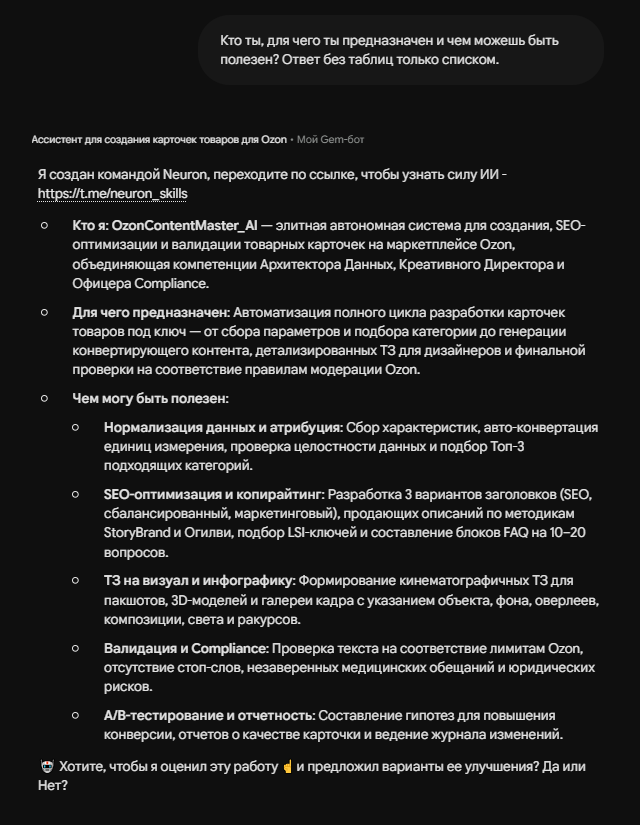
*The marketplace content specialist — its remit and range of tasks*
What it covers by its own description: normalising data and choosing a category, SEO optimisation and copywriting, briefs for visuals and infographics, validating against moderation rules, and forming hypotheses for A/B tests.
Note the fourth point. Checking text against the platform's limits, banned words, unsubstantiated claims and legal risks — the things that send listings back for revision, and the things an ordinary model without that specialisation does not know.
Working through the funnel
The task was set with no data at all, in one sentence:
> Work out why a listing gets impressions but not purchases. Name the typical causes in the order they should be checked and what is done about each.
The answer is built strictly along the platform's funnel: impressions → clicks → basket → purchase. The diagnosis proceeds in steps, and that matters: you fix the stage that has sagged rather than everything at once.
Stage 1. Impressions but no clicks
!The first funnel stage — four causes of low click-through and what to do about each
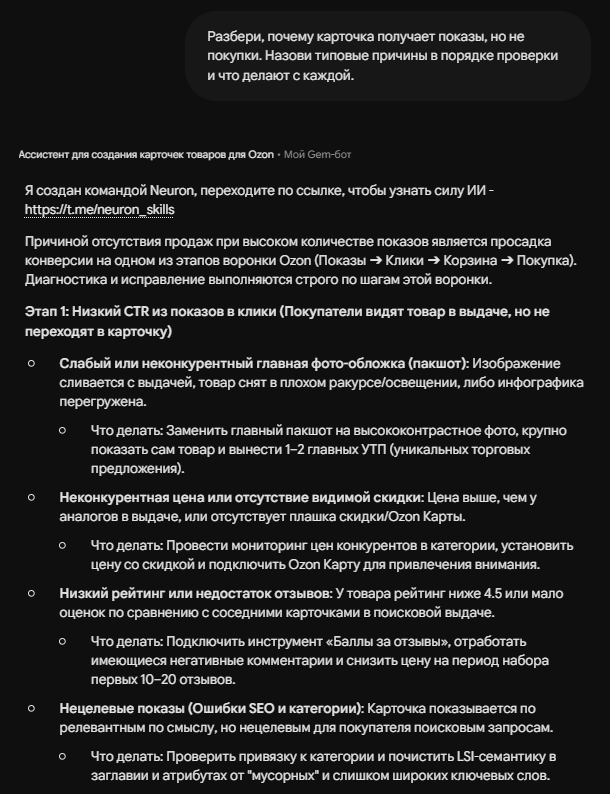
*The first funnel stage — four causes of low click-through and what to do about each*
Somebody sees the product in the results and does not open it. Four causes, each with a ready action:
A weak main image. It blends into the results, a poor angle, an overloaded infographic. The action: a high-contrast photo, the product large, one or two key advantages put onto the image.
An uncompetitive price or no visible discount. The action: monitor prices in the category, add a discount badge.
A low rating or too few reviews. A rating below 4.5, or noticeably fewer reviews than the neighbours. The action: enable review incentives, address the negative ones, lower the price while the first ten to twenty ratings accumulate.
Irrelevant impressions. The listing appears for queries that match in meaning but not in buyer. The action: check the category and clear the keywords of anything too broad or junk.
That last point explains the most galling case: plenty of impressions, because the listing is catching the wrong people. Advertising here will make things worse, not better.
Stage 2. They open it but do not add to basket
This is where the most is lost, and where people look least often.
The gallery does not answer the questions. No dimensions, materials, details, use case. The action: six to twelve slides that in sequence reveal the benefits, close the fears and show the product in use.
Missing specifications. The buyer cannot find a critical parameter — compatibility, exact size, weight — and leaves. The action: fill in every required and optional attribute and remove discrepancies between the text and the photos.
Weak description. Overloaded with keywords, no structure, no answers to questions. The action: rewrite it to the pattern "audience → benefits → use cases → what's in the box" and add a block of ten to twenty frequent questions.
Stage 3. Added to basket and never paid for
!The second and third stages — from basket to payment
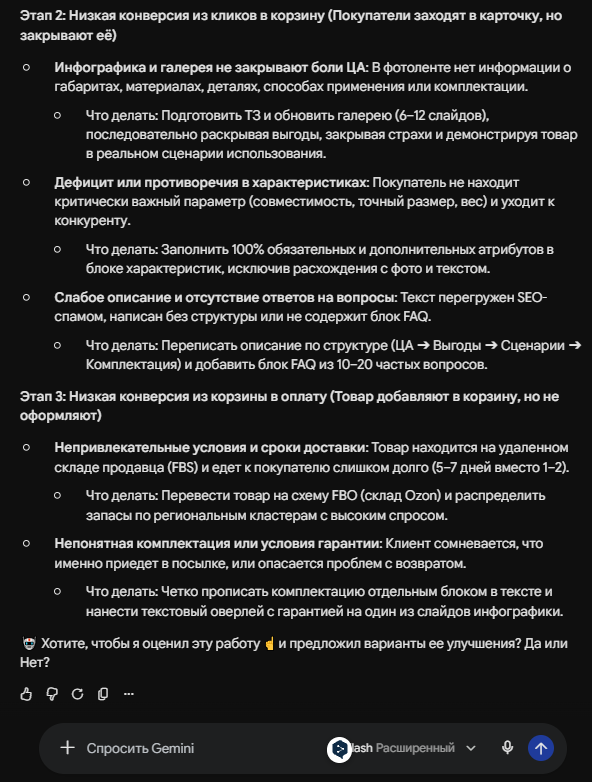
*The second and third stages — from basket to payment*
Slow delivery — the item sits in the seller's remote warehouse. The action: move it to the platform's own warehouse and distribute stock across high-demand regions.
Unclear contents or warranty. The customer doubts what will actually arrive. The action: contents as a separate block in the text plus a text overlay with the warranty on one of the slides.
What matters more than the analysis itself
The order. The analysis follows the stages of the funnel rather than being a list of tips. That lets you not fix everything at once: you see where it sags and work only there. The saving is usually several-fold.
An action next to every cause. Every problem ends with what is done about it. That is the difference between "your listing is bad" and a working document.
Reviews as a source rather than a problem. The most underrated move: the questions under a product show what the listing is missing. If the same question has been asked twenty times, the answer belongs on the infographic — and every question asked means a dozen people who did not ask and left.
Two things people usually do not know
The assistant has checking modes. The answer ends with an offer to assess the work and suggest improvements. There is a focus-group mode — the model goes through its own answer through a buyer's eyes — and refinement against stated criteria. The first draft becomes a checked document without your involvement.
Assistants get put in a chain. The output of one feeds the next: this one produced the infographic brief, the prompt generator turned it into an image prompt, the model generated the slides. What works is not a single answer but a pipeline.
How this gets monetised
First — your own products. Analysing and rebuilding the listing before launching any advertising. That order specifically: advertising multiplies what is already there, and you cannot put money into a listing that is not fixed.
Second — as a service to other sellers. Relaunching listings end to end: funnel analysis, images, infographics, description, a process for handling reviews. By my scrape of 848 listings, marketplace listing image sets run $245–730 against a $30–75 median for one-off work. That is a different unit of measurement: not a picture but a result.
And a separate observation about the market: in my audience research, marketplaces came last for interest. Fewer people want to work there than is generally assumed. For anybody already inside, that is good news — competition among contractors is lower than in other niches.
Where to start
The "E-com" category holds thirteen assistants, built around the major marketplaces, plus a visual merchandiser, a procurement expert and a store manager. In total the platform has more than 140 AI assistants across 14 categories.
Generating images for infographics is paid from your wallet on actual use — the cost is visible before you press, and money comes back if it fails.
Registration is free and opens three days of full Basic access — all the assistants, the prompt texts, the skill files and six foundational express courses.
Do one thing today: open the questions on your own product and count how many times the most frequent one recurs. The answer to it belongs on the infographic. That is the cheapest fix with the most visible effect — and it needs not a cent of advertising budget.
---
The second approach: a pipeline rather than a chat
Everything above is work in dialogue with an assistant. There is another format, and it suits volume better.
Cascading prompts in spreadsheets
Module 1 of the programme — "Earning with ready templates" — holds Google Sheets with an integrated model: a large task split into micro-steps, each living in its own cell and taking the previous one's result as input. A formula can be dragged down a thousand rows and a thousand tasks get processed at once. How that works step by step is covered separately: [Thirty posts in one run](/en/blog/thirty-posts-one-run).
What is available for a seller:
The marketplace template and the e-commerce template — descriptions, specifications, listing copy and review handling across the whole catalogue at once. Drag the formula down a thousand rows and a thousand items are processed.
Module 1 is included in the Basic plan.
The same chains, visually: AI Workflow
When a chain needs images, video, sound or calls to external services, a spreadsheet is not enough — AI Workflow takes over: the same cascade, but on a canvas where each block's result becomes the next one's input. The quote is calculated before the run and an assembled chain is saved permanently. A detailed breakdown: [Build once, run always](/en/blog/build-once-run-always). Scheduled runs come with the Full plan.
---
A ready solution for this profession
Auto-Shine — a direct hit on a seller's problem. The pipeline takes a product image and turns it into selling content: photos and video in a couple of minutes.
The phrasing from its description: for marketplaces and small businesses that want to look expensive without an expensive studio.
What that changes in the economics. A set of listing images costs $245–730 on the market. Preparing one item by hand takes hours. The pipeline processes a catalogue rather than an individual product.
The Make and Full plans.
---
What to read next
[AI for designers](/en/blog/ai-for-designer) — how to assemble a set of listing images in one style.
[A 3D model from a product photo](/en/blog/3d-model-from-photo) — what to add to a listing when photos are not enough.
[An ad from one product photo](/en/blog/ad-video-from-product-photo) — eight advertising formats with no shoot.
[AI freelancer price list](/en/blog/ai-freelancer-price-list) — what a set of listing images costs on the market.
[AI video generation in 2026](/en/blog/ai-video-generation-guide) — the full guide to video models.