An advertising clip from one product photo: eight formats with no filming
The usual path to an advertising clip is a script, a location, lighting, a model, editing. There is another: you describe the offer, attach a product photo, choose a character. Below are eight formats by task and where avatars with rights come from.
The usual path to an advertising clip is a script, a location, lighting, a model, editing. There is another: you describe the offer, attach a product photo, choose a character. Below are eight formats by task and where avatars with rights come from.
---
Advertising that costs as much as a shoot day
The usual way of producing an advertising clip: a script, a location, lighting, a model, a camera operator, an editor. A week of approvals and a budget small businesses cannot carry.
So most small brands advertise with photographs from a phone.
There is another way, and it is built fundamentally differently: you describe the offer, attach a product photo, choose a character — and get a finished vertical clip with sound.
Three steps as the person sees them:
Your product and offer → a character → a clip
Everything in between — writing the script, generating the frames, animating them, assembling with sound — the system does itself.
Eight formats
Not one universal one but eight for different tasks. The difference is what comes out at the end.
| Format | Frame | What to attach |
|---|---|---|
| UGC advert with a character | 9:16 | character, product photo |
| From a selfie to an advert | 9:16 | character |
| Product showcase | 16:9 | product photo |
| Creative for paid ads | 1:1 | product photo |
| Marketplace listing card | 3:4 | product photo |
| One visual, every format | multi | the source visual |
| A campaign end to end | multi | product photo |
| A clip from idea to result | 9:16 | text only |
A breakdown by task
UGC advertising. A vertical clip that looks like an ordinary user filmed it: the character holds the product and talks to camera. Hook, demonstration, call to action. For physical products and marketplaces, where what is needed is a live review rather than a studio presentation.
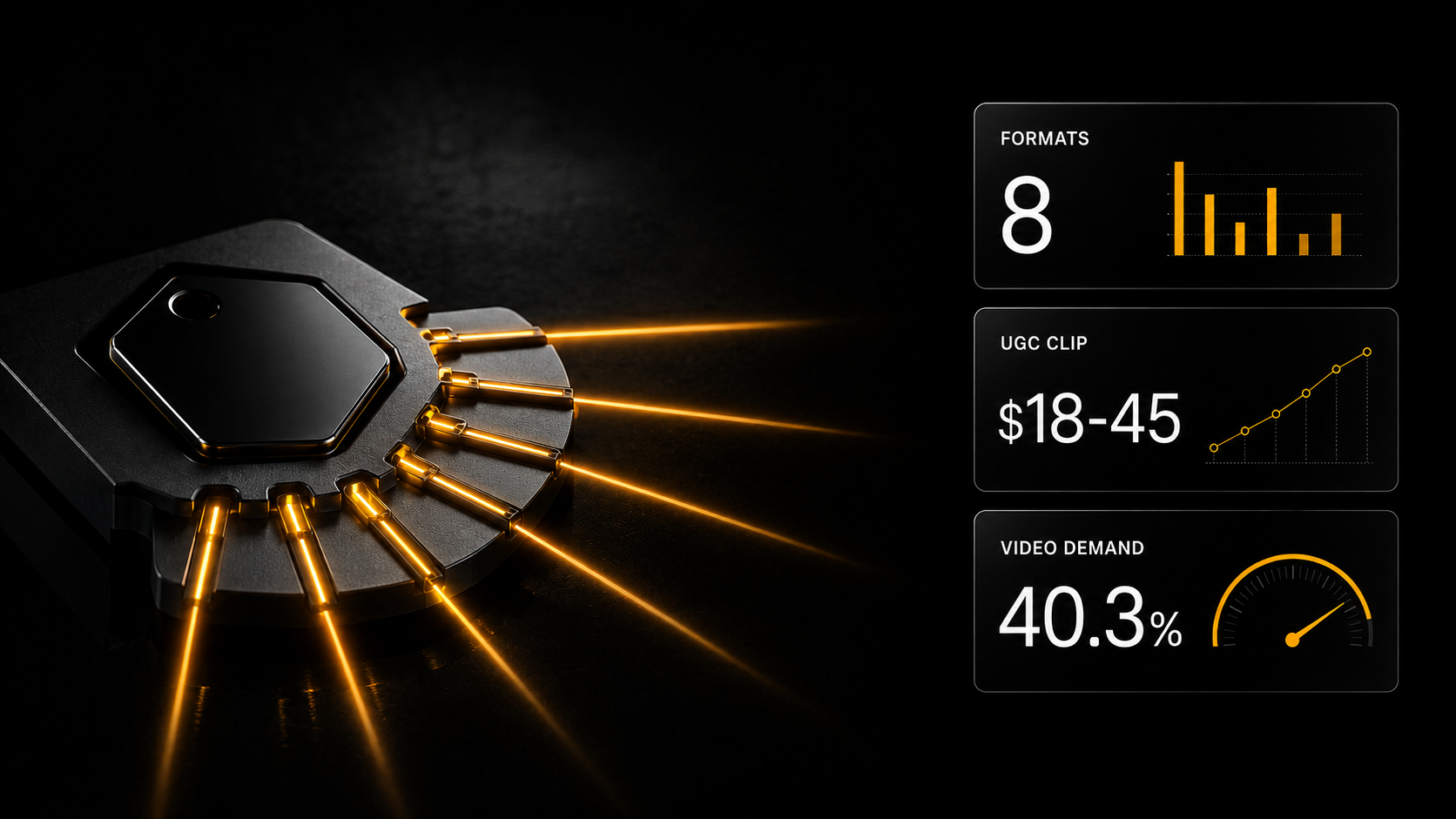
That is the largest area of demand: the UGC format is 40.3% of all jobs in my scrape of 848 listings.
From a selfie to an advert. Your face becomes the character: a series of frames and clips. For an expert, a coach, an author — advertising with yourself in frame and no shoot.
Product showcase. Cinematic advertising of 5–15 seconds: macro work, lighting, camera movement, no character. For premium products where the presentation decides: technology, jewellery, cosmetics.
Creative for paid ads. Six to nine static images with different angles of approach, ready to test. For a media buyer who needs a set at once rather than one at a time.
Marketplace listing card. A full set of images: the main photo, angles, an infographic.
One visual, every format. Adaptation for every platform: feed, stories, banner. Not stretching but recomposing — those are different things and the difference shows.
A campaign end to end. A concept and a tagline, from them a key visual, a creative for the feed and an eight-second clip — as one coherent package. For a product launch, when a complete set in one style is needed.
A clip from idea to result. When there is neither a photo nor a script — only a thought.
What it takes off a person
Four things, each of which usually required its own specialist.
Filming. No camera, lighting, studio or model needed.
The script. The direction gets written by the built-in Prompt Master. You describe the offer in ordinary words — no need to be good at writing prompts, and that removes the main barrier to entry.
Editing. The assembly with sound happens inside the pipeline.
Approvals. A clip comes out in minutes rather than a week of correspondence.
The character: three sources and the rights question
The point that matters more than picture quality for commercial work.
Your own photo. Upload a selfie and you are the character.
Your own trained character. If a permanent character has been trained in Gen AI, it gets dropped into the clips: the face does not drift from clip to clip. Without that a series cannot be assembled, and commercial work is always a series.
A ready avatar from the gallery — ten characters for different roles: cosy and lifestyle, youthful, business and expertise, kitchen and home, style and grooming, minimalism and tech, maker and DIY, city and sport, experience and trust.
Every avatar was generated by us. They are not stock people and not somebody else's faces — no rights questions arise. For advertising you hand to a client that is not a detail but a condition of working.
How the work runs
1. Choosing the format — what is needed at the end.
2. Input — the offer and the product in ordinary text, a product photo or a selfie.
3. Character and frame ratio — 9:16 for stories and reels, 1:1 for a feed, 3:4 for a listing card, 16:9 for a banner and YouTube.
4. The quote — visible before you run it, along with your remaining balance.
5. The run — the pipeline stages appear on screen with their status: scene and prompt, the hero frame of the product, animation with sound.
6. The result — files download immediately and stay in "my generations".
If you close the tab, the pipeline carries on running on the server.
Money: the quote before, not after
Two properties that remove the main fear — burning budget for nothing.
The price is known in advance. The quote is shown before the run.
Money comes back for anything not delivered. If a pipeline step did not complete, its cost returns to your balance automatically.
Payment comes off the wallet on use rather than by subscription: a month with no work costs nothing.
How this sells
Cost against fee. By my dataset: a short clip — $18–45, AI video end to end — $245–550, a set of marketplace listing images — $245–730. The median for one-off work is $30–75.
The spend on generations meanwhile runs to single dollars. The difference is your work.
Where the main gap is. Between "a short clip" and "end to end" it is more than tenfold, and it is not about picture quality. The second sells the whole result: a concept, a set of formats per platform, an agreed number of revisions.
The "campaign end to end" format is exactly that — not a clip but a coherent package. It is what moves you from the bottom line of the price list to the top.
What to ask a client before agreeing: where the material is going, whether there are strict requirements on product likeness, how many rounds of revisions are included in the price. For generative video a revision often means regenerating, which means a new cost.
What is under the bonnet
Every format is a ready chain template of five or six steps: Prompt Master writes the direction, the generator assembles the frames, the video model animates them with sound.
A user does not need to know that — they see a choice of format and a result. But if you want to build your own, the same blocks are available in AI Workflow: there the chain gets configured by hand, with conditions, an iterator for bulk processing and a block for publishing straight to social media.
Where to start today
Registration is free and opens three days of full Basic access — every assistant, the prompt texts and six foundational express courses. Generation is paid separately, from the wallet on use.
The video model courses come with the Plus plan, or $9 one-off, or 1 000 experience points.
One action. Take one product photograph — your own or an entrepreneur friend's — and run it through the UGC advertising format. One clip, fifteen seconds.
Not to sell. To find out how long it took and what it cost. After that, a conversation with a client about timescales and price stops being guesswork.
---
A ready pipeline for the same task
The eight formats above are a section of the platform. The automations archive holds a solution for the same task but built as a working process.
Auto-Shine — turns any product image into selling content in a couple of minutes: photos and video. The phrasing from its description: for marketplaces, online shops and small businesses that want to look expensive without an expensive studio.
The difference between them is the approach. Marketing Studio is three steps in an interface with a result straight away. Auto-Shine is a process that plugs into your pipeline and handles a catalogue rather than one product.
Plus "one file → every social platform" — video, photo or text gets processed automatically and published to every channel at once.
The archive — Make, N8N and Full.
---
What to read next
[Face rights in advertising](/en/blog/face-rights-in-ai-ads) — where the avatars come from.
[Lip sync: making a character talk](/en/blog/lip-sync-talking-character) — the technical part.
[What a clip actually costs to make](/en/blog/video-production-cost) — what one job comes to.
[AI for marketplace sellers](/en/blog/ai-for-marketplace-seller) — who this sells to.
[AI video generation in 2026](/en/blog/ai-video-generation-guide) — the full guide to video models.