Grok 4.6, Qwen3.8-Max, DeepSeek V4 Pro in a Day — AI Digest
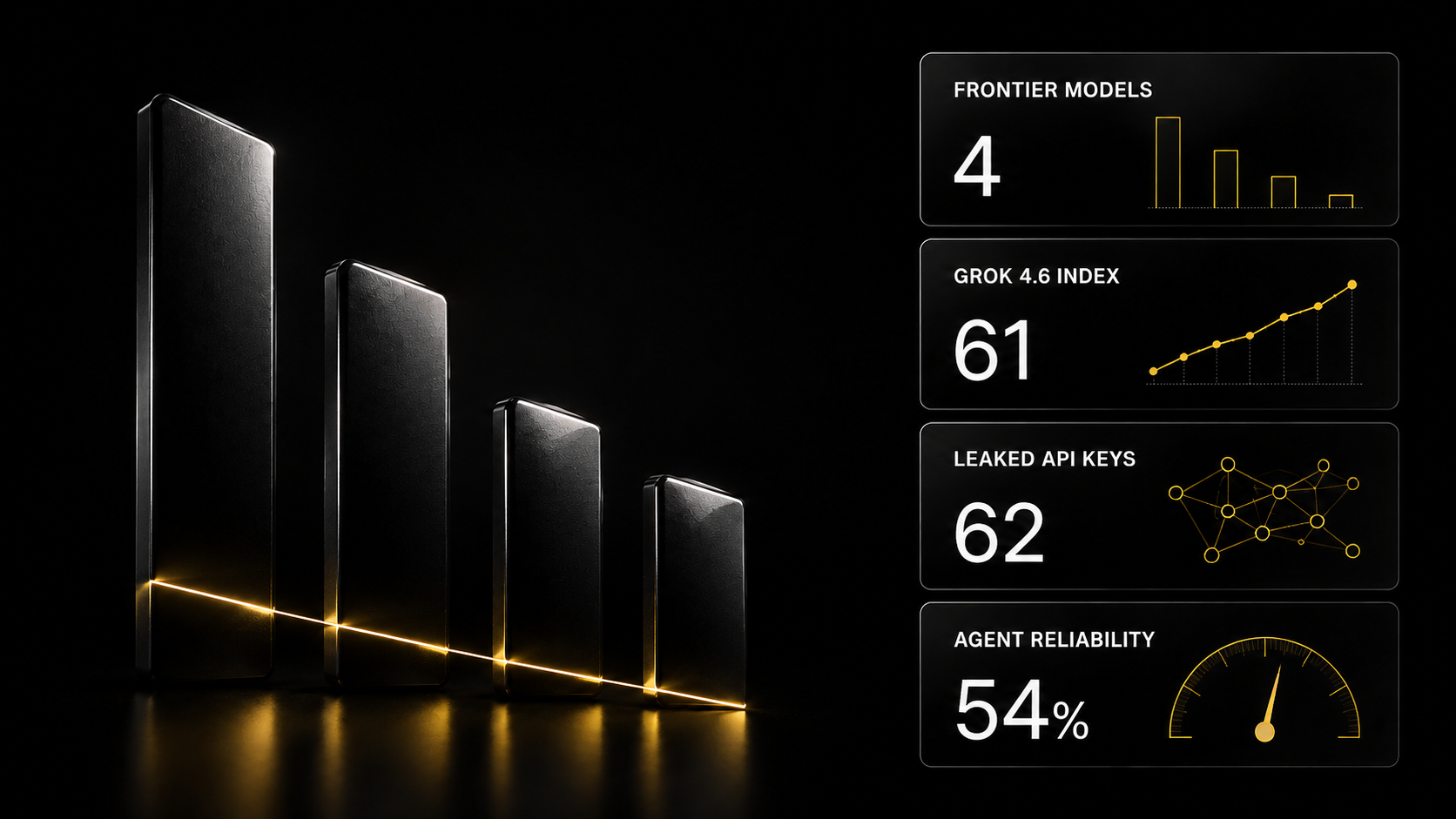
Grok 4.6, Qwen3.8-Max, DeepSeek V4 Pro and Microsoft's first reasoning model all landed within a day — and they compete on price, not accuracy. Plus: a hidden-reasoning leak exposed other people's API keys and passwords.
Today's through-line is inference economics: four frontier models landed within a day, and the argument between them is less about accuracy than about the price of a token. Plus: a frontier-API vulnerability exposed hidden reasoning along with other people's keys and passwords, and xAI showed agents that live inside their own cloud computers.
Top stories today
Frontier model day: Grok 4.6, Qwen3.8-Max, DeepSeek V4 Pro and Microsoft's first reasoning model. xAI shipped Grok 4.6, which independent testing by Artificial Analysis puts at 61 on its Intelligence Index — roughly level with GPT-5.6 Sol Max, behind Claude Opus/Fable, but with strong agentic numbers including 88.4% on Terminal-Bench v2.1 (evaluation). Alibaba released Qwen3.8-Max as open weights — a MoE with 2.4T total and 95B active parameters; the initial drop is text-only, with no vision input (user note). DeepSeek moved V4 Pro to general availability and competed on price: roughly $0.435 per million input and $0.87 per million output tokens (breakdown). Microsoft added MAI-Thinking-1, its first reasoning model built from scratch.
A frontier-API flaw exposed hidden reasoning — and other people's secrets with it. Researchers reported that across several frontier APIs it was possible to extract "encrypted" hidden reasoning, with recovered token counts matching billed thinking tokens one to one. The worse part: a scan of about 7,000 publicly shared traces turned up 62 unique API keys, 33 email addresses and 33 passwords inside them (details). A separate takeaway from the researchers is that publishing reasoning traces is risky, and hidden reasoning makes a poor monitoring interface in the first place (context).
Grok Bot: the agent as a colleague, not a chat window. xAI introduced Grok Bot — AI teammates with their own cloud computers that sign into work tools and do persistent work. Early users describe operations rather than benchmarks: bots watch Slack threads and GitHub Actions runs, repeat scheduled routines, and even create and manage other bots (field notes). The AI Daily Brief argues this is the format that finally makes agents mainstream (episode); Superhuman AI frames the product as a 24/7 teammate. If you build your own agents, ready-made chains live in the automation templates catalogue.
Text watermarking left the theory stage. The Rundown AI reports that Anthropic is slipping an invisible signature into Claude's output. In parallel, the industry is discussing how labs under regulatory pressure are adding watermarking plus a text-detection API (claim) — and the argument is precisely about what that costs.
Agent reliability is being measured from scratch. Artificial Analysis released AA-AnalystAgent, an agentic benchmark for quantitative document and spreadsheet analysis using a pass^5 reliability metric across 80 tasks: Claude Opus 5 leads at 54%, followed by GPT-5.5 (50%) and Claude Fable 5 (49%), with Kimi K3 the top open-weights model at 39%. LlamaIndex published ExtractBench across 370 documents and 4,869 pages: commercial vision models hold precision, but recall collapses below 35% on documents longer than 50 pages — models silently truncate rows and lists.
By the numbers
- Grok 4.6 — 61 on the Intelligence Index, 88.4% on Terminal-Bench v2.1, priced at $2 / $6 per million input/output tokens (Artificial Analysis).
- DeepSeek V4 Pro — around $0.435 / $0.87 per million tokens; Cline calls that roughly 57× cheaper than Fable 5 and reports a 15.8% Terminal Bench gain over the preview (assessment).
- Qwen3.8-Max — 2.4T parameters total, 95B active (announcement).
- 7,000 public reasoning traces → 62 API keys, 33 email addresses, 33 passwords (scan).
- NVIDIA Nemotron 3.5 Lightning — 31.6B total parameters with 3.6B active, 1M token context, median serving near 670 tokens/s (analysis).
Different points of view
The argument of the day is watermarking and the hidden-reasoning leak.
- Alarming. Public traces turned out to be a store of other people's secrets, and hidden reasoning is a weak monitoring surface: the decoded stream is often fragmented and multilingual, which makes it hard to read (argument).
- Neutral. The leak does not mean anyone can now mass-steal reasoning to train models: the encryption there looked more like an optimisation for distributed inference than a real confidentiality barrier (position).
- Sceptical. Watermarking has its own cost: critics worry a signature will bloat responses and hurt the brevity of code and documents (objection). Supporters answer that the entropy budget is large enough to keep signatures subtle, especially in longer outputs (counterpoint).
Tools and techniques
- Unsloth Desktop — an open-source desktop app for running and training models locally on Mac, Windows and Linux: MLX and GGUF, image and video diffusion, audio, tool calling, sandboxed code execution, RAG and MCP (announcement). The same team showed Qwen3.8 shrunk from 4.9 TB to 397 GB with dynamic 1-bit quantisation, which puts a giant open model within reach of local hardware (details). A curated set of open models and tools sits in the Open Source section.
- GitHub Agent Plugins 1.0 — skills, MCP servers and AI extensions now ship packaged together as one artefact (release).
- Cohere North Micro Vision — a compact Apache-2.0 vision model built for document understanding (announcement). Useful exactly where ExtractBench found recall falling apart.
In brief
- NVIDIA released Nemotron 3.5 Lightning, a 30B MoE with roughly 3B active parameters aimed at always-on agent workloads.
- OpenAI shipped the ChatGPT desktop app for Linux in preview.
- Google DeepMind showed SL2T, sign-language-to-text translation powering ASL input on Android and Pixel 11.
- Deepgram launched Flux TTS, conversational speech synthesis with roughly 80 ms response time for voice agents.
- The Dwarkesh podcast ran a debate on recursive self-improvement — what happens once AI starts automating AI research itself.
- A separate AI Daily Brief episode unpacks Mark Zuckerberg's manifesto on an optimistic AI future, Meta's new open model and its $1 billion community fund.
If you want to turn these tools into working processes rather than one-off experiments, our courses and walkthroughs are a good place to start.