Gemini 3.7 Flash Drops to Half Price — AI Digest
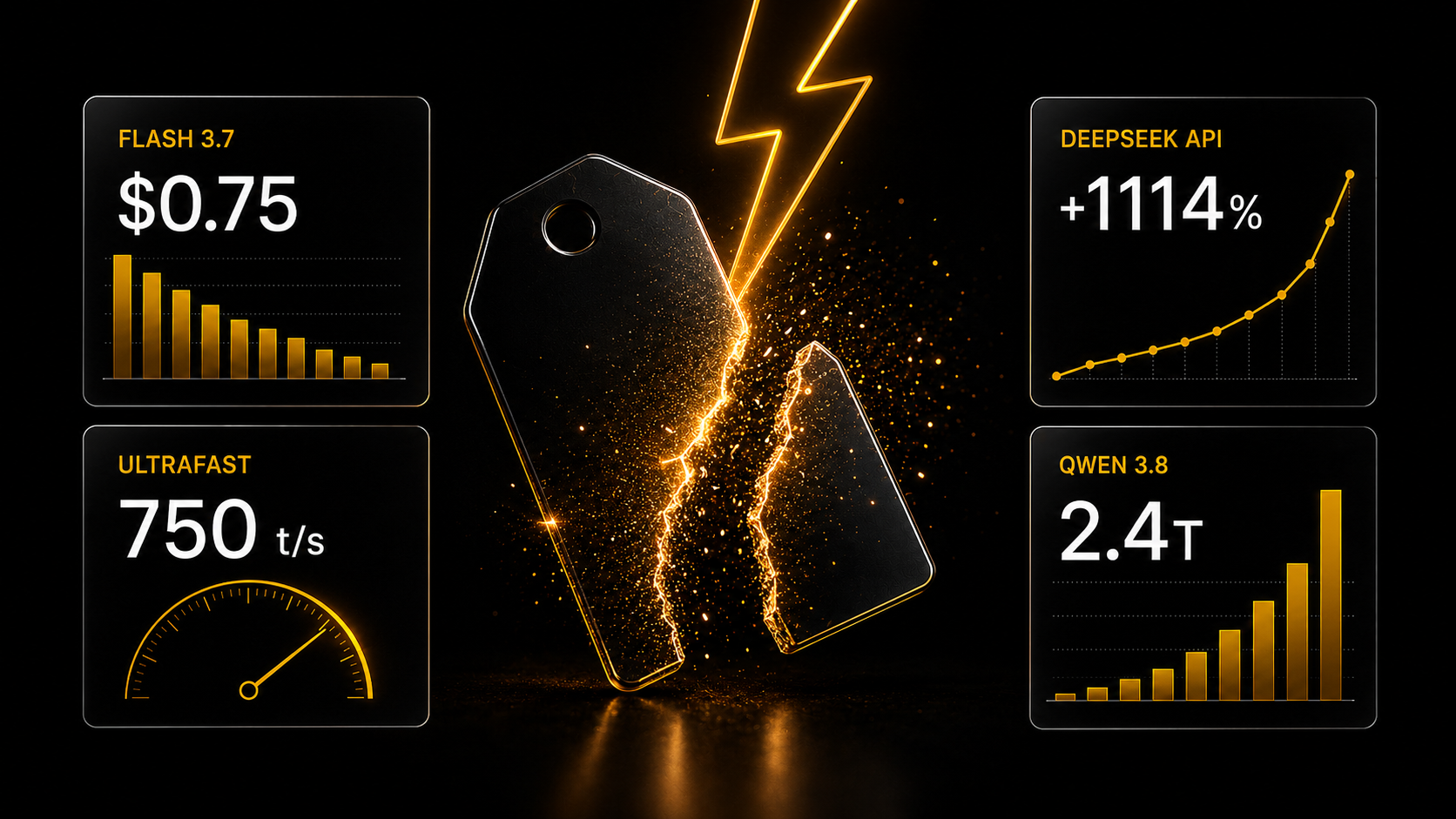
A day of speed and price reversals: Google shipped Gemini 3.7 Flash at half price, OpenAI pushed GPT-5.6 Sol to 750 tokens per second, and DeepSeek managed to open-source V4 Pro, release its own agent harness — and announce a steep API price hike, all in one day.
Top stories
Gemini 3.7 Flash: Google's new workhorse at half price. Just three weeks after 3.6 Flash, Google released Gemini 3.7 Flash — a mid-tier model aimed at coding, web development and agentic workflows. An introductory 50% discount runs through the end of the year: $0.75 per million input tokens and $3.75 per million output, rising to $1.50/$7.50 afterwards. Google reports solid benchmark gains — DeepSWE 65.3% vs 49.0% for the previous version, AutomationBench 30.4% vs 17.0% (DeepMind, Logan Kilpatrick). Independent testing by Artificial Analysis confirmed the jump: 56 on the Intelligence Index (+4 over 3.6 Flash), roughly 340 tokens per second, a 1M context window, and a spot on both the cost and speed Pareto frontiers. The model climbed to #8 in WebDev Arena, and the rollout hit the whole ecosystem at once — from AI Studio to VS Code and Cline.
DeepSeek's big day: open V4 Pro, its own harness — and a price hike. The company launched DeepSeek-V4-Pro out of preview with MIT-licensed weights (Hugging Face); community threads point to DeepSWE jumping from 12.8 to 62.7 for a 1.7T-parameter model. In parallel, DeepSeek open-sourced DeepSeek Harness — an MIT-licensed agent runtime where "everything is a plugin", down to hot-swapping the agent loop itself (repo). The prevailing read: this is a bid to own the operating layer for long-running autonomous work, not another coding-agent clone. The day's third announcement was less pleasant — new API pricing effective August 16; see Perspectives below.
OpenAI and Cerebras push GPT-5.6 Sol to 750 tokens per second. The Ultrafast mode was announced for a select set of API customers: up to 750 tok/s — 14x faster than the standard mode — running on Cerebras hardware. Target workloads are voice, support, commerce, coding and security, where response latency is everything. The telling market reaction: the discussion quickly shifted to tool latency, not model latency, becoming the real bottleneck of agentic systems.
Harnesses became an industry layer of their own. Several moves landed within a day: besides DeepSeek Harness, Arcee open-sourced NAC (Apache 2.0) — the internal harness that, per the team, has written a meaningful share of their pipeline code over the past three months; Cursor made cloud agents start 3x faster with failover to the last good build; Nous turned agent profiles into persistent named bots with their own chats, routines and bot-to-bot messaging. The direction is consistent: competition is moving from models to the environment where agents live and work around the clock.
Numbers that matter
- $0.75 / $3.75 per 1M tokens — Gemini 3.7 Flash intro pricing through year-end (then $1.50/$7.50); Intelligence Index 56 (+4), ~340 tok/s, 1M context (Google, Artificial Analysis).
- 750 tok/s at 14x standard speed — GPT-5.6 Sol Ultrafast on Cerebras (OpenAI).
- DeepSeek cache hits rise from $0.003625 to $0.022/$0.044 (off-peak/peak, +507%/+1,114%), V4 Pro output from $0.87 to $1.98/$3.96; effective August 16, 16:00 UTC (pricing, thread).
- 2.4T total parameters, 95B active, ~5 TB of bf16 weights — Qwen 3.8 landed on Hugging Face, and even serious homelab owners call full local inference a fantasy.
- 1,390 points with a +32 lead — MiniMax-H3 tops Video Edit Arena across all models (Arena).
- $40M at a $400M valuation — Series A for Vals, the independent benchmarking company (Vals AI).
Perspectives: the DeepSeek price hike
Only yesterday DeepSeek's rock-bottom pricing was the go-to argument in token-economics debates — from August 16 the picture changes: input up 1.5x, output more than 2x, cache hits up to +1,114%, plus doubled rates at peak hours (pricing).
- Critics argue that DeepSeek's value rested on price alone: the models are "token-hungry and a little slower", and at the new rates users are already migrating to competitors or their own hardware.
- Neutral observers note that off-peak stays half the peak price, and for some time zones the cheap window conveniently covers the working day — a scheduling problem, not a dealbreaker.
- Optimists point out that V4 Pro weights are open under MIT (Hugging Face), so the price ceiling is now set by third-party hosts and private clusters — the discussion has already shifted to who can serve the model cheaper than the official API.
Tools and techniques
- Optima by Artificial Analysis — a custom-benchmark platform: upload your own datasets or agent traces and measure models on your workloads instead of public leaderboards (announcement).
- Muse Glimmer 30B locally, for free: Unsloth published fine-tuning notebooks with GRPO support — 1.5x faster with half the VRAM, training fits in 24GB (Unsloth).
- Vibe-coding a game, honestly: Matt Wolfe built a sequel to his own game with Claude Code for the initial build and Codex for fine-tuning — a candid look at what already works and what doesn't (video).
In brief
- DeepMind released SL2T — real-time sign-language-to-text, with pose tracking running on-device (blog, discussion).
- OpenAI introduced Computer History: ChatGPT and Codex can (with explicit opt-in) use app and website activity as context (announcement).
- MiniMax open-sourced Music3 — an 8B LLM + 2.7B DiT that turns a prompt and lyrics into a full track on consumer hardware (MiniMax).
- New research: skill libraries can actively hurt agents — 307 failures attributed to loaded skills, 125 of them functional (breakdown).
- Context compactors retain only 17% of persistent session constraints without a dedicated extractor (DAIR.AI).
- Red Hat unveiled DSpark — a speculative decoder for Kimi-K3: roughly 4x faster, from 110 to ~435 tok/s on math workloads (Red Hat AI).
- Anthropic, OpenAI, Google, Meta, Microsoft and Mistral signed the EU Code of Practice on AI-content transparency — the community is already debating whether text watermarks survive trivial attacks (discussion).
- Users complain about Claude Opus 5 verbosity: simple edits balloon into "projects" with plans and task lists (thread).