Stripe Buys OpenRouter for $7B — AI Digest
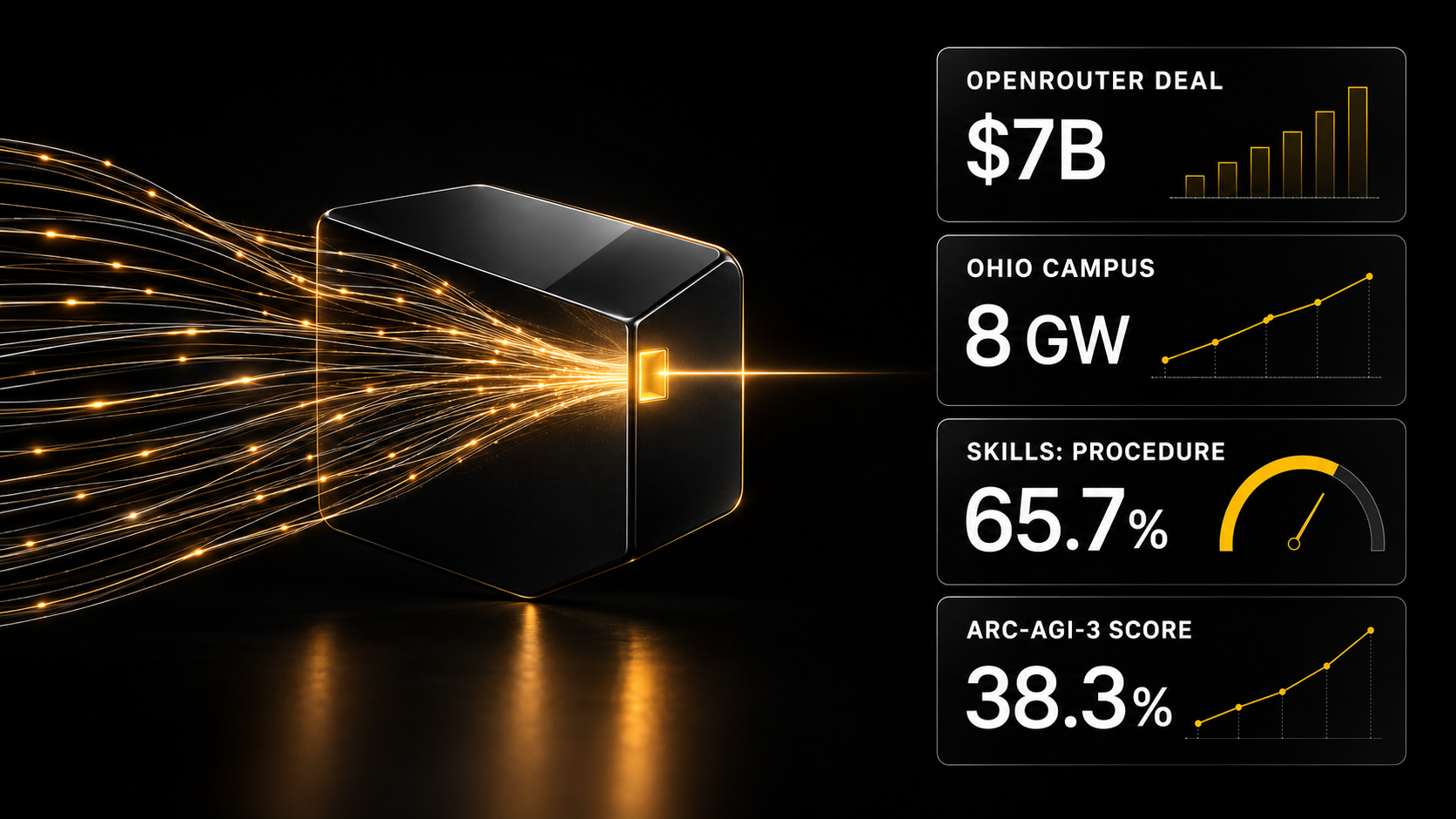
Stripe agreed to acquire the model router OpenRouter for more than $7B, Cursor shipped Origin repository hosting, OpenAI committed to an 8 GW Ohio campus, and Agent Skills research found 65.7% of a skill's value is procedure, not facts.
A day when AI infrastructure repriced itself in public: Stripe agreed to buy the model router OpenRouter for more than $7 billion, Cursor launched its own repository hosting, Origin, in the middle of a GitHub outage, OpenAI committed to an 8 GW campus in Ohio, and Dario Amodei stepped out to answer the industry's critics.
Today's top stories
Stripe is buying OpenRouter for more than $7B
Stripe has agreed to acquire OpenRouter for more than $7 billion, reported by @AndrewCurran_ citing Bloomberg during the week of August 15–17, 2026. OpenRouter is a model router: one API through which an application reaches models from many different providers and pays a single intermediary. The price tag shows what the market thinks the routing layer is worth — a layer that @kimmonismus estimates takes roughly 5% of customer spend. The same post raises the sharpest question about the deal: does that markup survive once competitors route for zero margin? The pressure on that markup is visible from both sides of the market at once — OpenRouter cut GPT-5.6 Sol pricing and Vercel did the same in its AI Gateway.
Cursor launched Origin, its own repository hosting
Cursor shipped Origin, repository hosting built directly into the editor, covering repo management, pull requests, review and deploy integrations (Cursor's announcement). This is not a bid to be another GitHub; it is a bid for the AI-native IDE to become the system of record for code — repository, agent, review surface and deployment in one loop. GitHub sync stays, and GitHub can remain the source of truth, as @kimmonismus points out. The launch landed in the middle of a major GitHub outage, which @Yuchenj_UW singled out and which amplified the announcement. The pattern across coding agents this week is consistent: they absorb the surrounding platform rather than autocomplete against it.
OpenAI is building an 8 GW campus in Ohio
OpenAI has committed to more than 4 GW of NVIDIA capacity, wrote Mark Chen during the week of August 15–17, 2026. A breakdown by @kimmonismus adds the detail: an 8 GW campus in Ohio, built and operated by SB Energy, with NVIDIA backing the first 4.25 GW and construction stretching through 2032 — the first 800 MW expected in 2028. Scale is not the only story here. OpenAI is coupling power, data centers, chips and long-dated access into a single vertical stack, which means the cost of a token in 2028–2032 is being fixed today, in electricity contracts.
Dario Amodei answered his critics: trust comes from curing disease, not marketing
Anthropic CEO Dario Amodei argued that AI could make it possible to cure most human disease within 5 to 10 years (his post). The claim extends his essay "Machines of Loving Grace" and runs straight into regulation: AI-accelerated drug discovery is worthless if it stalls in FDA process, so the process itself has to change. Amodei frames public hostility toward AI as a trust failure that marketing cannot fix — "the thing that will work is actually curing cancer" — and says Anthropic is rapidly expanding its biology and medicine work, hoping for early glimmers in the coming months. The Rundown AI covered his reply to critics, and an episode of The AI Daily Brief placed the central objection next to it: the industry has yet to deliver the benefits it promised.
Agent Skills research: 65.7% of the gain is procedure, 4.5% is facts
Skills help an agent mainly by anchoring procedure (65.7%), not by injecting factual knowledge (4.5%) — the numbers come from "Demystifying Agent Skills" as summarized by @omarsar0. The second finding bites harder than the first: precision in picking the right skill collapses as the skill pool grows, so an undisciplined library starts working against itself (follow-up). The scale of the ecosystem shows up in the fresh GitSkills dataset: per DAIR.AI it mines roughly 3.8 million SKILL.md files. The Skills for Claude Code section on aiskills.team currently holds 10,085 active skill cards with descriptions in English and Russian — hundreds of times smaller than the raw GitSkills corpus, and that is exactly the curation the paper is arguing for: trigger precision is a selection problem, not a volume problem. How SKILL.md and its loading conditions work is covered in our guide to Claude Code skills.
Numbers and facts
- 136.1 characters per second across 44 languages — Cartesia took Sonic 3.6 to #1 on both Artificial Analysis voice leaderboards (Artificial Analysis measurement, Cartesia's launch post).
- 13.3% → 38.3% on ARC-AGI-3 — the jump GPT-5.6 Sol made with retained reasoning and compaction, while spending roughly 6× fewer output tokens (OpenAI Devs).
- 150M parameters, 29.5% pass@2 on ARC-AGI-1, $0.0007 per task — the BDH-CQ result built on latent-space reasoning with temporary memory (The Turing Post).
- 30B parameters with 3B active — Nemotron 3.5 Lightning, a MoE model trained for high-throughput agent execution with multi-token prediction support (breakdown by @cwolferesearch).
- 3,000,000,000 downloads — the Qwen ecosystem milestone announced by Alibaba.
- 1.7M+ real-world sessions — the base on which Agent Arena launched cost-per-task and category filters (Agent Arena).
Different views: does Claude text need watermarking?
Anthropic started marking Claude's text output with invisible watermarks, and the rollout triggered a substantive argument about what actually breaks — the technology or the trust. Text watermarking is a hidden provenance mark a model leaves in the text itself, so that a dedicated verifier can later say whether the model wrote it. The dispute is not about whether the method works, but about who gets the verifier and what happens to authorship.
For. Arvind Narayanan writes that quality-preserving text watermarking is technically feasible and has precedent — which retires the "this is impossible" objection.
Neutral. @dbreunig looks at the practical side, while @suchenzang notes that the reaction is more complicated than for-or-against: people are not arguing with the math, they are arguing with a quiet change to the rules.
Against. The same Narayanan holds that the rollout failed on three fronts at once: communications, verifier transparency and user-trust framing. @SamuelFitouss10 recasts it in economics: without clear provenance the text market drifts toward a "market for lemons" where the honest writer loses. And the line between "AI helped edit" and "AI wrote it" is still undrawn — for products where text is edited four-handed, that is an architecture question, not a policy one.
Tools and techniques
- A local coding agent on 16 GB of VRAM. A developer published a working llama.cpp config for Qwen 3.8 27B on an RTX 5060 Ti: the UD-Q3_K_XL quant, a 73,728-token context, a q4_1 KV cache and speculative decoding via MTP. Speculative decoding is the trick where a light draft model proposes several tokens ahead and the main model only confirms them, which speeds up generation without costing quality. The reported result: over 1M tokens across three prompts and two hours of autonomous work. More local-deployment options sit in the Open Source section and in our open-weight LLM overview.
- MiniMax H3 as an image generator. The video model turned out to be unusually strong at prompt adherence, and ComfyUI-MiniMax-H3-Studio shipped around it — up to 9 ordered references, prompt and reference analysis through Qwen3-VL, fast previews and low-VRAM modes. A prompt for a specific image or clip is easy to assemble in the AI SKILLS prompt generator.
- Evaluating agents through error discovery. Hamel Husain updated his eval-skills plugin: it turns model outputs and traces into annotated failure modes and clusters them for review — a working replacement for "we eyeballed it, seems fine".
In brief
- Dreamina Seedance-2.5 reached #1 in the Video Edit category on Video Arena (Video Arena).
- A reasoning-effort test of Qwen 3.8 27B: xhigh scored 24.0 out of 25 in 717.8 seconds and 39,398 reasoning tokens, low scored 21.8 in 111.6 seconds (llama.cpp test).
- Empero released Qwen 3.8 distillations at 9B, 4B and 2B, claiming MMLU CoT on the 9B rises from 54.6 to 75.1 — vendor numbers, no independent verification yet (discussion).
- Vanta gave its TrustVanta agent computer-use, capturing screenshot evidence where a system exposes no API (@christinacaci).
- LangChain published a monday.com case study: agents work inside isolated LangSmith Sandboxes, analyzing CSVs and building maps (LangChain).
- Claude Max users report quotas burning down fast — one says 90 minutes of normal work consumed 10% of a weekly allowance, with no official confirmation of any metering change (thread).