Ornith-1.5 Released under MIT — AI Digest
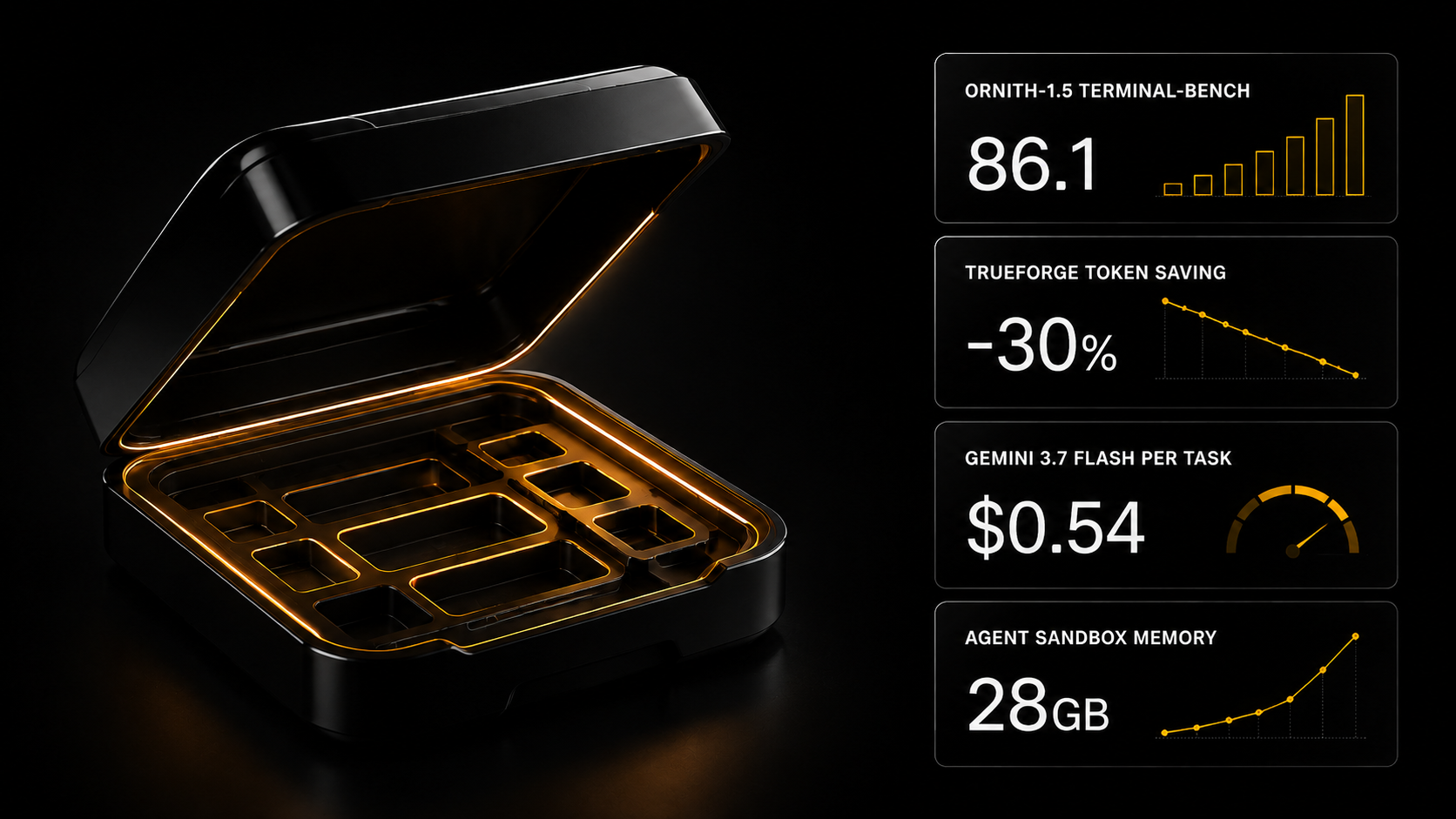
A day about harnesses and open weights: the MIT-licensed Ornith-1.5 family arrived with a self-improvement claim, the open TrueForge harness matched managed agents on Opus 4.8 with 30% fewer tokens, Gemini 3.7 Flash took first place on an analyst benchmark, and a study of ten production agents found that half of their latency lives outside the model.
Today's main stories
Ornith-1.5 ships under MIT with 86.1 on Terminal-Bench 2.1
The Ornith team released the Ornith-1.5 family under an MIT license — a 9B dense model plus 35B and 397B mixture-of-experts variants, published straight away in FP8, GGUF, MLX and NVFP4 formats (announcement). The reported numbers concentrate on agentic and coding work: 86.1 on Terminal-Bench 2.1, 86 on SWE-Bench Verified, 56 on DeepSWE, 44.6 on Humanity's Last Exam and 71.2 on Tool Decathlon. The headline claim is a self-improvement pipeline: the model proposes its own tasks, builds scaffolding for them and generates reinforcement-learning rollouts that become new training experience. That claim cannot be verified from a single post; availability can, and it was immediate — support landed in vLLM and Ollama the same day. New open models and ways to run them are catalogued in our Open Source section.
TrueForge: an open agent harness that saves 30% of tokens, and 75% of the bill through routing
TrueFoundry open-sourced TrueForge, a self-hostable MIT-licensed harness for production agents, and backed it with numbers: on a 14-task enterprise benchmark it matched Claude's managed agents on Opus 4.8 while spending roughly 30% fewer tokens, and routing part of the work to GLM-5.2 cut cost by about 75% without losing accuracy (TrueFoundry announcement, write-up by @omarsar0). A harness is the layer wrapped around the model: sessions, memory, tools, sandboxes, human approvals and traces. The opposite design philosophy showed up the same day: DeepSeek Harness is deliberately thin, with everything — including the agent loop itself — implemented as a plugin, and beta users shipped more than 100 plugins in a week. The lesson for anyone watching the bill: agent economics are decided as much by what happens between model calls as by which model is called.
Gemini 3.7 Flash tops AA-AnalystAgent at $0.54 per task
Gemini 3.7 Flash took first place on Artificial Analysis' AA-AnalystAgent benchmark: 60.0% pass^5, 70.5% pass@1 and 77.5% pass@5 across 80 spreadsheet- and document-heavy tasks, at 1.32 seconds and $0.54 per task on average (analysis by @_philschmid, Google's post). The pass^5 metric is stricter than the usual one: it requires the model to solve a task in all five attempts, so it measures repeatability rather than a lucky run — exactly what a working report needs. Google pushed the model into products the same day: Gemini chat and Spark, interactive simulations assembled on the fly in Search, and AI Studio synchronization with GitHub.
Half the latency of production agents lives outside the model
A study that instrumented ten production agent applications found that in half of them the dominant latency comes not from model calls but from everything else — sandboxes, tools and state handling (summary from DAIR.AI). The measurements are concrete: sandbox memory peaks at 28GB per session, latency varies by up to 32× between subsystems, and state sits in memory for long stretches between steps. Three fixes carry most of the win: task-aware serving removes 29–40% of latency, offloading state cuts memory use by 4.6×, and caching tool results eliminates 35.2% of repeated search calls. The practical implication: before swapping in a faster model, measure how much time your agent actually spends inside a model at all.
Anthropic reports $11.6B in revenue and a small operating profit
Anthropic's revenue more than doubled to $11.6B and the company reached a small operating profit — the WSJ figure circulated widely in discussion on August 19–20, 2026. The number matters less on its own than as a counterweight to the assumption that AI labs only burn cash: with paying developers and enterprise contracts, the economics can already close. Some caution is warranted — this is a business-paper report rather than company filings, and the comparison with a competitor's quarterly figures in that thread is loose. A second thread running through the same discussion is commoditization: Chinese open weights compress the difference between labs, pushing competition toward efficiency, integrations and support.
Numbers and facts
- 77% of BF16 accuracy on 8GB of RAM — what Unsloth's 1-bit quantizations of Qwen3.8-27B retain, while the new Dynamic V3 builds promise roughly 10% more accuracy at the same file size (Unsloth, details).
- 218 tokens per second — Qwen3.8-27B on two RTX 3090s with vLLM and a DFlash2 draft model (user benchmark).
- 30 tokens per second with 1.9s to first token — the same model on Alibaba's 64-core RISC-V XuanTie C950 (test discussion).
- 99.8% recall in 1.0ms versus 67.7% in 4.7ms — Qdrant's filterable HNSW against ACORN on a 1% filter over one million vectors (Qdrant benchmark).
- From 41.8% to 56.4% on SWE-Bench Verified — what Qwen3.5-9B gained from reinforcement learning applied through the harness in Agent Lightning v1.0, using roughly 6,000 examples (summary).
- 35% success versus 10–15% for humans — the share of Claude-designed protein binders confirmed in wet-lab work (report discussion).
- 10,101 skill cards — the current number of active Claude Code skills in the AI SKILLS catalogue, measured in our own database on August 21, 2026.
Different views: can a local model replace a cloud coding agent?
The argument is not about scores but about whether a win counts when you have to wait for it.
For. A thread with 2,485 upvotes argues that roughly 22GB local models beat Claude Code on Opus 5 High at real tasks published after the models' training cutoffs — that is, on work that could not have been memorized.
Neutral. The latest Agent Arena view shows a split: Claude Opus 5 (High) leads on quality, while the cost-quality frontier is held by cheaper models — Kimi K3, GLM 5.2, Grok 4.5 and GPT-5.6 Luna. Among open weights, GLM-5.3 ranks second on Terminal Bench and third on Legal Bench.
Against. The main objection in the same thread is speed: local models deliver acceptable accuracy but not acceptable response time, and a card with 22GB of video memory costs money that has gone up sharply this year. The thread also carries an unverified claim that a provider silently swapped models; no evidence is offered, and we repeat it only as an example of how measurements and rumours blur together in these arguments.
Tools and techniques
- Claude Code got terser and more observable. The Claude team added a concise output style, and managed agents gained memory for self-hosted sandboxes, allow and block lists of domains for web tools, and a multi-agent session viewer with cost shown per thread. Per-thread cost is the most useful part: it shows which agent is eating the budget.
- Running a 27B model on a consumer GPU. Unsloth's new Dynamic V3 GGUF builds deliver around 10% more accuracy at the same size, and the 1-bit variants run in 8GB of memory (Unsloth). A practical summary of local deployment lives in our open-weight LLM guide.
- Cache your tool results. Straight from the production-agent study: caching tool responses removes 35.2% of repeated searches (research). It is cheap to implement and almost always pays for itself in long sessions.
In brief
- OpenAI introduced Private Safety Processing, promising to preserve zero data retention for frontier models while still detecting risks without giving humans access to the content (OpenAI).
- Replit launched a free mode powered by GPT-5.6 Luna (Replit).
- Patrick Collison confirmed that OpenRouter is joining Stripe (his post).
- Sentence Transformers 6.0 cements the shift to multi-vector retrieval: instead of one vector per text it keeps token-level vectors and scores them against query tokens (overview).
- A Qwen co-author answered a question about a 35B A3B model with "do not wait for this", while the community expects a midsize open model next week (discussion).
- The headline block of The AI Daily Brief for August 20, 2026 includes an AI-assisted personalized cancer vaccine clearing a Phase III trial (episode).