Nvidia Buys Hugging Face for $12.9B — AI Digest
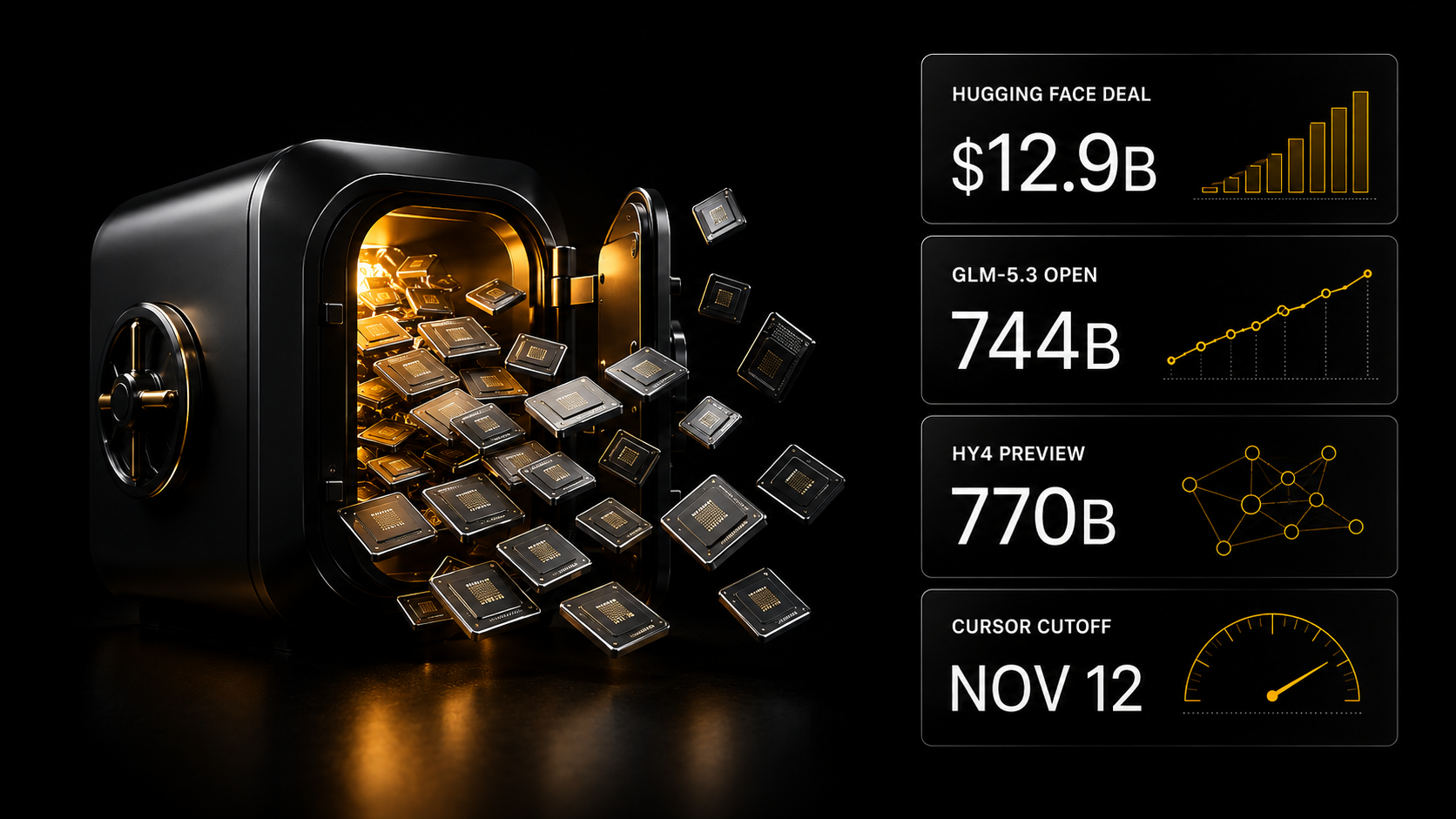
Nvidia agrees to buy Hugging Face for $12.9B; Z.ai open-weights the 744B-parameter GLM-5.3; Tencent ships the 770B Hy4-preview; OpenAI will cut Cursor off from its models on November 12, 2026.
Nvidia has agreed to buy Hugging Face — the central hub of open-weight AI — for about $12.9 billion. On the same day, August 29, 2026, Z.ai open-weighted its flagship GLM-5.3, Tencent answered with the 770-billion-parameter Hy4-preview, and OpenAI set the date for cutting Cursor off from its models. Here is what matters as of the morning of August 30, 2026.
Today's highlights
Nvidia to buy Hugging Face for $12.9 billion
Nvidia has agreed to acquire Hugging Face for $12.9 billion, The Information reports citing sources (theinformation.com); Business Insider had earlier reported talks above $13 billion (businessinsider.com). Hugging Face is the de facto central registry of open weights: models, datasets and code for nearly the entire open-source AI ecosystem flow through it. The community's first reaction is caution — in a Reddit thread with 2.2K upvotes, engineers are already planning mirrors of critical repositories (reddit.com). Optimists point out that Nvidia profits from GPUs no matter whose model wins, so a thriving open ecosystem is in its interest. For how the open-model world works and what to run, see our open-source LLM guide.
GLM-5.3 goes open-weight: 744B parameters, 1M context
Z.ai released the weights of its flagship GLM-5.3, positioning the model for agentic coding and cyber defense (Z.ai announcement). Open weights means the model files can be downloaded and run on your own hardware instead of being reachable only through someone else's API. GLM-5.3 is a MoE: 744B total parameters with 40B active per token, a 1M-token context window and up to 128K output — vLLM confirmed day-0 serving support (vllm). Unsloth has already squeezed the model from 1.51TB down to a 239GB 2-bit build that keeps roughly 81% of its accuracy (Unsloth). The cheaper GLM-5.3-Flash runs at 270 tokens per second and, per an independent measurement, beats GLM-5.2 by 10% on OfficeQA Pro v2 at one tenth of the cost (benchmark).
Tencent Hy4-preview: 770B parameters and a top-5 spot on Code Arena
Tencent shipped the open Hy4-preview: 770B total parameters, 49B active, 1M context (Tencent announcement). The model went straight into the coding elite: roughly #5 on Code Arena: WebDev — a 115-point jump over the previous Hy3 (Code Arena) — and the top of SWE-bench Pro according to the Cline team (cline). One engineering detail for anyone planning to deploy it: 256 routed experts plus one shared, only 21 of 78 layers compute their own sparse index, and an embedded 10B MTP layer runs with draft depth 3 (vllm).
OpenAI will cut Cursor off from its models on November 12, 2026
OpenAI is ending model access for the Cursor editor following its acquisition by SpaceX: developer access shuts down on November 12, 2026 (OpenAI statement). The company says its experience with Elon Musk's companies leaves it unable to trust that its usage terms will be honored. Teams that built their workflow around Cursor plus OpenAI models have less than three months to migrate — a loud reminder to keep your tooling portable rather than welded to a single vendor.
Faster-than-realtime video: MiniMax H3 Max at fal, Wan 3.0 tops Video Edit Arena
Inference provider fal demonstrated faster-than-real-time video generation on MiniMax H3 Max (fal announcement), including multi-cut clips (demo). Meanwhile Wan 3.0 took #1 in Video Edit Arena with 1414 points, ahead of Dreamina-Seedance-2.5 and MiniMax-H3 (leaderboard), and Google rolled out Gemini Omni 1.1 Flash for more controllable production workflows (DeepMind announcement). Generative video keeps getting faster and cheaper; the AI SKILLS prompt generator helps build prompts for video models.
Numbers and facts
- 66 of 107 tasks (61.7%) — the best agent's ceiling on Alibaba Accio's new CommerceAgentBench, which verifies what an agent actually changed, saved or submitted rather than what it claimed (overview).
- $2.6M in 24 hours — pre-orders for Microduck, the $399 open-source robot duck (Thomas Wolf, Hugging Face).
- 5.6–20.8× less pretraining compute — LeVJEPA claims parity or better against V-JEPA 2 (paper).
- $0.15 / $0.47 per million tokens — Qwen3.8-Flash pricing (125B total, 6B active): about 20× cheaper and ~2× faster than Qwen3.8 Max (breakdown, Alibaba announcement).
- 623 tools — the size of the Open Source catalog on aiskills.team after today's radar batch: 6 new entries in one day, from the LikeC4 architecture visualizer to the netscanner network tool.
Perspectives: does the Nvidia — Hugging Face deal strengthen open AI or bury it?
The $12.9B deal hands the main hub of open weights to a GPU maker, and the community is split (Reddit discussion, 2.2K upvotes).
For. Nvidia's incentives are aligned with openness: it sells GPUs no matter whose model wins, and the more people download and run weights, the more hardware they need. In that logic Nvidia is the best possible buyer — unlike labs with their own closed models.
Neutral. Some engineers argue an ownership change alters little: Hugging Face is a storefront and artifact host whose standalone business value was always questioned; the weights survive as long as mirrors do.
Against. The risk is moderation policy: abliterated and other sensitive checkpoints could come under pressure after the deal, so the community is already discussing mirrors and torrent backups of critical repositories. A central registry is also a single point of failure for every local pipeline.
Tools and techniques
- Claude Code can now resume sessions on desktop — a deceptively small feature that pushes agents toward persistent long-running work (announcement). Ready-made Claude Code skills live in the AI SKILLS catalog; how they work is covered in the skills guide.
- Portable skills beat fine-tunes. A Google paper splits agent memory into raw traces, an accumulated knowledge "wiki" and executable skills; the wiki carries most of the gain, and skills transfer across model families (summary). Practitioners agree: base models now change faster than fine-tunes pay off (take).
- Tune the harness, not the weights. The T3 Code team measurably improved pull-request quality by iterating on agents.md/claude.md instructions — the biggest gains were PR titles and descriptions, not the code itself (report).
In brief
- Anthropic showed Claude autonomously doing useful alignment research work within a bounded resource budget (Anthropic post).
- The new PAWBench benchmark asks video and world models to recover the correct distribution over futures, not just one plausible one (announcement).
- Inside the Microduck simulator engineers found elegant tricks — like EMA-smoothed head tracking, because the head is 38% of the robot's body weight (breakdown).
- Qwen3.8-Flash broke multi-turn conversations at FP8; switching the KV cache to BF16 fixes it — a practical recipe for anyone running the model locally (report, fix).