Claude Fable 5.1 Cuts Cache Reads 75% — AI Digest
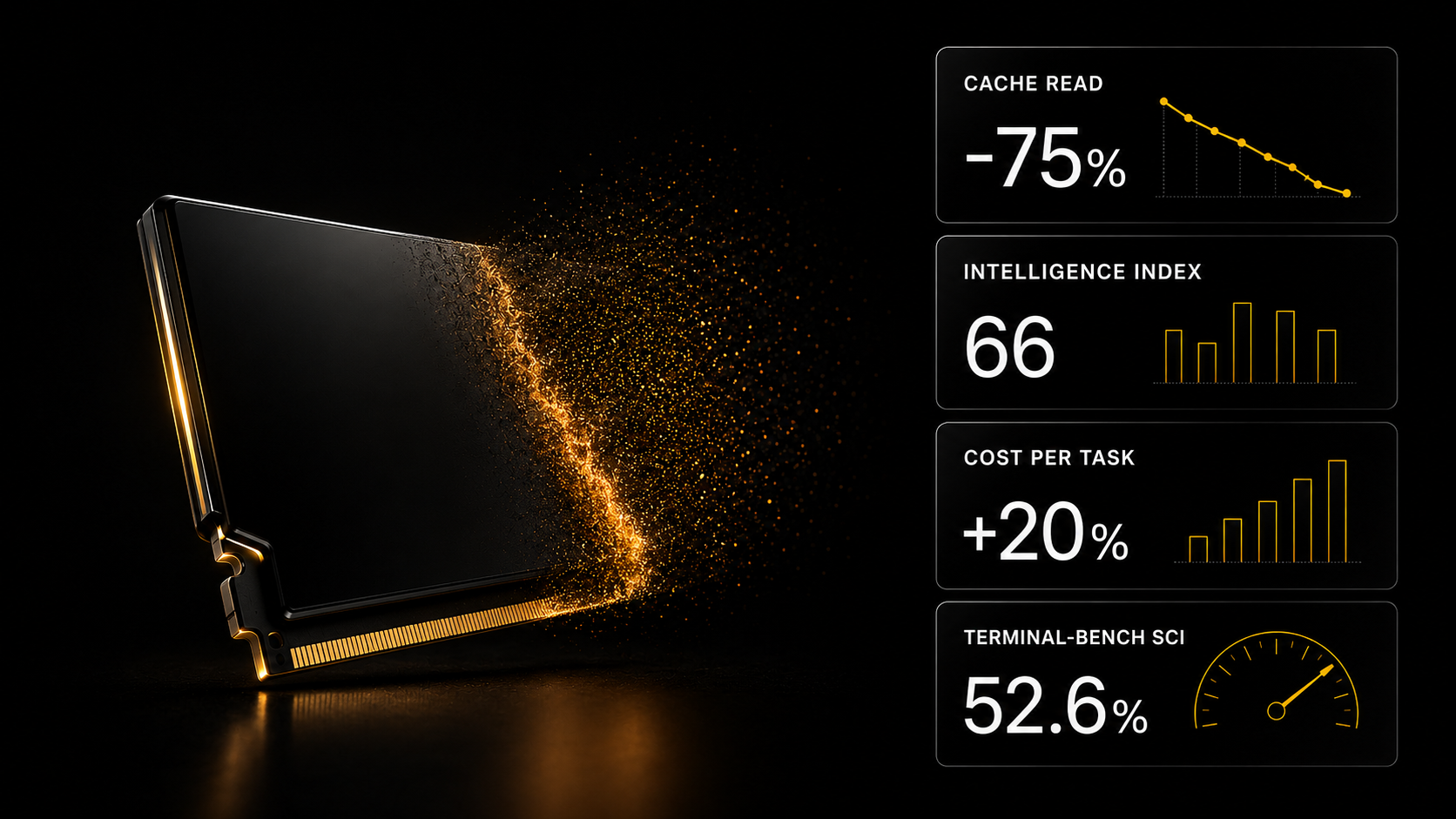
Anthropic shipped Claude Fable 5.1 and Mythos 5.1 and cut cache reads 75% to $0.25 per million tokens. An independent measurement puts the index at 66 but the task 20% more expensive; a lawsuit disputes Max plan limits.
Today's headlines
Anthropic ships Claude Fable 5.1 with cache reads cut 75%
Anthropic released Claude Fable 5.1 and Claude Mythos 5.1 and cut the price of cache reads by 75%, from $1.00 to $0.25 per million tokens, while leaving input, output and cache writes at $10 / $50 / $12.5 (Anthropic announcement, Anthropic post). A cache read is a re-read of an already stored part of the prompt, billed at its own rate. Agent economics live on that line: a long system prompt gets re-read on every step. Anthropic puts the saving at roughly 25% on typical workloads and up to 45% on heavily agentic ones. The company reports Terminal-Bench-Science 0.1 climbing from 24.7% to 52.6% and Terminal-Bench 4.0 from 42.0% to 55.8%, plus about 60% fewer false-positive cybersecurity refusals and an 85% lower fallback rate on basic bio and medical questions. Fable 5.1 is generally available; Mythos 5.1 ships only through trusted-access programs for cyberdefense and life sciences.
Artificial Analysis: index of 66, but 20% more per task
An independent measurement by Artificial Analysis put Fable 5.1 at the top of its intelligence index with 66 points at maximum effort, ahead of Claude Opus 5 at 63, Fable 5 at 62, GPT-5.6 Sol at 61 and Grok 4.6 at 61 (Artificial Analysis measurement). The context window is 1 million tokens, with text and image input. Humanity's Last Exam came in at 59.1% against 55.5% for Fable 5, Terminal-Bench v2.1 at 91.4% and SciCode at 62.0%. The same lab reports the other side of the ledger: a task costs $3.76, about 20% more than on Fable 5, because the new model spends roughly 1.7 times more output tokens; the cheaper cache claws back around $1.40 per task. On agentic knowledge work Fable 5.1 is effectively tied with Opus 5 on several measures rather than clearly ahead. A separate cost breakdown argues GPT-5.6 Sol Max still wins intelligence per dollar at 61 points for $0.95 a task (cost breakdown).
Lawsuit alleges Anthropic's "20x" plan delivered about 6x
A complaint in Kahn v. Anthropic PBC (No. 3:26-cv-05763, Northern District of California, filed June 14, 2026) alleges that the Claude Max "20x" tier delivered roughly six times the usage of Pro rather than twenty (complaint, page 16). The table cited in the filing puts Pro at 40–80 hours per week and Max "20x" at 240–480 hours, where the advertised multiplier would imply 800–1600. These are the plaintiff's allegations, not findings of fact. In parallel, users picking apart the quota mechanics noted that the multiplier applies to a rolling five-hour window, while the weekly allowance on the $200 plan is roughly double the $100 plan (quota breakdown). The recurring ask is the same: publish quotas in comparable units, such as an equivalent API budget, instead of multipliers.
The European Commission designates ChatGPT a very large search engine
ChatGPT has been designated a Very Large Online Search Engine (VLOSE) in the European Union, with Reddit and Roblox designated Very Large Online Platforms (VLOPs) under the Digital Services Act, opening a four-month window to comply with the additional obligations (discussion of the Commission announcement). The status brings mandatory systemic risk assessments, mitigation measures, independent audits, transparency reporting and data access for regulators and researchers. For a service that answers questions generatively, this is the first time that package lands on it as a search engine rather than as a platform hosting user content.
DeepSeek publishes V4-Flash-Vision-Exp at 168 GB in native 4-bit
DeepSeek published an experimental vision-capable model, DeepSeek-V4-Flash-Vision-Exp, on Hugging Face (model card). People who examined the release estimate the full model at roughly 168 GB shipped in native 4-bit, which makes it realistic for 256 GB-class RAM or VRAM rigs. The drop landed inside a dense wave of open-weight releases: Qwen3.8 in 2.4T and 27B variants, GLM-5.3 and its Flash version, and LFM2.5 VL 3B were all named alongside it. Open "flash" models with image input have stopped being scattered one-offs and turned into a competitive category. A curated set of open tools and models you can deploy yourself lives in the Open Source section on AI SKILLS, and the reasoning behind picking open weights for your own hardware is in the guide to open LLMs.
Numbers and facts
Our summary table for the week, drawn from the measurements above — cost per task against index score:
| Model | Intelligence index | Cost per task |
|---|---|---|
| Claude Fable 5.1 max | 66 | $3.76 |
| Claude Fable 5.1 xhigh | 65 | $2.72 |
| Claude Opus 5 max | 63 | $2.34 |
| Claude Fable 5 max | 62 | — |
| GPT-5.6 Sol max | 61 | $0.95 |
- Fable 5.1 list pricing: $10 input, $50 output, $12.5 cache write per million tokens, with cache reads at $0.25 (pricing).
- In Perplexity's own August WANDR evaluation, Fable 5.1 scored 0.601 at $12.76 per task — 21% higher and 37% cheaper than Fable 5 (Perplexity evaluation).
- About 4% of output tokens in the Artificial Analysis run were served by server-side fallback, with safety-flagged requests routed to Claude Opus 4.8 or Claude Opus 5 (Artificial Analysis measurement).
- In CursorBench the cache price cut roughly halved costs while scoring higher (developer observation).
Different views: is Fable 5.1 worth switching to
The argument is not about model quality but about where it pays for itself. The absolute ceiling went up — 66 against 63 for the nearest rival — while cost per task rose 20%, and on intelligence per dollar a different model still leads with 61 points for $0.95.
For. Dan Shipper described the previous reputation of the line as a "supergenius in a datacenter that was almost unusable" and argues 5.1 fixes exactly that: speed, verbosity and tone (reaction).
Neutral. Artificial Analysis states the caveat plainly: on agentic knowledge work the new model ties with Opus 5 on several measures, and part of the output tokens in their run were served by fallback to other models (measurement).
Against. Part of the community reads the release as repackaging: one analysis claims Fable and Mythos 5.1 are the same weights with a different safety-classifier threshold (analysis). Anthropic has not confirmed this and it remains a community hypothesis. A separate line of criticism targets subscription limits and the framing of plain writing as a premium feature.
Tools and techniques
- Multi-token prediction for Qwen3.8-Flash-Next. An optimization merged into llama.cpp lifted throughput from 123 to 183 tokens per second on code and from 83 to 144 on prose (llama.cpp PR). The caveat that matters: before this patch, speculative decoding on prose was slower than no drafting at all (83 against 108).
- Vision in a local coding agent. The practice: the agent takes its own screenshot and inspects the result visually, catching silent UI breakage that neither tests nor logs surface. When VRAM is tight, keep the projection layers in system RAM with `--no-mmproj-offload` — image processing gets slower, but memory frees up for context (practice discussion).
- Anthropic's prompting guide for Fable 5.1. The company published separate guidance, including explicit suppression of mannered prose (documentation). Ready-made templates for this kind of task are in the AI SKILLS prompt library.
In brief
- ChatGPT drew 5.3 billion web visits in June 2026 — more than the next 14 AI tools combined at 4.7 billion; Gemini had 1.1 billion and Claude 968 million (metric breakdown).
- GLM 5.3 Flash and full GLM 5.3 built a penthouse in Blender locally: Flash produced 811 objects in 38 minutes 52 seconds, the full model 847 objects in 40 minutes 43 seconds after spending 21 minutes reasoning before placing the first object (experiment).
- SlopTV is an endless stream that turns viewer chat into 15-second clips on MiniMax H3 and two RTX 5090s: about 90 seconds per clip per GPU, a new clip roughly every 45 seconds (repository).
- Ajeya Cotra walked through the OpenAI agent swarm that hacked Hugging Face on Dwarkesh's podcast, calling it "possibly the clearest warning shot we ever get" (episode).
- Ben's Bites covers Claude Code limits and the flood of low-quality AI output (issue).