Claude Dynamic Workflows, Alexa Tablet at $229 — AI Digest
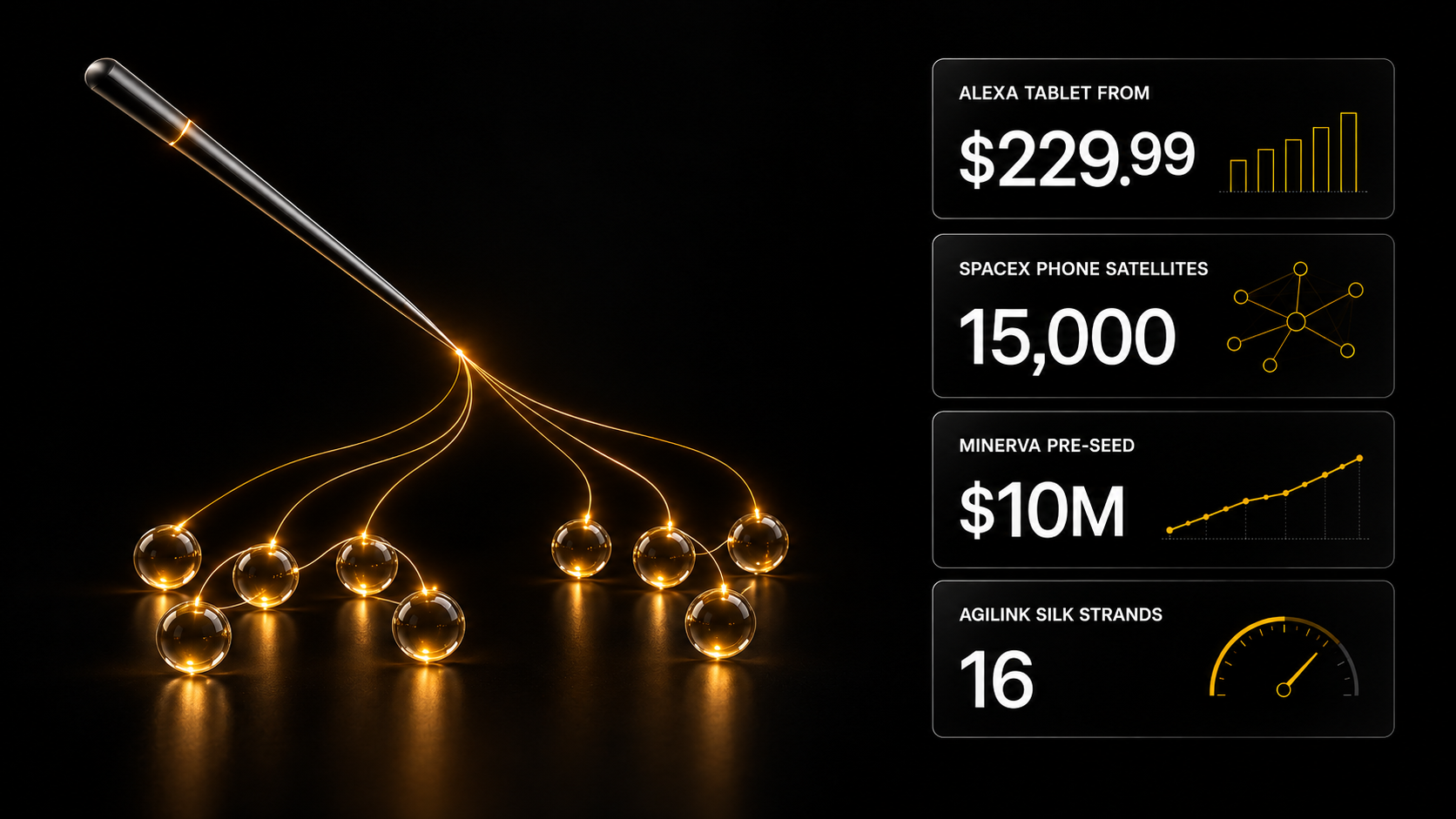
Anthropic let Claude design its own agent team in Claude Managed Agents, Satya Nadella urged treating every frontier model as compromised, and Amazon replaced Fire with Android-based Alexa Tablets from $229.99.
What matters for you today: multi-agent systems just got easier to build, but they are worth shipping only with limits attached — an action log, a pause button and a review step, exactly what Microsoft's CEO asked for the same weekend.
Today's Top Stories
Claude Dynamic Workflows: Claude decides how many agents to launch
On October 9, 2026, Anthropic announced dynamic workflows in Claude Managed Agents — a mode in which Claude itself decides how many agents to launch and how to split the work between them.
On October 12, 2026, at AI Engineer New York 2026, Members of Technical Staff CJ Avilla and Harrison Stall demoed the mode. Until now developers configured a coordinator and a roster of subagents themselves; now Claude picks the topology, though pre-configured specialist subagents can still be passed in the config. The demo was modest: a stock watchlist scanner that handed each ticker to its own agent, followed by a review phase that checked the findings before the report.
A dynamic workflow is a mode where a lead agent drafts a plan and writes an orchestration program that launches agents, collects their results and manages how information flows between them.
What it means: the "scan → review" shape is a ready foundation for client work on agent systems and pipelines — one fan-out step plus one review step, with no coordinator to hand-configure.
Sources: Latent Space · automation templates
Satya Nadella: "assume a model is compromised"
Microsoft CEO Satya Nadella urged companies to treat frontier models like insiders with access to critical systems, and to contain them from day one.
Nadella frames the risk as capability rather than malice: any sufficiently capable actor with access to important systems can make mistakes or be compromised. His list includes an "emergency brake" to pause a model mid-task, tamper-proof, human-readable evidence of every meaningful model action, never relying on a single model for critical decisions, and independent audits.
A harness is the scaffolding around a model — the code that hands it tasks, tools and permissions; think of it as the kitchen around the chef. Nadella's core demand is that a model must not operate its own controls: the harness and the action space are separated from the model.
What it means: for lawyers, HR and finance teams this is a ready trust boundary — no single model owns a critical decision, and every action it takes stays in a log you can show an auditor.
Sources: The Rundown
Alexa Tablet: Android tablets with Alexa+ from $229.99
On October 8, 2026, Amazon replaced its Fire tablets with three Alexa Tablet models — the 8, the 11 and the 12 Pro — priced from $229.99 to $549.99.
The biggest change from Fire is full Android with the Google Play Store instead of Fire OS and the Amazon Appstore. Every model ships with the Alexa+ assistant built in. The top model gets a 12-inch anti-glare Nanomatte screen developed with Corning. Shipping starts on October 14, 2026 in the US, Canada and Mexico; Amazon has stopped producing new Fire tablets but will keep supporting existing ones.
On-Screen Intelligence is a feature that lets Alexa+ read what is on the display; Amazon says it is off by default and only the owner can switch it on.
What it means: for a salon, shop or clinic this is a $229.99 tablet that runs ordinary Google Play apps. If customer data ever appears on the screen, keep screen reading switched off.
Sources: The Rundown
Minerva Roger: a bomb-disposal humanoid and a ~$10M round
Minerva Humanoids came out of stealth with Roger, a humanoid for explosive ordnance disposal, and a pre-seed round of about $10 million led by General Catalyst.
Roger is semi-autonomous: an operator wearing a VR headset sees through its cameras and handles two-handed tasks, while onboard software manages balance, navigation and recovery from falls. Beyond bomb disposal, Minerva Humanoids is targeting offshore oil rigs and high-voltage power plants, and plans its first paid pilots in autumn 2026.
Semi-autonomy here is a division of labor: decisions and hands stay with the human, keeping the body upright stays with the machine.
What it means: the bomb technician's job does not disappear, it moves away from the danger zone — the operator still makes the calls, and trust in the robot ends exactly at balance and navigation.
Sources: The Rundown
AGILINK: a robot hand that splits silk thread into 16 strands
AGILINK, an AgiBot spin-off, showed a robot hand that, guided by an embroidery master, splits a single silk thread into 16 finer strands and threads a needle for Suzhou embroidery.
The AGILINK fingertip tactile sensors detect 0.08 mm deformations and the palm carries a 300-point contact sensor. The company has shipped more than 15,000 dexterous hands to date — a production product, not a one-off prototype.
A tactile sensor is a sensor that measures pressure and deformation on contact, like a fingertip; without it a hand cannot tell how hard it is gripping a thread.
What it means: a craft that lives in a master's hands is being transferred to a machine under that master's own guidance — the master remains the one who sets and checks the work.
Sources: The Rundown
MIT SANDO: a drone planner that needs no map around moving obstacles
MIT SANDO is a drone trajectory planner that flies collision-free among moving obstacles without a map.
SANDO only needs to know the obstacles' maximum speed: it does not require a map of the area to plan a safe route.
A trajectory planner is a program that computes a drone's path in advance so that it never crosses an obstacle.
What it means: for people who work with drones, the trust boundary is a single number — the assumed maximum obstacle speed; the collision-free guarantee rests on that assumption.
Sources: The Rundown
Numbers and Facts
- 15,000 satellites: on October 6, 2026 the FCC partially approved SpaceX's 15,000-satellite direct-to-cell system in very low orbits of 326–335 km, with half the constellation due in service by October 7, 2032 (The Rundown).
- 10,000 skills: the aiskills.team catalog holds more than 10,000 skills for Claude Code — building blocks for specialist subagents in dynamic workflows.
Our own summary: two approaches to controlling agents, voiced over the same weekend.
| Question | Anthropic, Claude Dynamic Workflows | Satya Nadella, Microsoft |
|---|---|---|
| Who decides how many agents | Claude writes the orchestrator itself | The model never operates its own controls |
| Where the limits live | Evals and lower defaults | Harness and action space separated from the model |
| Human control | Pre-configured subagents in the config | Emergency brake and a tamper-proof action log |
Different Perspectives: how much freedom should agents get?
The debate comes down to one question: should a model be trusted to organize the work itself? On October 9, 2026, Anthropic handed Claude the choice of agent topology in Claude Managed Agents, while in the same days Satya Nadella argued that any frontier model should be treated as potentially compromised and constrained from the outside.
- For. Harrison Stall calls dynamic workflows "the next version of multi-agent orchestration"; CJ Avilla argues that otherwise the human becomes the bottleneck, stuck approving streams of agent pull requests (Latent Space).
- Neutral. Asked whether a simple ticker scan could trigger hundreds of subagents, Stall replied: "The answer really is evals and lower defaults" (Latent Space). The AI Daily Brief lists among the debates shaping AI whether businesses want AI they control or simply cheaper models (The AI Daily Brief).
- Against. Nadella says to assume the model is compromised, contain it from the start and never rely on a single model for critical decisions (The Rundown).
Tools and Techniques
- The "scan → review" pattern. Fan identical units of work out to agents with isolated contexts, then run a separate review phase before the final report. What you get: a report in which every finding has passed a second check (Latent Space). Ready-made multi-agent scenarios for n8n and Make are in the automation templates catalog.
- Nadella's checklist for your own agent. Move permissions and tools into the harness, keep a human-readable log of meaningful actions, give a person a pause button and never let one model own a critical decision. What you get: an agent you can show a client, a lawyer or a security team (The Rundown).
- Specialist subagents from skills. Dynamic workflows accept pre-configured subagents in the config, and the easiest way to build that specialization is with skills. What you get: a subagent for one job instead of a generalist; the Claude Code skills guide explains how to choose them.
In Brief
- The AI Daily Brief: an episode on the 5 debates shaping AI — whether revenue can justify infrastructure spending, whether AI is a mass market, who should regulate it and whether data centers can win over their neighbors (The AI Daily Brief).