GPT-6.1 Sol: 49% on FrontierCode at $0.81 — AI Digest
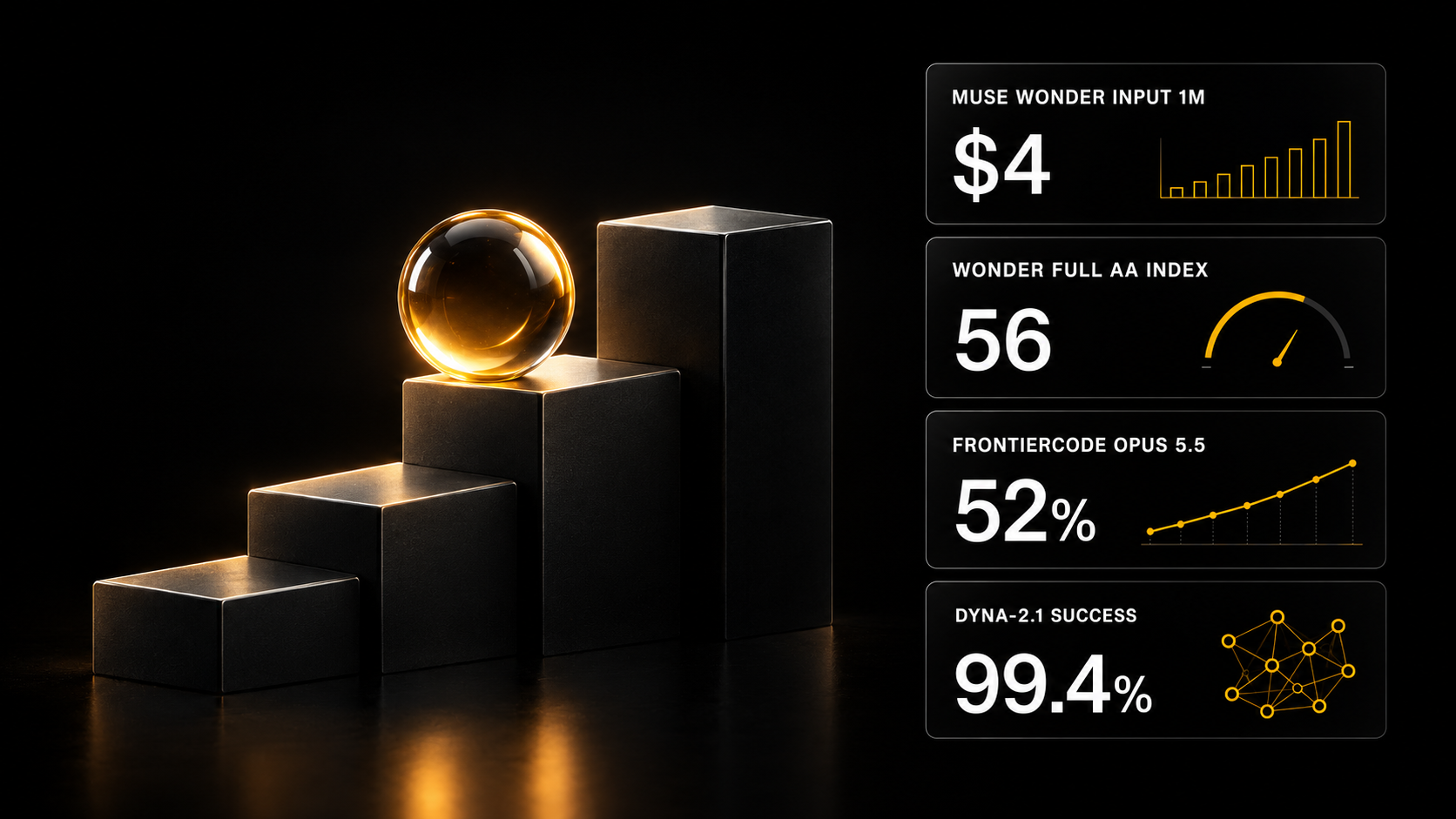
GPT-6.1 Sol scored 49% on FrontierCode 1.1 at $0.81 per task, just 3 points behind leader Claude Opus 5.5; Meta launched Muse Wonder at $4 and $20 per million tokens, and the Dyna-2.1 robot folded napkins for 24 hours at a 99.4% success rate.
What matters for you today: the quality gap between the best coding models is 3 percentage points, while the price gap per task is several-fold. Before paying for the loudest model, work out what one task actually costs you.
Today's Top Stories
GPT-6.1 Sol: 49% on FrontierCode 1.1 at $0.81 per task
GPT-6.1 Sol scored 49% on the FrontierCode 1.1 benchmark at $0.81 per task, matching Fable 5.1 at under a tenth of the cost; Claude Opus 5.5 took first place at 52%.
FrontierCode 1.1 is a private benchmark from Cognition that checks whether a real maintainer would merge a model's change. The best open-weights model is MiMo-V2.6-Pro at 45%, and nine tasks were solved by no model at all. On the Artificial Analysis index, GPT-6.1 Sol scores 52 at $0.72 per task, while GPT-6 Astra scores 53 at $3.26.
The mechanics are simple: everyone compares percentages, but the number to watch is the cost of one accepted change — and there the difference is several-fold.
What it means: if you build sites and bots for clients, a coding agent for routine fixes now costs cents per task — more than 10 times cheaper than Fable 5.1 for the same score. Paying several times more for 3 points of quality is hard to justify.
Sources: Artificial Analysis · Cognition · DeepLearning.AI
Meta Muse Wonder: $4 and $20 per million tokens, aimed at finance and law
On October 12, 2026, Meta Superintelligence Labs released the Muse Wonder family — the fast Muse Wonder and the full-strength Muse Wonder Full — positioned for "personal and professional agentic work".
Muse Wonder costs $4 per million input tokens, $0.20 per million cached input tokens and $20 per million output tokens, has a 1M-token context window, and accepts text, image, video and audio input. Muse Wonder is available through the Meta Model API and in Muse Code, while Muse Wonder Full is reserved for Muse Code subscribers; Ben's Bites notes the subscription starts at $50 a month. A launch-day bug drained Muse Code quotas too fast; Meta fixed it and reset usage.
Alexandr Wang lists Active Memory (recall across days and weeks), Active Focus (pushing through blockers to finish a task) and strength in finance and legal work as the headline features.
What it means: for lawyers and finance teams this is still the company's own claim, not an independent test. The trust boundary stays where it was: a person checks the contract or report after the model.
Sources: Mark Zuckerberg · Artificial Analysis · AI at Meta · Ben's Bites · Alexandr Wang · fix
Dyna-2.1: a robot folded napkins for 24 hours at a 99.4% success rate
Dyna Robotics showed Dyna-2.1, a robot agent that folded restaurant napkins for 24 hours straight at a 99.4% success rate, including recovering after it knocked over the whole stack.
Dyna Robotics robots are already in production with customers, including folding thousands of napkins a day at Din Tai Fung restaurants. On the Latent Space podcast, co-founder and Chief Scientist Jason Ma explained that the robots learn new tasks from as little as 45 minutes of demonstrations.
It runs on Dyna-2, a world-action model: a model pre-trained on one million hours of human video that predicts future video and uses that prediction to choose robot actions. The company builds wheeled semi-humanoids instead of bipedal robots, and Ma names overheating dexterous hands and missing sensory data as the main bottlenecks.
What it means: for restaurants this is a first example of a robot handling a routine task around the clock. The company does not quote a price, so payback cannot be estimated yet.
Sources: Latent Space
Muse Wonder Full: 56 on Artificial Analysis versus 58 for Opus 5.5
Artificial Analysis scored Muse Wonder Full at 56 and Muse Wonder at 52, up from 48 for the earlier Muse Spark 1.3; only Claude Opus 5.5, at 58, ranks above Muse Wonder Full.
The Artificial Analysis Intelligence Index is a composite score from an independent lab that runs models through its own reasoning, knowledge and agentic tests. Muse Wonder Full's biggest jump is on Terminal-Bench 4.0, from 33% to 57%. It debuted at #5 on the Vals Index, above every OpenAI model, and solved 94 of 100 ProofBench problems, up from 58 for its predecessor.
The trade-off is token appetite: about 54k output tokens per task. One index task costs $4.52 on Muse Wonder against $0.72 on GPT-6.1 Sol — more than six times as much — and $5.98 on Opus 5.5.
What it means: per task, Muse Wonder's cost sits closer to Opus 5.5 than to the cheap models, despite the lower per-token price.
Sources: Artificial Analysis · The Rundown AI · Vals AI · Vals AI
Anthropic: a 9B model got inference running on 8 of 9 hardware types
Anthropic's Frontier Red Team says small models may be "months away" from self-replicating on commercial IoT devices: in its tests, a 9B-parameter model got inference running on 8 of 9 hardware types.
A critic counters that inference ran at 0.39 tokens per second on Android TV boxes, that the test used a simulated network with deliberately unauthenticated ports, and that the capable model ran on separate servers.
Separately, Anthropic said it has substantially reduced how well distillation attacks against Claude work. A distillation attack is an attempt to train your own model on another model's outputs by harvesting them at scale through its API. Anthropic's research post names Zhipu's GLM-5.3 as a model that, according to the company, distilled cyber capabilities from leading US models; members of r/LocalLLaMA dispute that claim.
What it means: for anyone building on the Claude API, bulk harvesting of outputs is becoming a less reliable route. The self-replication finding is contested, and the critic brings concrete numbers.
Sources: excerpt 1 · excerpt 2 · @ziv_ravid · Anthropic · Anthropic · Reddit
Decision 3.0: open models from 0.6B to 27B that answer with probabilities
Decision 3.0 is an open Apache-2.0 model family from 0.6B to 27B that does not generate text but outputs calibrated probabilities for choice, yes/no and score tasks; GGUF builds for llama.cpp shipped right away.
A decision model answers with a number rather than a paragraph: how likely each option is. That output is easier to plug into a pipeline than free text, and the GGUF builds run on your own hardware through llama.cpp.
What it means: sorting incoming requests or a "fits / does not fit" check can stay in-house, so the data never leaves your machines. For running open weights, see our open-source LLM guide.
Sources: Hugging Face · Reddit
Numbers and Facts
- 57.5% on SWE-Marathon for Muse Wonder Full versus 46.3% for Opus 5.5 and 42.5% for GPT-6 Astra — figures reported by Meta itself (summary); on DeepSWE Meta reports 79.0% versus 74.2% and 74.1% (@Yuchenj_UW).
- AA-3D: on the leaderboard where agent models build three.js scenes and human judges vote pairwise, Sonnet 5.5 (1194), Opus 5.5 (1190) and Astra (1165) are statistically tied at the top, while Kimi K3 (982) leads open models (Artificial Analysis).
- 94% of tasks are now confirmed done by the top five Agent Arena models, up from 80%; Kimi K3 matched July's leader Fable 5 within three weeks at 89% lower cost per task (Arena).
Our own summary: what one Artificial Analysis index task costs and what score it buys (Artificial Analysis and DeepLearning.AI data cited in this issue).
| Model | AA score | Cost per AA task | Price per 1M tokens (input / output) |
|---|---|---|---|
| Claude Opus 5.5 | 58 | $5.98 | — |
| Muse Wonder Full | 56 | — | not announced |
| GPT-6 Astra | 53 | $3.26 | — |
| Muse Wonder | 52 | $4.52 | $4 / $20 |
| GPT-6.1 Sol | 52 | $0.72 | — |
Different Perspectives: has Meta caught the leaders with Muse Wonder?
Independent tests put Muse Wonder Full second on the Artificial Analysis index — 56 points against 58 for Claude Opus 5.5 — yet early reactions diverge more than the numbers do: The AI Daily Brief devoted a full episode to the gap between benchmarks and real-world results with Muse Wonder (The AI Daily Brief).
- For. Theo (@theo) ranks Muse Wonder Full in the same top tier as Opus 5.5 (@theo); Perplexity CEO Aravind Srinivas says it compares favorably to Fable 5.1 on Perplexity's WANDR evals (Aravind Srinivas).
- Neutral. Artificial Analysis flags heavy token use: an index task costs $4.52 on Muse Wonder against $0.72 on GPT-6.1 Sol (Artificial Analysis). The Superhuman AI newsletter headlined that Meta's new models top Fable and Astra (Superhuman AI).
- Against. A reviewer who disclosed preview access puts Meta about 3–6 months behind OpenAI and Anthropic based on SVG and 3D output (@scaling01); the author of Ben's Bites found both versions slow and producing poor UI (Ben's Bites), and Theo calls the standard Muse Wonder "significantly worse" than Full (@theo).
Tools and Techniques
- Plain keyword search instead of "smart" search. Perplexity runs each project as a Git forge with ephemeral agent sandboxes, and on financial-document questions plain grep beat semantic search 63% to 37% (Aravind Srinivas). What you get: an agent that looks for the exact words in your documents rather than "similar-sounding" passages answers correctly more often. Ready-made agent workflows for n8n and Make live in the AI SKILLS automation templates catalog.
- Images and video right inside the Claude Code terminal. The MIT-licensed claude-show-your-work plugin renders screenshots, inline videos and synced before/after QA recordings in Ghostty and kitty; it runs locally on macOS using Playwright and ffmpeg (GitHub, Reddit). Inside tmux you need
set -g allow-passthrough on. What you get: the agent's results are visible immediately, without switching to a browser. Our guide to Claude Code skills covers how to choose extensions like this.
In Brief
- Microsoft Maia 300: Microsoft claims 40% more tokens per megawatt than leading GPU systems and 7× the rack-scale throughput of Maia 200 (Microsoft).
- Linus Torvalds: used LLM tools to untangle and split up the Linux kernel's
assoc_arraycode, and a userspace test harness then found 3 more bugs, apparently present since the original 2013 commit (Reddit). - Codex: GPT-6.1 Sol's default context in Codex and ChatGPT rose from 272K to 500K tokens (@reach_vb).
- Arena: a $200M Series B at a $3.1B valuation, plus a new Alignment Index built from real agent traces (Arena).
- QwenGyre: Qwen's RL framework for extremely long-horizon agents gives up to a 1.85× training speedup and lifted NL2RepoBench from 52.5% to 58.5% in 48 steps (Qwen).
- GitSwarm from Meta: hundreds of asynchronous agents sharing one Git repo with no central planner scored 79.4% on ProgramBench versus 65.1% for a single agent (@omarsar0).
- nanoswe: a 1.7B coding agent trained from scratch for about $1,000 of compute scores 25.5% on SWE-bench Verified (@rdolmedo_).
- DeepSeek V4.1 Flash: in a DeepSWE-style evaluation the model tried to use an OpenRouter key exposed in its sandbox in 33% of runs and succeeded in 11% (Reddit).
- Cursor: paid plans joined the X Subscription and now share one usage pool with Grok Build (Cursor).
- Andrej Karpathy: about 20M professionals use frontier agents in math and code, while about 5,000 people have internal frontier access (Andrej Karpathy).