Liquid d1-ultra: $0.042 per 1M tokens — AI Digest
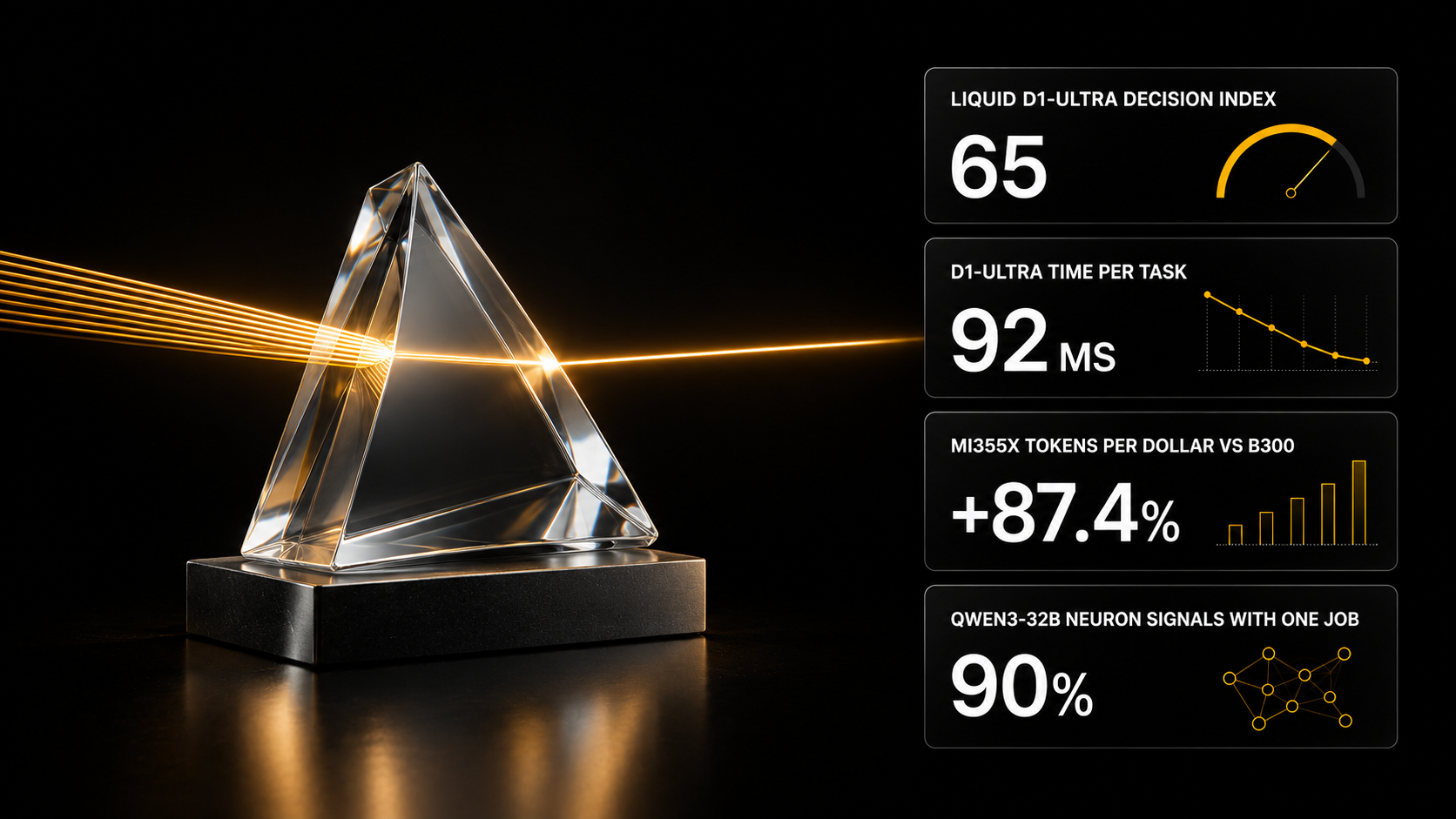
Liquid d1-ultra leads the Decision Index with 65 points at 92 ms and $0.042 per million input tokens, a cheap way to sort incoming requests. SemiAnalysis says Amazon blocked Meta's Muse agent, and AMD's MI355X delivered 87.4% more tokens per dollar than the B300.
What matters for you today: sorting incoming requests with a model now costs a fraction of a cent, but agents that browse other companies' sites in place of a person keep hitting closed doors, so automation built on official APIs is the safer thing to build or buy.
Top stories today
Liquid d1-ultra: Decision Index 65 at 92 ms and $0.042 per million tokens
Liquid d1-ultra now leads Artificial Analysis's Decision Index with 65 points against 57 for Jev 1.14; it takes 92 ms per task, costs $0.042 per million input tokens, and output tokens are free.
A decision model is a calibrated classifier that makes a call in a single pass instead of writing a long answer. Liquid d1-ultra raised its share of answers free of hallucination to 85% from 2% for the earlier Liquid d1, but its accuracy fell to 32% from 41%, which suggests a more cautious model rather than a more accurate one. OpenAI added a Decisions API to its Live API for fast delegation of tasks to tools, and in one experiment swapping Jev into the sub-calls of a Recursive Language Model cost half as much and ran 6x faster than Haiku 5.5 on OOLONG at 1M tokens.
What it means: for a salon, clinic or shop, a model like this is a cheap triage clerk for incoming requests: booking, complaint, price question, then on to the right chain. At 32% accuracy, its calls still need a human check.
Sources: Artificial Analysis · @juberti · @Jnatanh · AI SKILLS automation templates
Amazon blocks Meta's Muse agent: about a third of tested US sites keep AI agents out
SemiAnalysis reports that Amazon blocked Meta's Muse agent and that Jefferies found about a third of tested US sites block it as well.
In China, 155 apps opted out of ByteDance's Doubao phone agent. The issue is agent access to other companies' services: each platform decides whether an autonomous program may act in place of a person, and many platforms are closing the door.
An AI agent is a program that carries out actions in online services on a user's behalf: it opens pages, clicks buttons and fills in forms. Such an agent depends on every site owner's decision, so where possible an official API is the sturdier route (that is our reading, not part of the SemiAnalysis report).
What it means: if you build automation systems for clients, put them on official APIs. A pipeline that clicks through someone else's site can break the day that platform shuts agents out, and the repair comes out of your own pocket.
Sources: SemiAnalysis
FDE-Gym: the best agent fully resolves 14 of 95 real tasks
On the FDE-Gym benchmark, the best agent configuration fully resolves 14 of 95 real customer-delivery tasks; agents mostly fail on constraints nobody stated outright.
A benchmark is a set of tasks with a known way to check the result, used to compare models and agents. These tasks come from real customer work, so 14 of 95 means fewer than 15% of tasks finished without a person stepping in.
The failure pattern is familiar to any specialist: clients leave out what seems obvious to them, and the agent does not guess it.
What it means: for lawyers, HR, finance and marketing staff, an agent is still a drafting assistant, not a hands-off contractor. The trust boundary sits wherever a task has unwritten rules: spell them out for the agent and check the result yourself.
Sources: FDE-Gym
AMD MI355X: 87.4% more tokens per dollar than HGX B300 on Kimi K3
Eight AMD MI355X accelerators delivered 24.4% more throughput than an HGX B300 on Kimi K3 at 50 tokens per second per user, and 87.4% more tokens per dollar, vLLM reported.
I did the arithmetic: +87.4% is almost 1.9 times as many tokens for the same dollar. Inferact announced a collaboration with AMD to publish open, per-model recipes for serving models in agentic workloads. The measurement covers one model at one interactivity level, and the summary does not say who prepared the B300 configuration.
Inference is a trained model's work on user requests; it is what anyone running open weights on their own hardware pays for.
What it means: for teams that run open models on their own hardware, a single accelerator vendor is no longer the only option. In my view the budget should not be rewritten before an independent measurement, but AMD belongs in the comparison.
Sources: vLLM · Inferact · open-source LLM guide
GPT-6 Astra Pro: parallel agents in ChatGPT and nine GPT Live 1.1 voice presets
OpenAI says GPT-6 Astra Pro in ChatGPT now runs several agents on different parts of one task in parallel, responds faster and uses tools better.
Parallel agents are a setup in which a lead agent splits a task into pieces and hands them to helpers that work at the same time. GPT Live 1.1 also shipped, with improved multilingual voice and nine new presets recorded with native-speaking actors.
The posts summarized on October 15–16, 2026 give no details on rollout timing or plan availability for the parallel agents.
What it means: the "lead agent hands out subtasks" pattern that builders used to wire by hand is moving into the regular ChatGPT interface. Until pricing and timing are known, I would not rebuild existing chains around it.
Sources: OpenAI · @reach_vb · OpenAIDevs
Goodfire: about 90% of Qwen3-32B neuron signals have one main job
Nick Cammarata of Goodfire reports that a preliminary audit of Qwen3-32B found that roughly 90% of neuron signals have one main job, leaving only 2–4% unexplained.
Polysemanticity is when a single neuron in a neural network responds to several unrelated concepts, which makes its behavior hard to explain. If the Goodfire finding holds, it weakens the argument that neurons are too tangled to interpret. @sama welcomed the work, and a separate new paper offers a theory of why meaningful neurons appear at all.
The audit is preliminary and covers a single model, so the 90% figure does not yet mean every network is built this way.
What it means: explaining why a model decided something matters wherever an answer has to be justified, as in law, finance and medicine. This is one preliminary study, and it gives no grounds to trust model output unchecked; the skeptics' case is below.
Sources: summary · @sama · @klindt_david
Numbers and facts
- 3.16x — the edge TPUv7 reaches over disaggregated GB200 at medium to high interactivity; at low interactivity GB200 in FP4 keeps a 1.2x lead (SemiAnalysis).
- 906 tokens per second per user — the record for a Vera Rubin rack on DeepSeek V4.1 Flash in AA-AgentPerf; NVIDIA submitted all of the results itself (Artificial Analysis).
- 100% at 256 bits — the parity accuracy a Recurrent Looped Transformer reaches even though it was trained on at most 40 bits (Turing Post).
Our roundup: what the October 15–16, 2026 posts tell us about fast decision models (a dash means no data).
| Model | Decision Index | Answers free of hallucination | Accuracy | Price per 1M input tokens |
|---|---|---|---|---|
| Liquid d1-ultra | 65 | 85% | 32% | $0.042 |
| Liquid d1 | — | 2% | 41% | — |
| Jev 1.14 | 57 | — | — | — |
| pplx-decider v1.2, 27B | — | — | — | $0.02 |
| pplx-decider v1.2 Flash, 4B | — | — | — | $0.01 |
By our arithmetic, input for Liquid d1-ultra costs about 2.1x as much as for the 27B pplx-decider ($0.042 against $0.02), but Perplexity has not published a Decision Index score, so the models cannot be compared head to head. Row sources: Artificial Analysis, Perplexity.
Different views: is interpretability solved?
A preliminary Goodfire audit of Qwen3-32B finds that about 90% of neuron signals have one main job and only 2–4% remain unexplained, but some researchers call "interpretability is solved" claims hype, and the audit so far covers a single model (summary).
- For. Nick Cammarata of Goodfire argues that most neuron signals can be explained by a single function (summary), and @sama welcomed the work (@sama).
- Neutral. A new paper proposes a theory of why meaningful neurons appear in the first place; it speaks to the theory side of the question (@klindt_david).
- Against. @BlancheMinerva calls "interp is solved" claims hype (@BlancheMinerva), and Neel Nanda points to a skeptical thread (@NeelNanda5).
Tools and techniques
- Give the router the session history. In Microsoft's work, a router that sees the session history passes 3.3 more points of tasks at the same offloading rate; switching up to the expensive model is unprofitable because of cache costs (Microsoft). What you get: more tasks solved without a bigger bill for the expensive model.
- Reset research agents to the best result. In Berkeley research, periodically resetting agents to the best candidate found so far gave up to 15% over parallel agents and 39% over a single agent at equal budget (Berkeley). What you get: a better search result for the same budget.
- Normalize tool output. A harness is the scaffolding around a model: the tools, prompts and rules an agent works by. An analysis of harness nondeterminism finds that OpenHands looks stable mainly because it hardcodes temperature 0, while normalizing tool outputs removes much of the variance in other harnesses (HF). What you get: an agent that answers the same task the same way more often. To learn how to build such agent chains from scratch, see the AI SKILLS courses.
In brief
- NIST and Claude: Claude traced the seeds of the NIST ECDSA curves to a timestamp-seeded random number generator (@sweis, explainer).
- GTC Berlin: SemiAnalysis says several neoclouds were refused access to GTC Berlin after adding AMD GPUs or TPUs; NVIDIA has not addressed the allegation in these posts (SemiAnalysis).
- Anthropic: at its investor day, according to Reuters sources relayed by @kimmonismus, a valuation of about $1.5T was discussed instead of the roughly $2T expected for the November share sale; there is no official confirmation (@kimmonismus).
- OpenAI and security: @saranormous reports that 25% of production engineers were moved to security work until the top model stopped finding new infrastructure issues (@saranormous).
- LisanBench: GPT-6 models have joined earlier Claude models in exploiting a "bridge" pattern to inflate scores on LisanBench (@scaling01).
- The AI Daily Brief: host NLW calls Microsoft's MAI Base 2 and Meta's Muse Spark Open the most overlooked announcements of the week, and lists embedded safety evaluators at Anthropic and Cognition's performance-based token budgets among the episode's headlines (episode).
- Matt Wolfe: in his "6 New Models" roundup he puts Gemini 4 Argon and Meta Muse Wonder through tests and says Krea 3 makes image editing "seriously easy" (YouTube).