Sealed Secrets at 9.3K Stars, Cammarata's Essay — AI Digest
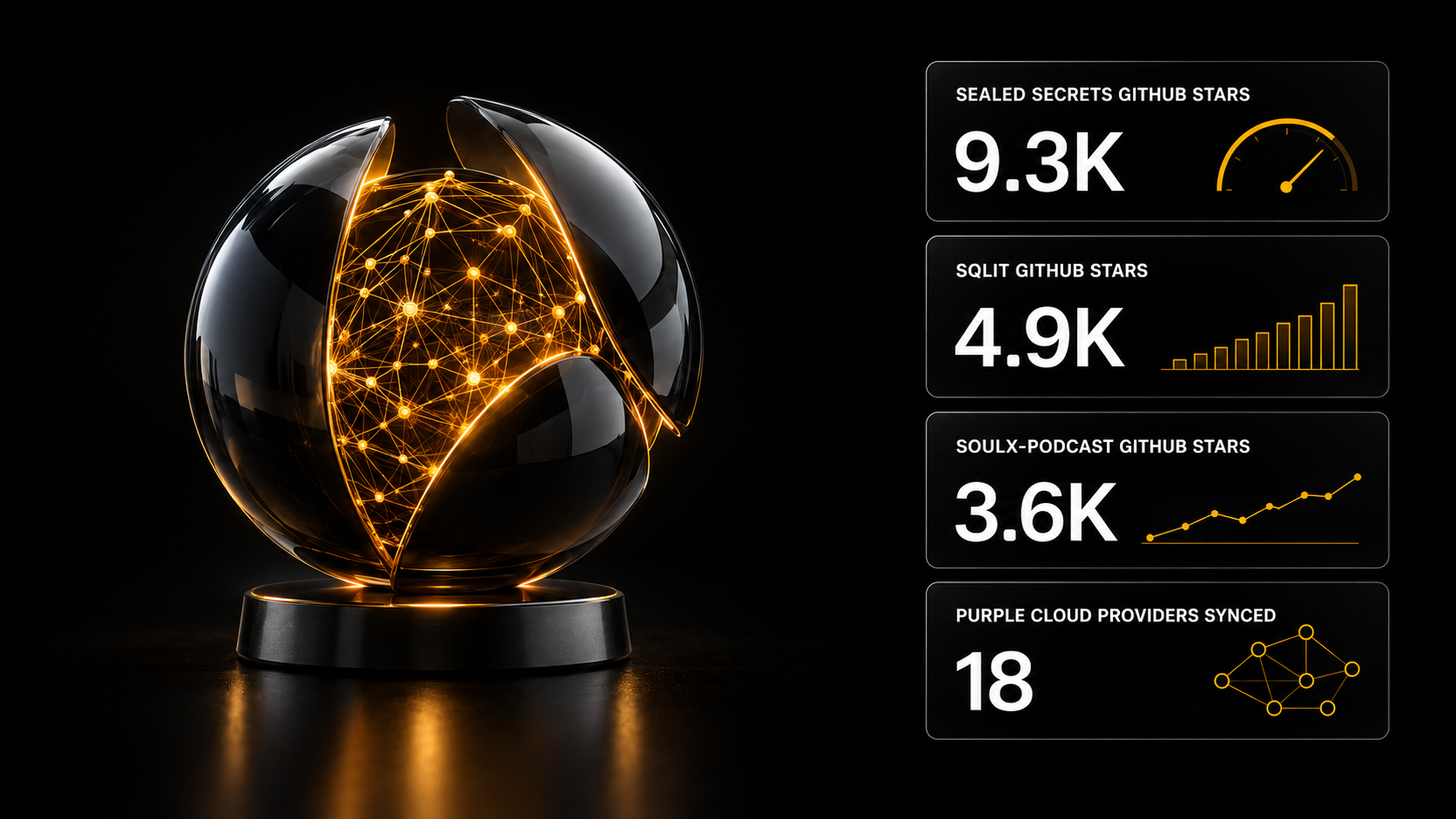
Every looks at why a vibe-coded app goes down right after it goes viral, SoulX-Podcast voices multi-speaker dialogue in the open, and Nick Cammarata's essay argues neural networks are more understandable than believed.
What matters for you today: a quickly assembled app can be sold, but real users break it at the first spike of interest, so load-test before launch. The rest of the day is open-source tools and pieces worth reading yourself.
Top stories today
Every on vibe coding: 2 pieces about an app that went viral and went down
Every's Chain of Thought newsletter published 2 pieces on apps whose code is written by agents: "Agent native architectures: how to build apps after the end of code" and "When your vibe coded app goes viral and then goes down".
Vibe coding means building software in a conversation with an AI without hand-writing most of the code. The second headline describes a familiar scenario: an app built this way suddenly becomes popular and then falls over under load. Only the headlines reached our reading list, so we are not summarizing the authors' conclusions.
Our own takeaway from the theme, not a summary: a product assembled quickly still has to be load-tested before the first spike of interest.
What it means: if you build landing pages and bots with vibe coding, load-testing is part of the job, not a bonus. An app that crashes on launch day costs you the client's trust in the very work you were paid for.
Sources: Every: architectures · Every: viral app
SoulX-Podcast: 3.6K stars for an open text-to-podcast generator
The Soul AI team released SoulX-Podcast, an open inference codebase for generating high-fidelity podcasts from text; the project has 3.6K stars on GitHub.
SoulX-Podcast covers two modes: multi-speaker, podcast-style conversational speech and ordinary monologue text-to-speech. Because the code is open, the tool can be deployed on your own machine instead of sending texts to someone else's service.
What it means: for a small business such as a salon, shop or clinic, an audio version of an article or a question-and-answer dialogue no longer needs a studio and two voice actors. The task comes down to a text and running open code; more open tools are in the Open Source section.
Sources: SoulX-Podcast
Every: GPT 5.6 in knowledge work and 4 pieces on the model market
Chain of Thought (Dan Shipper, Every) published 4 pieces on the model market: "How GPT 5.6 changes knowledge work", "Inside Anthropic's 2026 developer conference", "OpenAI has some catching up to do" and "The moral of Fable".
Again, only the headlines reached us, so we are not summarizing the authors' conclusions. The mix shows what practitioners are writing about right now: GPT 5.6 in knowledge work, Anthropic's 2026 developer conference and the author's claim that OpenAI has ground to make up. The content of "The moral of Fable" cannot be read off the title.
What it means: a lawyer, HR specialist, finance professional or marketer whose work is writing, spreadsheets and research should open the GPT 5.6 piece directly, since it is aimed at knowledge work. The trust boundary stays the same: test claims about a model on your own tasks, not on a headline.
Sources: Every: GPT 5.6 · Every: Anthropic · Every: OpenAI · Every: Fable
Nick Cammarata's essay: neural networks may be more understandable than thought
Former OpenAI researcher Nick Cammarata argues in a new essay that neural networks may already be far more understandable than researchers believed, and that years of apparent complexity may reflect flaws in how we have been looking at them.
The AI Daily Brief host NLW calls the essay potentially historic and walks through its threads: a surprisingly simple connection between cat faces and car fronts, the case that bigger models could be easier to interpret, and what this might mean for detecting AI deception.
Interpretability is the effort to understand what is actually happening inside a neural network and why it gives a particular answer. The breakdown separates what the evidence shows from what remains unproven.
What it means: for lawyers, finance and HR professionals this is a hypothesis, not a tool: model answers still have to be checked by hand. If the deception-detection thread holds up, specialists would gain a way to tell when an AI is wrong on purpose rather than by chance.
Sources: The AI Daily Brief
Sealed Secrets: 9.3K stars for Kubernetes secrets you can keep in Git
Sealed Secrets by Bitnami is a Kubernetes controller written in Go for one-way encrypted secrets; the project has 9.3K stars on GitHub.
Secrets are encrypted one way, so the encrypted version can be stored safely next to code in a GitOps workflow. GitOps is an approach in which a system's entire configuration lives in a Git repository and is deployed from it.
What it means: if you build systems for clients and keep configuration in Git, API keys no longer have to live apart from the code or be passed around by hand, which lowers the risk of leaking client credentials.
Sources: Sealed Secrets
sqlit: 4.9K stars for a terminal UI for SQL databases
sqlit is a Python terminal UI for SQL databases with 4.9K stars on GitHub; it supports SQL Server, MySQL, PostgreSQL, SQLite, Turso and more.
According to the project, sqlit connects to a database and runs queries from the terminal in seconds, without a separate graphical client for each database engine.
What it means: anyone maintaining databases for several clients on different engines gets one tool instead of several clients, with less switching when a bot's or an automation's data needs a quick check.
Sources: sqlit
Purple: a Rust SSH manager that syncs with 18 cloud providers
Purple is a free open-source terminal SSH manager in Rust for macOS and Linux that syncs SSH config with 18 cloud providers.
Beyond syncing ~/.ssh/config, Purple tracks live SSH tunnels and manages Docker and Podman containers from the terminal.
What it means: if you run client bots and automations on several cloud servers, Purple brings access and containers into one terminal window instead of hand-editing configuration for each provider.
Sources: Purple
Numbers and facts
| What | Number | What it means in tasks |
|---|---|---|
| Sealed Secrets | 9.3K stars, Go | Kubernetes secrets in Git without leaks |
| sqlit | 4.9K stars, Python | one console for SQL Server, MySQL, PostgreSQL, SQLite, Turso |
| SoulX-Podcast | 3.6K stars | multi-voice podcast from text |
| Purple | 18 cloud providers, Rust | server and container access in one place |
| Every, Chain of Thought | 6 pieces in this issue | GPT 5.6, Anthropic, OpenAI, Fable, vibe coding, agent-native architecture |
Differing views: has the neural network become transparent?
Nick Cammarata's essay is being called potentially historic, but The AI Daily Brief breakdown stresses that part of the conclusions is still unproven: this is a hypothesis, not a settled question (The AI Daily Brief).
- For. Cammarata argues that neural networks may be far more understandable than believed, and that years of apparent complexity reflect flaws in how we have been looking at them.
- Neutral. Host NLW examines the case that bigger models could be easier to interpret and separates what the evidence shows from what remains unproven.
- Against. There are no detailed rebuttals in today's material and we will not attribute any to anyone. The only restraining point is the breakdown's own caveat about the unproven part.
Tools and techniques
- Voice a dialogue from text. SoulX-Podcast produces multi-speaker podcast-style speech and ordinary monologue text-to-speech. What you get: an audio version of an article without a voice actor (SoulX-Podcast).
- Encrypt secrets for Git. Sealed Secrets. What you get: encrypted Kubernetes secrets stored next to code in a GitOps workflow (Sealed Secrets).
- Work with a database from the terminal. sqlit. What you get: a database query in seconds without a graphical client (sqlit).
In brief
- Tesla Roadster: Superhuman's Sunday special of October 18, 2026 is titled "Tesla unveils the Roadster"; the material has no specs, price or delivery dates (Superhuman).