DeepSeek V4.1 Flash: $0.22 a Task vs $2.35 — AI Digest
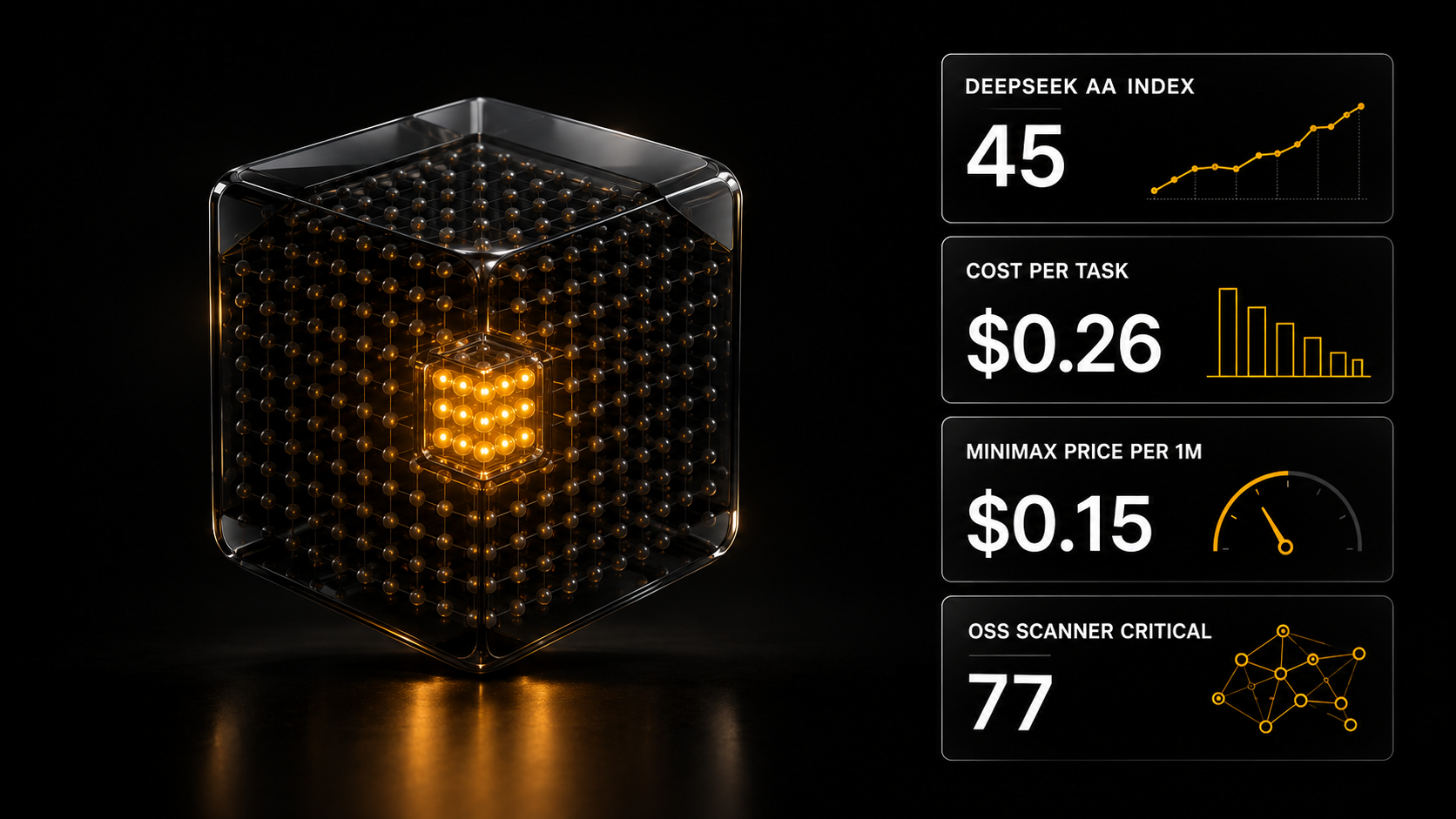
DeepSeek V4.1 Flash 1017 matches Opus 5.5 on long browser tasks at $0.22 instead of $2.35, about ten times cheaper. Plus a 10-second FLUX 3 Max clip for about $1.70, MiniMax M3.1 Flash with a 93% hallucination rate, Google Harness² and Anthropic OSS Scanner.
What matters for you today: on October 21, 2026, the price of AI work dropped again by a multiple — an open model runs an agent task ten times cheaper than a flagship, and a 10-second video clip costs under two dollars. The number to track is cost per task and error rate, not cost per token.
Top stories today
DeepSeek V4.1 Flash 1017: $0.22 instead of $2.35 per task, ten times cheaper than Opus 5.5
DeepSeek released DeepSeek V4.1 Flash 1017, an MIT-licensed open model that scored 75/100 on long-horizon browser use, matching Opus 5.5, at $0.22 versus $2.35 per task.
Token pricing stays at $0.30 per million input tokens and $1.20 per million output tokens at peak hours, and half that off-peak. On the Artificial Analysis Intelligence Index it scores 45, up 6 points, tying GLM-5.3 for second place among open-weight models at $0.26 per task. Its non-hallucination rate on AA-Omniscience jumped from 4% to 33%, and it is the top open model in Code Arena WebDev with 1670 points.
An MoE model is a model that activates only part of its parameters for each request: DeepSeek V4.1 Flash 1017 uses 16B of 552B, with a 1M-token context window.
What it means: everyone compares price per token; the number that matters is price per task. $2.35 / $0.22 ≈ 10.7, so an agent that works through websites costs about ten times less for the same score on this test.
Sources: Artificial Analysis · detail · Arena · browser_use · open-source LLM guide
FLUX 3 Max: a 10-second clip for about $1.70 in 12 seconds
FLUX 3 Max, the fal and BFL video model, renders a 10-second clip in about 12 seconds at $10.20 per minute of 720p video, according to Artificial Analysis.
For a 10-second clip that works out to $10.20 / 60 × 10 = $1.70. Generation takes roughly as long as the clip itself runs: 12 seconds for 10 seconds of video.
The per-minute price is the rate for a single generation; every redone take is billed again, so the cost of a finished clip is higher than $1.70.
What it means: client work. When one generation costs about $1.70, the value of a commissioned clip sits in the idea, choosing the best takes and the edit, not in the render itself. The render is now the cheapest part of the job by a wide margin.
Sources: Artificial Analysis
MiniMax M3.1 Flash: $0.15 per million tokens, but a 93% hallucination rate
MiniMax launched MiniMax M3.1 Flash at $0.15/$0.60 per million input/output tokens and says the weights will ship on October 23, 2026.
MiniMax claims 3x the speed of M3 at a third of the cost and 74% on DeepSWE. Artificial Analysis independently scores it 42, level with GLM-5.3-Flash and below the 45 of DeepSeek V4.1 Flash 1017, at about $0.22 per task. "Space Bunny," the stealth model that topped usage leaderboards, turned out to be an earlier build of MiniMax M3.1 Flash.
A hallucination is a confident model answer that the facts do not support. MiniMax M3.1 Flash hallucinates 93% of the time on that evaluation because it attempts nearly every question instead of admitting it does not know.
What it means: profession and trust. For lawyers, finance staff and HR, a model like this is fine for drafts and summaries but not for facts, dates and figures, because it almost never says "I don't know." Saving $0.04 per task against DeepSeek does not pay for checking every answer.
Sources: MiniMax · Artificial Analysis · r/LocalLLaMA
Ethan Mollick: 180 models beat GPT-4, and a correct answer got 750 times cheaper
In an essay marking the release of his book Co-Existence on October 20, 2026, Ethan Mollick counts 180 AI models that outperform GPT-4 as it was at launch, nineteen of which run on a modern smartphone.
On the METR Long Horizon benchmark, the amount of human work an AI can complete from a single prompt with at least a 50% success rate doubled eight times after GPT-4: a four-minute task in 2024, 17 hours of work by April 2026, after which METR said its methods could no longer measure it. Mollick adds that one correct answer on the GPQA exam fell from 30 cents to four hundredths of a cent: 30 / 0.04 = 750 times cheaper.
What it means: business. A task worth many hours of an employee's time can now go to AI in one prompt, but METR's yardstick is success half the time. Hand over long tasks, and keep a person on checking the result.
Sources: One Useful Thing
Google Harness² lets an agent rewrite its own harness, adding 8.4 points for Gemini 3.5 Flash
Google Research open-sourced Harness² under Apache 2.0, a framework in which an agent edits its own harness while the model weights stay frozen; Gemini 3.5 Flash gained 8.4 points on WorkBuddy-Bench and 7.5 on JobBench.
About half of all edits targeted skills and scripts. In Harness², an editor agent proposes changes, a composer diffs trajectories against a baseline, and a reflector stores lessons for later tasks, with no separate grader required.
A harness is the scaffolding around a model: the system prompt, skills, hooks, memory and tools through which an agent acts. Think of it as the kitchen around a chef: same chef, better dishes. Skeptics on Reddit warn that a self-improving harness can overfit to the benchmark and eat into the limited context of local models.
What it means: for builders. The gain came from rewritten scaffolding, not a new model, and half of it sits in skills. Before switching models, rebuild the agent's skills and instructions.
Sources: akshay_pachaar · _philschmid · google-research/harness2 · r/LocalLLaMA · Claude Code skills guide
Anthropic OSS Scanner reports 77 critical findings in open-source code in its first week
Anthropic launched OSS Scanner, a free program of periodic vulnerability scans for critical open-source projects that ships proofs of concept and patches; in its first week the model rated 77 findings critical and 803 high, including a fix for curl.
The launch landed next to a telling incident: OpenCode reported a sustained 48-hour attack by agent swarms. Mid-incident, frontier models refused to help analyze the attack because the malicious payloads tripped their guardrails. Things reportedly improved once OpenCode got access to Daybreak Blue.
A guardrail is a model rule that makes it refuse to handle dangerous content; in the OpenCode incident, guardrails failed to tell analysis of an attack apart from a harmful request.
What it means: for builders. A defensive model has to be able to read hostile code, or it is useless at the exact moment it is needed. If your project runs on open-source libraries, check which of them are already covered by the scans.
Sources: ClaudeDevs · thdxr · AndrewCurran_ · kimmonismus
Muse Glimmer 30B and Nemotron 3.5 Bolt: open models on a single 24GB GPU
Meta released Muse Glimmer, a 30B-parameter open-weight agentic model designed to run at 4-bit on a single consumer GPU.
NVIDIA Nemotron 3.5 Bolt (74B total / 9B active) fits in about 23.75GB of VRAM including its vision projector. LiquidAI LFM2.5-24B-A2B gets praise on Reddit as a strong local coding model.
Running at 4-bit is quantization: the model's weights are stored at lower precision, so it takes several times less memory at the cost of a small loss in accuracy.
What it means: business. A clinic or law office that cannot send documents to an outside service now has models that run on one computer with one GPU, so the data never leaves the building.
Sources: AIatMeta · r/LocalLLaMA · LFM2.5-24B-A2B · AI SKILLS Open Source section
Numbers and facts
Our own summary of the week's budget models, based on Artificial Analysis data and vendor statements as of October 21, 2026.
| Model | Price per 1M tokens (in/out) | AA index | Cost per task | Weights |
|---|---|---|---|---|
| DeepSeek V4.1 Flash 1017 | $0.30 / $1.20 | 45 | $0.26 | open, MIT |
| MiniMax M3.1 Flash | $0.15 / $0.60 | 42 | ~$0.22 | promised for Oct 23, 2026 |
- +43–85% requests per second from multi-API workers in vLLM v0.32.0, a release of 814 commits (vllm_project).
- +50GW of data center capacity in 2027, per SemiAnalysis, with another 60GW under construction and $1.3T in leases signed (SemiAnalysis).
- About $1B of training compute is now freely downloadable on the Hugging Face Hub, up from under $40M at the end of 2023 (Thom_Wolf).
- 60 of 65 reviewed Terminal-Bench tasks had issues, and 44 could be passed by cheating (chem_safety).
Different perspectives: is distillation why Chinese models are closing the gap?
Chinese open-weight models such as DeepSeek V4.1 Flash 1017 trail closed leaders by a few points at a fraction of the cost per task, and the argument is over how much of that closeness comes from distillation, meaning training on the outputs of stronger third-party models.
- For. Dean Ball, now at OpenAI, says distillation plays a bigger role in China's benchmark proximity than he had realized (deanwball).
- Neutral. Some researchers ask labs to publish the detection evidence behind distillation claims (ziv_ravid).
- Against. Skeptics reply that heavy fine-tuning on another model's traces usually raises hallucination, while DeepSeek V4.1 Flash 1017 sharply reduced it on AA-Omniscience (teortaxesTex).
Tools and techniques
- Put the constraint in the reasoning, not the request. Reasoning models follow a constraint far better when it sits in the chain of thought as a self-instruction rather than in the user prompt (dair_ai). What you get: fewer answers that break your limits on length, tone or format; ready-made phrasings are in the AI SKILLS prompt library.
- Run DeepSeek V4.1 Flash 1017 locally. Unsloth published dynamic GGUF quants and recommends its llama.cpp branch; in the Reddit thread one user reports a 366GB ds4 GGUF build running on an M5 Max MacBook with 128GB of memory at about 15 tokens per second (Hugging Face, r/LocalLLaMA). What you get: a model that ties for second place among open weights, with no API bill.
In brief
- Mercury 3: Inception shipped a diffusion LLM running at 1,000+ tokens per second, available on Baseten with a 1M-token context (StefanoErmon, Baseten).
- Muse Wonder Full (Max): Meta's model debuted at #6 in Code Arena WebDev with 1726 points (Arena).
- Indra OCR 1.1: a 1M-parameter model that processes 44 pages per second on CPU (VikParuchuri).
- Anthropic Public Benefit Fund: the fund starts with 5% of Anthropic's shares, and with founder and employee pledges roughly 20% of equity is committed to the public good (AnthropicAI).
- US DeepSeek ban: DHS Order 2026-01 tells civilian agencies to remove DeepSeek products, with 60 days to request exceptions (r/LocalLLM).
- China weight exports: a draft rule would require government approval to export the weights of models above 2T parameters or 10^26 FLOPs (kimmonismus).
- Anthropic replaces git: seven people built an in-house git replacement in five months after merges grew from 2,500 to more than 30,000 a day (dl_weekly).
- Busy Beaver: a DeepMind Gemini agent found and Lean-verified acceleration rules for 11 unresolved BB(6) machines (omarsar0).