Kitten-TTS 2: Voice Cloning From 5 Seconds — AI Digest
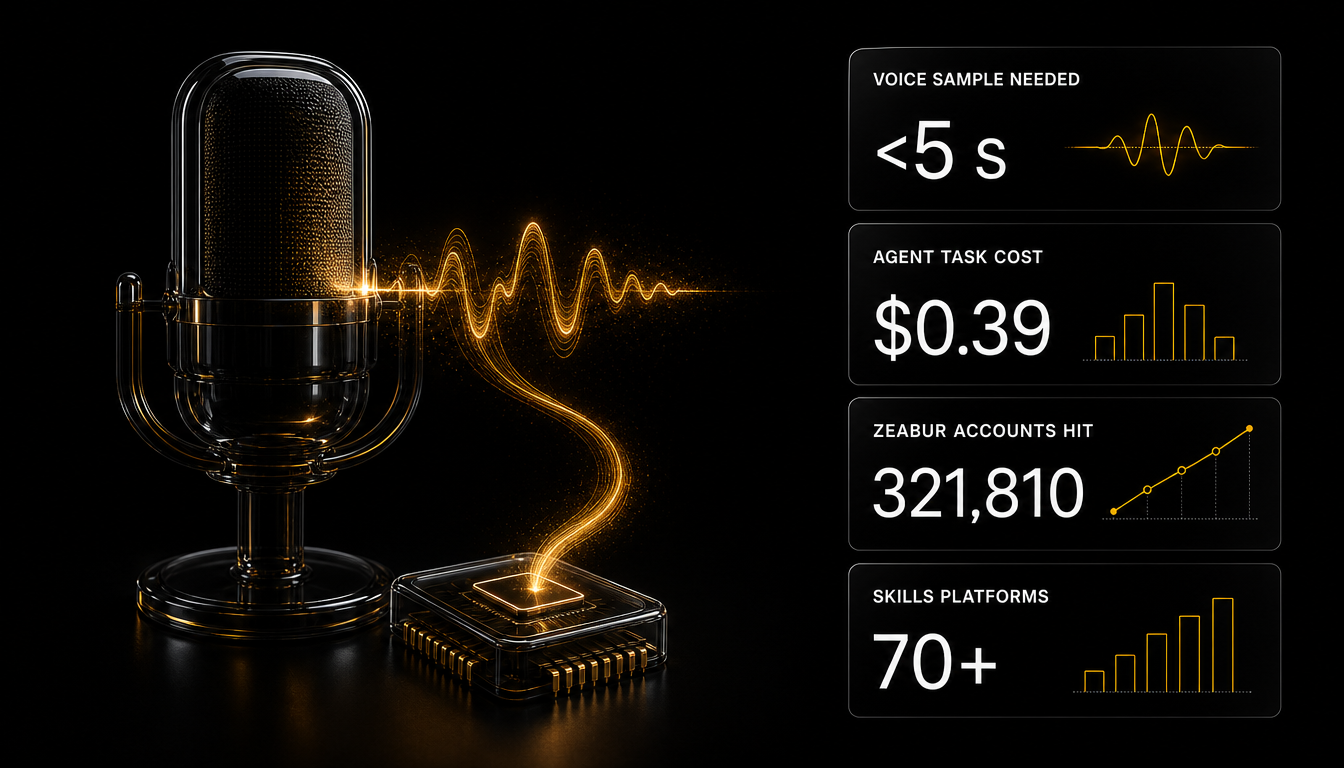
Kitten-TTS 2 clones a voice from under 5 seconds of audio and runs on an ordinary CPU. Also: DeepSeek V4.1 Flash is 29 times cheaper per agent task than Opus 5.5, Canva Craft and the Black October breach wave.
Today's main point for you: on October 22, 2026, Kitten-TTS 2 came out — an open voice-over model that clones a voice from a recording shorter than 5 seconds and runs on an ordinary processor with no graphics card. If you make videos to order, voice-over stops being a line in your expenses. And if you built bots for clients on Railway or LiteLLM, rotate your keys first.
Today's top stories
Kitten-TTS 2: a voice clone from 5 seconds of audio on an ordinary processor
KittenML released Kitten-TTS 2, a 1.7-billion-parameter voice-over model that, according to its developers, speaks in real time on a CPU and clones a voice from a sample shorter than 5 seconds.
The model understands more than 20 languages and controls emotion and stress. Its weights are compressed to 1.58 bits — each weight is stored as −1, 0 or +1, which is why an ordinary computer is enough. A discussion participant measured a real-time factor of 0.506 on an M4 Pro CPU with 8 threads: a minute of speech is ready in about half a minute. Other testers think Kokoro and Omnivoice sound more natural.
Voice cloning is when a model, given a short recording, speaks new text in the same voice.
What it means: client work. Voice-over in a video no longer needs a subscription or a paid narrator — it runs on your own machine at no per-video cost. I would clone a client's voice only with their written consent.
Sources: r/LocalLLaMA · GitHub · Hugging Face · builds for audio.cpp
Canva Craft and Ideogram Vector 1.0: two new models for images and vector graphics
Canva released Craft, its first image-generation model; it debuted in 4th place on the DesignArena ranking, making Canva the second image lab after OpenAI.
The same day Ideogram showed Vector 1.0, a vector-graphics generator. A vector is a drawing made of lines and shapes rather than pixels: it can be scaled up to banner size without losing quality, which is why logos and icons are delivered as vectors. The announcements list no generation prices.
What it means: client work. A model that returns a vector straight away removes the manual tracing of an image — the longest part of this kind of work. I would test how clean Ideogram's outlines are on a trial logo before quoting a client a deadline.
Sources: Canva · DesignArena · TechCrunch · Ideogram
DeepSeek V4.1 Flash: a coding-agent task for $0.39 versus $11.42 with Opus 5.5
Artificial Analysis updated its coding-agent index to version 2.0: Claude Code with Opus 5.5 leads with 61.7 points, while DeepSeek V4.1 Flash scores 47.3 points at $0.39 per task versus $11.42 for Opus.
$0.39 against $11.42 is 29 times cheaper per task. Sonnet 5.5 came second with 59.3 points. In the new version of the index the FrontierCode test replaced DeepSWE, and scores fell for 20 of 21 configurations. Critics point to discrepancies between subtests and possibly mixed-up harness labels.
What it means: your wallet. Everyone compares which model is smarter — what to count is the price of a task. For edits to a client's site or bot, where 47 points out of 62 is enough, the cheap model pays off immediately. I would still hand a hard task to Opus.
Sources: Artificial Analysis · criticism · open-source LLM guide
Black October: LiteLLM with a password stealer, Railway asks to rotate keys, Zeabur shuts down after 321,810 accounts were hacked
Over 48 hours on October 21–22, 2026, a wave of disclosures and breaches hit: a password stealer got into LiteLLM version 1.107.0, Railway asked customers to rotate their secrets, and the hosting company Zeabur is closing after 321,810 accounts were compromised.
The certificate authority eMudhra stored weak keys — one of them, reportedly, was the number 4. A researcher says Claude found them with a single query; eMudhra is leaving that business. Python users are advised to update pip, uv, certifi and system certificate stores. A secret is an access key to a service or a database that sits in an application's settings.
What it means: business. If you handed a client a bot or site that runs on Railway or reaches models through LiteLLM, rotate API keys and database passwords today, not on schedule. It is five minutes of work — cheaper than explaining a leak to the client.
Sources: summary · overview · list of updates · Railway · eMudhra · advice for Python
MiniMax M3.1 Flash: open weights, 428 billion parameters and a 1-million-token context
MiniMax published the weights of M3.1 Flash — a 428-billion-parameter model of which 23 billion work on each token, with a 1-million-token context and image understanding.
The company claims 73.7% on DeepSWE v1.1 and 61.7 on OSWorld V2. vLLM supported the model on release day: weights and cache in NVFP4 format compress it by 44.6%, to 250.1 GB. On four B300s at a 256K-token context, 76 parallel requests fit versus 28 for M3. Critics see the release as a renamed M3 with quantization and the DSpark accelerator.
What it means: for the technically minded. This is a model for your own server, not for a laptop: 250 GB of weights. If you run an agent on rented B300s, three times as many simultaneous requests on the same hardware is a direct saving.
Sources: MiniMax · vLLM · criticism
Agent Skills: Anthropic handed the skills format to the Agentic AI Foundation, and 70+ platforms already support it
Anthropic transferred the Agent Skills standard to the Agentic AI Foundation; more than 70 platforms already support the format, and a technical committee from Anthropic, Google, Microsoft, OpenAI and other companies will govern it.
A skill is a folder with instructions and files that an agent loads when it takes on a task of a particular type. The same day, Hugging Face is moving its OpenEnv project for training environments to the foundation and the Linux Foundation.
What it means: for the technically minded. A skill built once is no longer tied to a single agent: several companies stand behind the standard. Investing in your own skill library is now safer.
Sources: ClaudeDevs · OpenEnv · catalog of skills for Claude Code
Claude proved the safety of 123 open libraries: 180 million lines of verified proofs
Anthropic's Frontier Red Team, together with Theorem Labs, used Claude over a few weeks to prove safety properties of more than 100 open libraries.
By the count of the author of the write-up, that is about 180 million lines of machine-checked proofs for 239 entry points in 123 libraries; hundreds of bugs were fixed along the way. Formal verification means code safety is not checked with tests but proved mathematically, and a program checks the proof.
What it means: for the technically minded. Against a backdrop of breaches this is rare good news: a check that used to take people years now takes weeks. I would choose libraries with such a proof first.
Numbers and facts
Our own summary: what from the October 21–22, 2026 releases you can run yourself, and on what.
| Model | Size | Where to run | Source |
|---|---|---|---|
| Kitten-TTS 2 | 1.7 billion parameters, 1.58 bits | ordinary processor | GitHub |
| Raon-1-mini-preview | 30 billion, about 4 billion active | MLX on Mac, NVFP4 | Hugging Face |
| Recursive Flint | about 24 GB of memory at 4 bits | Mac M5 Max, 131 tokens per second | Rapid-MLX |
| OCRia-1 | 4 billion parameters | about 4,700 tokens per second on one B200 | measurement |
| MiniMax M3.1 Flash | 250.1 GB in NVFP4 | four B300s | vLLM |
- From 4,000 to 15,000 vulnerabilities a month — reportedly how far the CVE flow has grown since April 2026 (@saranormous).
- 2,250+ Microsoft 365 accounts were attacked by the Storm-0940 group with the open agentic framework ARTEX — about 2,900 login attempts per minute (MSTIC).
- 80.3% versus 46.8% — accuracy of Microsoft MAI-DxO and physicians on emergency-department cases; the paper was published in Science (Mustafa Suleyman).
- 862 tokens per second per user is what Rubin NVL72 delivers on GLM 5.3 after 8 days of kernel work (SemiAnalysis).
- $1 billion in annual revenue and a $750 million round at a $16 billion valuation — Modal, a cloud platform for running code on GPUs (Latent Space).
- $0.75 per 1,000 searches — the price of DeepSeek Search API; on the multi-step search benchmark BrowseComp it scores 63% (Artificial Analysis).
Different views: are attackers with AI already outpacing defense?
The flow of vulnerabilities has reportedly grown from 4,000 to 15,000 a month since April 2026, and October 21–22 brought a series of major disclosures and breaches at once. The debate over what this means is going on inside the industry too.
- For. Anthropic's deputy chief security officer Jason Clinton believes it will get "much worse before it gets better" and advises defenders to hold out for about 18 months (Jason Clinton).
- Neutral. Joshua Achiam reportedly noted that of roughly 16 major incidents this week only about 4 actually happened this week — the rest were found earlier and disclosed now (MTS).
- Against. @BlancheMinerva calls the "attack is winning" story disinformation: the PHP case is a defensive audit, and there is no evidence of mass attacks (thread).
Tools and techniques
- Check your projects for this week's vulnerabilities with one prompt. Phil Schmid published a read-only prompt: the agent checks whether the LiteLLM, Railway, PHP, GitLab and eMudhra stories affect you, and changes nothing itself (prompt). What you get: a list of what to update and which keys to rotate, with no risk that the agent breaks something.
- Remove the ads from your Samsung TV's home screen. A user built his own launch screen in Claude Code to replace the ad-filled one and published the code (GitHub, write-up). What you get: a clean screen with a clock and the apps you need — and an example of how Claude Code changes the behavior of household devices.
- Give Claude Code a status lamp. A developer connected a USB lamp through Claude Code hooks: blinking red — the agent is working, solid red — waiting for an answer, green — idle (r/ClaudeAI). What you get: no need to check every five minutes whether the agent is stuck on a question.
In brief
- U.S. banks: Axios reports that large banks are finding unauthorized third-party agents in customers' accounts; Peter Wildeford thinks these are agents the customers connected themselves (Axios, opinion).
- Quest Diagnostics: the lab that serves about half of U.S. hospitals and doctors reported a patient data leak (report).
- METR and OpenAI: two auditors spent three weeks on site checking how OpenAI monitors its agents; the report was cut from 61 to 38 pages (METR, Andrew Curran).
- KRAFTON Raon-1-mini-preview: the creators of PUBG trained a 30-billion-parameter model from scratch under Apache 2.0 and, by their data, beat Qwen3.6-35B (r/LocalLLM).
- Carbon-X: a 14-billion-parameter Hugging Face model for DNA and text scored 67% against 61% for Opus 5.5 and runs on a laptop (Thomas Wolf).
- OpenAI Decisions API: left beta and accepts up to 400 questions per call (OpenAI Devs).
- OpenAI: according to CNBC, the company is close to raising up to $30 billion at a $1.25 trillion valuation (CNBC).
- Tesla Optimus: humanoid production has started, and Elon Musk is aiming for 20,000 robots a week by 2027 (r/singularity).
- Unitree H2-X: a "bodyguard robot" with a claimed battery life of about 8 hours (Unitree).
- Warp Sciences: Kevin Weil's company, which combines AI drug discovery with robotic labs, raised $215 million (Kevin Weil).
- Anthropic: 17 of 211 scorpion-neurotoxin binder proteins designed by Claude passed the lab threshold (Ben's Bites).